汇添富香港优势精选

Search documents
公募“出海”再提速!30只QDII收益超50%、5家申请设立境外子公司
Xin Lang Cai Jing· 2026-02-09 08:15
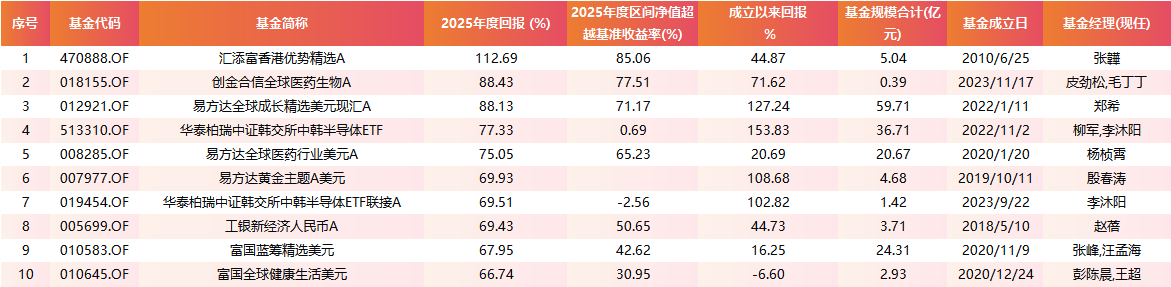
Core Viewpoint - The public fund industry in China is steadily advancing its overseas expansion, with significant growth in QDII funds and increasing establishment of overseas subsidiaries by fund management companies [1][5][14]. Group 1: QDII Fund Growth - As of the end of 2020, there were only 168 QDII funds with a total scale of 128.89 billion yuan, but by the end of 2025, the number had surged to 329 funds with a scale of 981.56 billion yuan, nearly doubling in quantity and increasing nearly sevenfold in scale [12][14]. - By February 9, 2026, the total scale of QDII funds reached 996.23 billion yuan, a 59.46% increase compared to 624.73 billion yuan in the same period of 2025, accounting for 2.68% of the total market fund scale [12][14]. - In 2025, many QDII fund products achieved positive returns, with 30 products (considering multiple share classes) yielding over 50%, led by E Fund with six products, and ICBC Credit Suisse and Fortune Fund each with four products [12][14]. Group 2: Performance of Specific Funds - The top-performing QDII fund was Huatai-PB Hong Kong Advantage Selection, achieving a return of 112.69%, followed by CCB Fund's Global Pharmaceutical and Biotechnology at 88.43%, and E Fund's Global Growth Selection at 88.93% [12][14]. - The Vietnam market has become a highlight for public funds, with Tianhong Vietnam Market Equity Fund growing from 200 million yuan at inception in 2020 to over 4.8 billion yuan by the end of 2025, marking a 24-fold increase in four years [12][14]. Group 3: Overseas Subsidiaries and Regulatory Support - The establishment of overseas subsidiaries by public funds is accelerating, with several companies like Yongying Fund and Ruifeng Fund receiving approvals for their Hong Kong subsidiaries in recent years [16][17]. - The China Securities Regulatory Commission has emphasized the importance of supporting qualified fund management companies to "go global," which has facilitated the rapid expansion of public funds overseas [5][14]. - Leading public funds have received substantial QDII investment quotas, with E Fund at the top with 7.78 billion USD, followed by Huaxia Fund with 6.77 billion USD, and Southern Fund with 6.02 billion USD [15][14]. Group 4: Cross-Border ETF Development - Major institutions are collaborating with foreign asset management firms to launch cross-border ETF products, with E Fund partnering with Itaú Asset Management in Brazil and Huaxia Fund promoting an ETF through Bradesco Asset Management [17]. - As of February 9, 2026, the management scale of cross-border ETFs reached 977.72 billion yuan, reflecting a 119.32% increase compared to the previous year [17].

跨境ETF规模首次突破万亿 百亿级产品激增至25只
Zheng Quan Shi Bao· 2026-01-14 18:21
Group 1 - The total scale of cross-border ETFs reached 1,009.8 billion RMB as of January 13, marking the first time it has surpassed the trillion RMB threshold, with a growth of 138% from 424.2 billion RMB in early 2025 [1][2] - The leading cross-border ETF is the Invesco Hong Kong Internet ETF, with a scale of 91.509 billion RMB, followed by the Huaxia Hang Seng Technology Index ETF at approximately 53.434 billion RMB [2] - As of January 14, 2026, the premium rate for the Invesco Nasdaq Technology ETF reached 19.28%, indicating a significant demand-supply imbalance in the secondary market [4] Group 2 - The QDII market has shown strong performance, with 95.2% of 650 comparable QDII funds reporting net value increases in 2025, driven by sectors like artificial intelligence and innovative pharmaceuticals [3] - Fund managers remain optimistic about investment opportunities in Hong Kong stocks, viewing them as a bridge for foreign capital into Chinese assets, particularly in the technology sector [6][7] - The S&P 500 index is expected to see a 10% growth in earnings per share in 2026, which will support continued stock market gains [7]
翻倍基“出现又离开”!港股基金突围
券商中国· 2026-01-13 10:48
Core Viewpoint - The Hong Kong stock market has been underperforming compared to the A-share market since Q4 2025, with liquidity issues and a lack of strong rebounds in key sectors like innovative drugs and technology being significant factors [1][2]. Group 1: Market Performance - The Hong Kong stock market has seen a correction trend since Q4 2025, with previously leading sectors like innovative drugs and technology struggling to rebound [1]. - By the end of last year, the Hang Seng Innovation Drug Index experienced a pullback, resulting in a lack of performance from related thematic funds, with only one fund, Huatai-PineBridge Hong Kong Advantage Selection, rising over 112% [2]. - The Hang Seng Technology Index also faced a high-level pullback, dropping approximately 15% in a single quarter, leading to an overall annual increase of only about 20% [2]. Group 2: Liquidity Issues - Liquidity has been identified as a core factor suppressing Hong Kong stock valuations, with many fundamentally strong stocks experiencing significant price drops due to low trading volumes [1][4]. - In 2025, the total fundraising amount from IPOs in Hong Kong reached approximately HKD 280 billion, with predictions of over HKD 300 billion in 2026, posing a challenge to market liquidity [4]. - The net inflow of southbound funds significantly slowed in December, with only HKD 23 billion entering the market, which is substantially lower than previous months [4]. Group 3: Investment Strategies - Fund managers emphasize the importance of prioritizing "win rate over odds" in Hong Kong stock investments, advocating for value investing and diversification to mitigate liquidity risks [7][8]. - Investors are advised to focus on the fundamentals and quality of companies, as historical integrity issues can significantly impact valuations [8]. - The current trend of RMB appreciation may provide a buffer against liquidity concerns, potentially attracting more capital into the Hong Kong market [6]. Group 4: Sector Focus - Fund managers are increasingly optimistic about the value proposition of Hong Kong stocks, particularly in technology and high-end manufacturing sectors, which are seen as having significant growth potential [9][10]. - There is a growing interest in consumer sectors, particularly in high-quality cultural products and competitive tea beverage companies, which are expected to achieve stable long-term growth [10].

“翻倍基”乍现背后基金经理依然相信港股繁荣刚刚开始
Zheng Quan Shi Bao· 2026-01-11 17:03
Group 1 - The core viewpoint of the articles indicates that the Hong Kong stock market is facing challenges, particularly in terms of liquidity and performance compared to the A-share market, with a focus on value investment and risk management strategies [1][3][6] - In 2025, the Hong Kong stock market saw significant activity in sectors like innovative drugs and artificial intelligence, but by the end of the year, these sectors experienced a downturn, leading to a lack of high-performing funds in these themes [2][3] - The liquidity issues in the Hong Kong market are characterized by a concentration of trading in large-cap stocks, while small-cap stocks suffer from low trading volumes, leading to a disparity in market performance [3][4] Group 2 - Fund managers emphasize the importance of focusing on fundamental performance and quality of companies when investing in the Hong Kong market, as external factors and macroeconomic conditions heavily influence market dynamics [5][6] - The outlook for the Hong Kong market suggests that sectors such as technology and consumer goods may become key investment themes, with a belief that the market's valuation remains attractive compared to global peers [7][8] - There is a growing interest in high-quality consumer brands and innovative companies within the tea beverage sector, which are expected to achieve stable long-term growth due to their competitive advantages [8]
2025年度QDII业绩出炉:最高汇添富香港优势精选涨超112%VS易方达原油跌逾13%(附涨跌榜)
Xin Lang Cai Jing· 2026-01-09 08:36
Core Insights - The QDII (Qualified Domestic Institutional Investor) funds have shown significant performance differentiation in 2025, with some funds achieving remarkable returns while others faced substantial losses due to market volatility and sector-specific challenges [1][4][6]. Performance Highlights - The top-performing QDII fund, Huatai-PB Hong Kong Advantage Selection, achieved a return of over 112%, benefiting from the global rise in innovative pharmaceuticals and biotechnology [2][9]. - Other notable funds include China Universal Global Pharmaceutical Biology and E Fund Global Growth Selection, both with returns exceeding 88%, driven by the global pharmaceutical sector's growth [2][9]. - The E Fund Gold Theme QDII also performed well, nearing a 70% return amid global risk aversion and monetary policy adjustments [2][9]. Underperformers - In contrast, several QDII funds focused on oil and real estate faced significant declines, with returns ranging from -10.78% to -13.76% for oil-themed funds like E Fund Oil and Southern Oil [4][11]. - Funds tracking the Saudi Arabian market also struggled, with returns exceeding -12% since their inception in 2024 [4][11]. - Real estate-focused funds, such as Penghua US Real Estate and Nuveen Global Real Estate, reported negative annual returns, reflecting broader market challenges [4][11]. Market Trends - The performance of QDII funds in 2025 highlights the importance of sector-specific trends, with technology and healthcare being key drivers of growth, while traditional cyclical assets like oil and real estate remain sensitive to macroeconomic conditions [6][13]. - The ability to diversify across different asset classes and geographic regions is emphasized as a critical strategy for investors to mitigate risks associated with concentrated investments [6][13].
掘金港股 基金经理看好结构性机会
Zhong Guo Zheng Quan Bao· 2026-01-08 22:24
Core Viewpoint - The Hong Kong stock market is expected to continue its upward trend in 2026, with significant investment opportunities in sectors such as innovative pharmaceuticals, technology, and dividend assets [1][4]. Group 1: Market Performance - The Hong Kong stock market experienced a strong start in 2026, with the Hang Seng Index and Hang Seng Tech Index rising by 2.76% and 4% respectively on January 2, and maintaining gains of 2.02% and 2.94% by January 8 [2]. - In 2025, both the Hang Seng Index and Hang Seng Tech Index increased by over 20%, ranking among the top global markets [2]. - Several funds investing in Hong Kong stocks achieved impressive returns in 2025, with notable QDII products like Huatai-PineBridge Hong Kong Advantage Select yielding a return of 112.69% [2]. Group 2: Fund Inflows - Multiple cross-border ETFs focused on Hong Kong stocks saw significant net inflows in 2025, with the Hong Kong Stock Connect Internet ETF leading at a net inflow of 56.659 billion yuan [3]. - Other ETFs such as the Hong Kong Stock Connect Technology 30 ETF and the Hong Kong Stock Connect Non-Bank ETF also reported substantial net inflows of 25.544 billion yuan and 24.978 billion yuan respectively [3]. Group 3: Strategic Outlook - The overall sentiment towards the Hong Kong stock market remains optimistic, with expectations of continued capital inflows exceeding 1.3 trillion HKD in 2025, a historical high [4]. - Factors influencing the market include the Federal Reserve's monetary policy, domestic economic fundamentals, technology trends, and geopolitical situations, with a generally positive outlook [4]. Group 4: Sector Opportunities - Key investment areas identified include AI infrastructure, internet technology, new consumption, innovative pharmaceuticals, resource companies, and dividend sectors [5]. - The innovative pharmaceutical sector is highlighted for its potential, with a focus on companies that can sustain cash flow through successful product launches [5]. - Dividend assets are considered attractive due to their historical performance, lower volatility, and favorable valuation compared to A-shares [6].
掘金港股基金经理看好结构性机会
Zhong Guo Zheng Quan Bao· 2026-01-08 20:50
Core Viewpoint - The Hong Kong stock market is expected to present investment opportunities in 2026, particularly in sectors such as innovative pharmaceuticals, technology, and dividend assets, following a strong performance in 2025 [1][3]. Group 1: Market Performance - The Hong Kong stock market experienced a strong start in 2026, with the Hang Seng Index and Hang Seng Tech Index rising by 2.76% and 4% respectively on January 2, and year-to-date increases of 2.02% and 2.94% as of January 8 [1]. - In 2025, both the Hang Seng Index and Hang Seng Tech Index saw annual gains exceeding 20%, ranking among the top global markets [1]. Group 2: Fund Performance - Several funds investing in Hong Kong stocks achieved impressive returns in 2025, with the Huatai-PineBridge Hong Kong Advantage Selected Fund's A share returning 112.69% [2]. - Other notable funds, including the GF CSI Hong Kong Innovative Pharmaceuticals ETF and Southern Hong Kong Medical Industry A, reported returns over 60% [2]. - Cross-border ETFs focused on Hong Kong stocks attracted significant inflows, with the Hong Kong Stock Connect Internet ETF leading with a net inflow of 56.659 billion yuan in 2025 [2]. Group 3: Strategic Outlook - The overall sentiment towards the Hong Kong stock market remains optimistic, with expectations of continued inflows from southbound capital, which exceeded 1.3 trillion HKD in 2025 [3]. - Factors influencing the market include the Federal Reserve's monetary policy, domestic economic fundamentals, technology trends, and geopolitical situations, with a general positive outlook [4]. - The market's current valuation is considered attractive compared to global standards, providing potential investment opportunities [3][4]. Group 4: Sector Opportunities - Key sectors identified for investment include AI infrastructure, internet technology, new consumption, innovative pharmaceuticals, resource companies, and dividend-paying stocks [3]. - The non-bank financial sector and leading internet companies are viewed as having strong growth potential due to the rapid development of artificial intelligence [4]. - The innovative pharmaceutical sector is highlighted for its attractiveness, with a focus on companies with robust pipelines and cash flow improvements [4].
收好不谢!容易出现高溢价的基金清单~
Sou Hu Cai Jing· 2025-12-26 10:17
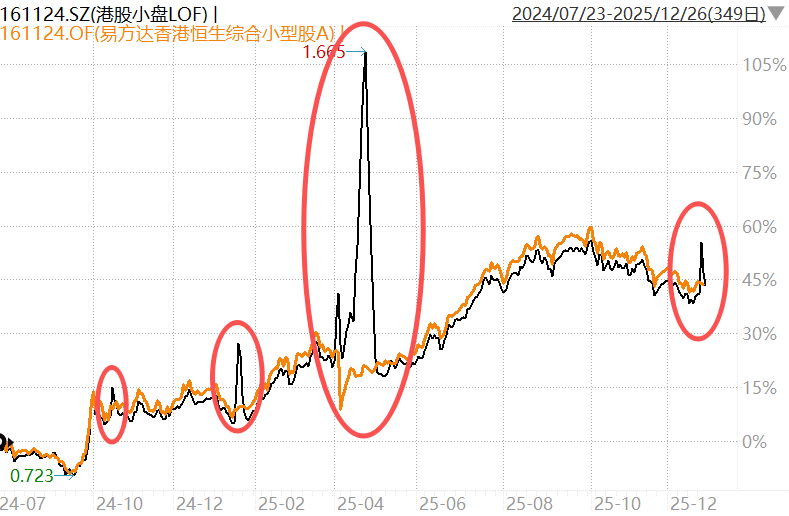
Group 1 - The article discusses the phenomenon of certain funds, particularly small-cap Hong Kong funds, being sold at high premiums intermittently, suggesting a potential trading strategy to buy during low premium periods and sell during high premium periods [5][6][10] - Specific funds that have shown high premiums include "Hong Kong Small Cap LOF" with a premium of 9.69% and "Guotou China Value LOF" with a premium of 8.63% as of September 24 [7][6] - The underlying reason for these high premiums is attributed to the small scale of the funds, making them susceptible to speculative trading [6][10] Group 2 - QDII commodity funds, particularly those related to gold, frequently experience high premiums due to factors such as purchase limits and rising underlying asset prices [10][12] - The "Gold Theme LOF" is highlighted as a fund that often sees significant premiums, with a recent premium of 18.43% [12] - The article also notes that the "National Investment Silver LOF" had a high premium but historically has not maintained such levels consistently [10][12] Group 3 - QDII stock funds, especially those linked to the Nasdaq and S&P 500, are also mentioned as having premiums due to quota restrictions and the strong performance of U.S. stocks [17][18] - The Nasdaq Technology ETF has been noted for maintaining a long-term premium of around 20% [17] - The article suggests that if premiums disappear, investors holding related funds might consider converting their holdings from off-market to on-market [17]
QDII基金2025年业绩爆发,17只收益率超70%,2026年该怎么投?
Mei Ri Jing Ji Xin Wen· 2025-12-25 14:51
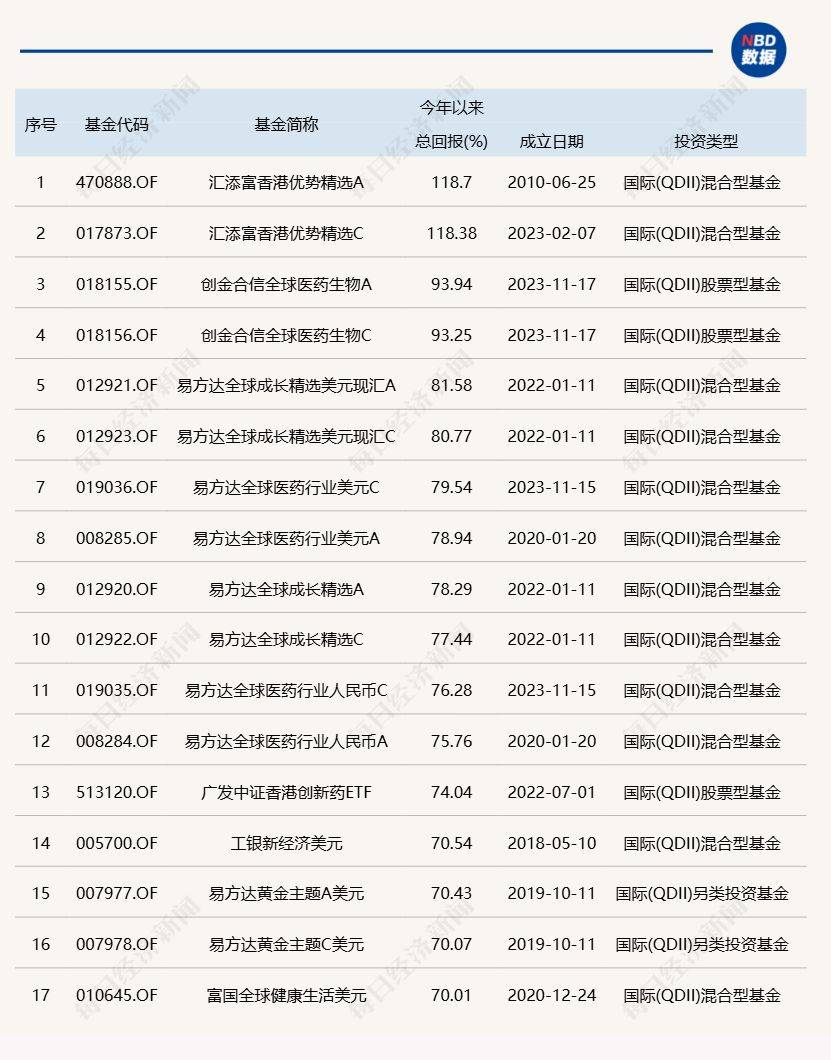
Core Insights - QDII funds have emerged as a significant channel for investors to participate in global wealth growth amid increasing volatility in global capital markets and diversified asset allocation needs [1] - In 2025, QDII funds delivered impressive returns, with many products achieving high yields, and the focus for 2026 will be on investment opportunities in Hong Kong and U.S. markets [1][2] Group 1: 2025 Performance Review - The QDII fund market showed a clear trend of "overall improvement with partial differentiation," with over half of the products achieving returns exceeding 15% and 17 products surpassing 70% [2] - Notable performers included Huatai-PB Hong Kong Advantage Selection, with A and C class shares returning 118.70% and 118.38% respectively, and several other funds in the healthcare and technology sectors also achieving over 70% returns [2] - However, there was significant performance differentiation, with some funds focused on single assets, such as oil and real estate, experiencing negative returns, highlighting the risks associated with concentrated investments [2] Group 2: 2026 Opportunity Outlook - Market expectations for QDII funds in 2026 are optimistic, particularly for U.S. and Hong Kong stocks, with a focus on sectors like innovative pharmaceuticals and new consumption [3][4] - Analysts remain positive about the mid-term trends in the innovative pharmaceutical sector, despite some short-term risks related to high valuations and geopolitical tensions [3] - The Hong Kong market is expected to benefit from increased participation and recognition, with a focus on the performance of innovative pharmaceutical companies and their R&D capabilities [4] Group 3: Investment Strategy for 2026 - Investment strategies for 2026 suggest allocating to broad-based index QDII funds tracking major indices like NASDAQ 100 and S&P 500, as well as comprehensive index funds covering the Hong Kong market [5] - Given potential market volatility, a dollar-cost averaging approach is recommended to mitigate risks associated with short-term fluctuations, particularly in the Hong Kong market [5][6] - Investors are advised to consider the investment management capabilities of fund managers, the research strength of fund companies, and fee structures when selecting QDII funds to build a diversified portfolio for long-term growth [6]
QDII基金2025年业绩爆发:17只收益率超70%,2026年该怎么投?
Sou Hu Cai Jing· 2025-12-22 03:17
Core Viewpoint - QDII funds have emerged as a significant channel for investors to participate in global wealth growth amid increasing volatility in global capital markets and diversified asset allocation needs [1]. Group 1: 2025 Performance Overview - As of December 18, 2025, the QDII fund market showed a clear trend of "overall improvement with partial differentiation," with most products achieving positive returns [2]. - Over half of the QDII products recorded returns exceeding 15%, with more than 50 products surpassing 50%, and 17 products achieving returns over 70%, with some top products exceeding 100% [2]. - Notable performers include Huatai-PineBridge Hong Kong Advantage Selection A and C classes, with total returns of 118.70% and 118.38% respectively, leading the market [3]. Group 2: 2026 Investment Outlook - The market is optimistic about investment opportunities in QDII funds for 2026, particularly in Hong Kong and U.S. stocks, with a focus on sectors like innovative pharmaceuticals and new consumption [4][5]. - Analysts suggest that the structural trends in the innovative pharmaceutical sector are expected to continue, despite some short-term risks related to high valuations and geopolitical disturbances [5]. - The Hong Kong market is viewed positively due to its expanding asset base and increasing participation from mainland investors, with a notable reduction in the AH premium [5]. Group 3: Investment Strategy for 2026 - Investment strategies for 2026 recommend allocating to broad-based index QDII funds tracking major indices like the Nasdaq 100 and S&P 500, as well as comprehensive index funds covering the Hong Kong market [6]. - Given potential market volatility, a systematic investment approach such as dollar-cost averaging is advised to mitigate risks associated with short-term market fluctuations [7]. - Investors are encouraged to consider the management capabilities of fund managers, the research strength of fund companies, and fee structures when selecting QDII funds to build a diversified portfolio for long-term asset appreciation [7].