吉利中国星

Search documents
吉利汽车发布2025年业绩 总收入同比增长25%创新高
Xin Hua Cai Jing· 2026-03-18 13:42
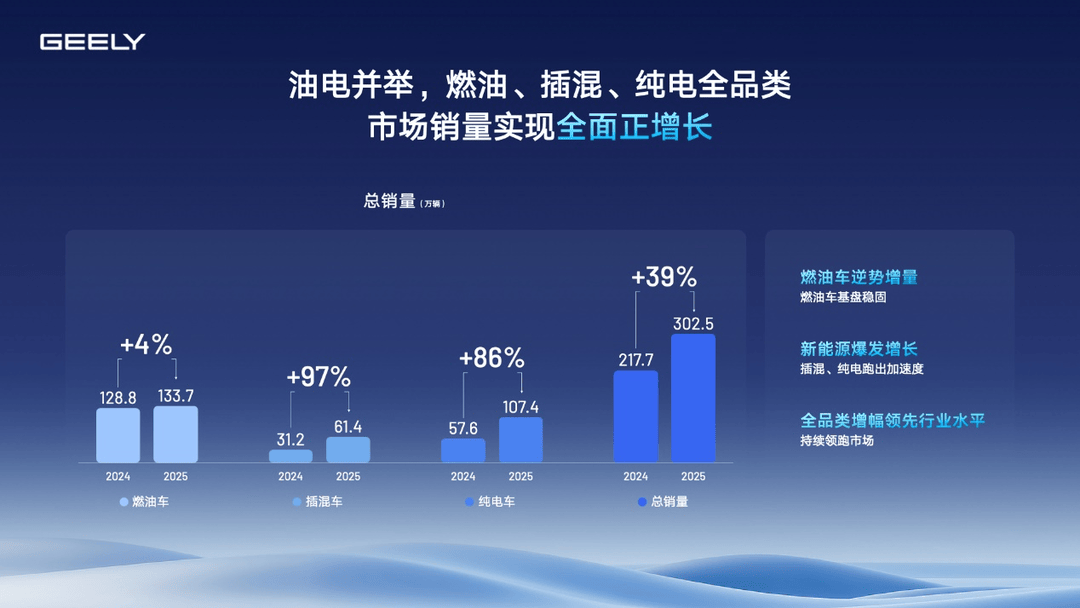
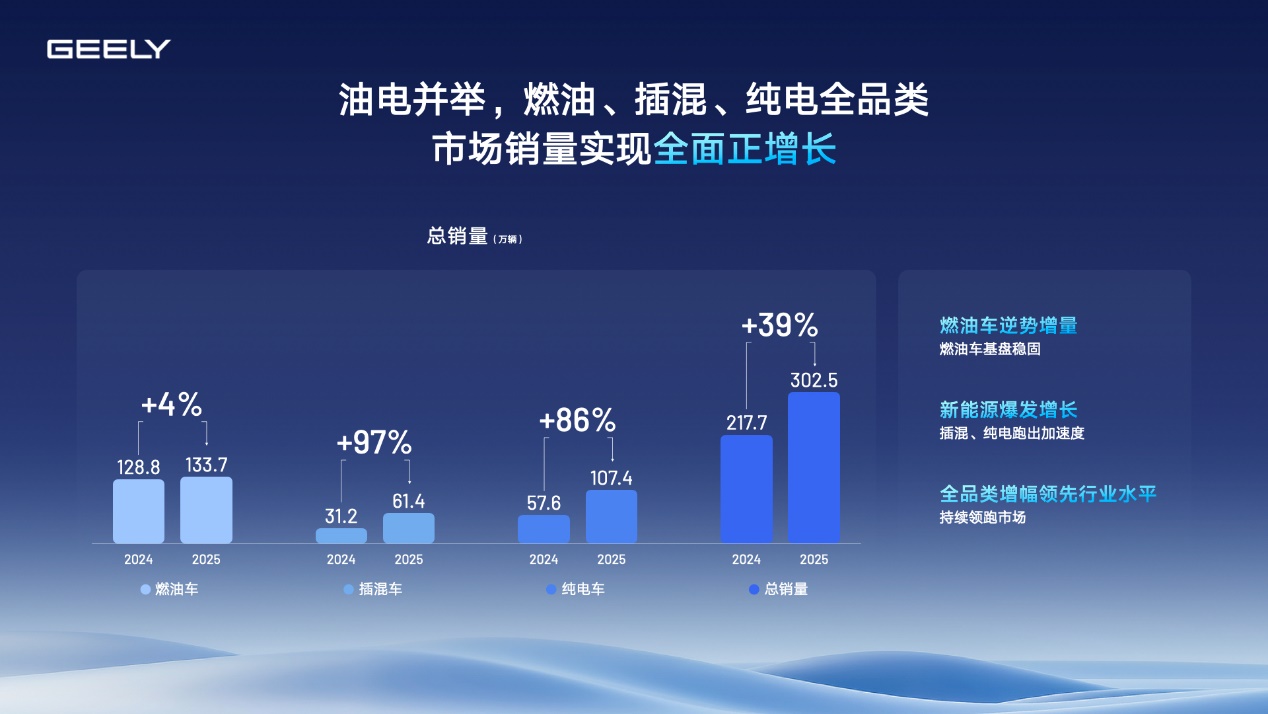
Core Insights - Geely Automobile Holdings Limited reported a total revenue of 345.2 billion yuan for 2025, marking a 25% year-on-year increase and setting a historical record [2] - The core net profit attributable to shareholders reached 14.41 billion yuan, reflecting a 36% year-on-year growth, indicating high-quality growth as the profit growth rate outpaced revenue growth [2] - Total gross profit increased to 57.3 billion yuan, up 25% year-on-year [2] Financial Performance - By the end of 2025, total cash levels rose by 46% to 68.2 billion yuan, indicating a robust cash reserve [2] - The proposed dividend per share increased by 51.5% to 0.5 HKD, with a total dividend payout of 5.39 billion HKD [2] Sales Performance - In 2025, Geely's cumulative sales reached 3.025 million units, a 39% year-on-year increase, with new energy vehicle sales exceeding 1.68 million units, up 90% [2][3] - In the first two months of 2026, Geely's sales reached 476,000 units, maintaining the top position in the domestic market for two consecutive months [2] Brand Development - Geely's CFO highlighted the successful integration of the "One Geely" strategy, which includes brands like Zeekr, Lynk & Co, and Geely Galaxy, enhancing brand value and sales scale [3] - Zeekr brand sales surpassed 224,000 units in 2025, with December marking a record monthly sales of over 30,000 units [3] - Lynk & Co achieved annual sales of 350,000 units, a 23% increase year-on-year [3] - Geely Galaxy became the fastest new energy vehicle brand to reach annual sales of 1 million units, with a 150% year-on-year growth [3] Market Expansion - Geely's overseas sales reached 420,000 units in 2025, with over 120,000 units being new energy exports [4] - The company entered 13 new markets in 2025, including major European markets and high-potential regions like Brazil and South Africa [4] - By the end of 2025, Geely expanded its brand presence to 88 countries and regions, totaling over 1,200 outlets [4] Technological Advancements - 2025 marked the culmination of the "Smart Geely 2025" strategy, with significant advancements in smart and electric vehicle technologies [4] - Geely launched the industry's first comprehensive AI technology system, establishing a long-term technological barrier for the smart electric vehicle era [4] Future Outlook - Geely aims to launch multiple new products in 2026, targeting a total sales goal of 3.45 million units, covering various market segments from mainstream to luxury and from fuel to new energy vehicles [5]


银河155万辆 极氪30万辆,吉利汽车拆解2026年345万业绩目标
Guo Ji Jin Rong Bao· 2026-03-18 09:57
Core Insights - Geely Auto reported a total sales volume of 3.0246 million units for 2025, representing a year-on-year increase of 39% [2] - The company aims for a sales target of 3.45 million units in 2026, with specific targets for its various brands [2] Sales Targets - The Zeekr brand aims for a sales target of 300,000 units in 2026, which is a 34% increase year-on-year [2] - Lynk & Co is targeting 400,000 units for the year, supported by the Lynk 07 station wagon and a new mid-to-large SUV [2] - Geely Galaxy has set a target of 1.55 million units for 2026, reflecting a 25% year-on-year growth [2] - The Geely China Star brand aims for a sales target of 1.2 million units [2]
吉利汽车2025年全年营收3452亿元,核心归母净利润增36%
Sou Hu Cai Jing· 2026-03-18 09:56
Core Insights - Geely Automobile Holdings Limited reported a total revenue of 345.2 billion yuan for the year 2025, marking a 25% year-on-year increase and setting a new historical record [1] - The core net profit attributable to shareholders, excluding foreign exchange gains and other non-core items, reached 14.41 billion yuan, reflecting a 36% year-on-year growth, with the profit growth rate outpacing revenue growth [1] Financial Performance - The total gross profit increased to 57.3 billion yuan, also up by 25% year-on-year [3] - By the end of 2025, total cash levels rose by 46% to 68.2 billion yuan [3] - The company proposed a dividend increase of 51.5% to 0.5 HKD per share, with a total dividend payout amounting to 5.39 billion HKD [3] Sales Performance - In 2025, Geely's total sales reached 3.025 million units, representing a 39% year-on-year increase [3] - The cumulative sales of new energy vehicles exceeded 1.68 million units, showing a 90% year-on-year growth [3] - In the first two months of 2026, Geely's sales reached 476,000 units [3] Strategic Developments - In 2025, Geely deepened its "One Geely" strategic deployment, completing the integration with Zeekr [5] - The Zeekr brand achieved annual sales of over 224,000 units, with December marking the first month of sales exceeding 30,000 units [5] - The Lynk & Co brand recorded annual sales of 350,000 units, a 23% increase year-on-year, while the flagship model Lynk 900 saw cumulative deliveries surpassing 50,000 units within six months, with an average transaction price exceeding 330,000 yuan [5] - The Geely Galaxy brand achieved annual sales of 1.24 million units, reflecting a 150% year-on-year increase [5] - In the fuel vehicle segment, Geely's China Star brand sold 1.21 million units in 2025, a 3% year-on-year increase [5]
GEELY AUTO(00175) - 2025 Q4 - Earnings Call Transcript
2026-03-18 09:30
Financial Data and Key Metrics Changes - Geely's gross margin improved to 16.9% in Q4 2025, higher than the full-year average of 16.6% [60][62] - R&D expenses increased by CNY 1.5 billion quarter-on-quarter, reaching CNY 590 million in Q4 2025, with a target of maintaining around 40% utilization in 2026 [60][64] Business Line Data and Key Metrics Changes - Zeekr brand achieved annual sales of 224,000 units, with a record monthly delivery of over 30,000 units in December [1] - Lynk & Co sales volume reached 350,000 units, with new energy vehicles making up 65% of the mix [3] - Galaxy sales reached 1.236 million units, up by 150% [4] - Geely China Star ICE sales reached 1.214 million units, with Xingyue L ranked number one in China's ICE SUV segment [4] Market Data and Key Metrics Changes - Geely's export sales target for 2026 is 640,000 units, a 50% increase from 2025, with a focus on overseas markets [9][40] - New energy vehicle sales in overseas markets reached 124,000 units in 2025, growing by 240% [40][42] Company Strategy and Development Direction - Geely aims to become a global leader in smart vehicles, focusing on technology and globalization [5][10] - The company has set a five-year carbon reduction target to reduce vehicle lifecycle carbon emissions by 25.5% by the end of 2025 [5] - Geely plans to launch new models, including the Zeekr 8X and Lynk & Co zero seven wagon version, to enhance its product offerings [7][8] Management's Comments on Operating Environment and Future Outlook - Management expressed confidence in achieving higher sales volumes and net profits in 2026, building on the successes of 2025 [38] - The company highlighted the importance of safety and intelligence in vehicle development, establishing a global automotive safety center [15][16] - Geely's management acknowledged the competitive landscape and emphasized the need for continuous improvement in brand development and global market scale [34][35] Other Important Information - Geely has integrated Lynk & Co and Zeekr brands to enhance resource allocation and operational efficiency [49][50] - The company is focusing on diversifying energy inputs, covering ICE, hybrid, PHEV, and BEV technologies [29][30] Q&A Session Summary Question: What are the driving reasons for the gross margin improvement? - The gross margin improved due to higher sales of high-end products like Zeekr 9X, which accounted for a significant portion of total sales volume [60][62] Question: What is the outlook for R&D expenses in 2026? - R&D expenses are expected to maintain around 40% utilization, with a focus on improving the quality of profits [64] Question: How does Geely evaluate overseas markets and competitive edge? - Geely has laid a solid foundation for overseas markets in 2025, with plans to deepen production capabilities and focus on branding and technology export [39][40]
吉利汽车2025年实现高质量发展,全年营收3452亿元,核心归母净利润劲增36%
Zhong Guo Qi Che Bao Wang· 2026-03-18 06:12
Core Insights - Geely Automobile Holdings Limited reported a record total revenue of 345.2 billion yuan for 2025, marking a 25% year-on-year increase, with core net profit rising 36% to 14.41 billion yuan, indicating high-quality growth [1] - The company plans to increase its dividend by 51.5% to 0.5 HKD per share, totaling 5.39 billion HKD, reflecting its commitment to sharing growth with shareholders [1] - Geely's total sales reached 3.025 million units in 2025, a 39% increase, with new energy vehicle sales exceeding 1.68 million units, up 90%, solidifying its position in the industry [1] Financial Performance - Total revenue for 2025 was 345.2 billion yuan, a 25% increase year-on-year [1] - Core net profit reached 14.41 billion yuan, reflecting a 36% growth [1] - Total cash reserves increased by 46% to 68.2 billion yuan, indicating strong liquidity [1] Sales and Market Position - Geely's total sales for 2025 were 3.025 million units, exceeding the adjusted target of 3 million units [1] - New energy vehicle sales reached 1.68 million units, marking a 90% increase and positioning Geely among the top players in the sector [1] - In the first two months of 2026, Geely maintained its industry-leading position with sales of 476,000 units [1] Strategic Developments - The "One Geely" strategy was further deepened in 2025, integrating Zeekr to create a comprehensive brand portfolio across mainstream, high-end, and luxury markets [3] - The Zeekr brand achieved sales of 224,000 units in 2025, with significant monthly sales milestones [4] - Lynk & Co maintained a growth trajectory with annual sales of 350,000 units, a 23% increase [6] Technological Advancements - Geely launched its first comprehensive AI technology system in 2025, enhancing its capabilities in smart and electric vehicle technology [12] - The company achieved significant advancements in battery technology, including the ShenDun JinZhuan battery and the upcoming all-solid-state battery [16] - Geely's AI-assisted driving system has gained global recognition, with successful deployments and partnerships [14] Global Expansion - Geely's overseas sales reached 420,000 units in 2025, with over 120,000 units being new energy vehicles, reflecting a strong international presence [20] - The company entered 13 new markets in 2025, expanding its global footprint significantly [22] - Geely's global manufacturing capabilities were enhanced with the launch of new plants in Egypt and Indonesia [22] Sustainability and ESG Initiatives - Geely was included in the S&P Global "Global Sustainability Yearbook 2026," highlighting its leadership in ESG practices [25] - The company achieved a 25.5% reduction in carbon emissions per vehicle compared to 2020, exceeding its carbon reduction targets [25] - Geely aims to launch multiple new products in 2026, targeting a total sales goal of 3.45 million units [25]
首月卖车27万部,李书福再夺销冠
2 1 Shi Ji Jing Ji Bao Dao· 2026-02-03 05:39
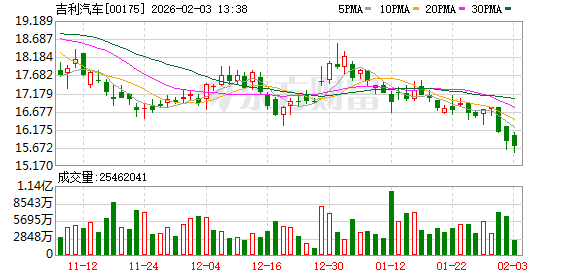
Core Viewpoint - Geely Auto has achieved significant sales growth in January, surpassing BYD to become the top-selling domestic car brand for the first time in 40 months, with total sales of 270,167 units, reflecting a year-on-year increase [2][4]. Sales Performance - In January, Geely sold 270,167 vehicles, a slight increase of 1% compared to 266,737 units in the previous year [4]. - The breakdown of sales includes: - Geely brand: 217,438 units, down 3% year-on-year - Galaxy series: 82,990 units, down 11% - Lynk & Co: 28,877 units, down 4% - Zeekr: 23,852 units, up 100% [4]. - The sales of pure electric vehicles (BEVs) were 68,012 units, down 15%, while plug-in hybrid electric vehicles (PHEVs) increased by 37% to 56,240 units [4]. Factors Contributing to Growth - The growth is attributed to three main factors: 1. A dual-line strategy that maintains stability in operations [5]. 2. Strong performance of the high-end brand Zeekr, which delivered 23,852 units in January, nearly doubling year-on-year [5]. 3. Significant growth in overseas exports, with 60,506 units exported in January, a 121% increase year-on-year [6][7]. Global Expansion - Geely has entered 13 new markets in 2025, including major European markets and high-potential regions like Brazil and South Africa, expanding its presence to 88 countries with over 1,200 outlets [8]. - The company aims to achieve an export target of 600,000 units this year, with several key models, including Zeekr 9X, planned for international launch [9]. Future Sales Targets - Geely has set a sales target of 3.45 million units for 2026, representing a 14% increase from 2025, with specific targets of 2.75 million for the Geely brand, 300,000 for Zeekr, and 400,000 for Lynk & Co [10][11]. - The company aims for a total of 2.22 million units in electric vehicle sales, a 32% increase, indicating ambitious growth plans in a competitive market [12].
从“更大”,到“更强大”!“一个吉利”以万亿为锚,驶向全球前五
Jin Rong Jie· 2026-01-23 11:03
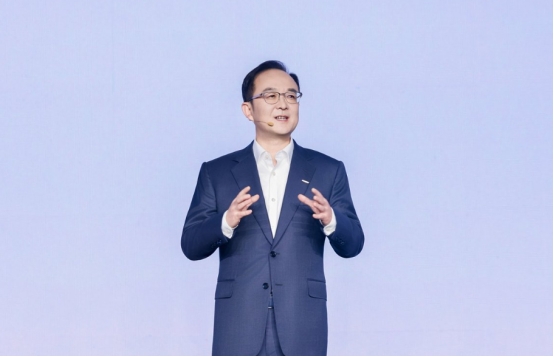
Core Insights - Geely has set a five-year strategic goal to become a leading player in the global automotive industry, aiming for total global sales to exceed 6.5 million units and revenue to surpass 1 trillion yuan by 2030 [1][2]. Group 1: Strategic Goals - By 2030, Geely aims to achieve global total sales of over 6.5 million vehicles, with revenue exceeding 1 trillion yuan, positioning itself among the top five global automakers [1][2]. - The company plans for 75% of its sales to come from new energy vehicles (NEVs) and over one-third of sales to be from international markets [2]. Group 2: Market Position and Growth - In 2025, Geely's total sales are projected to reach 4.116 million units, a 26% year-on-year increase, making it the fastest-growing company among the top ten automotive groups [2]. - NEV sales are expected to reach 2.293 million units, reflecting a 58% year-on-year growth, with a penetration rate of 56%, significantly above the industry average [2]. Group 3: Brand Strategy - Geely is focusing on strengthening its core brand and has established a brand matrix that includes "Geely China Star," "Geely Galaxy," "Lynk & Co," and "Zeekr," covering a wide range of market segments from mainstream to high-end [3][5]. - The company aims to leverage its global brands like Volvo and Polestar in international markets while exploring new joint venture models with partners like Renault [5]. Group 4: Technological Advancements - Geely is enhancing its "Seven Vertical" technology system, focusing on key areas such as intelligent driving, smart cockpit, electronic architecture, and battery technology [7]. - The company’s intelligent driving platform, "Qianli Haohan," is positioned as one of the most advanced globally, with plans for L2-level assistance and rapid advancement towards L3 and L4 technologies [7]. Group 5: Safety and Sustainability - Safety is a top priority for Geely, which aims to create a "world safety dual-pole" system with Volvo, focusing on a comprehensive safety ecosystem [8]. - Geely is committed to integrating green and low-carbon principles throughout its product lifecycle and aims for carbon neutrality in its manufacturing processes [14]. Group 6: Future Ecosystem Development - Geely is developing a "Heaven and Earth Integrated" transportation network, which includes various mobility solutions and aims to launch 100,000 customized Robotaxi vehicles by 2030 [11]. - The company is also advancing its alcohol-hydrogen electric vehicle technology, with over 50,000 units already in operation, contributing to carbon neutrality and energy security [11]. Group 7: Alignment with National Strategy - Geely's 2030 strategy aligns with China's "14th Five-Year Plan," focusing on high-quality development and seizing global market opportunities [13]. - The company is transitioning from simple product exports to a comprehensive value chain output model, emphasizing technology and service integration [13].
吉利控股发布2030战略目标:销量突破650万 营收破万亿并冲击全球前五
Yang Shi Wang· 2026-01-23 09:53
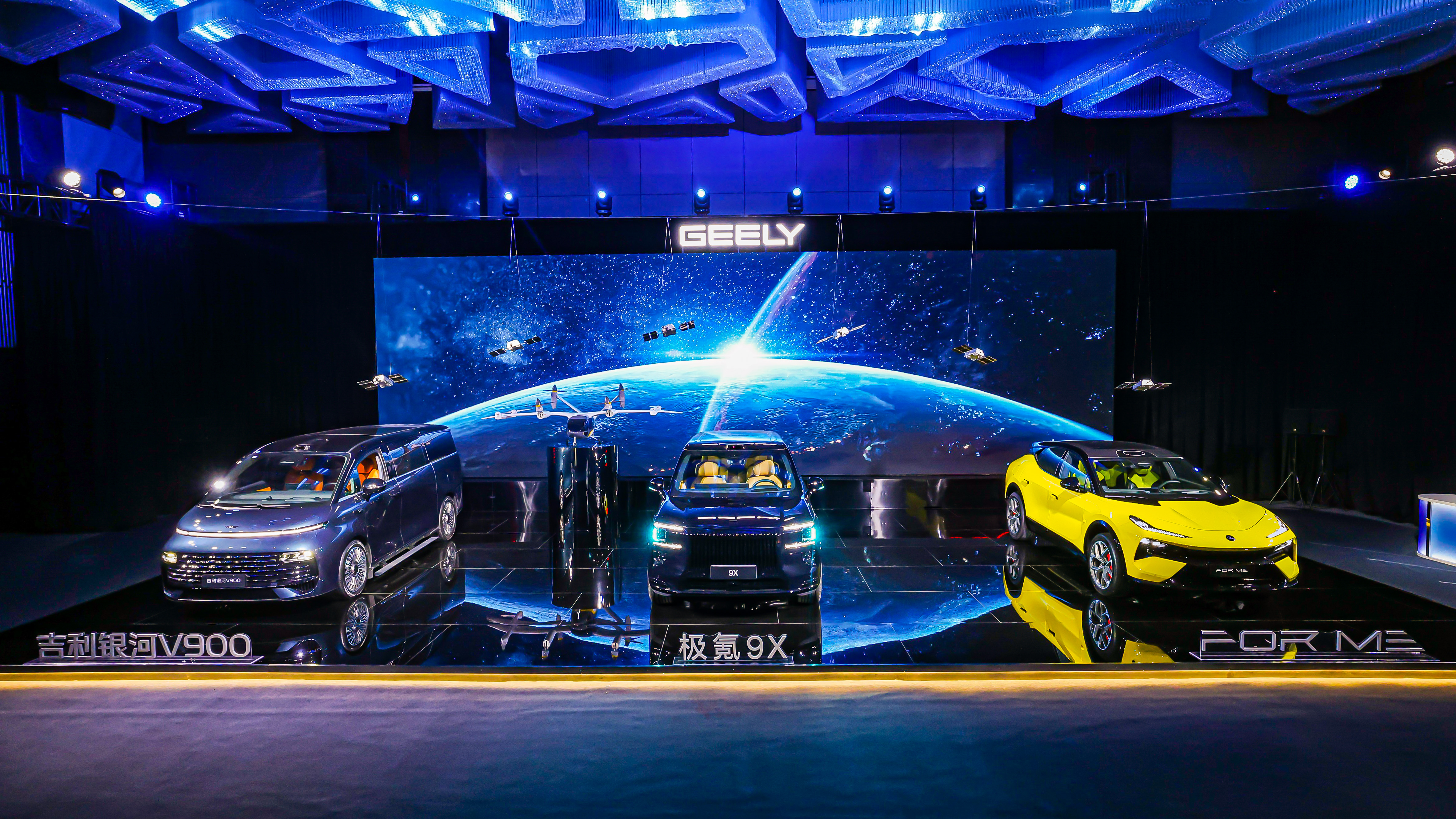
Core Viewpoint - Geely Holding Group has officially launched its "One Geely, Leading All" 2030 strategic goal, aiming to enhance global coordination and establish a comprehensive core capability system to achieve leading indicators in the global automotive industry [1][4]. Group 1: Strategic Goals - Geely aims to achieve global total sales exceeding 6.5 million units (including passenger and commercial vehicles) and revenue surpassing 1 trillion yuan by 2030, positioning itself among the top five global automakers, with approximately 75% of sales from new energy vehicles and over one-third from overseas markets [4]. - The company plans to develop a leading global new energy architecture covering vehicle classes A to E, with a target to reduce average model development cycles and comprehensive costs by over 30% based on the new architecture [4]. Group 2: Six-in-One Capability System - Geely will focus on six areas: brand, technology, complete vehicles, ecology, talent, and sustainable development, with an emphasis on strengthening the Geely parent brand and creating a clear, distinctive global brand matrix [7]. - The company will leverage its brands, including Geely, Lynk & Co, and Polestar, while also enhancing the localized operational capabilities of international brands like Volvo and Lotus in the European and American markets [7]. Group 3: Technological Advancements - Geely will enhance its "Seven Vertical" technology system, focusing on smart driving, smart cockpits, electronic architecture, complete vehicle architecture, batteries, electric drives, and super hybrid technologies [8]. - The company aims to establish "Qianli Haohan" as a globally advanced technology platform, achieving full coverage of L2-level assisted driving and accelerating the commercialization of L3 technology and Robotaxi [8]. Group 4: Safety and Ecological Layout - Safety remains the top priority for Geely, with plans to strengthen safety technology collaboration within the group and establish a "world safety dual-pole" structure between Volvo and Geely [10]. - Geely will focus on three ecological areas: user services, future mobility, and methanol-hydrogen electric vehicles, aiming to launch 100,000 customized Robotaxis by 2030 [10]. Group 5: Talent and Sustainability - Geely will deepen its "Talent Forest" strategy, investing 500 million yuan initially and up to 300 million yuan in total to foster innovation and entrepreneurship among youth [12]. - The company commits to integrating green and low-carbon principles throughout the product lifecycle, promoting eco-friendly materials, and achieving carbon neutrality in benchmark factories [12]. Group 6: Future Directions - By 2026, Geely will focus on AI technology, energy diversification, product premiumization, and internationalization, with upcoming technologies including the full-domain AI 2.0 system and the next-generation Qianli Haohan assisted driving system [13]. - New products, such as the Zeekr 8X, are set to be launched, reflecting the company's commitment to high-quality development [13].
2030年销量突破650万辆 跻身全球前五 吉利控股集团发布“一个吉利 全面领先”战略目标
Jing Ji Wang· 2026-01-23 09:25
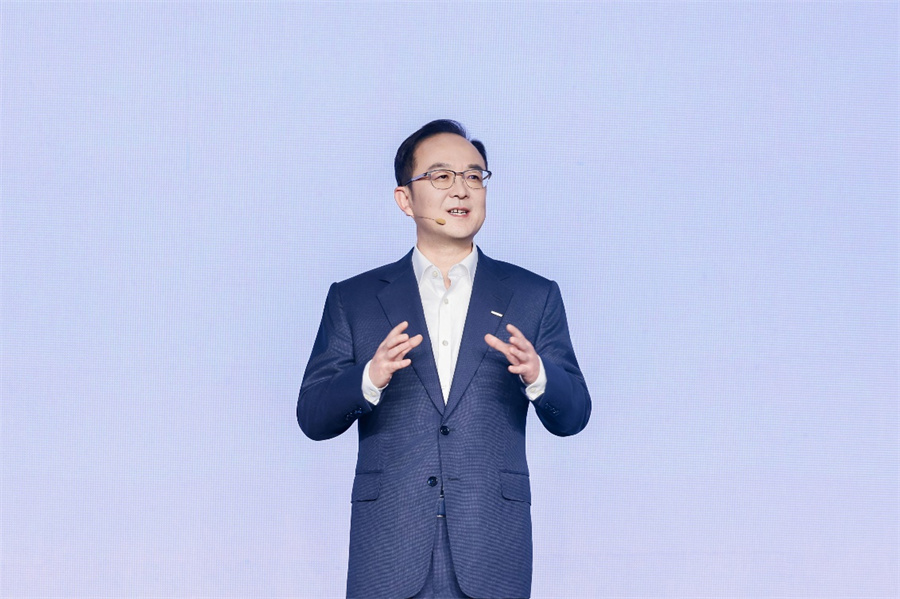
Core Insights - Geely Holding Group has announced its 2030 strategic goal of "One Geely, Comprehensive Leadership," aiming to achieve global sales exceeding 6.5 million vehicles and revenue surpassing 1 trillion yuan, with 75% of sales from new energy vehicles and over one-third from overseas markets [1][5]. Group 1: Strategic Goals - The 2030 strategy focuses on enhancing top-level planning and global collaboration to create a unified strategic framework [1][5]. - Geely aims to develop a "six-in-one" core capability system to ensure key performance indicators reach a leading level among global automakers [1][5]. Group 2: Sales Performance - In 2025, Geely's total sales reached 4.116 million vehicles, a 26% year-on-year increase, marking five consecutive years of rapid growth [3]. - New energy vehicle sales reached 2.293 million units, up 58%, with a penetration rate of 56% [3]. Group 3: Brand and Market Strategy - Geely plans to strengthen its core brand and create a clear, distinctive global brand matrix to enhance brand competitiveness and influence [5]. - The company will leverage its international brands like Volvo and Polestar to capitalize on local market advantages in Europe and North America [5]. Group 4: Technological Advancements - Geely is committed to enhancing its "seven verticals" technology system, focusing on smart driving, smart cockpits, and electric architectures to maintain a leading position in safety and innovation [6][9]. - The company aims to develop advanced platforms for smart driving and AI technologies, including the L2 and L3 autonomous driving capabilities [6][7]. Group 5: Ecosystem Development - Geely is focusing on three major ecological business areas: user services, future mobility, and methanol-hydrogen electric ecosystems [10][12]. - The company plans to establish a comprehensive service system for users and develop a nationwide integrated mobility service by 2030 [10]. Group 6: Talent and Sustainability - Geely is enhancing its organizational structure and talent development to support its transformation into a technology-driven enterprise [13]. - The company is committed to sustainable development, aiming to reduce carbon footprints and promote green technologies across its product lifecycle [13]. Group 7: Future Outlook - Geely aims to innovate in AI technology, energy diversification, product premiumization, and internationalization to drive high-quality development in the automotive industry [15]. - The company is set to launch new models and technologies that enhance user experience and operational efficiency [15].
吉利控股发布2030战略目标:实现全球总销量突破650万辆,营收超1万亿元,跻身全球车企销量前五
Xin Lang Cai Jing· 2026-01-23 01:32
Core Insights - Geely Holding has announced its "One Geely, Comprehensive Leadership" 2030 strategic goal, aiming to enhance top-level coordination and global collaboration to achieve a unified strategic framework [1][6] - The company targets to exceed global total sales of 6.5 million vehicles (passenger and commercial), with revenue surpassing 1 trillion yuan, ranking among the top five global automakers, and aims for approximately 75% of sales to come from new energy vehicles [1][6] Strategic Framework - The "One Geely" initiative focuses on strengthening the group's top-level operations and global governance, creating a platform for strategic collaboration and resource integration [3][8] - The "Comprehensive Leadership" aspect aims to build a core capability system centered on brand, technology, complete vehicles, ecology, talent, and sustainable development, ensuring key competitive indicators reach a leading global level [3][8] Sales and Growth Projections - In 2025, Geely's total sales are projected to reach 4.116 million units, a 26% year-on-year increase, with new energy vehicle sales expected to hit 2.293 million units, reflecting a 58% growth and a penetration rate of 56% [3][8] Brand Strategy - Geely plans to enhance its core brand by creating a clear, distinctive, and complementary global brand matrix, leveraging the strengths of its various brands, including Geely, Lynk & Co, and Volvo [4][9] - The company aims to establish a new collaborative brand partnership model with international partners like Renault, focusing on localized operations in key markets [4][9] Technological Advancements - Geely will enhance its "Seven Vertical" technology system, focusing on smart driving, smart cockpit, electronic architecture, complete vehicle architecture, batteries, electric drives, and super electric hybrid technologies [4][9] - The company aims to achieve full coverage of L2-level assisted driving and accelerate the commercialization of L3 technology and Robotaxi services [4][9] Ecosystem Development - Geely is focusing on three major ecosystems: user services, future mobility, and methanol-hydrogen electric vehicles [5][10] - The user service ecosystem will aim to create a convenient, transparent, digital, and ecological after-sales service system, enhancing customer satisfaction and loyalty [5][10] - The future mobility ecosystem will involve a comprehensive integrated service capability across major cities by 2030, including the deployment of 100,000 Robotaxi vehicles [5][10] - The methanol-hydrogen electric vehicle ecosystem will leverage a full industry chain advantage, with over 50,000 vehicles already in operation and a cumulative mileage exceeding 23 billion kilometers [5][10]