
商品浆

Search documents
未知机构:浙商轻工史凡可周观点3月浆价继续强势提涨出口关税迎阶段利好-20260224
未知机构· 2026-02-24 02:50
Summary of Conference Call Records Industry Overview - **Industry**: Pulp and Paper, Real Estate, Metal Cans, New Consumption, Tobacco, Personal Care, AI Applications, Pet Industry - **Key Trends**: Positive cyclical expectations, price increases in pulp, recovery in real estate transactions, and growth in various consumer sectors Key Points Pulp and Paper Industry - **Price Increases**: March pulp prices continue to rise strongly, with Suzano reporting an increase of $20 per ton in China [1] - **Supply Chain Issues**: Indonesia's revocation of forestry licenses affects the supply of hardwood pulp chips, compounded by APP's announcement of delays in the second phase of OKI production [1] - **Investment Recommendations**: Continued recommendations for companies such as Sun Paper, Nine Dragons, and Xianhe, with a focus on potential growth in the sector [1] Real Estate Sector - **Market Recovery**: Improvement in second-hand housing transactions, with the National Bureau of Statistics reporting a narrowing decline in housing prices across 70 cities [1] - **Top Picks**: Recommended companies include Kuka, Hanhai, with expectations for recovery in brands like Gongniu, Oppein, and others [1] Metal Can Industry - **Aluminum Price Adjustment**: Recent pullback in aluminum prices is beneficial for profit release, with a bottom recommendation for Aorikin and attention on Baosteel and Shengxing [1] New Consumption Sector - **Core Products**: Many core products have entered the layout phase, with various brands launching new items and maintaining high store traffic during the Spring Festival [2] - **Tobacco Market**: British American Tobacco reports rapid market share growth in Poland, with a recommendation for Smoore as a core stock [2] - **Personal Care Growth**: Brands like Leshushi and Baia are experiencing significant growth, with new product launches and marketing strategies enhancing their market positions [2] AI Applications - **Smart Glasses Sales**: Kangnait's smart glasses are projected to exceed 7 million units in sales for the year, with ongoing attention to order progress [2] - **Acquisition Plans**: Yudong plans to acquire 51% of Huayan Technology, extending its reach into precision components and AI glasses [2] Pet Industry - **Market Recovery**: The pet industry saw a recovery in January with an overall growth of 18%, with specific brands like Guibao and Zhongchong showing significant increases [3] Cross-Border Trade - **Tariff Changes**: Recent tariff adjustments are favorable, with a 5% reduction in the overall tax rate benefiting cross-border enterprises, particularly focusing on companies like Zhiou and Henglin [3]
岳阳林纸股价涨5.23%,南方基金旗下1只基金位居十大流通股东,持有963.7万股浮盈赚取289.11万元
Xin Lang Cai Jing· 2026-02-11 02:53
Group 1 - The core viewpoint of the news is that Yueyang Lin Paper's stock price increased by 5.23% to 6.04 CNY per share, with a trading volume of 2.32 billion CNY and a turnover rate of 2.23%, resulting in a total market capitalization of 10.616 billion CNY [1] - Yueyang Lin Paper Co., Ltd. is located in the Hunan Free Trade Zone and was established on September 28, 2000, with its listing date on May 25, 2004. The company focuses on the forestry and paper industry, extending into ecological sectors, and has developed a dual-core business model of "pulp and paper + ecology" [1] - The main revenue composition of Yueyang Lin Paper includes: printing paper (49.33%), commodity pulp (22.61%), packaging paper (14.55%), biomass power generation (3.82%), industrial paper (3.66%), municipal landscaping (2.64%), and others [1] Group 2 - From the perspective of major circulating shareholders, Southern Fund has a fund that ranks among the top ten circulating shareholders of Yueyang Lin Paper. The Southern CSI 1000 ETF (512100) entered the top ten in the third quarter, holding 9.637 million shares, accounting for 0.55% of circulating shares, with an estimated floating profit of approximately 2.8911 million CNY [2] - The Southern CSI 1000 ETF (512100) was established on September 29, 2016, with a latest scale of 78.996 billion CNY. Year-to-date returns are 8.61%, ranking 1564 out of 5569 in its category; the one-year return is 34.61%, ranking 1862 out of 4295; and the return since inception is 24.22% [2]

提价预期传导-浆纸行业更新推荐
2026-02-02 02:22
Summary of Conference Call on the Pulp and Paper Industry Industry Overview - The pulp and paper industry is expected to see an improvement in market conditions after a year of declining fixed asset investment, with a potential recovery in 2026 [1][2] - The Producer Price Index (PPI) has shown a slight increase since September 2025, indicating stabilization in pricing, although demand has not fully recovered yet [1][2] Key Insights - The anticipated decline in interest rates and a stronger RMB are expected to drive up pulp prices, which will subsequently lead to an increase in paper prices [1][2] - The U.S. Federal Reserve's interest rate cuts may enhance liquidity and stimulate end-user demand, while a weaker dollar could reduce upstream pulp manufacturers' profitability, providing them with pricing power [2] - China remains the largest consumer market for commodity pulp, accounting for nearly 40% of global demand, with seasonal demand expected to support pulp prices in March and April 2026 [5] - Domestic leading paper companies are expected to increase their self-produced pulp capacity, which may create variability in demand linked to end-user consumption [5] Supply and Demand Dynamics - The supply pressure for commodity pulp is expected to ease significantly in 2026, with only the APP Indonesia OKI Phase II project having uncertain production plans [5] - Some overseas pulp manufacturers have announced production cuts or shifts in production plans, contributing to a likely balanced supply-demand scenario in 2026 [5] - The European and American markets are projected to recover in 2026, with European port inventories showing a downward trend since October 2025 [5] Segment Analysis - **Cultural Paper**: Prices are at historical lows (approximately 4,700 RMB/ton), with many companies facing losses due to excess capacity. However, seasonal demand may provide some price support [7] - **White Cardboard**: Currently priced around 4,200 RMB/ton, it has seen slight price increases but remains at historical lows due to supply pressures. Marginal improvements are expected in 2026 [7] - **Specialty Paper**: This segment has faced declining profitability due to weak demand and increased competition. Price recovery is unlikely in the short term [7] - **Recycled Paper**: Prices have fluctuated due to raw material costs, with boxboard prices around 3,500 RMB/ton and corrugated prices at 2,700 RMB/ton. A clear improvement in supply-demand dynamics is anticipated [7] Future Outlook - The overall economic environment, cost control, and seasonal demand are expected to support gradual recovery across all segments of the paper industry [8] - The boxboard sector is experiencing positive changes in supply-demand dynamics, with prices expected to recover moderately [9] - The industry is approaching a critical inflection point for supply contraction, with minimal new capacity expected from 2026 or 2027 onwards [10] Recommended Companies - Leading companies with integrated pulp and paper capabilities are recommended for investment, such as Sun Paper, Jiulong, and Xianhe, due to their cost advantages from self-produced pulp [11] - Companies like Huawang Technology, Bohui, Chenming Paper, and Wuzhou Specialty are also suggested for consideration based on their relatively low valuations and potential for profit recovery [11]
岳阳林纸子公司项目终止,又迎罕见预亏!
Shen Zhen Shang Bao· 2026-01-27 11:48
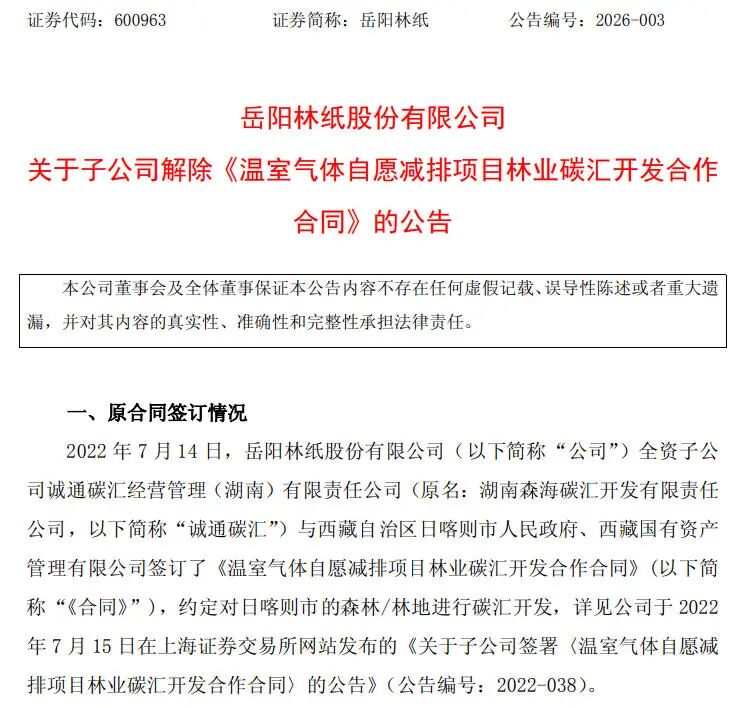
Group 1 - The company Yueyang Lin Paper announced the termination of the "Voluntary Greenhouse Gas Emission Reduction Project Forestry Carbon Sink Development Cooperation Contract" with the government of Shigatse, Tibet, due to policy changes [1][5] - The contract was originally signed on July 14, 2022, by the company's wholly-owned subsidiary, Chengtong Carbon Sink Management (Hunan) Co., Ltd., and was aimed at carbon sink development in Shigatse's forests [1][5] - The termination of the contract will not have a significant adverse impact on the company's production, financial status, or carbon sink business [5] Group 2 - Yueyang Lin Paper is a major domestic producer of cultural paper and commodity pulp, involved in the research, production, and sales of various paper products [5] - The company is expected to report a net loss of between 260 million to 200 million yuan for the year 2025, marking a significant decline compared to the previous year [7] - The anticipated loss is attributed to intensified market competition in the cultural paper sector and a downturn in the landscaping ecological industry, leading to decreased sales prices and profit margins [7]

浙商证券:美元降息周期纸浆价格强势 浆纸一体化龙头利好
智通财经网· 2026-01-23 02:56
Group 1 - The core viewpoint is that the Federal Reserve's entry into a rate-cutting cycle may stimulate demand while simultaneously weakening the profits of pulp companies in Brazil, leading to supply control and driving pulp prices upward [2] - The industry is currently at a valuation and profit bottom, with paper prices at historical low percentiles and pulp prices also at low levels, indicating a safety margin for the sector [2] - The historical negative correlation between pulp prices and the US dollar index suggests that the Fed's rate cuts could be a key catalyst for price increases in the pulp market [2] Group 2 - Supply of commodity pulp is slowing, with limited new overseas capacity expected after 2025, and domestic self-sufficient pulp production is projected to add approximately 660 million tons from 2025 to 2026 [3] - Short-term demand remains resilient, with global hardwood pulp shipments expected to increase by 7% year-on-year, primarily driven by demand from China [4] - Current inventory levels are at a medium-low position, with global hardwood pulp producer inventory days at 44.7 days, indicating a strong price outlook for Q1 2026 [4] Group 3 - The cost of pulp varies significantly based on raw materials, with domestic pulp relying on imported wood chips having a cash cost of approximately $480 per ton, while using domestic wood chips can reduce costs to $420 per ton [4]


岳阳林纸股价涨5.34%,南方基金旗下1只基金位居十大流通股东,持有963.7万股浮盈赚取240.92万元
Xin Lang Cai Jing· 2026-01-22 03:51
Group 1 - The core viewpoint of the news is that Yueyang Lin Paper Co., Ltd. has seen a stock price increase of 5.34%, reaching 4.93 CNY per share, with a trading volume of 257 million CNY and a turnover rate of 3.04%, resulting in a total market capitalization of 8.665 billion CNY [1] - Yueyang Lin Paper, established on September 28, 2000, and listed on May 25, 2004, operates primarily in the forestry and paper industry, extending into ecological sectors, and has developed a dual-core business model of "pulp and paper + ecology" [1] - The company's revenue composition includes: printing paper 49.33%, commodity pulp 22.61%, packaging paper 14.55%, biomass power generation 3.82%, industrial paper 3.66%, municipal landscaping 2.64%, others 2.07%, construction labor services 1.02%, timber sales 0.19%, and commercial housing 0.10% [1] Group 2 - From the perspective of major circulating shareholders, Southern Fund's Southern CSI 1000 ETF (512100) has entered the top ten circulating shareholders of Yueyang Lin Paper, holding 9.637 million shares, which accounts for 0.55% of the circulating shares, with an estimated floating profit of approximately 2.4092 million CNY [2] - The Southern CSI 1000 ETF (512100) was established on September 29, 2016, with a latest scale of 78.996 billion CNY, and has achieved a year-to-date return of 8.6%, ranking 1617 out of 5542 in its category, and a one-year return of 41.53%, ranking 1751 out of 4256 [2]
从产能周期看浆纸产业链的结构性变化与趋势
Guo Tai Jun An Qi Huo· 2025-12-23 13:52
1. Report Industry Investment Rating - Not provided in the document 2. Core View of the Report - The pulp and paper industry is undergoing significant structural changes, with broadleaf pulp gradually seizing market share from softwood pulp, and the industry is facing challenges such as overcapacity and compressed downstream profits [50][52][59] 3. Summary According to Related Catalogs 3.1 Pulp Mill Capacity: Is It in the Clearance Stage? - **Market Structure of Commodity Pulp**: Global commodity pulp capacity is dominated by broadleaf pulp, accounting for about 50%, followed by softwood pulp at about 20%. Suzano, APP, and UPM are major players [5] - **Pulp Production Cost Curve**: The average cash cost of BHKP is 289 dollars/ton for 70% of the capacity, and the CIF China break - even point (excluding logistics) is 580 - 600 dollars/ton for 70% - 75% of the capacity. For BSKP, the average cash cost is 500 dollars/ton for 41% of the capacity, and the CIF China break - even point (excluding logistics) is 445 - 465 dollars/ton for 85% - 90% of the capacity [8] - **Company Performance Analysis** - **SUZANO**: In 25Q1 - Q3, revenue was 37 billion reais, a year - on - year increase of 11%. Operating cost was 24.8 billion reais, a year - on - year increase of 33%. Operating profit was 7.5 billion reais, a year - on - year decrease of 1%. Net profit rebounded significantly mainly due to less derivative losses last year. Pulp revenue accounts for about 80% of the company's revenue [10][13] - **ARAUCO**: Q3 revenue was 1.5 billion dollars, a quarter - on - quarter decrease of 1%. Gross profit was 350 million dollars, with a gross profit margin of 23%. The company has been unprofitable since 2025, and Q3 net profit after non - recurring items was underwater. Pulp business EBITDA Margin is about 26.5% [22] - **Metsa Group**: Sales revenue increased, but profit reached a new low. In Q3, the operating profit margin was - 12%. Pulp sales continued to rise [26] - **Mercer**: In 25Q3, revenue was 458 million dollars, flat quarter - on - quarter. Gross profit was negative for two consecutive quarters. Net profit after non - recurring items was - 81 million dollars, the lowest since 2023. There was no substantial production cut [29][31][33] - **UPM**: Revenue continued to decline, with about 2.3 billion euros in 25Q3. Q3 gross profit margin was only 0.3%. Net profit was 18 million euros, with a net profit margin of 0.8%. ROCE in Q3 was 2.4%, the lowest in nearly two years [37][39][42] - **Solvency Analysis**: Most pulp mill asset - liability ratios are below 60%. As of Q3 2025, Mercer's asset - liability ratio was about 68.1%, and Suzano's was 60.7%. Most pulp mills' EBIT interest coverage ratios are above 1, but Arauco's was 0.36 and Mercer's was - 2.37 as of Q3 [45] 3.2 What Structural Changes Are Taking Place Currently? - **Difference between Softwood and Broadleaf Pulp Prices**: The price difference between softwood and broadleaf pulp has been widening. Broadleaf pulp capacity growth is faster than that of softwood pulp, and broadleaf pulp is gradually seizing market share from softwood pulp. The global consumption of commodity pulp is 67.7 million tons, of which about 64.6% is broadleaf pulp [50][52][53] - **Consumption Situation in Europe**: European softwood pulp monthly consumption is stable at 20 - 25 tons, far from recovering to the pre - energy - crisis level. European broadleaf pulp monthly consumption is above 50 tons and has returned to normal [55] - **Apparent Consumption and Paper Formula Adjustment**: Softwood pulp monthly apparent consumption is maintained at 60 - 80 tons, while broadleaf pulp monthly apparent consumption has increased from about 140 tons to 180 tons. The proportion of toilet paper and white cardboard has increased to about 35%, and the proportion of cultural paper has decreased. The pulp formula of toilet paper and double - glue paper has been deeply adjusted [58] - **Profit and Capacity Expansion of Finished Paper**: Downstream profits are continuously compressed, and the apparent profit per ton of many finished papers has turned negative. From 2025 to 2026, a large amount of new paper - making capacity is planned to be put into production, mainly in toilet paper, cultural paper, and white cardboard [59] - **Industrial Chain Inventory**: As of November, European softwood pulp inventory was 27 days, and broadleaf pulp inventory was 26 days. Pulp mill softwood pulp inventory days reached 48 days, a historical high for the same period, and broadleaf pulp inventory days were 45 days, flat month - on - month. Domestic pulp inventory has started to decline, with a structural surplus of softwood pulp [62] - **Stable Growth of Broadleaf Pulp Consumption**: The natural demand for BHKP may increase to 459,000 tons, with a CAGR of + 2.1%. Emerging markets contribute the main increment, and toilet paper and specialty paper are the main drivers [64] 3.3 Future Development Trends of the Pulp and Paper Industry Chain - **Industry Status**: The cumulative revenue of the paper - making industry was 1.16 trillion yuan, a year - on - year decrease of 2.4%. The profit was 31.22 billion yuan, a year - on - year decrease of 11.7%. The industry loss area exceeded 30%, and the cumulative loss of loss - making enterprises reached 16.7 billion yuan, a year - on - year increase of 10%, the highest in the same period in history. The SW paper - making industry index had a revenue of 125.7 billion yuan in 2025Q1 - Q3, a year - on - year decrease of 12%, and a net profit attributable to the parent company of - 1.8 billion yuan, a year - on - year decrease of 138%. The asset - liability ratio of listed paper enterprises exceeded 60%, and the current ratio and quick ratio fell below 1 [68][71] - **Integration of Forest, Pulp, and Paper**: Leading paper enterprises are implementing pulp - paper integration strategies, and some enterprises have a high degree of forest - pulp - paper integration. Domestic wood pulp consumption has increased from 9.5 million tons in 2015 to 26 million tons in 2024, and imported wood pulp has increased from 17.57 million tons to 25.95 million tons. The proportion of domestic wood pulp has increased from less than one - third to 50% [76] - **Integration Project Commissioning**: From 2025 to 2029, about 4.6 million tons of self - used BHKP capacity will be put into production in China. It is expected that the output of major wood - pulp - based finished papers will increase by 2.58 million tons in 2029, and self - used pulp will crowd out 2.66 million tons of commercial pulp demand for these paper types [80] - **Supply - Demand Changes of Commercial Pulp**: BHKP commercial pulp capacity will increase from 46.5 million tons to 50.5 million tons from 2024 to 2029E. Although demand continues to grow, capacity utilization will decline due to new capacity. The commissioning of integrated capacity is expected to reduce the demand for broadleaf commercial pulp by 4.4 million tons from 2024 to 2029 [83]
岳阳林纸涨2.12%,成交额4037.37万元,主力资金净流出404.93万元
Xin Lang Cai Jing· 2025-12-22 02:44
Core Viewpoint - The stock price of Yueyang Forest and Paper has shown fluctuations, with a recent increase of 2.12% but a year-to-date decline of 14.06%, indicating volatility in the market performance of the company [1][2]. Group 1: Stock Performance - As of December 22, the stock price reached 4.34 yuan per share, with a trading volume of 40.37 million yuan and a turnover rate of 0.54%, resulting in a total market capitalization of 7.628 billion yuan [1]. - The stock has experienced a 3.83% increase over the last five trading days, a slight 0.46% increase over the last 20 days, and a 5.24% decline over the last 60 days [2]. Group 2: Financial Performance - For the period from January to September 2025, the company reported a revenue of 6.568 billion yuan, reflecting a year-on-year growth of 27.42%, while the net profit attributable to shareholders was 162 million yuan, marking a significant increase of 270.65% [3]. Group 3: Business Overview - Yueyang Forest and Paper, established on September 28, 2000, and listed on May 25, 2004, operates primarily in the forestry and paper industry, with a business model that integrates ecological services [2]. - The company's revenue composition includes printing paper (49.33%), commodity pulp (22.61%), packaging paper (14.55%), biomass power generation (3.82%), industrial paper (3.66%), municipal landscaping (2.64%), and other segments [2]. Group 4: Shareholder Information - As of September 30, 2025, the number of shareholders stood at 56,300, with an average of 31,227 circulating shares per person, indicating a slight decrease in shareholder count [3]. - The company has distributed a total of 981 million yuan in dividends since its A-share listing, with 302 million yuan distributed over the past three years [4].
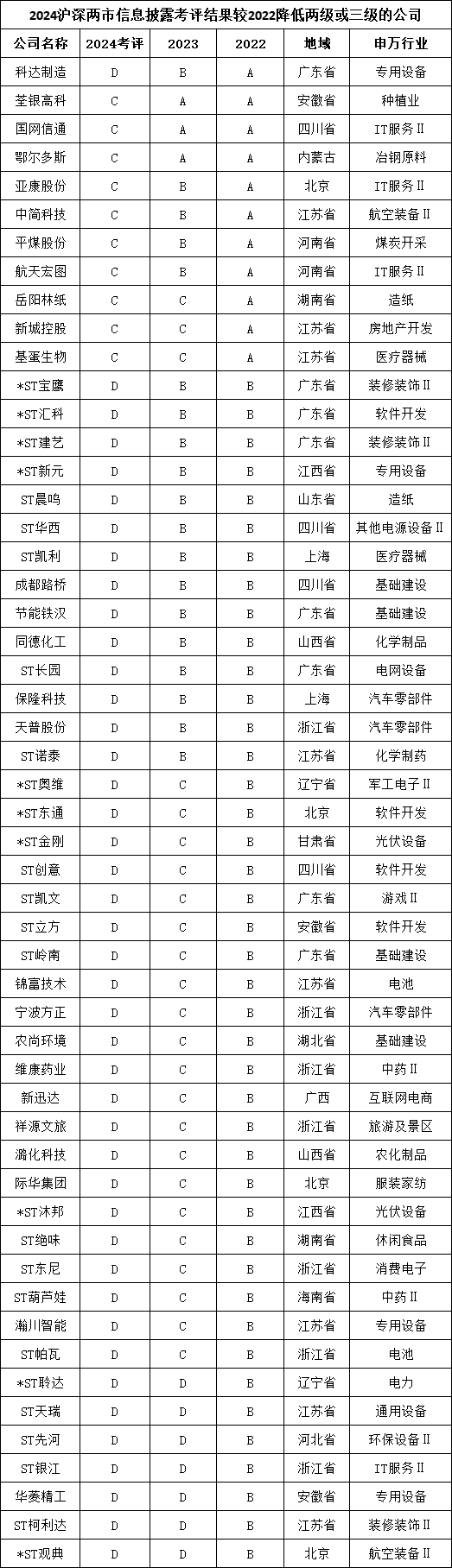
岳阳林纸信披评级两年下降两级,从A优秀降低至C合格,董秘易兰锴薪酬从69万涨至70万
Xin Lang Zheng Quan· 2025-11-06 10:57
Core Insights - The 2024 information disclosure evaluation results for listed companies show a significant decline in ratings compared to 2022, with Yueyang Lin Paper's rating dropping from A to C [1][2]. Group 1: Company Performance - Yueyang Lin Paper's information disclosure rating decreased by two levels from A in 2022 to C in 2024 [1]. - The company is located in the Hunan Free Trade Zone and was established on September 28, 2000, with its stock listed on May 25, 2004 [3]. - The main business of Yueyang Lin Paper includes the paper industry and ecological sector, with a revenue composition of 49.33% from printing paper, 22.61% from commodity pulp, and 14.55% from packaging paper [3]. Group 2: Management Information - The company’s Secretary of the Board, Yi Lankai, has served since August 27, 2019, with a salary of 690,000 in 2022, 330,000 in 2023, and 700,000 in 2024 [4]. - Yi Lankai, born in September 1978, holds a bachelor's degree and has held various positions within the company, including Deputy General Manager and General Manager Assistant [4].
岳阳林纸上半年营收44.84亿元 打造“浆纸+生态”双核驱动模式
Zheng Quan Ri Bao Wang· 2025-08-30 04:14
Group 1 - The company reported approximately 4.484 billion yuan in operating revenue and about 0.141 billion yuan in net profit attributable to shareholders for the first half of 2025 [1] - As a major domestic enterprise in cultural paper and commodity pulp, the company has a production capacity of 1.4 million tons per year for paper and 400,000 tons per year for commodity pulp [1] - The company emphasizes clean production and energy conservation, having been awarded the national "Green Factory" title [1] Group 2 - The company is expanding its market share in high-margin products such as special needle pulp and is accelerating the construction of fluff pulp and specialty pulp projects to cultivate new growth drivers [1] - In production management, the company is focusing on stabilizing and exceeding production targets, enhancing new product development, and maximizing system efficiency [2] - The company has signed contracts for carbon sink projects covering an area of 11.11 million acres and has a cumulative project reserve of 82.4679 million acres [2] Group 3 - The company is developing a standardized approach to carbon sink project development, including a manual and a smart management platform to enhance data collection and project management [2] - The company is actively exploring bio-based new materials and bioenergy to create new growth areas [2] - The company has made significant progress in project reserves and contract signings in the carbon sink business, with a steady advancement of market layout [2]