外汇研究报告

Search documents
德银推演AI终局:是“资本吃掉人类”,还是“历史重演”?
Ge Long Hui· 2026-02-27 07:35
Core Viewpoint - Deutsche Bank suggests that the discussion around AI should extend beyond concerns of job displacement, proposing two extreme outcomes of AI development [1] Group 1: Potential Outcomes of AI Development - The first outcome is "complete replacement," where AI significantly displaces human labor, leading to a scenario where wealth and income are concentrated among a few capital owners, resulting in diminished income and demand for the average person [1] - The second outcome is "historical repetition," where AI enhances efficiency without fully replacing human labor, allowing for the emergence of new jobs and the ability of policy systems to mitigate shocks, leading to a more stable economic environment with moderate inflation, interest rates, and stock market growth [1]
2026年全球外汇展望报告:美元下行 格局有变(英文版)-高盛
Sou Hu Cai Jing· 2026-01-23 22:07
Core View - The central conclusion of Goldman Sachs' 2026 Global FX Outlook is that the US dollar is expected to depreciate moderately, with a cyclical pattern in the global currency market leading to significant differentiation in currency performance [1][2]. Dollar Outlook - The report maintains the view that the relative economic advantage of the US is diminishing, which will contribute to a long-term weakening of the dollar. After a significant drop in 2025, the dollar is anticipated to stabilize due to unexpected resilience in the US economy and a slowdown in policy adjustments [2][6]. - In 2026, the dollar will face opposing forces: robust global economic growth and more balanced asset returns will exert downward pressure, while the dollar remains overvalued by approximately 15%, supported by higher-than-consensus US growth expectations [2][8]. - The expected depreciation of the dollar in 2026 will be less severe than in 2025, with pro-cyclical currencies leading the downward trend [2][10]. Major Currency Outlook - **G10 Currencies**: The euro is projected to approach fair value after leading in 2025, with expectations of EUR/USD moving towards 1.25 due to increased fiscal spending in Germany and a weaker dollar [5][34]. The Japanese yen is expected to strengthen moderately, supported by narrowing interest rate differentials, but with increased volatility [42]. The British pound is likely to continue underperforming relative to European peers due to fiscal tightening and a weak economic outlook [49][55]. - **Emerging Market Currencies**: Pro-cyclical and undervalued currencies, as well as high-yield currencies from emerging markets, are identified as key investment opportunities for 2026. The South Korean won, New Taiwan dollar, and Malaysian ringgit are expected to outperform high-yield currencies due to supportive economic conditions in China [3][5]. - **Latin America and Africa**: Currencies like the Brazilian real and South African rand are expected to gain attention due to their cyclical attributes and interest rate buffers, while the Turkish lira and Colombian peso may experience increased volatility due to political uncertainties [5][3]. Market Opportunities and Risks - Investment opportunities in 2026 will focus on pro-cyclical currencies, undervalued currencies, and high-yield emerging market currencies, with attention to cross-border M&A-related currency fluctuations [3][67]. - The report highlights that low implied volatility in the forex market may rise, providing cost advantages for directional trading [3][67]. However, risks include unexpected US economic performance, geopolitical conflicts, and policy adjustments that could lead to currency fluctuations [3][5].


【中金外汇 · 月报】美元指数能否在年初企稳
Sou Hu Cai Jing· 2026-01-04 10:04
Group 1: US Economic Data and Federal Reserve Outlook - The US economic data released in December indicates a weakening economy, leading to market skepticism about the Federal Reserve's cautious stance potentially ending sooner than expected [1] - The upcoming Federal Reserve meeting at the end of January is expected to maintain the policy interest rate unchanged unless significant downward pressure on economic data emerges [2] - The nomination of a new Federal Reserve chair could significantly impact the US dollar, with market concerns about a potentially dovish candidate [2] Group 2: RMB Exchange Rate Trends - The RMB exchange rate is projected to break the 7.0 mark by the end of 2025, driven by a weak US dollar and seasonal settlement demands [3] - In January, the RMB is expected to maintain upward momentum, supported by seasonal factors and foreign trade enterprises' hedging needs [4][6] - The RMB's appreciation may be moderated by the central bank's policies aimed at stabilizing the exchange rate [5][12] Group 3: USD Exchange Rate Predictions - The USD is forecasted to trade within a range of 96.5 to 99.5 in January, with a central tendency around 98 [25] - The USD index has shown a downward trend, influenced by weak economic data and expectations of future interest rate cuts by the Federal Reserve [26][27] - The market anticipates limited upward movement for the USD in January, particularly if upcoming labor market data continues to reflect weakness [39] Group 4: Eurozone Economic Outlook - The Eurozone's economic data showed signs of stabilization in December, with inflation trends indicating a slowdown [40][41] - The European Central Bank (ECB) maintained its interest rates in December, reinforcing market expectations that the current rate cycle has ended [49] - The Euro is expected to maintain a high-level oscillation in January, supported by the ECB's stance and the absence of further rate cuts [53]
【中金外汇 · 周报】美元受益于降息节奏的反复
Sou Hu Cai Jing· 2025-11-23 09:52
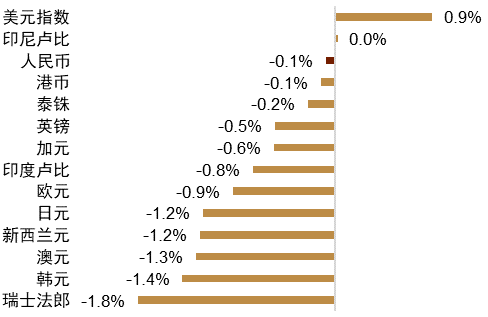
Core Viewpoint - The US dollar has regained strength, surpassing the 100 mark and recovering the 200-day moving average for the first time since early March, supported by various factors including stronger-than-expected non-farm payroll data and hawkish FOMC meeting minutes [1][28]. Group 1: US Dollar Strength - The US government ending the shutdown and the release of September non-farm payroll data exceeding market expectations have weakened the logic for the Federal Reserve to cut rates due to deteriorating employment data [1][25]. - The hawkish tone of the October FOMC meeting minutes has reinforced market expectations that the Fed will not easily cut rates again in December [1][28]. - The weakness of the Japanese yen and British pound has also provided support to the US dollar index [1]. Group 2: Performance of Non-USD Currencies - Non-USD currencies have broadly declined against the strengthening dollar, with the Swiss franc dropping 1.77%, leading the G10 currencies [2]. - The Norwegian krone, Australian dollar, and New Zealand dollar also saw significant declines of 1.59%, 1.27%, and 1.23%, respectively, amid a drop in market risk appetite [2]. - The euro and British pound experienced declines of 0.93% and 0.55%, respectively, influenced by weaker economic data [2][29]. Group 3: Market Focus and Predictions - This week, the market will focus on a series of economic data from the US, particularly PPI inflation and weekly unemployment claims, as well as China's October industrial profits [3][22]. - The market's risk appetite may continue to be volatile, especially after a significant drop in US stocks last week, which could pose a risk to the dollar's further rise [3][36]. - The predicted range for USD/CNY is between 7.09 and 7.14, with expectations for the RMB to maintain a moderately strong trend overall [3][4]. Group 4: RMB Exchange Rate Stability - The RMB showed resilience against the dollar's rise, with only a slight depreciation, while appreciating against a basket of currencies [4][11]. - The CFETS RMB exchange rate index rose by 0.4%, indicating a stable performance despite external pressures from a strong dollar [4][11]. - The RMB's demand is expected to remain balanced, supported by expectations of a moderate appreciation and seasonal factors as the year-end approaches [4][22]. Group 5: UK Economic Outlook - Recent UK economic data has confirmed a weak outlook, raising market expectations for a Bank of England rate cut, with the probability of a cut in December now around 90% [29][33]. - The UK unemployment rate rose to 5%, and retail sales data showed a significant decline, further supporting the case for a rate cut [29][33]. - The upcoming fiscal budget report may also impact the pound, with expectations of increased government borrowing potentially leading to bond market pressures [35].
美元已见底?渣打援引三大理由有力论证牛市情景!
Jin Shi Shu Ju· 2025-10-14 06:12
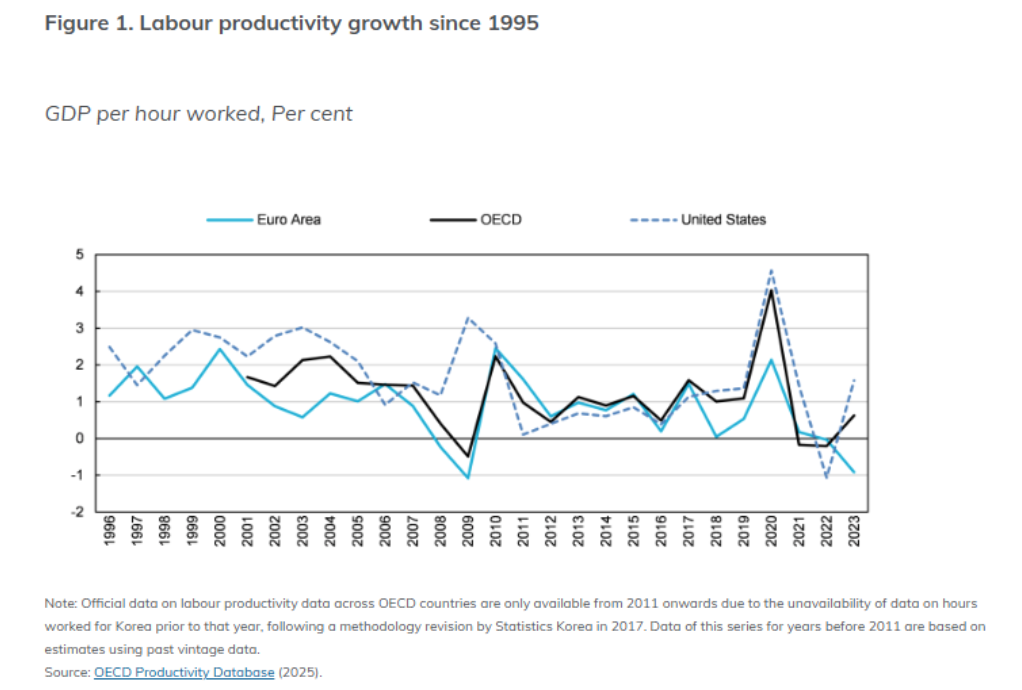
Core Viewpoint - The recent strength of the US dollar is largely attributed to the significant depreciation of the Japanese yen due to political changes in Japan, despite the overall gloomy outlook for the dollar as the Federal Reserve is expected to lower interest rates [2][3]. Group 1: Economic Factors - The US productivity growth is projected to remain strong, with a 1.6% increase in 2023, significantly higher than the OECD average of 0.6% and contrasting with a decline of 0.9% in the Eurozone [5]. - The second quarter of 2023 saw an annualized productivity growth rate of 3.3% in the US, with expectations that this could rise to 5.0% in the third quarter [8]. - The potential for a rising trend in productivity growth is linked to advancements in artificial intelligence, with the US expected to capture the largest share of the productivity benefits due to its leading position in AI, strong intellectual capital, and a flexible labor market [9][10]. Group 2: Interest Rates and Investment Climate - The report suggests that artificially lowering real interest rates could lead to economic overheating, especially as productivity improvements and profitability are already driving robust economic growth [12]. - The current US policy interest rates, adjusted for inflation, remain high by global standards, and significant aggressive rate cuts are unlikely in the short term [12]. - Concerns about the US policy's recklessness and the potential for an AI bubble are acknowledged, but the lack of attractive alternatives for capital outflow from the US is emphasized [15]. Group 3: Market Sentiment - Despite prevalent bearish sentiment towards the dollar, the situation may not be as straightforward, as the US remains a dominant player in the global economy, and the potential for a significant alternative investment option is limited [15]. - The comparison to the internet bubble of the 1990s indicates that the current market dynamics may still be in the early stages of development, suggesting that the outlook for the dollar could be more complex than commonly perceived [15].