宝来

Search documents
燃油车的困境与突围
Hua Xia Shi Bao· 2025-11-20 00:31
Core Insights - The fuel vehicle market is experiencing a structural recovery after a significant downturn, driven by price advantages and changing consumer preferences [3][4][6] - Despite the resurgence, the industry faces challenges from the rapid growth of electric vehicles and high inventory levels among dealers [2][5][9] Group 1: Market Dynamics - In 2024, over 4,400 4S dealerships closed, indicating a severe contraction in the fuel vehicle market, with a loss rate of 41.7% among dealers [1][2] - The average gross margin from new car sales for dealers is reported at -17.7%, highlighting the financial strain on fuel vehicle sales [1] - The inventory levels for some brands exceed two months, leading to increased liquidity risks for dealers [2] Group 2: Consumer Behavior - A notable shift in consumer demographics is observed, with younger buyers increasingly opting for fuel-efficient hybrid vehicles due to practical considerations [3][6][8] - Approximately 65% of fuel vehicle customers are first-time buyers, primarily in the 80,000 to 150,000 yuan price range, attracted by significant price discounts [3][4] - The trend of "multi-car households" is rising, where consumers own both electric and fuel vehicles to suit different usage scenarios [6][8] Group 3: Sales Performance - A significant increase in sales of A-class sedans and compact SUVs is noted, with A-class fuel sedans seeing a 12.3% month-on-month growth in September [4][5] - Specific models like the Nissan Sylphy and Volkswagen Lavida have surpassed sales of 20,000 units, indicating strong demand in the fuel vehicle segment [4] Group 4: Policy and Support - Government policies, such as subsidies for trade-ins and local initiatives to promote vehicle purchases, are contributing to the recovery of the fuel vehicle market [5][6] - The implementation of the National VI B emission standards is prompting manufacturers to adjust their strategies, including inventory clearance and price reductions [3][5] Group 5: Technological Advancements - The fuel vehicle sector is undergoing a technological transformation, focusing on smart features to enhance competitiveness against electric vehicles [10][12] - Major brands are investing in advanced driving assistance systems and smart cockpit experiences to attract tech-savvy consumers [12][13] - The integration of intelligent features in fuel vehicles is seen as essential for maintaining market relevance in a rapidly evolving automotive landscape [10][11][14]
一汽-大众3000万辆之后:待解自主品牌围攻考题
Bei Jing Shang Bao· 2025-11-02 13:28
Core Viewpoint - FAW-Volkswagen has become the first domestic automaker in China to achieve cumulative sales of over 30 million vehicles, marking a significant milestone in its 34-year history amidst a rapidly changing automotive market [1][4]. Group 1: Company Achievements - The launch of the FAW Audi A5L and the subsequent production of the 30 millionth vehicle highlight FAW-Volkswagen's growth from a single brand to a comprehensive matrix of three brands: Volkswagen, Audi, and Jetta, with over 30 models [1][3]. - Since its establishment in 1991, FAW-Volkswagen has expanded its production capabilities, with five major manufacturing bases and an annual production capacity of 2.55 million vehicles [3][4]. - The company achieved the milestone of 10 million vehicles in 2014 and 20 million in 2020, reaching 30 million just five years later, demonstrating its strong market performance [4]. Group 2: Market Challenges - The Chinese automotive market is undergoing significant changes, with the rise of new energy vehicles (NEVs) and increased competition from domestic brands like BYD, which has surpassed FAW-Volkswagen in sales [5][6]. - In 2022, the mainstream joint venture market saw a decline in new car retail sales by 15.7%, with FAW-Volkswagen facing pressure despite being a leading joint venture brand [5][6]. - In September, FAW-Volkswagen's wholesale volume was 143,000 units, a year-on-year decline of 3.8%, indicating the competitive pressures it faces in the market [6]. Group 3: Future Strategies - FAW-Volkswagen aims to achieve an annual sales target of 2 million vehicles, with plans to launch nearly 30 new products in the next five years, including over 20 new energy models [8][9]. - The company has signed a strategic cooperation agreement to introduce 11 new models tailored for the Chinese market, including six pure electric vehicles [9][10]. - Investment of approximately 10 billion yuan annually will be directed towards research and development, focusing on smart driving and software innovations, with a goal to significantly reduce project development cycles [10].

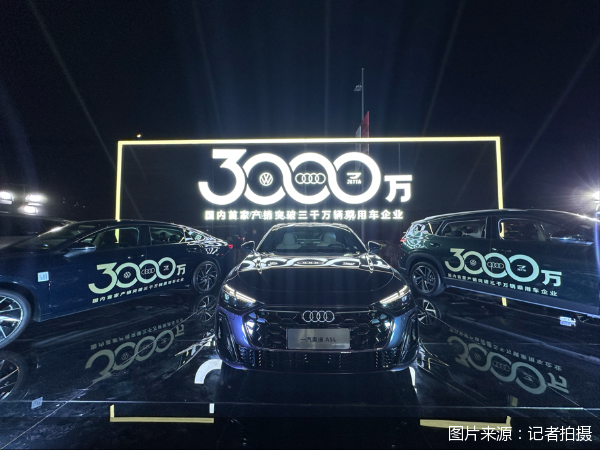
站在3000万辆起点,看中欧合作新时代
Guan Cha Zhe Wang· 2025-10-31 09:28
Core Insights - FAW-Volkswagen has achieved a significant milestone by producing its 30 millionth vehicle, the Audi A5L Pilot Edition, becoming the first passenger car manufacturer in China to surpass this production figure [1][3] - The achievement highlights China's robust market potential and the deep cooperation between Chinese and German automotive industries, reflecting a favorable business environment in China [3][5] Company Milestones - FAW-Volkswagen was established in 1991 as a joint venture between China FAW Group and Volkswagen AG, with the first vehicle, the Jetta A2, rolling off the production line in December of the same year [5] - The company reached the 1 million vehicle production mark in 2004, achieving this milestone in just 13 years [5] - By 2014, FAW-Volkswagen's production and sales exceeded 10 million units, marking a rapid growth from 1 million to 10 million in under a decade [5] Future Strategy - FAW-Volkswagen plans to accelerate its transformation in response to the electric and intelligent vehicle trends, facing increased competition in the automotive market [7] - A strategic cooperation agreement was signed in March 2023, focusing on new vehicle planning and accelerating the transition to electric and intelligent vehicles [7] - The company aims to introduce 11 new models tailored for the Chinese market by 2026, including 6 pure electric vehicles, 2 plug-in hybrids, 2 range-extended models, and 1 fuel vehicle [7][9] Product and Innovation Focus - FAW-Volkswagen will implement a "hybrid and electric co-prosperity" strategy, launching nearly 30 new products in the next five years, with over 20 being new energy vehicles [9] - The company will maintain an annual R&D investment of nearly 10 billion, focusing on intelligent driving and software innovations [9] Operational and Cultural Development - FAW-Volkswagen is exploring new localized operational models for the Jetta brand, leveraging local resources to enhance brand and product offerings [9] - The company has introduced a new corporate culture, emphasizing high-quality development and a commitment to customer-centric long-termism [10][12]
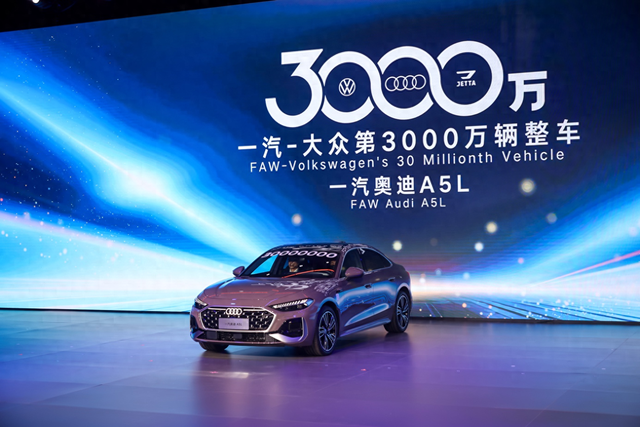
时光相册|34年,3000万辆!这本相册也是时代的缩影
Xin Hua Wang· 2025-10-30 15:42
Core Points - FAW-Volkswagen has achieved a significant milestone by producing its 30 millionth vehicle, an Audi A5L, marking it as the first passenger car manufacturer in China to surpass this production figure [3][36] - The company has evolved over 34 years, starting from the production of its first vehicle, the Jetta, in 1991, to becoming a symbol of China's automotive industry growth and international cooperation [3][27] Group 1 - The 30 millionth vehicle was unveiled in Changchun, Jilin, on October 30, 2025, highlighting the company's extensive production history [3][36] - FAW-Volkswagen's journey began with the establishment of the company in February 1991, leading to the first Jetta rolling off the assembly line in December of the same year [4][6] - The Jetta has been a significant part of many families' lives in China, representing an accessible entry into car ownership for many [6][15] Group 2 - The company has transitioned from manual assembly to automated production lines, achieving 100% automation in welding processes, which signifies advancements in precision, efficiency, and environmental standards in Chinese automotive manufacturing [18][27] - FAW-Volkswagen has created over 500,000 jobs and contributed more than 730 billion yuan in taxes, showcasing its economic impact [27] - The collaboration between German engineering and the dynamic Chinese market has led to the establishment of five major production bases across the country [27][28]
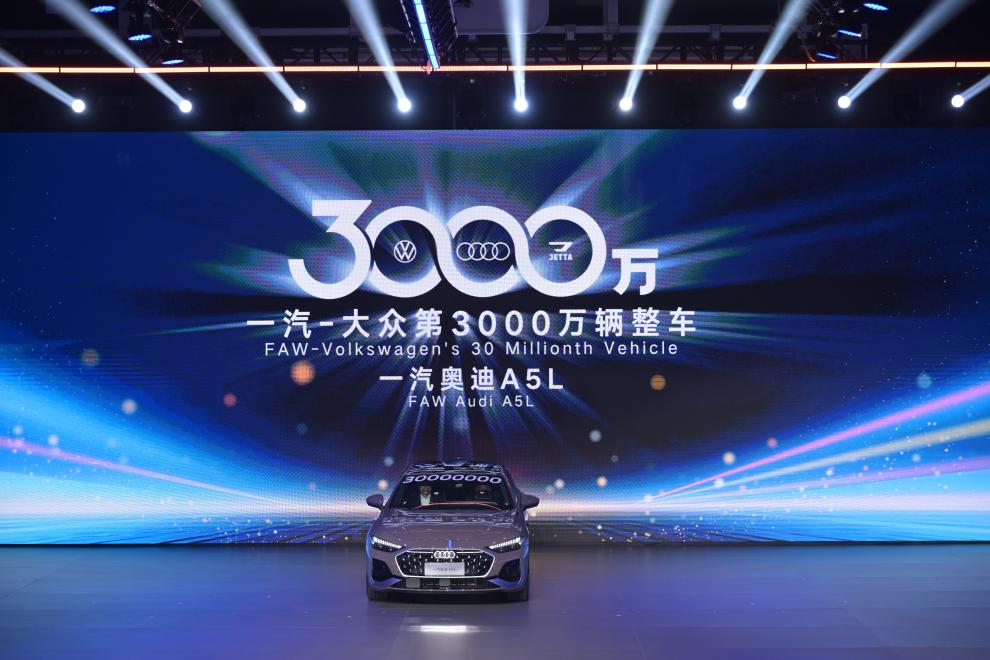
一汽-大众3000万辆整车即将下线 成国内首家达成乘用车企
Zhong Guo Jing Ying Bao· 2025-10-29 10:40
Core Insights - FAW-Volkswagen is set to achieve the milestone of producing its 30 millionth vehicle on October 30, becoming the first passenger car manufacturer in China to reach this achievement [1] - The company has evolved from a single brand and model in 1991 to a comprehensive lineup of 33 models across three brands: Volkswagen, Audi, and Jetta, including both fuel and new energy vehicles [1] - Volkswagen has played a significant role in transforming China's automotive market from a "scarcity era" to a "popular era" with its classic models like Jetta and Bora [1] - Audi has pioneered the high-end car market in China, introducing innovations such as the extended wheelbase A6 (C5) in 1999 and is now focusing on smart luxury vehicles with the launch of the Q6L e-tron [1] Brand Developments - The Jetta brand has transitioned from a classic model to an independent brand, emphasizing German quality, and is launching the new mid-size SUV VS8, which has gained popularity for its high-quality design and comprehensive safety features [2] - Jetta plans to establish a new company to accelerate its transition towards new energy and intelligent vehicles, with a goal to introduce four new energy models by 2028 [2]
3000万辆背后,一汽-大众树立合资合作新典范
Zhong Guo Qi Che Bao Wang· 2025-10-28 01:55
Core Insights - FAW-Volkswagen is set to celebrate the production of its 30 millionth vehicle on October 30, marking it as the first passenger car manufacturer in China to achieve this milestone [1][3] - The company has evolved from a single brand with one model to a comprehensive lineup of 33 models across three brands: Volkswagen, Audi, and Jetta, including both fuel and new energy vehicles [1][3] Industry and Company Development - FAW-Volkswagen has played a pivotal role in the deep integration of the Chinese and German automotive industries, introducing advanced manufacturing systems and localizing project management [3][6] - The company has contributed significantly to the modernization of China's automotive industry by adopting global standards and management practices, enhancing operational efficiency [6][8] Economic Contributions - With annual sales exceeding 1.6 million vehicles, FAW-Volkswagen has generated over 5.5 trillion yuan in cumulative revenue and contributed more than 730 billion yuan in taxes over 34 years, supporting over 500,000 jobs in the supply chain [6][8] - The strategic layout of its manufacturing bases in five cities has not only upgraded local manufacturing but also stimulated the regional economy [6][8] Green Initiatives - All six of FAW-Volkswagen's factories have been established as "waste-free factories," with two achieving near "zero carbon" standards, showcasing the company's commitment to sustainable development [8] Product and Market Evolution - The Volkswagen brand has been instrumental in transitioning Chinese consumers from a scarcity to a more widespread automotive market, with models like the Jetta and Bora leading the way [9][11] - Audi has pioneered the luxury car market in China, introducing innovations such as extended wheelbases and advanced electronic architectures, while Jetta is transitioning to a standalone brand with plans for new energy vehicles [11][13] Future Outlook - FAW-Volkswagen is poised to continue its journey in the automotive industry, focusing on innovation and practical efforts to contribute to the high-quality development of China's automotive sector [13]

从“开创者”到“引领者”,一汽-大众3000万辆背后的价值共创逻辑
Zhong Guo Jing Ji Wang· 2025-10-21 08:58
Core Insights - FAW-Volkswagen has achieved a significant milestone by producing its 30 millionth vehicle, becoming the first passenger car manufacturer in China to reach this achievement, reflecting its leadership in the industry [1][2][12] - The company has evolved from a single brand with one model to a comprehensive portfolio that includes three brands (Volkswagen, Audi, and Jetta) and 33 models, showcasing its commitment to technological advancement and quality [1][2] Historical Development - Established in 1991, FAW-Volkswagen was the first modern passenger car manufacturer in China, introducing international technology and management practices to the domestic market [2][4] - Over 34 years, the company has expanded its manufacturing capabilities across five major bases in China, transitioning from a single model to a diversified product range that covers various market segments [2][4] Economic Impact - FAW-Volkswagen has significantly contributed to the automotive industry by creating over 500,000 jobs in the supply chain and paying more than 730 billion yuan in taxes [4] - The company has engaged over 1,900 upstream suppliers and 1,500 downstream dealers, demonstrating its extensive influence on the automotive ecosystem [4] Technological Advancements - The company has transitioned from technology importation to independent innovation, establishing rigorous research and development standards that have led to successful models like the Jetta [5][7] - FAW-Volkswagen is actively developing core technologies for electric and intelligent vehicles, including a new SOA electronic architecture and hybrid engines, positioning itself for future market leadership [8][10] Future Strategy - Starting in 2026, FAW-Volkswagen plans to launch 11 new models tailored for the Chinese market, including six electric vehicles, indicating a strong commitment to electrification [10] - The company aims to enhance its international presence, with its first batch of vehicles set to enter the Middle Eastern market, marking a significant step in its global expansion strategy [12]
青岛汽车产业全域突围
Qi Lu Wan Bao· 2025-09-25 23:36
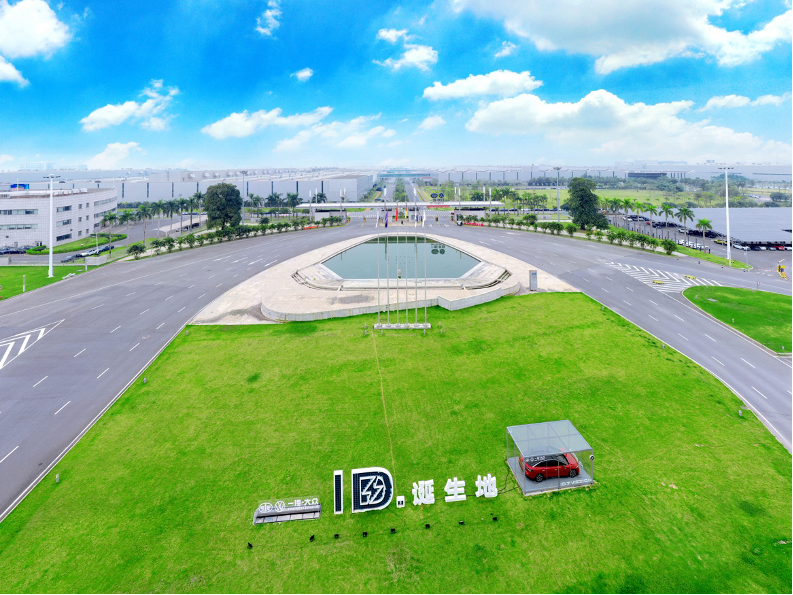
Core Viewpoint - Qingdao is positioning itself as a leader in the automotive industry, particularly in the field of smart connected new energy vehicles, as part of its "10+1" innovative industrial system [1] Group 1: Overall Layout - Qingdao's automotive industry has developed a multi-point layout with distinct characteristics, with Jimo District being the most concentrated area, housing major production bases [2] - In 2024, Jimo's automotive industry is expected to produce over 450,000 vehicles, with new energy vehicles accounting for over 20% [2] - Qingdao has 8 qualified vehicle manufacturers and over 300 automotive enterprises, establishing a complete industrial chain [2] Group 2: Jimo Cluster - Jimo District is the core area of Qingdao's automotive industry, with a significant cluster effect, achieving a vehicle output value of 36.877 billion yuan in the first half of 2025, a year-on-year increase of 8.5% [3] - Chery Automobile has emerged as a leader in Jimo, surpassing FAW-Volkswagen and FAW Jiefang in production for the first time in 2024 [3] - FAW Jiefang produced 72,200 vehicles in the first half of 2025, with a value of 23.849 billion yuan, reflecting a year-on-year growth of 9.22% [3] Group 3: Supporting Efforts - Qingdao is building a collaborative automotive industry chain across the city, with Jimo District focusing on attracting component manufacturers [4] - Jimo aims for a local matching rate of over 40% for core components by 2025, while also enhancing the introduction of key components [4] - The establishment of the Qinfeng Automotive Component Industrial Park is a response to the demand for automotive parts [4] Group 4: New Energy Transition - The rise of new energy vehicles is a key variable for Qingdao's automotive industry, with Chery producing over 92,700 new energy vehicles in 2024, accounting for more than half of the city's total [6] - FAW Jiefang has been focusing on new energy since 2021, with plans for a micro commercial vehicle project that allows for the production of both fuel and new energy vehicles [6] - The West Coast New Area is also actively planning the introduction of new energy vehicle models [6] Group 5: Technological Breakthroughs - Innovations in lightweight materials and new technologies are enhancing the value of automotive products, with FAW Jiefang's new model achieving a weight reduction of 400 kg [7] - Local suppliers are supporting these innovations, with companies like Qingdao Yuyuan New Materials becoming key suppliers for major manufacturers [7] - Qingdao Lind Technology is focusing on lightweight components for new energy commercial vehicles, planning significant R&D investments [7] Group 6: Challenges and Future - The automotive industry in Qingdao is on a growth trajectory, but faces challenges such as the need for improved local matching rates and accelerated transitions to smart connected new energy vehicles [8] - The city aims to leverage regional advantages for collaborative development, targeting a vehicle output of over 1.3 million by 2027, with new energy vehicles making up over 40% [9] - The automotive industry is advancing through comprehensive layout, vehicle-driven growth, supporting follow-ups, new energy transitions, and technological innovations [9]