
宠物健康产品

Search documents
一年2415家海外企业开出首店,中国仍是全球品牌“试金石”
Huan Qiu Wang· 2026-01-28 11:56
Core Insights - The article highlights the structural changes in the entry of overseas brands into the Chinese consumer market, reflecting the evolving landscape of import consumption in China [2] Group 1: Brand Entry Strategies - The concept of "first store economy" is shifting from physical locations in key urban areas to online platforms, with e-commerce becoming the primary entry point for many overseas brands, especially smaller ones [2] - By establishing "online first stores," brands can conduct market testing and channel development at a lower cost, facilitated by platforms like Tmall International that provide essential infrastructure [2] - In 2025, brands from 52 countries are expected to enter China through this method, with the highest numbers from the US (555 brands) and South Korea, while countries like Cuba and Chile are also making their debut [2] Group 2: Competitive Strategies - New brands are increasingly focusing on niche markets rather than mass-market products, with health, beauty, and maternal and infant categories being the most attractive [3] - In the health sector, "precision nutrition" and "oral anti-aging" are emerging as key areas for new brand entries, while the maternal and infant sector sees a 128% increase in new baby food brands, indicating a growing demand for specialized dietary needs [3] - The beauty sector is witnessing a shift as overseas brands pivot towards personal care products, with a 37% increase in new personal care brands, many focusing on hair care [3] Group 3: Consumer Behavior Trends - The fastest-growing imported categories in 2025 include toys, outdoor gear, baby food, fashion cosmetics, and pet health, all showing growth rates exceeding 100% [4] - The growth in toy-related products is driven by fan economy and emotional consumption, while outdoor gear growth correlates with the rise of leisure lifestyles in China [5] - The high growth rates in baby food and pet health reflect families' increasing demand for quality in these areas, where imported brands hold a recognition advantage [5] Group 4: Platform Evolution - E-commerce platforms are evolving from mere entry points to providing operational support for overseas brands, as seen with Korean brands on Tmall International [7] - In 2023, eight of the top ten Korean brands by sales on Tmall International were beauty brands, but the platform is guiding these brands to diversify into apparel and other categories [7] - The structural shift in Korean brands from a beauty-centric focus to a broader distribution across various categories is supported by market insights and resources provided by the platform [7] Group 5: Market Attractiveness - The continuous entry of overseas brands is based on the stable demand from Chinese consumers for certain imported categories, particularly in health, maternal, and pet sectors [8] - Improved e-commerce infrastructure has lowered the cost for brands to test the market, allowing smaller brands to enter with manageable risks [9] - The segmentation and differentiation of the Chinese consumer market provide opportunities for brands with varying positioning, as evidenced by the growth of online first stores on Tmall International [10]

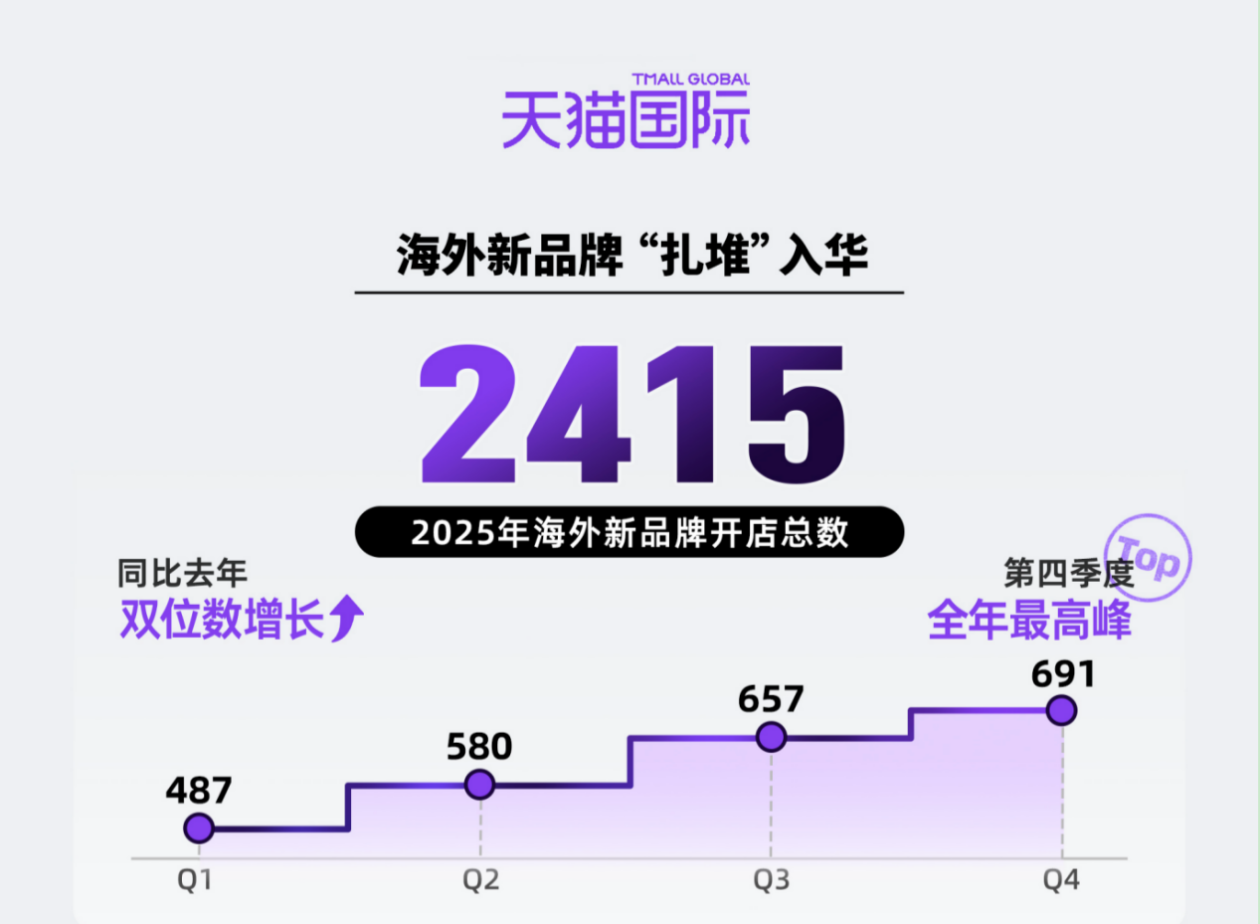
2415个海外新品牌在天猫国际开出中国首店
Xin Lang Cai Jing· 2026-01-27 03:41
Core Insights - Tmall International is set to welcome 2,415 new overseas brands in 2025, indicating a double-digit growth in the number of first stores opened, averaging over 6 new brands daily [1][3] - The top three new imported brands for 2025 include the South Korean fashion brand COVERNAT, the Australian nutrition brand herbs of gold, and the South Korean celebrity merchandise brand Weverse Shop [1][3] - The new brands span 52 countries and regions, with the highest number coming from the United States, Japan, and South Korea, while France, New Zealand, and Australia show the fastest growth [1][3] Industry Trends - The most concentrated influx of new overseas brands is in the health, beauty, and maternal and infant sectors, with the maternal and infant industry seeing a 128% increase in new brands, particularly in the baby food segment [1][3] - The fastest-growing categories in terms of transaction volume over the past year include toys, outdoor equipment, baby food, fashion cosmetics, and pet health, all of which have doubled in growth, reflecting consumer preferences for quality imports and family-oriented products [1][3] Brand Expansion - Tmall International currently hosts over 40,000 brands from more than 110 countries and regions, indicating a significant global reach and brand diversity [2][4]

跨境电商运营:2024中国宠物产业出海分析报告
Sou Hu Cai Jing· 2025-06-27 13:19
Core Insights - The report highlights the rapid expansion of China's pet industry in the international market, with exports reaching $5.8 billion in 2023 and projected to exceed $6.5 billion in 2024, driven primarily by pet food, which accounts for 55% of exports [1] - The United States remains the largest market for pet products, holding a 40% share of the global pet market, with a household penetration rate of 70% [1][26] - Emerging markets such as Southeast Asia and Latin America show significant growth potential, with Indonesia's pet market expected to grow from $2.3 billion in 2023 to $5.9 billion by 2033 [1][44] Industry Overview - The global pet products market was valued at $261 billion in 2022 and is expected to reach $350 billion by 2027, with a compound annual growth rate (CAGR) of approximately 6.1% [10] - The U.S. pet market is projected to reach $80.69 billion in 2024, with pet food and treats accounting for $64.41 billion of that total [26] - In Europe, the pet market is also substantial, with a total value of approximately €29.2 billion, indicating strong demand for pet products [30] Export Overview - China's pet product exports have shown consistent growth, with a peak of $4.39 billion in 2022, followed by a slight decline to $3.96 billion in 2023 [13] - The main export categories include pet food, toys, clothing, and care products, with a complete supply chain from raw materials to logistics [14] - The U.S., Germany, and the UK are the primary destinations for Chinese pet food exports, with significant growth rates observed in these markets [17] Market Analysis - The North American market is a major driver for pet e-commerce, with platforms like Chewy and PetSmart leading the way [24] - In Europe, there is a strong emphasis on high-quality and natural products, with German platforms like Zooplus setting market trends [24] - The Asia-Pacific region, particularly China, is witnessing rapid growth in pet e-commerce, driven by platforms like JD and Taobao [24] Competitive Landscape - Chinese pet companies possess advantages such as cost efficiency, manufacturing capabilities, product innovation, and e-commerce experience [22] - Challenges include insufficient brand influence, quality control issues, and regulatory barriers in foreign markets [22] - Opportunities arise from the growing global pet market, diverse consumer demands, and the rise of digital marketing [23]

澳大利亚华商:一直视中国为亚太地区重要战略市场
Zhong Guo Xin Wen Wang· 2025-06-26 16:35
Core Viewpoint - Homart Group views China as a key strategic market in the Asia-Pacific region and is increasing its investment in the Chinese market [1][2] Group 1: Company Overview - Homart Group, established in 1992, focuses on the health and nutrition sector and has multiple cGMP-certified production bases in Australia and New Zealand [2] - The company has obtained various international certifications, including TGA, FDA, halal, and organic production [2] - Homart is preparing for a listing on the Australian Securities Exchange to seek broader international cooperation opportunities [2] Group 2: Market Engagement - Homart participated in the 15th China International Health Products Expo, showcasing Australia's latest achievements in health products and promoting deeper cooperation between China and Australia [1] - The expo is a significant platform for the health and nutrition industry in the Asia-Pacific region, attracting global enterprises and professionals [1] - During the expo, Homart engaged in brand exchange sessions and trade matching activities, discussing product compliance, channel cooperation, and market trends with Chinese enterprises and institutions [2] Group 3: Market Trends - The demand for high-quality nutrition and health products in China is continuously growing as the country accelerates its health initiatives [2] - Australia is recognized as a major exporter of health products, possessing advantages in quality regulation and product development [2] - The potential for cooperation between China and Australia in the health sector is increasingly being realized [2]
“硬科技”“好产品”搭桥梁 中国与中东欧国家共建互利合作新范式
Zheng Quan Shi Bao· 2025-05-23 21:16
Group 1 - The Fourth China-Central and Eastern European Countries Expo and International Consumer Goods Expo was held from May 22 to 25 in Ningbo, Zhejiang Province, serving as a high-level economic and cultural event to enhance practical cooperation between China and Central and Eastern European countries [1] - The expo has become an "accelerator" for pragmatic cooperation, focusing on "hard technology" and "good products," with Chinese and Central and Eastern European enterprises exploring multi-layered and multi-field collaborations [1] - A notable exhibit was the large-space VR amusement park from Hungary's VR PARK, which aims to attract Chinese consumers by offering a unique VR experience distinct from common VR setups found in malls [1][2] Group 2 - The large-space VR project is successfully promoted in cities like Ningbo and Yangzhou, with plans to expand to 10 cities this year, targeting the younger generation, particularly Gen Z [2] - The centerpiece of the expo was the HEMEP hybrid multi-engine aircraft, the world's first multi-engine hybrid aircraft developed by Austria's Diamond Aircraft, which has been fully acquired by China's Wan Feng Group [2] - Wan Feng Group aims to become a global leader in general aviation manufacturing, having established four aircraft manufacturing bases and three design and R&D centers worldwide, with services in 90 countries [2] Group 3 - During the expo, a procurement signing event resulted in contracts totaling 2.49 billion yuan, covering various products including minerals, pet health products, and ski equipment [3] - A significant partnership was formed between Ningbo Free Trade Zone and Serbia's Vetplanet, agreeing to import pet health products worth 80 million yuan annually over three years, totaling 240 million yuan [3] - The collaboration is seen as a bright spot in the domestic pet health market, emphasizing the importance of product safety and efficacy, supported by compliance and testing from authoritative institutions [3]

2025年宠物电商市场分析报告
Ren Tuo· 2025-04-15 06:37
Investment Rating - The report indicates a strong growth potential in the pet consumption market, projecting a market size to exceed 300 billion yuan by 2025, with a compound annual growth rate (CAGR) of approximately 18.5% from 2020 to 2025 [13][15][16]. Core Insights - The pet consumption market is experiencing a shift from basic needs to more refined demands, with consumers increasingly prioritizing quality and health in pet food and products [22][24][32]. - E-commerce in the pet sector has shown consistent growth over the past five years, with domestic brands leading the new consumption landscape [25][28]. - The report highlights a significant increase in pet ownership, particularly among urban households, contributing to the rising market penetration rates for pet dogs and cats [15][18]. Market Overview - The overall market size for pet consumption is projected to reach 300 billion yuan by 2025, with a notable increase in household penetration rates for pet dogs and cats [15][16]. - The pet food segment is witnessing a transition from basic sustenance to premium offerings, reflecting a growing consumer awareness regarding pet health and nutrition [22][32]. E-commerce Growth - The pet e-commerce market has been growing at a CAGR of 9%, with a notable increase in the share of domestic brands [25][28]. - The online sales of pet products are expected to continue their upward trajectory, driven by changing consumer preferences and the convenience of e-commerce platforms [25][28]. Pet Food Insights - The pet food market is evolving, with a focus on high-quality ingredients and specialized diets tailored to different life stages of pets [22][73]. - The demand for functional pet foods is increasing, with consumers looking for products that address specific health concerns [61][111]. Health and Wellness Trends - The pet health market is mirroring human health trends, with a focus on preventive care and wellness products [94][99]. - There is a growing demand for specialized health products, including supplements and veterinary care items, reflecting a shift towards proactive pet health management [99][105]. Pet Products Market - The pet products market is being reshaped by a trend towards emotional and experiential purchases, with consumers willing to invest in products that enhance their pets' quality of life [126][153]. - Categories such as pet cleaning supplies and home products are seeing significant growth, indicating a diversification of consumer needs [126][130]. Consumer Behavior - Pet owners are increasingly concerned about the safety and quality of pet food, with ingredient transparency becoming a key decision factor [55][58]. - The emotional bond between pets and owners is driving demand for products that enhance the pet ownership experience, including toys and accessories [153][167].