
富国港股通互联网ETF

Search documents
千亿资金 流入
Shang Hai Zheng Quan Bao· 2026-02-25 14:48
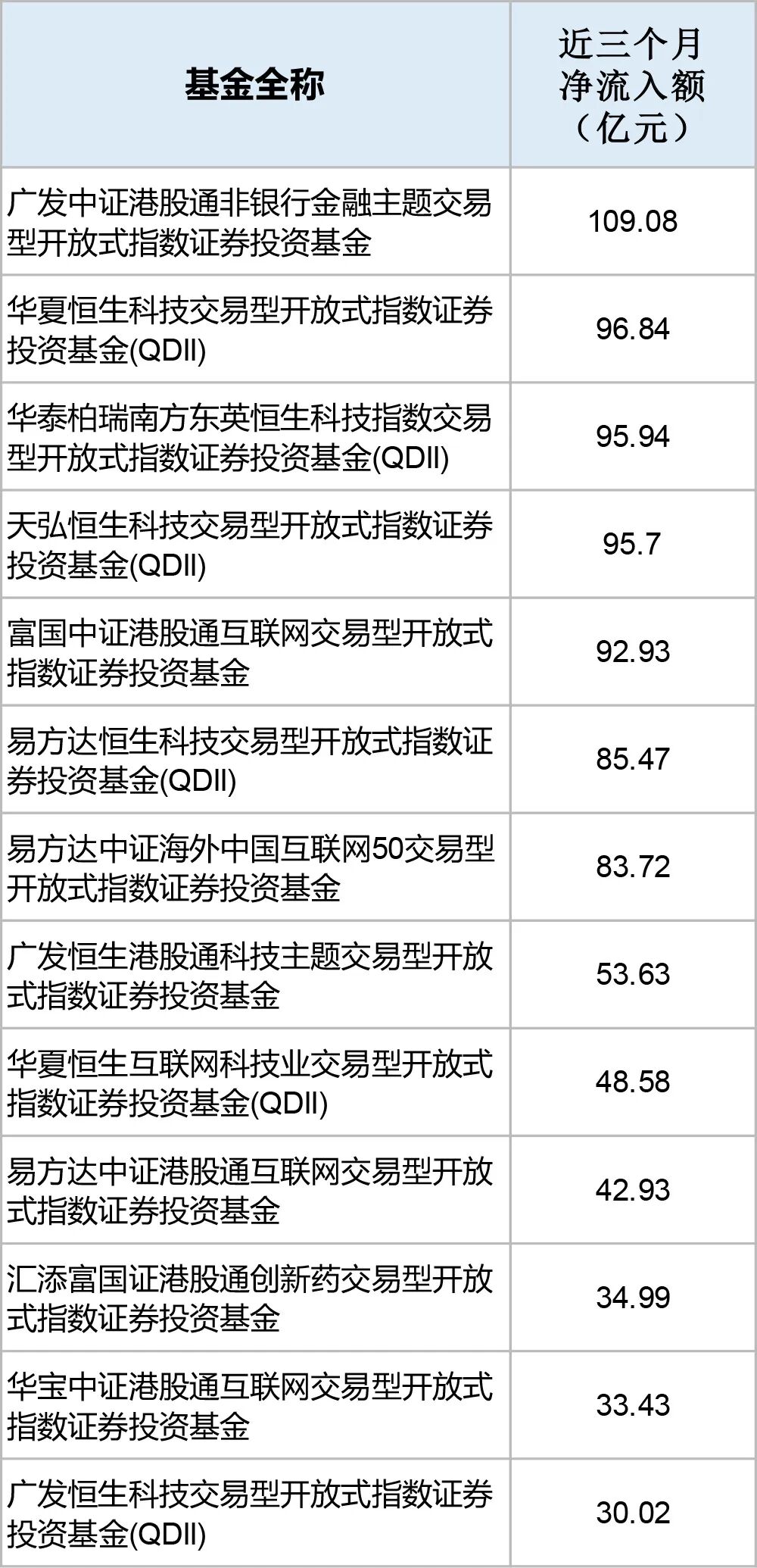
Group 1 - Significant capital inflow into Hong Kong thematic ETFs, with nearly 10 billion yuan net inflow on February 24, focusing on technology ETFs [1][2] - Over the past three months, net inflow into Hong Kong thematic ETFs exceeded 100 billion yuan [1] - Multiple Hong Kong technology thematic ETFs reached historical highs in terms of shares, with notable inflows into various funds [2] Group 2 - Specific funds with substantial net inflows over the past three months include: - GF CSI Hong Kong Stock Connect Non-Bank Financial Theme ETF: 10.91 billion yuan - Huaxia Hang Seng Technology ETF: 9.68 billion yuan - Haitong Southbound Hang Seng Technology ETF: 9.59 billion yuan - Tianhong Hang Seng Technology ETF: 9.57 billion yuan - Fortune CSI Hong Kong Stock Connect Internet ETF: 9.29 billion yuan [3][4] - New products focused on Hong Kong thematic ETFs are being launched, primarily targeting the technology sector [5] - Analysts suggest that the current valuation of the Hang Seng Technology Index is at a historically low level, indicating potential for recovery [5][6]

多路资金逆势加仓 跨境ETF规模重返万亿元
Shang Hai Zheng Quan Bao· 2026-02-12 17:42
Core Insights - The cross-border ETF market has reached a scale of 1 trillion yuan as of February 11, with Hong Kong-themed ETFs accounting for 822.51 billion yuan [1][2] - There has been a net inflow of 54.43 billion yuan into Hong Kong-themed ETFs this year, indicating strong investor interest despite market adjustments [1][4] - The number of cross-border ETFs has significantly increased, with 214 listed as of February 12, compared to 138 at the end of 2024 [2] Group 1: Market Growth - The cross-border ETF market first surpassed 1 trillion yuan on January 12, but has seen fluctuations since then [2] - The number of cross-border ETFs exceeding 10 billion yuan has grown from 11 at the beginning of 2025 to 26 as of February 11 [2] Group 2: Fund Inflows - Significant capital has flowed into Hong Kong-themed ETFs, with over 500 billion yuan entering the market this year [1][4] - Specific ETFs such as the Fortune Hong Kong Internet ETF and Huatai-PB Southern East England Hang Seng Technology ETF have seen substantial net inflows of 69.96 billion yuan and 68.63 billion yuan, respectively [4] Group 3: Institutional Insights - Public funds have been increasing their allocations to Hong Kong-themed ETFs, with nearly 30 new index funds reported this year [5] - Analysts suggest that the recent adjustments in the Hang Seng Technology Index may stabilize, as valuations are at historically low levels, and there are signs of recovery in the technology sector [6]
恒生科技指数近5日净流入超69亿元
Jin Rong Jie· 2026-02-05 06:48
Group 1 - The Hang Seng Tech Index has shown a "buying on dips" trend, with a net inflow of over 6.9 billion yuan in the past five days, making it the highest among all market indices [1] - Since the fourth quarter of last year, the Hang Seng Tech Index has declined nearly 20%, yet there has been a notable trend of capital accumulation during this period [1] - On February 4, the net inflow for the Hang Seng Tech Index reached 2.884 billion yuan, leading the stock ETF market [1] Group 2 - The top fund companies have demonstrated significant capital attraction, with the Huaxia Fund's Hang Seng Tech Index ETF seeing a net inflow of 1.021 billion yuan, bringing its latest scale to 50.914 billion yuan [1] - The Fuguo Hong Kong Internet ETF has recorded a net inflow of 6.709 billion yuan, while the Huatai-PineBridge Southern Eastern Hang Seng Tech ETF has seen a net inflow of 5.087 billion yuan [1] - Southbound funds have also increased their investments, with a total net purchase of 13.373 billion HKD through the Hong Kong Stock Connect on February 4 [1]
基金早班车丨千亿港股ETF现身,公募南下布局再提速
Jin Rong Jie· 2026-01-28 00:36
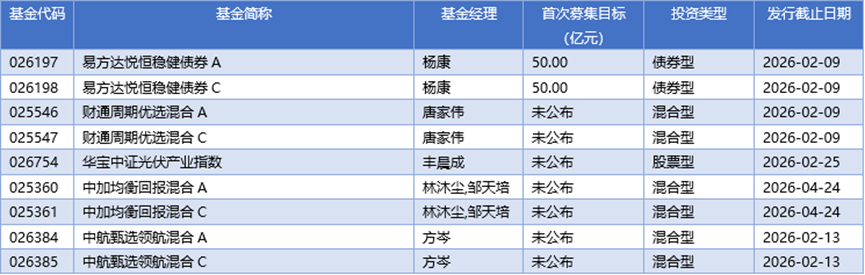
Group 1 - Hong Kong stocks have become a core battleground for public offerings at the beginning of the year, with 26 new Hong Kong stock-themed products reported since 2026, focusing on technology, pharmaceuticals, and cyclical sectors [1] - Hong Kong-themed ETFs have seen a net inflow of nearly 30 billion yuan this year, with the Fuguo Hong Kong Stock Connect Internet ETF being the first to exceed 100 billion yuan in assets [1] - The combination of low valuations and favorable policies is expected to lead to continued inflows of southbound capital, accelerating the expansion of Hong Kong's financial products [1] Group 2 - On January 27, a total of 9 new funds were launched, primarily mixed and bond funds, with the E Fund Yueheng Stable Bond A aiming to raise 5 billion yuan [2] - In the context of A-share market fluctuations, stock ETFs have seen significant trading volume, with a noticeable shift in funds; the CSI 300 ETF and the CSI 1000 ETF experienced net outflows of 336.9 billion yuan and 78 billion yuan respectively [2] - Meanwhile, resource and technology sector-themed ETFs have attracted a combined net inflow of 158.5 billion yuan, indicating a shift from broad-based to high-growth sector investments [2] Group 3 - China Life recently announced plans to establish a pension industry fund and a Yangtze River Delta private equity fund, with a total subscription scale of nearly 12.5 billion yuan [2] - Insurance capital has been increasingly allocated to private equity and other equity assets, with regulatory encouragement for long-term capital entering the market, leading to a diversified investment approach [2]
净流出,超400亿元!
Zhong Guo Ji Jin Bao· 2026-01-20 06:22
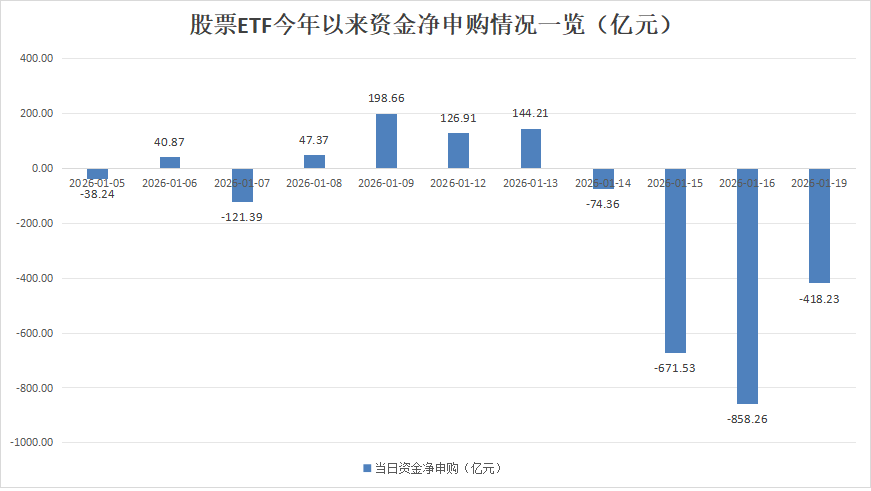
Core Viewpoint - The stock ETF market experienced significant net outflows, exceeding 400 billion yuan on January 19, marking the third consecutive day of substantial outflows, totaling over 1.9 trillion yuan in the past three trading days [1][2]. Group 1: Market Performance - The A-share market continued its volatile trend, with the Shanghai Composite Index rising by 0.29% to 4114.00 points, while the CSI 300 Index increased by 0.05% [2]. - Trading volume in the Shanghai and Shenzhen markets decreased to 2.73 trillion yuan, with weaker performance from large-cap stocks and stronger performance from growth-style sectors [2]. Group 2: ETF Fund Flows - The total scale of all stock ETFs (including cross-border ETFs) reached 4.61 trillion yuan, with a net outflow of 418.23 billion yuan on January 19 [2]. - Industry and commodity ETFs saw net inflows of 155.04 billion yuan and 22.44 billion yuan, respectively, while broad-based ETFs experienced net outflows of 586.07 billion yuan, leading to a decrease in their scale by 694.95 billion yuan [4]. Group 3: Specific ETF Performance - The top net inflows were observed in industry ETFs, with the Huaxia Electric Grid Equipment ETF leading at over 25 billion yuan, followed by the Penghua Chemical ETF with over 11 billion yuan [6]. - Four major CSI 300 ETFs collectively saw net outflows exceeding 300 billion yuan, with the Southern CSI 1000 ETF experiencing over 50 billion yuan in outflows [5][6]. Group 4: Market Sentiment and Outlook - Analysts noted that the recent net outflows from broad-based ETFs have contributed to a cooling effect on the previously hot market, aiding in the stable operation of the A-share market [7]. - The market is expected to maintain a volatile pattern in the short term, with potential support from funds adjusting their positions, while long-term sentiment remains optimistic [7].
近三个交易日权益类ETF净申购额超470亿元
Sou Hu Cai Jing· 2026-01-15 00:50
Group 1 - The total net subscription amount for equity ETFs from January 9 to January 13 reached 47.303 billion yuan [1] - Popular thematic ETFs saw significant interest, with the GF Media ETF net subscription amounting to 7.064 billion yuan, the Yongying Satellite ETF at 4.901 billion yuan, and the Southern CSI 1000 ETF at 4.193 billion yuan [1] - Other ETFs such as the Southern Nonferrous Metals ETF, Harvest Software ETF, and Fortune Satellite ETF also had net subscriptions exceeding 2 billion yuan [1] Group 2 - Hong Kong stock thematic ETFs also attracted attention, with the Fortune Hong Kong Internet ETF net subscription at 2.475 billion yuan and the GF Hong Kong Non-bank ETF at 1.539 billion yuan [1] - The Huatai-PB Southern Dongying Hang Seng Technology ETF and the E Fund Hong Kong Stock Connect Innovative Drug ETF both had net subscriptions exceeding 1.1 billion yuan [1]
超百亿资金借道ETF入市 场外基金热度也显著升温
Shang Hai Zheng Quan Bao· 2026-01-15 00:42
Group 1 - Over 120 billion yuan of net subscriptions for equity ETFs were recorded for three consecutive trading days from January 9 to 13, totaling over 470 billion yuan [1][2] - On January 13, the net subscription amount for equity ETFs reached 146.31 billion yuan, with previous days showing 127.14 billion yuan on January 12 and 199.58 billion yuan on January 9 [2] - Popular theme ETFs saw significant inflows, including 70.64 billion yuan for GF Media ETF, 49.01 billion yuan for Yongying Satellite ETF, and 41.93 billion yuan for Southern CSI 1000 ETF [2] Group 2 - Several ETFs experienced rapid growth in scale, surpassing 10 billion yuan, with GF Media ETF increasing from 26.43 billion yuan to 107.67 billion yuan by January 13, 2026 [3] - Yongying Satellite ETF grew from 66.6 billion yuan to 155.92 billion yuan, while Jiashi Software ETF increased from 60.25 billion yuan to 101.67 billion yuan [3] Group 3 - The popularity of off-market funds has surged, with some funds announcing limits on subscriptions due to reaching their scale control limits [4] - For instance, the asset net value of the China Europe Small Cap Growth Mixed Fund exceeded its control limit of 2 billion yuan, leading to a partial confirmation of subscription applications at a rate of 47.84% [4] - Fund companies like Debang and Yongying have also announced adjustments to their subscription limits for certain funds [4] Group 4 - New funds are frequently ending their fundraising early, with announcements from E Fund and Tianhong regarding the early closure of several ETFs and mixed funds [5] - The investment outlook for 2026 highlights artificial intelligence as a key area, with opportunities in overseas computing power, domestic computing power, and AI large models [5] - Other investment themes include commercial aerospace, humanoid robots, quantum computing, and controlled nuclear fusion, along with AI hardware and satellite communication [5]
跨境ETF规模首次突破万亿 百亿级产品激增至25只
Zheng Quan Shi Bao· 2026-01-14 18:21
Group 1 - The total scale of cross-border ETFs reached 1,009.8 billion RMB as of January 13, marking the first time it has surpassed the trillion RMB threshold, with a growth of 138% from 424.2 billion RMB in early 2025 [1][2] - The leading cross-border ETF is the Invesco Hong Kong Internet ETF, with a scale of 91.509 billion RMB, followed by the Huaxia Hang Seng Technology Index ETF at approximately 53.434 billion RMB [2] - As of January 14, 2026, the premium rate for the Invesco Nasdaq Technology ETF reached 19.28%, indicating a significant demand-supply imbalance in the secondary market [4] Group 2 - The QDII market has shown strong performance, with 95.2% of 650 comparable QDII funds reporting net value increases in 2025, driven by sectors like artificial intelligence and innovative pharmaceuticals [3] - Fund managers remain optimistic about investment opportunities in Hong Kong stocks, viewing them as a bridge for foreign capital into Chinese assets, particularly in the technology sector [6][7] - The S&P 500 index is expected to see a 10% growth in earnings per share in 2026, which will support continued stock market gains [7]
持续“吸金” 科技方向ETF规模大增
Shang Hai Zheng Quan Bao· 2026-01-13 18:34
Core Viewpoint - The Chinese technology sector has seen significant capital inflow in 2026, driven by strong performance in various technology-related ETFs and positive market sentiment towards the long-term growth potential of the sector [1][2][4]. Group 1: ETF Inflows - Several technology-focused ETFs have attracted substantial net inflows this year, with the Yongying Satellite ETF leading at 4.79 billion yuan, followed by the Guotai Semiconductor Equipment ETF at 3.014 billion yuan and the Fuguo Satellite ETF at 2.824 billion yuan [1][2]. - Other ETFs, including the Fuguo Hong Kong Internet ETF and Huatai-PB Hang Seng Technology ETF, have also seen significant inflows, with amounts exceeding 1 billion yuan [1][2]. Group 2: Market Performance - The performance of technology indices has been strong, with the Shenwan Computer and Shenwan Electronics indices rising by 14.13% and 5.7% respectively, while the Hang Seng Technology Index increased by 6.41% [2]. - In the U.S. market, Alibaba and Baidu stocks have outperformed the Nasdaq index, rising by 13.46% and 16.53% respectively, compared to the Nasdaq's 2.12% increase [2]. Group 3: Growth Potential - Foreign institutions express confidence in the long-term growth logic of the Chinese technology sector, highlighting the potential for continued market performance in 2026 [4]. - Key sub-sectors such as robotics, autonomous driving, and commercial aerospace are expected to experience significant growth, driven by technological advancements and increasing policy support [5][6]. Group 4: AI and Emerging Technologies - The integration of AI across various industries is anticipated to be a transformative process over the next 3 to 5 years, with core companies in the AI sector currently valued reasonably without entering bubble territory [5]. - Specific applications of AI, such as smart glasses and autonomous driving, are identified as having high growth potential, with ongoing technological breakthroughs and market expansion [6].


开年以来港股主题ETF“吸金”超百亿元多只产品份额创新高
Shang Hai Zheng Quan Bao· 2026-01-09 18:38
Group 1 - The core viewpoint of the news is that the Hong Kong stock market has seen significant inflows into thematic ETFs, with a total net subscription amount exceeding 100.5 billion yuan from January 5 to 8, indicating strong investor interest, particularly in the technology sector [1][2]. - Multiple ETFs have reached record high share volumes, with notable subscriptions including 17.02 billion yuan for the Fuguo Hong Kong Internet ETF and 33.55 billion yuan for the GF Hong Kong Non-Bank ETF [2][3]. - New thematic ETFs are being launched, with a notable presence of private equity funds among the top shareholders, indicating a growing interest in this investment vehicle [3]. Group 2 - Public funds are increasing their investment in Hong Kong thematic ETFs, with new funds accelerating their issuance. For instance, the Baoyin Hang Seng Technology Index Fund has shortened its fundraising period to capture market opportunities [4]. - The Hong Kong market has shown signs of seasonal volatility, with historical data suggesting a strong performance from Christmas to the Lunar New Year, which may continue this year due to favorable liquidity conditions and positive expectations for domestic AI developments [5]. - Analysts believe that the current valuation of Hong Kong stocks remains reasonable, with strong corporate earnings expected to support market strength, particularly in technology and new consumption sectors [5].