小汽车

Search documents
税事秒懂丨日常消费购物是否需要缴纳消费税?
蓝色柳林财税室· 2026-03-14 02:29
Group 1 - The article discusses the categories of goods subject to consumption tax in China, including non-essential items and high-energy or high-pollution products such as tobacco, alcohol, luxury cosmetics, and motor vehicles [5][12][18] - It explains that consumption tax is primarily paid by manufacturers, importers, and specific wholesale and retail enterprises, and is typically included in the product price, meaning consumers do not need to file separately [5][12] - The article outlines the criteria for whether a product is subject to consumption tax, such as the price thresholds for luxury cosmetics and the retail price for certain high-value items [5][12] Group 2 - The article highlights that certain industries, including tobacco manufacturing, real estate, and entertainment, are specifically mentioned in the context of consumption tax regulations [12][13] - It details the research and development (R&D) tax deduction policies, indicating that failed R&D activities do not qualify for tax deductions, while successful R&D expenses can be deducted [14][16][21] - The article specifies that companies with sound accounting practices and accurate expense tracking can benefit from R&D tax deductions, while certain activities, such as routine upgrades or market research, do not qualify [18][19][21]


【广发宏观郭磊】通胀上行继续加快
郭磊宏观茶座· 2026-03-09 12:37
Core Viewpoint - Inflation is accelerating, with February CPI year-on-year at 1.3%, up from 0.2% previously, and PPI year-on-year at -0.9%, up from -1.4% previously. The simulated deflation index based on CPI and PPI weights is 0.42%, marking the first positive reading in 36 months, one month earlier than expected [4][5]. Group 1: Inflation Trends - The inflation trend shows a significant turning point over the past three years, with the monthly simulated deflation index turning negative in March 2023 and reaching a low of -2.16% in June 2023. It is expected to recover gradually, approaching zero growth by July 2024, before facing downward pressure again due to real estate adjustments and concentrated capacity in the new energy sector [7]. - The CPI's month-on-month performance in February 2026 did not exceed seasonal expectations, with a general increase in service prices at 1.1%, indicating a seasonal effect from the Spring Festival [7][8]. Group 2: CPI Components - Key components of CPI include seasonal increases in travel-related expenses, gold jewelry prices rising by 6.2% due to international gold price influences, and a 2.8% increase in transportation energy prices, marking the first rise in seven months. However, household appliance prices fell by 1.1%, likely due to concentrated Spring Festival promotions [10][12][15]. - Pork prices increased by 4.0% month-on-month, but high-frequency data suggests this trend may not strengthen, as prices have begun to decline again since late February [16]. Group 3: PPI Insights - PPI showed a month-on-month increase of 0.4%, marking the fifth consecutive month of positive growth. Increases were observed in mining, processing, durable consumer goods, and raw materials, while food prices remained stable and clothing prices declined [17][18]. - The rise in PPI is driven by sectors such as non-ferrous metals, petrochemicals, and the computer communication electronics industry, influenced by the AI revolution. However, coal and non-metal prices have seen rapid increases due to geopolitical tensions in the Middle East, despite February data showing a month-on-month decline [17][20]. Group 4: Future Outlook - March inflation data is expected to remain favorable, with significant increases in oil prices and a continued upward trend in domestic industrial product prices. The broad fiscal policy is leaning towards stable investment, which will benefit the construction and industrial product prices [23][24]. - The Brent crude oil price rose from $72.5 per barrel at the end of February to $92.7 per barrel by March 6, indicating potential upward pressure on inflation [24].

通胀上行继续加快
GF SECURITIES· 2026-03-09 06:28
Inflation Trends - Inflation continues to accelerate, with February CPI at 1.3%, up from 0.2% previously, and PPI at -0.9%, an improvement from -1.4%[2] - The simulated monthly deflation index for February 2026 is 0.42%, marking the first positive reading in 36 months, one month earlier than expected[2] - The monthly simulated deflation index turned negative in March 2023 at -0.58%, reaching a low of -2.16% in June 2023, before gradually recovering[2] Price Movements - CPI for February 2026 shows a month-on-month increase of 1.0%, consistent with previous years (2015, 2018, 2024) at 1.2%, 1.2%, and 1.0% respectively[2] - Key contributors to CPI increases include air travel (31.1%), travel agency fees (15.8%), and gold jewelry (6.2%)[4][3] - PPI shows a month-on-month increase of 0.4%, marking the fifth consecutive month of positive growth, with notable increases in mining (1.2%) and processing industries (0.6%)[8] Future Outlook - March inflation data is expected to remain favorable due to rising oil prices, with Brent crude increasing from $72.5 to $92.7 per barrel[10] - The South China Industrial Product Index has shown an upward trend, averaging 3902 in March compared to 3656 in February[11] - Risks include potential external economic shocks, geopolitical tensions, and fluctuations in commodity prices that could impact downstream pricing[12]
湖南去年为消费者挽回经济损失3300余万元
Xin Lang Cai Jing· 2026-01-27 08:30
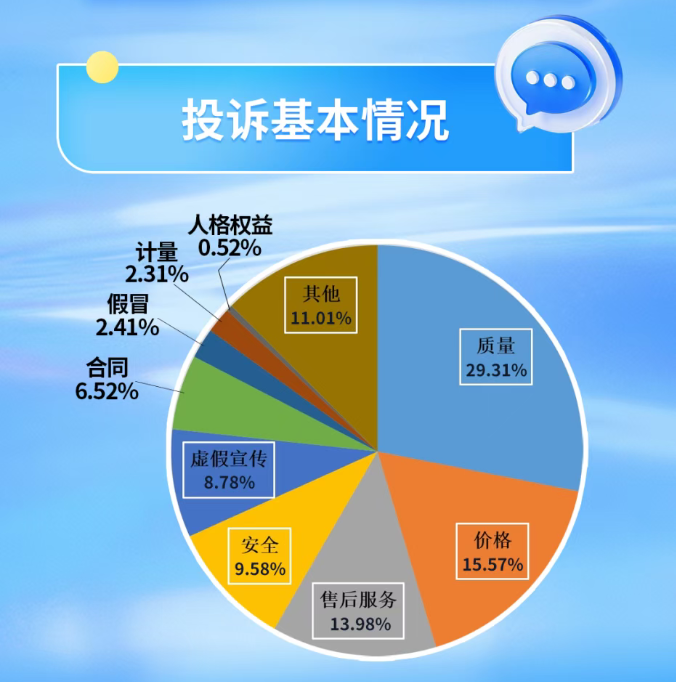
Group 1 - In 2025, the Hunan Consumer Protection Committee received a total of 40,511 consumer complaints, recovering direct economic losses of 33.53 million yuan, which helped maintain market order and boost consumer confidence [1] - Quality-related complaints accounted for nearly 30% of total complaints, with 11,874 cases reported, representing 29.31% of the total, an increase of 0.55% from the previous year [3] - Complaints regarding false advertising and pricing issues also saw increases, with false advertising complaints rising by 1.34% and pricing complaints by 0.45%, indicating strong consumer concerns about transparency and fairness [4] Group 2 - Food-related complaints were the most prevalent, with 9,233 cases, making up 35.5% of total product complaints, highlighting ongoing issues with food quality, safety, and labeling [6] - Complaints about daily necessities and clothing also ranked high, with 3,642 complaints about daily goods (14.00%) and 3,040 about clothing and footwear (11.69%), primarily concerning product quality and return difficulties [6] - Public utility service complaints increased significantly, with 1,031 cases reported, a 69.02% rise from the previous year, indicating a growing need for regulation in service quality and pricing in public utilities [8]
2025年12月CPI:环比涨0.2%同比涨0.8%
Sou Hu Cai Jing· 2026-01-11 06:42
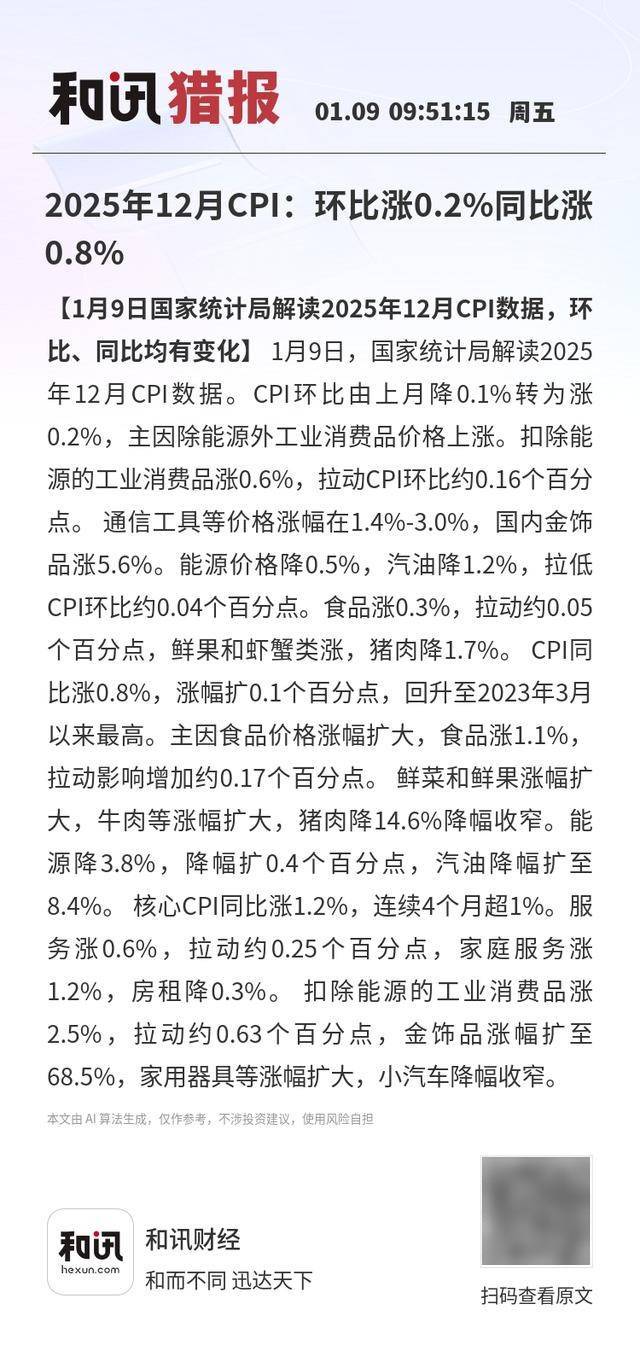
Group 1 - The core viewpoint of the article is the analysis of the December 2025 CPI data released by the National Bureau of Statistics, highlighting changes in both month-on-month and year-on-year figures [1] Group 2 - The month-on-month CPI increased by 0.2%, reversing a previous decline of 0.1%, primarily due to rising prices of industrial consumer goods, excluding energy, which rose by 0.6% [1] - The increase in CPI was driven by price hikes in communication tools (1.4%-3.0%) and domestic gold jewelry (5.6%), while energy prices fell by 0.5%, with gasoline decreasing by 1.2% [1] - Year-on-year CPI rose by 0.8%, an increase of 0.1 percentage points, marking the highest level since March 2023, mainly due to an expansion in food price increases [1] - Food prices increased by 1.1%, contributing approximately 0.17 percentage points to the CPI, with significant rises in fresh vegetables and fruits, while the decline in pork prices narrowed to 14.6% [1] - Core CPI rose by 1.2% year-on-year, remaining above 1% for four consecutive months, with service prices increasing by 0.6%, contributing about 0.25 percentage points [1] - The industrial consumer goods, excluding energy, increased by 2.5%, contributing approximately 0.63 percentage points, with gold jewelry prices surging by 68.5% [1]
江门鹤山一汽车坠江致一家5口死亡,官方通报详情
Xin Lang Cai Jing· 2025-12-26 17:58
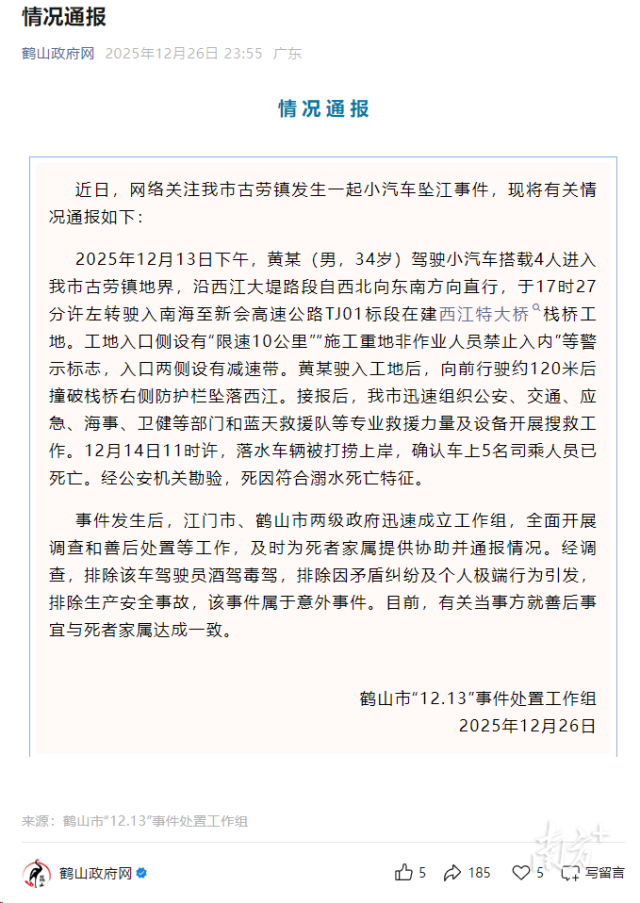
Group 1 - The incident involved a car accident in Gulao Town, where a vehicle fell into the West River, resulting in the death of all five occupants [1] - The driver, Huang (34 years old), entered a construction site despite warning signs indicating speed limits and restricted access [1] - Emergency response teams, including police, traffic, and rescue units, were mobilized immediately after the incident, and the vehicle was recovered the following day [1] Group 2 - An investigation ruled out factors such as drunk driving, drug use, personal disputes, and production safety accidents, categorizing the event as an accident [1] - Local governments established a working group to manage the aftermath and provide assistance to the victims' families [1]
四川10月居民消费价格指数同比降幅收窄 核心CPI处于高点如何看?
Si Chuan Ri Bao· 2025-11-11 00:30
Core Insights - In October, the Consumer Price Index (CPI) in Sichuan experienced a year-on-year decline of 0.6%, but the rate of decline narrowed by 0.3 percentage points compared to the previous month, with a month-on-month increase of 0.4% [1][2][4] - The core CPI rose by 0.9% year-on-year, marking the highest point since February 2023, driven by increased service prices and improvements in industrial consumer goods prices due to "anti-involution" policies [1][4][5] Price Movements - Fresh vegetable and fruit prices increased by 5.7% and 2.2% month-on-month, respectively, primarily due to seasonal factors and the demand surge during the National Day and Mid-Autumn Festival [1][3][4] - Pork prices continued to decline, with a month-on-month decrease of 1.9% and a year-on-year drop of 20.2%, attributed to sufficient market supply and the timing of seasonal consumption [1][3][4] - Egg prices also fell by 1.3% month-on-month due to temporary oversupply and reduced demand post-holiday [4] Industrial Producer Price Index (PPI) - The PPI in Sichuan decreased by 0.3% month-on-month, reversing from an increase in the previous month, with a year-on-year decline of 2.5% [1][6][7] - The automotive manufacturing sector saw a month-on-month price drop of 0.5%, while electricity and heat production prices also fell [6][7] - Despite the overall decline, some industries, such as computer manufacturing and non-ferrous metal processing, showed signs of price recovery [7][8] Economic Outlook - The ongoing implementation of demand expansion policies and improvements in market competition are expected to stabilize and potentially increase prices in certain sectors [5][8] - The "anti-involution" policies are positively impacting the PPI, leading to a reduction in price declines in various industries [6][8] - The real estate market's adjustment continues to exert downward pressure on prices in sectors like black metals and building materials, which may hinder PPI recovery [8]
“反内卷”成效初显,7月小汽车价格止跌回稳
Zheng Quan Shi Bao Wang· 2025-08-15 08:04
Core Viewpoint - The automotive industry is undergoing significant changes as multiple departments take action to address "involutionary" competition, effectively curbing the "price war" in the market [1][2]. Group 1: Market Conditions - Recent policies aimed at boosting domestic demand and consumption have led to improvements in market supply and demand relationships, resulting in positive price changes in certain sectors [1]. - In July, the Consumer Price Index (CPI) rose by 0.4% month-on-month, with industrial consumer goods prices increasing by 0.5%, indicating a stabilization in automotive prices [1]. - Data from the China Passenger Car Association shows that the average price of luxury brand cars was 358,000 yuan, up by 4,000 yuan year-on-year; joint venture brand cars averaged 175,000 yuan, up by 1,000 yuan; while domestic brand cars averaged 123,000 yuan, down by 1,000 yuan [1]. Group 2: Industry Outlook - Regulatory actions to halt prolonged "price wars" signal a turning point for the automotive industry, with manufacturers expected to reduce significant discounts and promotional financing, potentially stabilizing overall profitability and profit margins [2]. - Despite a decrease in production and sales in July, the year-on-year growth rates were 13.3% and 14.7%, respectively, indicating that demand suppression is not overly pronounced [2]. - The automotive industry is expected to see a gradual recovery in retail sales as several new models are set to launch in the third and fourth quarters, enhancing market supply [3].
黑龙江:7月份居民消费价格同比再次持平
Zheng Quan Shi Bao Wang· 2025-08-11 10:16
Group 1 - The core point of the articles indicates that in July, the Consumer Price Index (CPI) in Heilongjiang Province remained flat year-on-year, with industrial prices rising by 0.8%, service prices by 0.3%, while food and energy prices decreased by 2.4% and 3.7% respectively [1][2] - In July, the price changes in Heilongjiang Province showed a "five increases and three decreases" trend across eight major categories of goods and services, with other goods and services prices rising by 8.4% due to high international precious metal prices, contributing approximately 0.26 percentage points to the overall CPI [1] - The transportation and communication category experienced the largest decline, with prices dropping by 3.0%, which pulled down the overall CPI by about 0.41 percentage points [1] Group 2 - The core CPI, excluding food and energy prices, continued to rise, reaching a year-high increase of 1.0% in July, contributing approximately 0.76 percentage points to the overall CPI [1][3] - Food and energy prices both showed a downward trend, with food prices decreasing by 2.4% and energy prices by 3.7%, collectively pulling down the overall CPI by about 0.77 percentage points [1] - In comparison to other provinces, Heilongjiang's CPI change was consistent with the national average of 0.0%, ranking it 8th among 31 provinces, with the highest increase in Anhui Province at 0.4% and the lowest in Guangxi at a decrease of 0.7% [2]
【热点问答】小汽车的消费税征收范围是什么?
蓝色柳林财税室· 2025-07-29 15:29
Group 1 - The article emphasizes the importance of tax services and public awareness in enhancing taxpayer compliance and understanding of tax regulations [5] - It highlights the role of local tax authorities in providing educational resources and support to taxpayers, aiming to improve overall tax literacy [5] - The content serves as a reminder for taxpayers to stay informed about their rights and responsibilities regarding tax obligations [5] Group 2 - The article mentions that the platform is a non-official resource created for learning purposes, indicating a focus on community engagement and knowledge sharing [5] - It encourages readers to participate in discussions and share their experiences related to tax matters, fostering a collaborative learning environment [5] - The copyright notice suggests that the content is intended for educational use, reinforcing the idea that it is not a substitute for official tax guidance [5]