
山西汾酒

Search documents
出行热、票房红 沪市上市公司借助年味活动助力消费“开足马力”
Zheng Quan Ri Bao Zhi Sheng· 2026-02-23 13:39
Group 1: Travel and Transportation - Shanghai International Airport reported a single-day passenger flow of 424,900 on February 20, with a year-on-year increase of 6.4%, marking a historical high [2] - During the Spring Festival travel period, Shanghai Airport expects a total of 96,000 flights and a passenger throughput of 15.53 million, reflecting a year-on-year growth of 3.6% [2] - Guangzhou Baiyun International Airport achieved a record of 27,776 passengers on February 21, with a year-on-year increase of 9.12% [3] Group 2: Film Industry - The Chinese film market's total box office surpassed $1.1 billion, making it the leading single market globally, with the Spring Festival box office exceeding 5.2 billion yuan [4] - Shanghai Film reported a box office of 348 million yuan during the Spring Festival, capturing 6.9% of the national market share [4] Group 3: Tourism and Attractions - The Shanghai Yuyuan Lantern Festival implemented a fully digital transformation, enhancing visitor engagement through technology [5] - Changbai Mountain received 81,000 visitors during the Spring Festival, reflecting a year-on-year growth of 1.28% [5] - Huangshan Scenic Area welcomed 174,400 visitors from February 17 to 22, achieving a 2.38% increase in visitor numbers compared to the previous year [6] Group 4: Food and Beverage Industry - Jiangsu Jinshiyuan Wine Industry launched a promotional event during the Spring Festival, allowing consumers to participate in a lottery by scanning QR codes [7] - Shanxi Fenjiu introduced an interactive campaign with a 99.9% winning rate for consumers who scanned codes on bottle caps [7] - Guangzhou Restaurant Group integrated various experiences and product innovations during the Spring Festival, enhancing consumer engagement [7]



2026年2月:中国酒类行业展望
Zhong Cheng Xin Guo Ji· 2026-02-09 11:21
Investment Rating - The report maintains a stable investment rating for the Chinese liquor industry, indicating that the overall credit quality of the industry is not expected to change significantly in the next 12 to 18 months [5]. Core Insights - The liquor industry is closely tied to macroeconomic conditions and per capita income levels. Recent years have seen consumption pressures due to economic slowdown, low investment, and policy restrictions, leading to negative revenue and profit growth for large-scale enterprises [6][8]. - The white liquor sector has been experiencing a continuous decline in production since 2017, with a "volume and price drop" scenario expected to persist into 2025 due to high inventory and slow market movement [6][14]. - The beer industry remains stable with high market concentration, but faces challenges from reduced consumption in dining and entertainment venues. The trend towards product premiumization and innovation continues to drive growth [5][26]. - Overall, the liquor industry is under pressure from weak economic recovery and consumption policies, with expectations of continued downward pressure on revenue and profits in the future [10][39]. Summary by Sections Key Points - The liquor industry's demand is significantly affected by macroeconomic conditions and per capita income. Recent economic factors have led to a decline in revenue and profit growth for large-scale enterprises [6][9]. - White liquor production has been decreasing since 2017, with a projected "volume and price drop" scenario continuing into 2025 due to high inventory levels and slow market activity [14][25]. - The beer industry maintains a high concentration level, with stable production capacity utilization. However, the reduction in dining and entertainment venues has negatively impacted beer consumption [26][37]. Analytical Approach - The analysis focuses on the credit fundamentals of the liquor industry, examining key indicators affecting consumption since 2025, including disposable income, consumer confidence, and policy adjustments [7]. Industry Fundamentals - The liquor industry's demand is closely linked to macroeconomic conditions and disposable income levels. Recent years have seen consumption pressures due to economic slowdown and policy restrictions [8][9]. - The white liquor sector has been facing a continuous decline in production, with a significant drop in output expected in 2025 due to high inventory and slow market movement [14][25]. Financial Performance - Since 2025, white liquor enterprises have generally experienced significant declines in operating performance, while beer companies have benefited from optimized product structures [39][40]. - The overall debt levels of liquor companies are low, and while debt service indicators have declined, they remain favorable. Group companies have access to financing channels that support their debt repayment capabilities [39][40].
“十四五”期间山西省实物商品网上零售额年均增长24.1%
Zhong Guo Xin Wen Wang· 2025-12-05 10:39
Core Insights - During the "14th Five-Year Plan" period, Shanxi Province's online retail sales of physical goods grew at an average annual rate of 24.1%, outpacing the national growth rate [1][3] - The advantages of e-commerce in connecting online and offline markets, bridging supply and demand, and linking urban and rural areas are becoming increasingly evident [1] Group 1: E-commerce Development - The Shanxi Provincial Department of Commerce is focusing on cultivating market entities, innovating business models, promoting consumption upgrades, developing rural e-commerce, and optimizing the development environment to drive high-quality e-commerce growth [3] - Since 2020, Shanxi has strengthened the management of live e-commerce bases, fostering a live e-commerce ecosystem and enhancing the sales capabilities of local live-streaming agencies [3] - In 2024, a joint initiative titled "Famous Products from Shanxi" will be launched, featuring 21 key tasks aimed at integrating e-commerce with local specialty industries [3] Group 2: Consumer Growth - Shanxi has created promotional events such as the "All Jin Shopping" online New Year goods festival, leveraging new models like influencer marketing and live e-commerce to provide diverse consumer choices [3] - These initiatives are expected to continuously stimulate consumer spending and unlock potential market demand [3] Group 3: Rural E-commerce - Since 2022, Shanxi has invested 1.47 billion yuan in developing 100 rural e-towns and establishing public service platforms for rural e-commerce [4] - The province has built 100 county-level e-commerce public service centers, covering a total area of 230,000 square meters, and has over 2,700 e-commerce enterprises registered [4] - Shanxi's rural e-commerce initiatives have been recognized as exemplary practices by the State Council for promoting high-quality development [4] Group 4: E-commerce Ecosystem - In 2023, Shanxi introduced an action plan to accelerate the integration of e-commerce systems and logistics delivery [6] - A key initiative includes subsidies for the logistics of agricultural products, which have led to a total subsidy of 120 million yuan, driving approximately 3.3 billion yuan in agricultural sales [6] - The logistics costs for major courier companies have decreased by 20% to 30%, enhancing the efficiency of the dual circulation of agricultural products and industrial goods [6]


食饮年度投资策略:稳基调黎明将至,抱主线向阳而生
Guotou Securities· 2025-11-26 08:09
Core Insights - The report emphasizes a cautious yet optimistic outlook for the food and beverage sector, suggesting that the economic cycle and drinking policies will stabilize, leading to potential recovery in valuations, particularly in the liquor segment [1][12] - The investment strategy focuses on identifying companies with strong performance resilience and growth potential across various sub-sectors, including liquor, beer, dairy, soft drinks, and snacks [12] Group 1: Liquor Industry - The liquor sector is currently experiencing a bottoming out phase, with low expectations, low holdings, and low valuations. The report suggests that the supply-demand imbalance is easing, and consumer spending is expected to gradually recover, making it a good time to invest in leading brands like Moutai and Wuliangye [1][27] - In Q3 2025, the liquor industry saw a revenue and profit decline of around 20%, with high-end and regional liquor experiencing significant drops in growth rates. The report indicates that the industry is in an adjustment phase, with companies becoming more pragmatic in their growth targets [27][39] - The report highlights a trend towards premiumization, with consumers increasingly favoring well-known brands and products, leading to a concentration of market share among top players [53][58] Group 2: Beer Industry - The beer sector is expected to maintain a structural growth trend, particularly for companies with strong single-product growth logic. The profitability of beer companies is on an upward trajectory, driven by the expansion of products priced between 8-10 yuan and improved operational efficiency [2] Group 3: Dairy Industry - The dairy sector is poised for a turnaround in the raw milk cycle in 2026, with expectations of recovering demand for raw milk as deep processing capacities come online. The report recommends investing in the dairy supply chain, as average milk prices are projected to rise above production costs [3][6] Group 4: Soft Drinks Industry - The soft drink sector is advised to focus on high-growth categories and capitalize on changes in competitive dynamics within the market. The report notes that functional beverages, particularly low-sugar options, are expected to gain traction, catering to the needs of health-conscious consumers [4] Group 5: Snack Industry - The snack segment is benefiting from new channel dynamics, with significant growth potential in bulk snack sales. The report highlights the strong performance of companies like Wancheng Group and suggests that products like konjac snacks have substantial market growth opportunities [5][20]
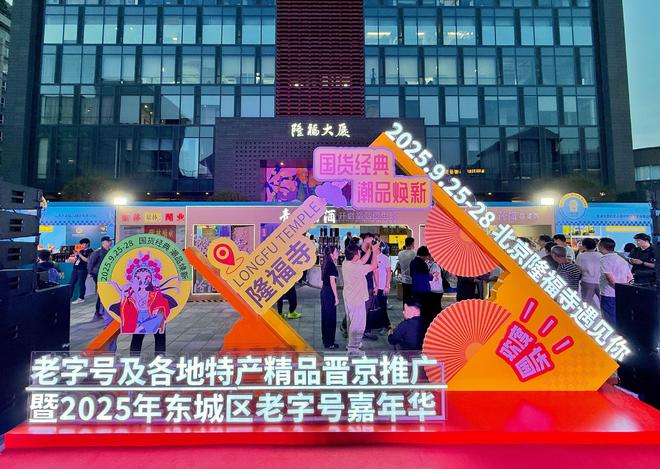
隆福寺再掀“国潮”热,全国百余家老字号进京推广
Xin Jing Bao· 2025-09-25 13:25
Core Points - The event themed "Classic National Goods, Trendy Products Renewed" showcases over 100 time-honored brands and specialty products from 19 provinces and regions in China, running from September 25 to September 28 [1][3] - The exhibition area exceeds 3,000 square meters, featuring innovations in food and beverages, traditional Chinese medicine, and arts and crafts, allowing visitors to experience regional specialties [3] - The event includes a special "Old Brand Dopamine Zone" themed around the 24 solar terms, highlighting the fusion of traditional craftsmanship with modern life [3][4] Industry Insights - Nearly 80% of the participating companies are time-honored brands, including 29 national and 40 local brands, indicating a vibrant innovation and development within the old brand sector [3] - The event is part of Beijing's efforts to establish itself as an international consumption center, utilizing a dual approach of "exhibition + market" to modernize the image of old brands [4] - The East District's Business Bureau reports significant enhancement in brand value since the implementation of a three-year action plan for time-honored brands in 2023, through platform building and environmental optimization [3]
白酒近况更新
2025-09-22 01:00
Summary of Conference Call Notes Industry Overview - The conference call primarily discusses the liquor industry, particularly focusing on the performance and strategies of major companies like Guizhou Moutai and Wuliangye during the recent sugar and liquor fair [1][2][3][4]. Key Points and Arguments 1. **Market Feedback from the Sugar and Liquor Fair**: Overall feedback from the fair was in line with expectations, with some channel operations exceeding expectations. Most liquor companies emphasized price stability in their channel operations [1]. 2. **Valuation Changes**: Post-Spring Festival, the market's perception of real estate stability has led to an increase in Guizhou Moutai's valuation from 18x to 22x, with many other stocks also experiencing valuation upgrades [2]. 3. **Seasonal Performance**: Despite being the off-season, banquet consumption has continued to show growth similar to the Spring Festival, with business consumption also receiving positive feedback due to a more favorable operating environment for private enterprises [3]. 4. **Confidence in Price Recovery**: There is a growing confidence in price recovery, although it remains untested during the off-season. The overall sentiment is that the liquor sector is not facing a downturn but is on an upward trend [4][7]. 5. **Foreign Investment Interest**: Foreign investors are likely to increase their allocation in liquor stocks, particularly Guizhou Moutai, due to strong earnings growth and attractive dividend yields. In contrast, domestic investors are more cautious due to previous significant gains in other sectors [5][6]. 6. **Inventory and Pricing Strategies**: Most liquor companies are maintaining stable prices and avoiding aggressive discounting to ensure natural sales growth. This strategy is crucial for maintaining market share in the mid-to-high price segments [14][15]. 7. **Channel Operations**: Wuliangye is undergoing significant channel reforms, focusing on reducing traditional channel volumes while enhancing direct sales and new market channels. The success of these reforms depends heavily on management execution [19][20][21]. 8. **Sales and Payment Trends**: The first quarter's sales performance is expected to show a mid-single-digit growth rate, with most companies nearing completion of their payment collection for the quarter [18][39]. 9. **Consumer Behavior Insights**: There is a notable recovery in consumer demand, particularly in banquet and business settings, although the overall market remains cautious about confirming a definitive recovery point [10][11][12]. Additional Important Insights - **Regional Performance Variations**: The performance of liquor sales varies significantly by region, with southern regions showing stronger recovery compared to northern areas [27]. - **Emerging Trends in Consumer Preferences**: There is a shift towards premium products, with some companies reporting substantial growth in high-end liquor sales [10][11]. - **Future Outlook**: The overall sentiment is cautiously optimistic, with expectations of gradual recovery in consumer demand and potential for further valuation increases in the liquor sector [6][12][13]. This summary encapsulates the key discussions and insights from the conference call, providing a comprehensive overview of the current state and future outlook of the liquor industry.