工业设备

Search documents
Alamo (ALG) - 2025 Q4 - Earnings Call Transcript
2026-03-03 16:02
Financial Data and Key Metrics Changes - Net sales for Q4 2025 were $373.7 million, down 3% from Q4 2024 [9] - Gross profit for Q4 2025 was $85 million, compared to $91.8 million in Q4 2024, with a gross margin of 22.7%, down 110 basis points [9] - Adjusted EBITDA for Q4 2025 was $44.8 million, or 12% of net sales, compared to $51.8 million, or 13.4% of net sales, in Q4 2024 [11] - Adjusted earnings per share for Q4 2025 was $1.70, down from $2.39 in Q4 2024 [11] - SG&A expenses for Q4 2025 were $58.3 million, up 9.3% from Q4 2024 [10] Business Line Data and Key Metrics Changes - Industrial Equipment Division net sales for Q4 2025 were $234.9 million, an increase of 4.2% compared to Q4 2024, with adjusted EBITDA of $41.5 million, or 17.7% of net sales [12] - Vegetation Management Division net sales for Q4 2025 were $138.7 million, a decrease of 13.2% compared to Q4 2024, with adjusted EBITDA of $3.2 million, or 2.3% of net sales [13] Market Data and Key Metrics Changes - The Industrial Equipment Division represented 59% of total net sales, while the Vegetation Management Division accounted for 41% [20][24] - Net orders in the Industrial Equipment Division were up 21% year-over-year, while net orders in the Vegetation Management Division were down 3% [19][23] Company Strategy and Development Direction - The company is focusing on four strategic pillars: People and culture, Commercial excellence, Operational excellence, and Capital deployment [25] - The company completed the expansion of its manufacturing facility in France, nearly doubling its size to support growth in Western Europe [25] - The company is pursuing tuck-in acquisitions, with a robust M&A pipeline, focusing on businesses with similar sales channels and product categories [27][52] Management Comments on Operating Environment and Future Outlook - Management expressed confidence in the company's direction and growth potential over the next three to five years [8] - The company anticipates a slowdown in growth rates for the Industrial Division in 2026, expecting flattish to low to mid-single-digit growth [32] - Management noted that the Vegetation Management Division is expected to stabilize and improve margins in 2026, aiming for adjusted operating margins of 15% in the long term [50][62] Other Important Information - The company approved a 13.3% increase in its quarterly dividend to $0.34 per share [17] - The company is in the process of divesting certain product lines that do not fit its long-term strategy [67] Q&A Session Summary Question: What are the growth expectations for the Industrial side in 2026? - Management expects flattish to low to mid-single-digit growth in 2026, with a focus on quality of earnings in the Snow business [32][33] Question: Can you provide details on the Petersen acquisition? - The Petersen acquisition is expected to be accretive and is in a growth end market, with a management team remaining in place [36][37] Question: How do you expect Vegetation margins to progress through 2026? - Management anticipates margin improvement in the Vegetation Management Division, aiming to return to at least 8% adjusted operating margins in 2026 [50][62] Question: What is the current M&A pipeline looking like? - The company is focused on tuck-in acquisitions, primarily in the Industrial space, with a robust pipeline being developed [52]

Plexus (NasdaqGS:PLXS) FY Conference Transcript
2026-03-02 16:27
Summary of Plexus Conference Call Company Overview - **Company**: Plexus - **Industry**: Electronic Manufacturing Services (EMS) - **Market Focus**: Healthcare life sciences, industrial, aerospace, and defense - **Company Size**: Approximately $4 billion in revenue - **Financial Goals**: Targeting annual revenue growth of 9%-12%, operating margin of 6% or greater (non-GAAP), and 15% return on invested capital [4][4][4] Core Insights and Arguments - **Market Dynamics**: - Plexus is experiencing a recovery from two years of flat growth, with positive trends in semiconductor capital equipment, healthcare, defense, and commercial space [11][12] - Commercial aerospace is still recovering, with expectations for future growth as Boeing and other aerospace companies ramp up production [12][12] - **Capacity Expansion**: - Recent investments include a new facility in Penang, Malaysia, which is expected to support up to $1 billion in revenue with a break-even point anticipated soon [19][19] - Expansion in Thailand is also underway, with rapid growth expected [19][19] - **Supply Chain Management**: - Plexus is focusing on regional production to shorten supply chains, with a strong presence in North America, Mexico, Asia, and Europe [27][27] - The company is actively managing component price fluctuations through a cost-plus model, ensuring that price increases are passed on to customers [58][58] - **Technological Investments**: - Investments in automation, such as the AutoStore unit, are expected to improve efficiency and margins [40][40] - AI is being deployed to enhance internal processes, including procurement and inventory management, leading to significant time savings [49][50] Additional Important Points - **Financial Performance**: - The company generated approximately $500 million in free cash flow over the past two fiscal years, with a target of $100 million in free cash flow for fiscal 2026 [101][101] - The cash cycle is being targeted to be in the mid-60s, with a current healthy balance sheet and a debt to EBITDA ratio below 1 [103][103] - **Shareholder Returns**: - Plexus has a $100 million share repurchase program, with $63 million remaining on the current authorization [117][117] - **Engineering Focus**: - Engineering is core to Plexus's operations, allowing for strong customer engagement and product development, particularly in aerospace and defense sectors [81][81][90] - **Growth Potential**: - The defense and unmanned systems market has the potential to double by fiscal 2026, driven by early engagement in upcoming programs [74][74] - The industrial sector, particularly semiconductor capital equipment, is expected to benefit from increased spending and AI advancements [75][75] This summary encapsulates the key points discussed during the Plexus conference call, highlighting the company's strategic focus, market dynamics, and financial performance.

800%的暴涨!俄罗斯疯狂抛售黄金,中国照单全收,这盘棋你看懂了吗?
Sou Hu Cai Jing· 2026-02-16 16:53
Core Viewpoint - The article discusses the significant increase in China's import of physical gold from Russia, which reached 25.3 tons valued at $3.29 billion, marking an 800% increase compared to the same period last year. This transaction reflects a shift in the global financial landscape, where gold is being used as a medium of exchange to bypass the dollar system, particularly in the context of sanctions against Russia [2][5][9]. Group 1: Russia's Gold Export - Russia is selling gold due to financial constraints caused by Western sanctions, which froze over $300 billion of its foreign reserves and excluded it from the SWIFT system [5][9]. - The 25.3 tons of gold sold to China represents less than 1% of Russia's total gold reserves of over 2,300 tons, indicating that this is a manageable liquidity release for Russia [5][9]. - The transaction is structured so that Russia receives renminbi in exchange for gold, which it then uses to purchase essential goods from China, such as automotive parts and industrial equipment [7][8]. Group 2: China's Strategic Move - China's gold reserves have been increasing, reaching 74.19 million ounces, but still represent only 9.7% of its total foreign reserves, which is significantly lower than the global average of 15% [11][12]. - The purchase of gold is not for speculative purposes but is a strategic move to enhance the stability of China's financial system amid rising geopolitical tensions and the risks associated with holding dollar-denominated assets [15][16]. - This transaction allows China to secure hard assets that are not reliant on any country's credit, providing a form of insurance against unpredictable external environments [13][14]. Group 3: New Settlement Logic - The transaction exemplifies a new settlement logic where gold serves as both a value reserve and a credit bridge, facilitating trade without relying on the dollar [18][20]. - A new triangular structure is emerging in international trade, where resource-rich countries provide commodities, manufacturing countries supply industrial goods, and financial infrastructure is developed by countries like China [19][20]. - This model is being replicated by other nations, indicating a structural shift in the global financial system, where gold is gaining prominence as a safe haven, potentially surpassing U.S. Treasury bonds in value [21][23]. Group 4: Implications for the Global Financial System - The transaction between China and Russia is a response to Western financial sanctions, demonstrating that countries with resources and partnerships can operate outside the dollar system [23][25]. - The article suggests that the traditional credit system is facing a trust crisis, prompting a return to tangible assets like gold, which are seen as more reliable in uncertain times [25][27]. - The actions of China and Russia are characterized as pragmatic rather than retrogressive, highlighting the importance of having transaction options that do not depend on the goodwill of adversarial parties [27].


卡特股价单日大涨近5% 工业板块情绪回暖与公司转型预期成主因
Jing Ji Guan Cha Wang· 2026-02-13 22:45
Group 1 - The stock price of Caterpillar (CRI.N) experienced a significant increase of 4.98% on February 13, 2026, closing at $40.03, with an intraday high of $40.18 and a trading volume of approximately $44.42 million, reflecting a turnover rate of 3.08% [1] - The industrial sector sentiment has improved, with the engineering machinery sector showing a strong performance, achieving a biweekly increase of 7.80%, driven by domestic demand recovery and global resource demand [2] - Caterpillar's valuation logic is shifting from "cyclical manufacturing" to "industrial services + global energy infrastructure," which may influence investor expectations regarding the increase in service revenue proportion [2] Group 2 - Recent financial data indicates that Caterpillar's revenue for Q3 2025 decreased slightly by 0.08% year-on-year, while net profit fell by 80.23%, with a gross margin of 45.08% [3] - The current price-to-earnings ratio (TTM) stands at 16.27, which is above the industry average, suggesting that stock price fluctuations may be driven by short-term sentiment [3]
“制作精良、交货迅速、售后到位”,日本网民热议中国制造业“迭代快”
Huan Qiu Shi Bao· 2026-02-05 22:39
Core Viewpoint - The rapid iteration speed of Chinese products is causing concern among Japanese engineers, highlighting a significant shift in the competitive landscape of manufacturing between China and Japan [1] Group 1: Industry Insights - A Japanese engineer with 30 years of experience expressed anxiety over the dominance of Chinese manufacturers at a recent mechanical products exhibition in Japan, noting that Chinese companies now occupy a substantial portion of the exhibition space [1] - Chinese products are no longer seen merely as alternatives but are recognized for their quality, rapid delivery, and effective after-sales service, which has raised concerns about Japan's competitive position [1] - Many Japanese netizens praised the improvements in "Made in China" products, citing advancements in quality management, delivery management, and after-sales systems, as well as faster decision-making processes [1] Group 2: Market Trends - The perception of Chinese products has shifted in the consumer market, with Chinese digital products and home appliances gaining popularity in Japan, moving from discount sections to mainstream display areas in large electronics stores [2] - Sales staff now emphasize the functionality of Chinese products rather than just their price advantages, indicating a change in consumer priorities towards performance and software integration [2] - A young Japanese consumer noted a transition in purchasing behavior, moving from price-driven choices to selecting products based on their suitability and functionality [2]
宏利投资:偏好中资科技股投资机会 美国2026年或减息3次
Zhi Tong Cai Jing· 2026-01-21 07:49
Core Viewpoint - Manulife Investment Management assigns a "neutral" rating to mainland and Hong Kong stocks, favoring Chinese stocks for their investment opportunities despite not expecting explosive returns [1] Group 1: Economic Outlook - The Chinese economy is operating steadily, and Asian stock markets may benefit from a weakening US dollar [1] - China is increasingly exporting high-value products, including industrial equipment and new energy vehicles [1] Group 2: Sector Focus - Under the "14th Five-Year Plan," China is expected to focus on high-tech innovation sectors such as artificial intelligence, advanced manufacturing, and renewable energy [1] - Manulife is optimistic about Chinese technology stocks, particularly those related to artificial intelligence like semiconductors, as well as advanced manufacturing, robotics, and healthcare stocks [1] Group 3: Monetary Policy Expectations - Manulife's senior global macro strategist anticipates that the US will cut interest rates three times this year, with the first cut expected before the Federal Reserve chair transition in May, and the remaining two cuts likely occurring in the second half of the year [1] - There is a possibility that the current chair, Jerome Powell, may remain on the committee after his term ends, which could lead to a more hawkish monetary policy stance than Manulife's expectations [1]
Forget the 2.8% Social Security Increase. These Aristocrats Pay You 4% to 7% More Annually
247Wallst· 2025-12-14 14:51
Core Insights - The Social Security Administration announced a 2.8% cost-of-living adjustment (COLA) for 2026, following a 2.5% increase in 2025, impacting 71 million Americans [1][2] - Dividend growth stocks have historically provided higher annual increases compared to Social Security adjustments, with several blue-chip companies consistently outperforming these adjustments [1][2] Dividend Growth Companies - **Caterpillar**: Achieved a 10-year compound annual dividend growth rate of 7.2%, with a quarterly dividend increase of 7.1% to $1.51 in December 2025, marking 32 consecutive years of increases [3][4] - **Coca-Cola**: Raised its dividend for 62 consecutive years, with a 10-year compound annual growth rate of 4.5% and a quarterly dividend increase of 5.2% to $0.51 in 2025 [6][8] - **Johnson & Johnson**: Also increased its dividend for 62 consecutive years, with a 10-year compound annual growth rate of approximately 6.5% and a quarterly dividend increase of 4.8% to $1.30 in 2025 [9][10] - **PepsiCo**: Maintained a 52-year dividend increase streak, with a 10-year compound annual growth rate of 7.1% and a quarterly dividend increase to $1.4225 in 2025 [12][14] - **Procter & Gamble**: Holds the longest streak with 68 consecutive years of dividend increases, averaging annual growth of 5-7% [15][17] Financial Performance - **Caterpillar**: Projected annual dividend increase from $1.84 in 2012 to $6.04 in 2026, a 228% increase over 14 years, with Q3 2025 operating cash flow of $3.7 billion [4][5] - **Coca-Cola**: Quarterly dividend increased from $0.16 in 1999 to $0.51 in 2025, a 219% increase, with Q3 2025 dividends totaling $2.108 billion [7][8] - **Johnson & Johnson**: Quarterly dividend increased from $0.25 in 1999 to $1.30 in 2025, a 420% increase, with Q3 2025 dividends of $3.132 billion [10][11] - **PepsiCo**: Annual dividend growth from $2.15 in 2012 to $5.55 in 2025, a 158% increase, with Q3 2025 dividends of $1.949 billion [13][14] - **Procter & Gamble**: Paid $2.549 billion in dividends in Q1 2026, with a current dividend yield of 2.93% and a 60% payout ratio [16][17]



我国贸易顺差首次超1万亿美元
Sou Hu Cai Jing· 2025-12-10 05:45
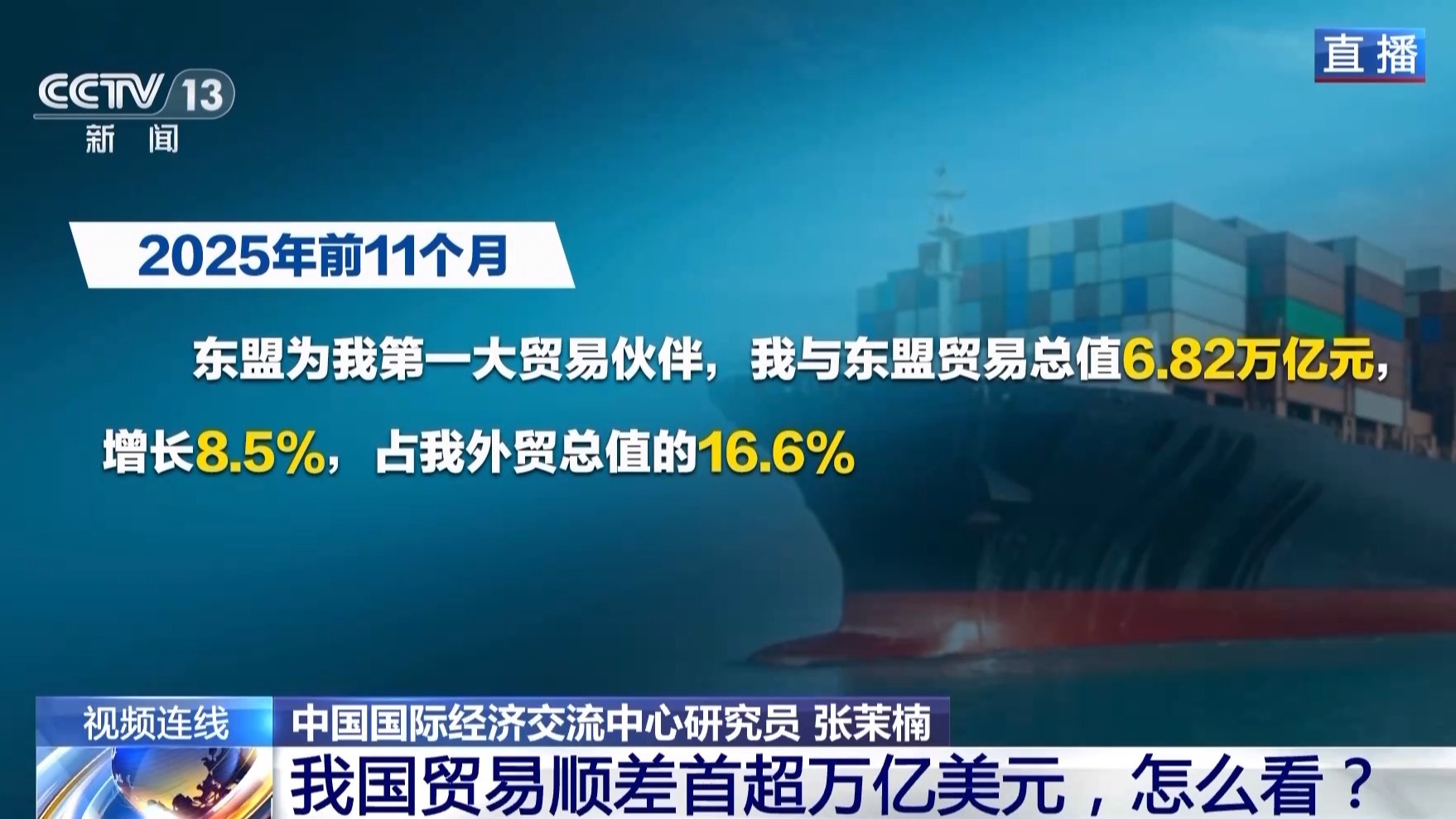
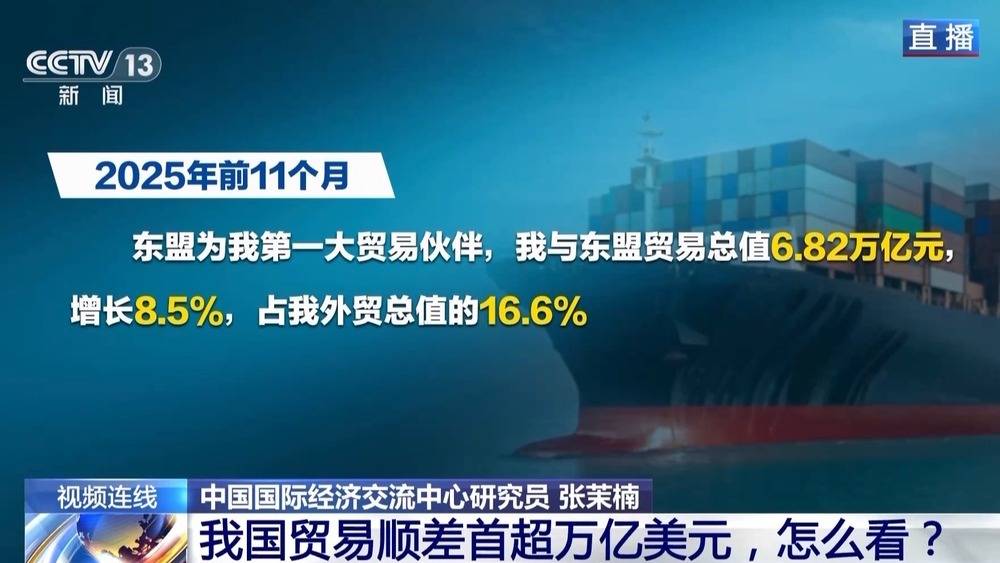
Core Insights - China's trade surplus has exceeded $1 trillion for the first time in the first 11 months of the year, with private enterprises accounting for 57.1% of the total foreign trade value [1] - The resilience of China's foreign trade is attributed to its comprehensive advantages in manufacturing and global trade, as well as the optimization of trade and industrial structures [1][3] Group 1: Trade Performance - China's position as the world's largest trading and manufacturing country is further emphasized, with a significant portion of industrial products ranking at the top globally [1] - The trade structure has been diversified, with emerging markets becoming key growth drivers, particularly in trade with ASEAN and the EU [1] - Despite a decline in exports to the U.S., China's overall trade surplus has increased, indicating a strengthening of trade relationships with other countries [3] Group 2: Trade Structure Changes - The trade structure between China and the EU has shifted significantly, with a 14.8% increase in exports to the EU in November, and the trade surplus expected to exceed €350 billion [4] - The similarity in the top ten export products between China and the EU suggests a transition from vertical to horizontal division of labor, which may lead to increased trade friction [4] - To mitigate potential trade tensions, China aims to enhance imports from the EU and increase investments to balance trade relations [4] Group 3: Economic Policy Adjustments - Future economic policies will focus on counter-cyclical and cross-cyclical adjustments, utilizing structural policy tools such as tax, financial, and credit measures [6] - This approach aims to provide targeted support to market participants and enterprises rather than relying on large-scale fiscal stimulus [6]
贸易顺差首超万亿美元 中国外贸韧性源自哪
Sou Hu Cai Jing· 2025-12-10 02:37
Core Insights - China's trade surplus has exceeded $1 trillion for the first time in the first 11 months of the year, with private enterprises accounting for 57.1% of the total foreign trade value [1] Group 1: Trade Resilience - China's position as the largest trading and manufacturing nation globally is a key factor in its trade resilience, supported by a comprehensive industrial structure and supply chain [2][4] - The diversification of trade, particularly with emerging markets, has contributed significantly to trade growth, with notable increases in trade with ASEAN and the EU [2][4] Group 2: Trade Structure Optimization - The trade structure is continuously optimizing, moving towards high-end industrial chains, with industrial products like integrated circuits, machinery, and automobiles being the main drivers of trade growth [4] - Despite a decline in exports to the U.S., China's overall trade surplus has increased, indicating a strengthening of trade relationships with other countries [5] Group 3: China-EU Trade Dynamics - There has been a significant shift in the trade structure between China and the EU, with a 14.8% increase in exports to the EU in November, and a projected trade deficit for the EU with China exceeding €350 billion [6] - The similarity in the top traded products between China and the EU suggests a shift from vertical to horizontal division of labor, which may lead to increased trade tensions [6] Group 4: Future Trade Strategies - China aims to balance trade relations with the EU by increasing imports of services and agricultural products, as well as enhancing investments in the EU [7] - Future macroeconomic adjustments will focus on counter-cyclical and cross-cyclical measures, utilizing structural policy tools for more precise market support [8]
新闻1+1丨贸易顺差首超万亿美元 中国外贸韧性源自哪
Yang Shi Xin Wen Ke Hu Duan· 2025-12-09 23:48
Core Viewpoint - China's trade surplus has exceeded 1 trillion USD for the first time in the first 11 months of the year, with private enterprises becoming the core pillar of stable growth in foreign trade, accounting for 57.1% of the total foreign trade value [1]. Group 1: Resilience of China's Foreign Trade - The resilience of China's foreign trade is attributed to its comprehensive advantages in manufacturing and global trade, as China is the largest trade and manufacturing country in the world [5]. - A complete industrial structure and supply chain system are crucial for sustaining trade growth amid complex international circumstances [5]. - Trade diversification has been actively pursued, with emerging markets becoming significant contributors to growth, particularly in trade with ASEAN and the EU [5]. Group 2: Trade Structure Optimization - Despite a significant decline in exports to the U.S., China's overall trade surplus has increased, indicating a strengthening of trade relationships with various countries [9]. - The optimization of trade and industrial structures is evident, with industrial products such as integrated circuits, machinery, and automobiles being key drivers of trade growth [7]. Group 3: Changes in China-EU Trade Relations - There has been a notable shift in the trade structure between China and the EU, with a 14.8% increase in exports to the EU in November, and the trade surplus expected to exceed 350 billion euros [12]. - The similarity in the top ten export products between China and the EU suggests a transition from vertical to horizontal division of labor, which may lead to trade friction [12]. Group 4: Future Economic Adjustments - The focus on counter-cyclical and cross-cyclical adjustments reflects a long-term consideration for macroeconomic regulation, utilizing structural policy tools such as tax, financial, and credit policies [16]. - This approach aims to provide precise benefits to market entities and enterprises rather than relying on large-scale fiscal stimulus [16].