广发中证传媒ETF

Search documents
行业轮动双周度跟踪:边际增持有色、钢铁、医药(2026年03月24日期)-20260327
SINOLINK SECURITIES· 2026-03-27 08:23
1. Report Industry Investment Rating - No information provided in the given content 2. Core Viewpoints of the Report - As of March 22, 2026, the model recommends investing in non - ferrous metals, media, communication, steel, non - bank finance, and pharmaceutical biology, with marginal increases in non - ferrous metals, steel, and pharmaceutical biology. Non - bank finance, steel, and communication are mainly driven by expected boosts, while non - ferrous metals, media, and pharmaceutical biology are mainly driven by price - volume reversals and capital flows [2] - The industry rotation model assesses market micro - structure from fundamental, price - volume, and sentiment dimensions, and constructs a strategy using 7 relatively effective factors [2] 3. Summary by Relevant Catalogs 3.1 Industry Rotation Model and Recommended Industries - The industry rotation model analyzes from three dimensions: fundamentals, price - volume, and sentiment. It back - tests original factors bi - weekly and expands price - volume factors from multiple dimensions, ultimately selecting 7 factors to build a strategy [2] - Recommended industries are non - ferrous metals, media, communication, steel, non - bank finance, and pharmaceutical biology, with marginal increases in non - ferrous metals, steel, and pharmaceutical biology [2] 3.2 Industry ETF Portfolio - The industry ETF portfolio includes Southern China Securities Shenwan Non - Ferrous Metals ETF, GF China Securities Media ETF, Guotai China Securities All - Index Communication Equipment ETF, Guotai China Securities Steel ETF, E Fund CSI 300 Non - Bank Financial ETF, and E Fund CSI 300 Medical and Health ETF [4] - Details of each ETF, such as weight, year - end scale, institutional investors, trading volume, and returns, are provided. For example, the Southern China Securities Shenwan Non - Ferrous Metals ETF has a weight of 16.67%, a year - end scale of 20.591 billion yuan, and a one - year return of 77.03% [5] 3.3 Performance of the Industry Rotation Strategy - The industry rotation strategy declined 1.18% in the past two weeks, with an excess return of 3.18%. The excess return in the past year was 20.68%, the Sharpe ratio was 1.93, and the Calmar ratio was 3.83 [5][7] 3.4 Strategy/Composite Factor Back - testing Results - Different factors (price - volume, fundamental, and sentiment) have different IC means, IC standard deviations, ICIRs, and frequencies of IC>0. For example, the成交均价因子 has an IC mean of 4.02% and an ICIR of 15.14% [10] - After optimization, the composite factor has an IC mean of 7.81%, an ICIR of 32.49%, and a frequency of IC>0 of 46.64% [10]
字节Seedance 2.0催化 传媒等主题基金走强
Zheng Quan Ri Bao· 2026-02-12 16:15
Core Insights - The A-share market has seen a strong rise in AI application-related sectors since February 2026, with significant interest in the film and gaming theme ETFs, driven by ByteDance's AI video generation model Seedance 2.0 undergoing gray testing, which has injected strong momentum into the media sector [1][4]. ETF Performance - The film and gaming theme ETFs have shown remarkable performance, with the Guotai CSI Film Theme ETF increasing by 11.67% and the Yinhua Fund's film ETF rising by 11.53% from February 9 to February 12, 2026. During the same period, these funds attracted net inflows of 742 million yuan and 701 million yuan, respectively, marking them as the most popular ETFs in the film sector [2]. - The animation and gaming theme ETFs also performed well, with net value increases of at least 8.50% for several ETFs during the same timeframe [2]. - Media ETFs also saw gains, with the Penghua CSI Media ETF and the GF CSI Media ETF rising by 5.93% and 5.89%, respectively, and the GF CSI Media ETF attracting over 400 million yuan in net inflows from February 9 to February 11 [2]. AI Industry Chain - The AI industry chain extension sectors have benefited as well, with 10 AI-related ETFs on the STAR Market showing net value growth exceeding 13% year-to-date, indicating sustained market interest in AI applications [3]. Technological Breakthrough - The Seedance 2.0 model's technological advancements are viewed as a core catalyst for the current market trend. Launched on February 7, 2026, it features capabilities for audio-visual synchronization and can complete image creation in 60 seconds, potentially reducing production costs for short films and videos significantly [4]. Market Sentiment and Future Outlook - Despite ongoing concerns regarding privacy, copyright, and ethical standards, institutions remain optimistic about the model's potential to drive industry transformation. Experts suggest that AI's application in lightweight content creation has already shown value, while its use in feature films is still in exploratory stages [5]. - The introduction of Seedance 2.0 is seen as a step towards commercializing AI video generation technology, with significant potential for efficiency improvements and cost optimization in the industry [6]. - As the AI application market continues to heat up, institutions express overall optimism regarding investment value in related sectors, with expectations for sustained benefits from technological advancements in film and gaming as direct applications of AI [6].
东吴证券晨会纪要2026-01-26-20260126
Soochow Securities· 2026-01-25 23:30
Macro Strategy - The report highlights the investment value of the GF CSI Media ETF (512980.SH), which is closely tracking the CSI Media Index (399971.SZ) and has a management fee of 0.5% per year and a custody fee of 0.1% per year. As of January 16, 2026, the ETF has a circulation scale of 10.759 billion yuan and an annualized return of 29.47% with a volatility ratio of 0.89, indicating reasonable risk control capabilities [1][12] - The underlying index focuses on AI applications, with a significant weight of 31.43% in GEO concept stocks, including key companies like BlueFocus, Yanshan Technology, and Kunlun Wanwei. The top ten weighted stocks account for 51.52% of the index, indicating a high concentration of component stocks [1][12] - The report emphasizes that the current media bull market is driven by AI technology transformation and the assetization of data factors, contrasting with the previous bull market driven by mobile internet traffic. The media sector's valuation is at a historical low, providing a high margin of safety for investors [1][12] Non-Bank Financial Industry - The report indicates that the non-bank financial sector is experiencing an upward trend in market conditions, with public fund holdings in the sector increasing to 2.42% by the end of 2025, up 0.82 percentage points from the previous quarter. However, the sector remains underweight compared to the market [5][16] - The report recommends key stocks such as China Life, Ping An, New China Life, China Pacific Insurance, and CITIC Securities, highlighting their potential to benefit from the improving market environment [5][16] - The average daily trading volume of equity funds reached 34.444 trillion yuan, a year-on-year increase of 155%, indicating a significant improvement in market activity [5][16] Real Estate Industry - The report notes that the real estate market is gradually stabilizing, with a narrowing decline in sales and construction metrics compared to 2024. The total development investment in 2025 was 8.3 trillion yuan, down 17.2% year-on-year, while the new construction area was 5.9 million square meters, down 20.4% [6][18][19] - Sales figures show a cumulative sales area of 8.8 million square meters, down 8.7% year-on-year, with a cumulative sales amount of 8.4 trillion yuan, down 12.6%. The decline in sales is narrowing, particularly in first-tier cities [6][18][19] - Investment recommendations include China Resources Land, China Merchants Shekou, and New City Holdings, with a focus on property management companies like China Resources Mixc Life and Greentown Service [6][18][19] Environmental Industry - The report discusses the growth potential of the waste incineration sector, particularly in Southeast Asia and India, where an estimated 500,000 tons per day of waste incineration capacity is expected, corresponding to an investment scale of approximately 250 billion yuan [7][20] - Companies like Weiming Environmental and Sanfeng Environment are highlighted for their overseas expansion and operational stability, with significant revenue increases driven by high electricity prices and processing fees in international markets [7][20] - The report emphasizes the importance of cost control in overseas projects, with potential for significant profit margins compared to domestic projects, particularly in Indonesia where new projects are expected to yield higher returns [7][20]
东吴证券晨会纪要2026-01-23-20260123
Soochow Securities· 2026-01-22 23:30
Macro Strategy - The report highlights the investment value of the Guangfa CSI Media ETF (512980.SH), which is closely tracking the CSI Media Index (399971.SZ) and has a management fee of 0.5% per year and a custody fee of 0.1% per year [10] - As of January 16, 2026, the ETF has a circulation scale of 10.759 billion yuan, leading in scale and liquidity, with an annualized return of 29.47% and a volatility ratio of 0.89, indicating reasonable risk control [10] - The underlying index focuses on AI applications, with a high weight of GEO concept stocks, including major companies like BlueFocus and Rock Mountain Technology, which account for 31.43% of the index [10] - The report notes that the media sector is experiencing a bull market driven by AI technology transformation and the assetization of data elements, contrasting with the previous bull market driven by mobile internet traffic [10] Company Analysis Kangning Jereh Pharmaceutical-B (09966.HK) - The company is expected to have total revenues of 414 million yuan and 471 million yuan in 2025 and 2026, respectively, with a new forecast for 2027 at 563 million yuan [6] - The net profit forecast for 2025 and 2026 has been adjusted down to -115 million yuan and -97 million yuan, respectively, due to increased R&D expenses [6] - The company maintains a "Buy" rating as it anticipates a gradual reduction in losses with the upcoming domestic launch of product KN026 and the submission of JSKN003 for listing [6] Fuan Energy (002911) - The company reported a net profit of 1 billion yuan for 2025, a year-on-year increase of 17.3%, driven by strong growth in its energy and chemical business [17] - The forecast for net profit for 2025-2027 has been raised to 1 billion, 1.07 billion, and 1.12 billion yuan, respectively, reflecting a growth of 17.3%, 7.0%, and 4.4% [17] - The company maintains a "Buy" rating, supported by a stable natural gas business and diversified growth strategies [17] Huace Testing (300012) - The company expects a net profit of 1.01-1.02 billion yuan for 2025, with a growth rate of 10%-11%, and a strong performance in Q4 with a net profit increase of 15%-20% [18] - The report emphasizes the company's strategic focus on traditional markets and emerging sectors, which is expected to drive growth [19] - The company maintains an "Overweight" rating, with adjusted net profit forecasts for 2025-2027 at 1.02 billion, 1.16 billion, and 1.29 billion yuan [19] Tianfu Communication (300394) - The company forecasts a net profit of 1.88-2.15 billion yuan for 2025, representing a year-on-year increase of 40%-60% [20] - The growth is attributed to the acceleration of the AI industry and global data center construction, which has driven demand for high-speed optical devices [20] - The company is positioned to benefit from the upcoming commercial launch of its 1.6T optical engine products [20]
ETF周报2026年1月第1期:宽基ETF净流出超2000亿-20260119
East Money Securities· 2026-01-19 13:07
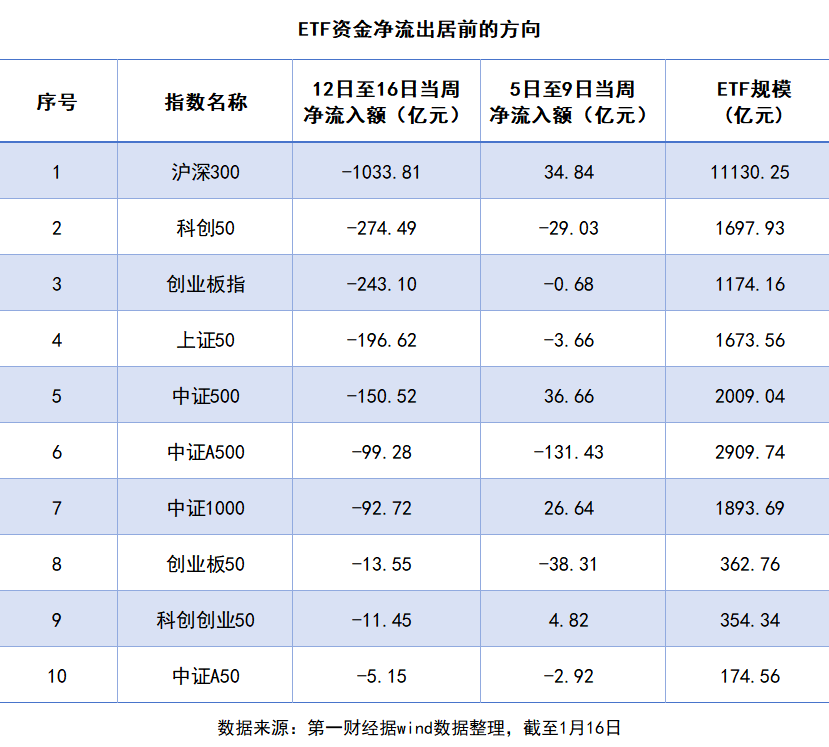
Group 1: Overall ETF Fund Flow Situation - The overall net outflow of the stock ETFs (excluding cross-border) from January 12 to 16, 2026, reached 1412.8 billion, a change of -1436.2 billion compared to the previous week, with a significant outflow of 1545.6 billion occurring on January 15 and 16 alone [12][15] - Money market ETFs have seen continuous net outflows in recent weeks, while A-share industry and thematic ETFs recorded a net inflow of nearly 700 billion in a single week, indicating that individual investors are actively entering the market [15][17] - Hong Kong stock ETFs experienced a net inflow of over 10 billion, continuing the inflow trend, while cross-border industry and thematic ETFs had a net inflow of 104.2 billion, slightly decreasing by 31.6 billion from the previous week [17][21] Group 2: Wide-based/Style/Industry/Sub-sector ETF Fund Flow Analysis - The total net outflow of wide-based ETFs reached 2126.2 billion, with those linked to the CSI 300 index seeing a net outflow of over 1000 billion, while the CSI 500, CSI A500, and other wide-based ETFs also experienced varying degrees of outflow [21][22] - In terms of Smart Beta and major industries, there was a notable inflow in dividend ETFs, particularly in the latter half of the week, while technology and cyclical sectors remain the hottest directions [21][24] - From January 12 to 16, the inflow in the non-ferrous metals sector showed strong sustainability, with software, artificial intelligence, media, and military industries also seeing significant net inflows, although some divergence was observed in the latter half of the week [24][26] Group 3: Representative ETF Fund Flow Overview - The top five ETFs with the highest net inflows from January 12 to 16 were: - Harvest CSI Software Service ETF (75.4 billion) - Southern CSI Shenwan Non-ferrous Metals ETF (63.7 billion) - GF CSI Media ETF (62.7 billion) - Yongying National Satellite ETF (58.0 billion) - Huaxia CSI Electric Grid Equipment Thematic ETF (38.9 billion) - The ETFs with the highest net outflows during the same period included: - Huatai-PB CSI 300 ETF (-475.2 billion) - Huaxia CSI 300 ETF (-269.7 billion) - E Fund Shanghai Stock Sci-Tech 50 ETF (-249.1 billion) - E Fund ChiNext ETF (-239.0 billion) - Huaxia Shanghai Stock 50 ETF (-191.1 billion) [30]
ETF周成交超1.28万亿,资金加速“弃宽基追主题”
Di Yi Cai Jing· 2026-01-18 11:23
Core Viewpoint - A significant shift in the A-share ETF market has occurred, with over 200 billion yuan withdrawn from core broad-based ETFs and nearly 70 billion yuan flowing into thematic industry ETFs, indicating a potential turning point in market trends [1][2][7]. Group 1: ETF Market Dynamics - From January 12 to 16, over 2 trillion yuan was withdrawn from broad-based ETFs, marking a 15-fold increase compared to the previous week and setting a record for weekly net outflows [2][3]. - The core broad-based ETFs, including the CSI 300 and STAR 50, were the main targets for fund withdrawals, with the CSI 300 ETF alone experiencing a net outflow of over 1 trillion yuan [2][3]. - The total trading volume of stock ETFs reached 1.28 trillion yuan during the same week, the highest in five years, reflecting intense trading activity and rapid fund turnover [7]. Group 2: Thematic ETF Inflows - In contrast to the broad-based ETFs, thematic ETFs saw a net inflow of nearly 70 billion yuan, with 117 products receiving over 1 billion yuan in net subscriptions [3][4]. - Key sectors attracting investment included software, media, and semiconductors, with specific products like the Harvest CSI Software Service ETF receiving a net inflow of 75.43 billion yuan, reaching a record size of 146 billion yuan [3][6]. - The satellite internet sector emerged as a focal point for investment, with six satellite-themed ETFs attracting 74.71 billion yuan in net inflows, highlighting a growing interest in this area [3][4]. Group 3: Market Sentiment and Future Outlook - Analysts suggest that the significant outflows from broad-based ETFs and inflows into thematic ETFs may indicate a healthy market adjustment rather than a downturn, as investors seek more flexible and growth-oriented investment opportunities [7][8]. - The recent regulatory environment is seen as a corrective measure to excessive market speculation, with expectations that market sentiment will improve within a couple of weeks [8]. - The ongoing trend of reallocating funds from broad-based to thematic ETFs reflects a broader shift in investor strategy, moving towards long-term asset allocation rather than short-term trading [9].

ETF规模速报 | 传媒ETF净流入超41亿元,沪深300ETF华泰柏瑞净流出超16亿元
Sou Hu Cai Jing· 2026-01-14 01:13
Market Overview - The A-share market experienced a collective adjustment, with the Shenzhen Component Index falling over 1% and the ChiNext Index dropping nearly 2% [1] - AI application concepts rose against the trend, while sectors like commercial aerospace and controllable nuclear fusion saw significant declines [1] ETF Market Activity - On January 13, the non-monetary ETF market saw significant inflows, with the GF CSI Media ETF increasing by 3.12 billion shares and a net inflow of 4.122 billion yuan [1] - The Yongying National Satellite Communication Industry ETF also saw an increase of 894 million shares with a net inflow of 1.886 billion yuan [1] - The Harvest CSI Software Service ETF had an increase of 1.439 billion shares and a net inflow of 1.507 billion yuan [1] Fund Performance - The top-performing ETFs by net inflow for the month include: - GF CSI Media ETF with a net inflow of 7.321 billion yuan and a total fund size of 10.767 billion yuan [4] - Yongying National Satellite Communication Industry ETF with a net inflow of 6.765 billion yuan and a total fund size of 15.592 billion yuan [4] - Southern CSI Nonferrous Metals ETF with a net inflow of 5.941 billion yuan and a total fund size of 29.006 billion yuan [4] Overall ETF Market Statistics - As of January 13, the total ETF shares in the market reached 33,788.87 billion shares, with a total scale of 62,409.89 billion yuan [4] - The consumer sector saw the largest increase in shares, with 10 funds tracking it, while the CSI Media Index had the largest increase in shares with 2 funds tracking it [4]

两市ETF两融余额增加35.1亿元丨ETF融资融券日报
2 1 Shi Ji Jing Ji Bao Dao· 2026-01-13 03:39
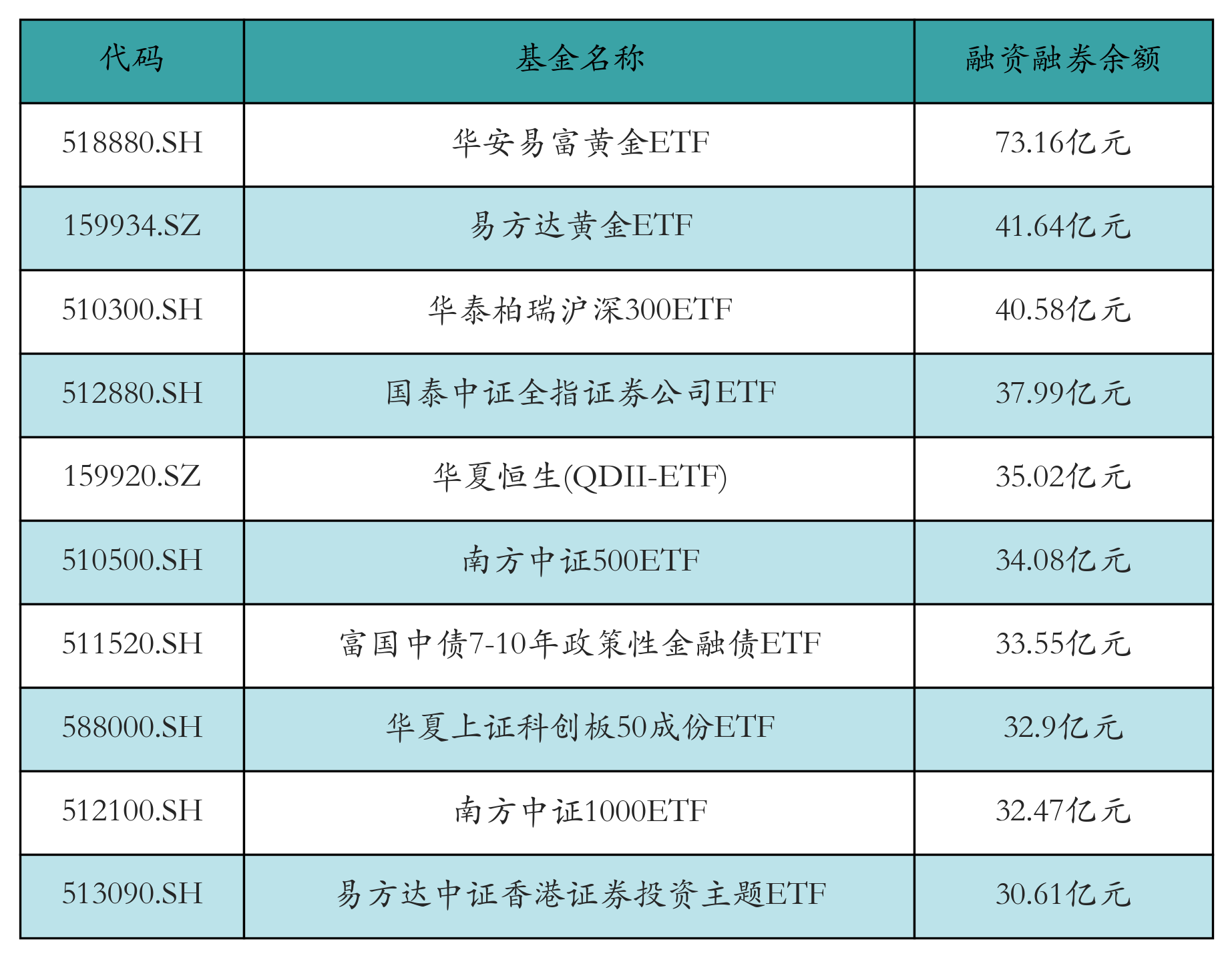
Market Overview - As of January 12, the total ETF margin balance in the two markets reached 122.95 billion, an increase of 3.51 billion from the previous trading day [1] - The financing balance was 114.98 billion, up by 3.24 billion, while the securities lending balance was 7.97 billion, increasing by 0.27 billion [1] - In the Shanghai market, the ETF margin balance was 86.99 billion, an increase of 2.50 billion, with a financing balance of 79.97 billion, up by 2.24 billion [1] - The Shenzhen market's ETF margin balance was 35.96 billion, increasing by 1.01 billion, with a financing balance of 35.01 billion, up by 0.99 billion [1] ETF Margin Balances - The top three ETFs by margin balance on January 12 were: - Huaan Yifu Gold ETF (7.32 billion) - E Fund Gold ETF (4.16 billion) - Huatai-PB CSI 300 ETF (4.06 billion) [2][3] ETF Financing Buy Amounts - The top three ETFs by financing buy amounts on January 12 were: - E Fund CSI Hong Kong Securities Investment Theme ETF (2.10 billion) - Hai Fu Tong CSI Short Bond ETF (1.97 billion) - Bosera CSI Convertible Bonds and Exchangeable Bonds ETF (1.31 billion) [4] ETF Financing Net Buy Amounts - The top three ETFs by financing net buy amounts on January 12 were: - Fuguo 7-10 Year Policy Financial Bonds ETF (681 million) - GF CSI Media ETF (437 million) - Hai Fu Tong CSI Short Bond ETF (208 million) [5] ETF Securities Lending Sell Amounts - The top three ETFs by securities lending sell amounts on January 12 were: - Huatai-PB CSI 300 ETF (51.19 million) - Huaxia CSI A500 ETF (39.12 million) - Southern CSI 500 ETF (24.49 million) [6]
308只ETF获融资净买入 富国中债7—10年政策性金融债ETF居首
Zheng Quan Shi Bao Wang· 2026-01-13 02:04
Core Viewpoint - As of January 12, the total margin balance for ETFs in the Shanghai and Shenzhen markets reached 122.95 billion yuan, reflecting an increase of 3.51 billion yuan from the previous trading day [1] Group 1: ETF Financing and Margin Balances - The ETF financing balance stood at 114.98 billion yuan, up by 3.24 billion yuan compared to the previous trading day [1] - The ETF margin short balance was recorded at 7.97 billion yuan, which is an increase of 0.27 billion yuan from the previous trading day [1] Group 2: Top Performing ETFs - On January 12, a total of 308 ETFs experienced net financing inflows, with the top performer being the Fortune China Bond 7-10 Year Policy Financial Bond ETF, which saw a net inflow of 681 million yuan [1] - Other ETFs with significant net financing inflows included the GF CSI Media ETF, Hai Fu Tong CSI Short-term Bond ETF, Southern CSI 500 ETF, Yongying National Standard Commercial Satellite Communication Industry ETF, Southern CSI 1000 ETF, and Harvest CSI Software Service ETF [1]
传媒ETF、半导体材料设备ETF涨幅居前丨ETF基金日报
2 1 Shi Ji Jing Ji Bao Dao· 2025-11-19 02:46
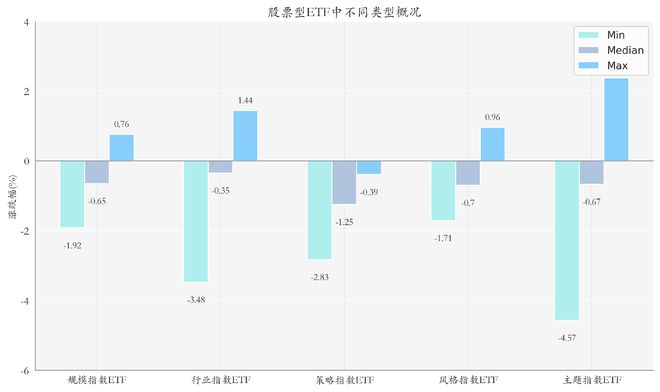
Market Overview - The Shanghai Composite Index fell by 0.81% to close at 3939.81 points, with a high of 3966.89 points during the day [1] - The Shenzhen Component Index decreased by 0.92% to 13080.49 points, reaching a peak of 13223.12 points [1] - The ChiNext Index dropped by 1.16% to 3069.22 points, with a maximum of 3115.31 points [1] ETF Market Performance - The median return of stock ETFs was -0.67% [2] - The highest performing scale index ETF was the Penghua SSE STAR 50 Enhanced Strategy ETF, with a return of 0.76% [2] - The highest performing industry index ETF was the China Securities Software ETF, yielding 1.44% [2] - The highest return among thematic index ETFs was the Guangfa CSI Media ETF, which achieved 2.38% [2] ETF Gains and Losses - The top three ETFs by gain were: - Guangfa CSI Media ETF (2.38%) - Penghua CSI Media ETF (2.35%) - China Securities Semiconductor Industry ETF (2.32%) [4] - The top three ETFs by loss were: - Huatai-PB CSI Battery Theme ETF (-4.57%) - China Securities Battery Theme ETF (-4.57%) - Fortune CSI Battery Theme ETF (-4.46%) [4] ETF Fund Flows - The top three ETFs by fund inflow were: - E Fund ChiNext ETF (1.12 billion) - Fortune SSE Composite Index ETF (653 million) - Huatai-PB CSI 300 ETF (540 million) [6] - The top three ETFs by fund outflow were: - Huaxia SSE 50 ETF (372 million) - Guolian An CSI All-Index Semiconductor Products and Equipment ETF (359 million) - Huabao CSI Bank ETF (333 million) [6] ETF Margin Trading Overview - The top three ETFs by margin buying were: - Huaxia SSE STAR 50 Component ETF (469 million) - E Fund ChiNext ETF (417 million) - Guotai Junan CSI All-Index Securities Company ETF (359 million) [8] - The top three ETFs by margin selling were: - Southern CSI 500 ETF (37.58 million) - Huatai-PB CSI 300 ETF (34.35 million) - Huaxia CSI 1000 ETF (18.28 million) [8] Industry Insights - Huaxin Securities highlighted that the media industry is experiencing structural opportunities driven by AI, focusing on three dimensions: state-owned enterprises leveraging AI for cultural strength, major companies enhancing AI applications, and new media catalyzing the industry chain [9] - Galaxy Securities emphasized that the long-term value of quality content production companies remains unchanged, as they are positioned in the upper-middle of the media industry value chain, representing a scarce resource [10]