
康复护理服务

Search documents
郑州市2026年度民生实事项目确定
Zheng Zhou Ri Bao· 2026-02-10 01:23
Group 1 - The core focus of the news is the approval of ten livelihood projects for the year 2026 during the municipal people's congress meeting [1] Group 2 - The initiative aims to enhance elderly care services by improving rehabilitation capabilities in over six public nursing institutions and distributing at least 50,000 service vouchers for elderly care [2] - A target of creating 129,000 new urban jobs and facilitating the transfer of 25,000 rural laborers is set, along with the goal of training over 93,000 individuals in employment skills [3] - The plan includes attracting over 200,000 new graduates and talents to stay in Zhengzhou, with the provision of 10,000 affordable rental housing units [4] - Newborns will receive free health screenings, with a target screening rate of 95% for two diseases and 65% for prenatal screenings [5] - The addition of 9,870 new compulsory education slots through the construction of six new primary and secondary schools and one public high school [6] - Infrastructure improvements include the renovation of 100 kilometers of rural roads and the establishment of 3,000 new public electric vehicle charging stations [7] - Emergency rescue knowledge will be disseminated to over 100,000 people, with training for 2,500 Red Cross rescuers and 10,000 volunteers [8] - Over 1,700 psychological care activities will be conducted, along with the training of 1,000 psychological care specialists [9][10] - Health check-ups will be provided for 40,000 new employment form workers and other vulnerable groups, along with insurance benefits for union members [11] - The housing provident fund system will be strengthened, aiming for an increase of 200,000 new contributors [12]
“十五五”青海全力打造高原养老服务样板
Xin Lang Cai Jing· 2026-01-18 18:29
Group 1 - The core focus of the 2026 Qinghai provincial civil affairs work meeting is to enhance the balance of elderly care supply and improve community home-based elderly care service facilities coverage and quality, aiming for nursing bed occupancy in care institutions to reach 70% [1] - The meeting emphasizes the integration of elderly services with finance, education, culture, and property sectors, promoting a comprehensive development approach [1] - Qinghai plans to establish a robust elderly service guarantee system and advance the construction of an age-friendly society, encouraging social participation among the elderly and enhancing their rights protection [1] Group 2 - The reform of public-private partnerships in elderly care is being promoted to introduce social forces, enrich service content, and build embedded community elderly care institutions, expanding the coverage of smart elderly care [2] - There is a focus on strengthening the training and development of the elderly care workforce, enhancing skills training, and conducting skill level assessments [2] - Initiatives are being taken to improve care services for elderly individuals with disabilities or dementia, as well as to develop rehabilitation and palliative care services [2]
有人预言,10年后这3个行业比房子更有“钱途”,建议早点了解
Sou Hu Cai Jing· 2026-01-05 13:41
Core Insights - The traditional view of real estate as a "hard currency" is diminishing due to changing market dynamics, demographic shifts, and evolving consumer habits [1] - New investment opportunities are emerging, focusing on long-term demand, recurring purchases, and technological or service barriers [3] Group 1: Aging-Related Industries - Industries related to aging are quietly expanding, with increasing demand for health management, rehabilitation care, functional improvement, and life assistance [5] - This demand is gradual and persistent, leading to strong user loyalty and a business model that resembles a snowball effect rather than quick profits [7] - The aging sector is expected to be one of the least customer-deficient fields in the next decade, despite not being a get-rich-quick industry [7] Group 2: Efficiency-Oriented Businesses - Businesses that enhance efficiency are becoming increasingly valuable, addressing both physical and informational needs [8][9] - The most profitable aspects of these businesses often lie in the underlying systems, services, and solutions, which are scalable and have low replication costs [11] - Compared to real estate, efficiency-driven industries are characterized by being lightweight, fast, and scalable, with higher potential ceilings once a model is validated [11] Group 3: Emotional Value-Driven Consumption - Consumption related to emotional value is being redefined, with consumers willing to pay for feelings of happiness, ease, and understanding [13] - This sector includes leisure activities, companionship services, and niche markets focused on experiences, which are driven by ongoing societal pressures and fast-paced lifestyles [15] - Unlike real estate, these industries are dynamic and present continuous opportunities for those who understand user needs and can operate effectively [15] Group 4: Comparative Analysis with Real Estate - The profitability of these emerging industries is less dependent on economic cycles and more on sustained demand and individual capabilities, contrasting with real estate's reliance on market cycles [17] - Common characteristics of these industries include being less geographically constrained and exhibiting significant compounding effects, with early entry providing greater room for experimentation [17] - Mistakes in real estate investments can incur high adjustment costs, while experiences gained in emerging sectors are not wasted even if initial attempts are flawed [17] Group 5: Long-Term Trends - Trends develop gradually and often go unnoticed until they become mainstream, at which point they may no longer be affordable [19] - Companies and investors are encouraged to consider where to focus their time and energy for long-term growth and to identify potentially undervalued industries [19]


就业失业双涨:美国经济到底谁在说谎?
虎嗅APP· 2025-11-23 10:01
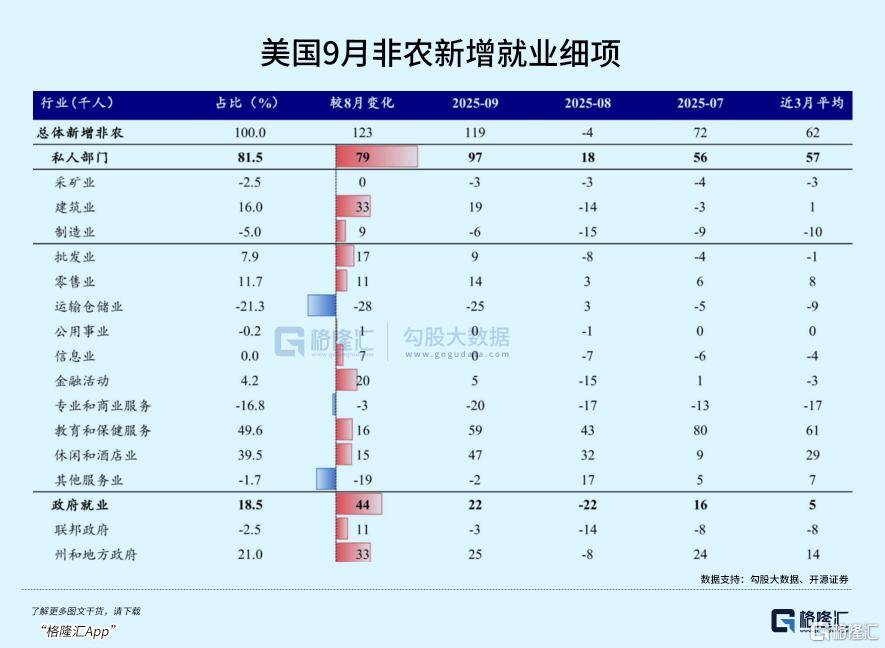
Core Viewpoint - The article discusses the unexpected strength of the U.S. non-farm payroll data for September, highlighting both positive and negative signals in the labor market, and suggests that the apparent economic prosperity may be fragile and accompanied by underlying structural issues. Group 1: Non-Farm Payroll Data Analysis - The U.S. added 119,000 jobs in September, significantly exceeding the expected 51,000, and far above the Dallas Fed's estimate of 30,000 jobs per month [7] - The unemployment rate unexpectedly rose to 4.4%, and revisions to previous months' data showed a downward adjustment of 33,000 jobs, undermining the strength of the September figures [11][12] - The service sector was the main contributor, adding 87,000 jobs, with leisure and hospitality accounting for 47,000 of those jobs, linked to a rebound in consumer spending [18] Group 2: Structural Issues in the Labor Market - There is a structural imbalance in the labor market, with the labor force participation rate rising to 62.4%, indicating an influx of 500,000 workers, but job growth lagging behind, leading to a higher unemployment rate [33] - The average duration of unemployment increased to 21 weeks, with 21% of unemployed individuals taking over 27 weeks to find new jobs, indicating decreased labor market fluidity [37] - Job growth is concentrated in low-wage sectors, which has led to a stagnation in overall wage growth, with average hourly earnings increasing only by 0.2% [42] Group 3: Economic Outlook and Federal Reserve Implications - The article suggests that the strong September data may be a short-term rebound rather than a trend reversal, with ongoing structural issues and tightening credit conditions posing risks to the economy [53] - The Federal Reserve faces internal divisions regarding interest rate policy, with hawks emphasizing employment resilience and doves focusing on rising unemployment rates [50] - Current expectations for the December Federal Reserve meeting indicate a 60% probability of maintaining interest rates, reflecting uncertainty due to data gaps and internal disagreements [52]

脆弱的繁荣
Sou Hu Cai Jing· 2025-11-22 10:53
Core Insights - The U.S. non-farm payroll report for September showed a surprising increase of 119,000 jobs, significantly exceeding expectations of 51,000, which has implications for Federal Reserve interest rate decisions [2][4]. Employment Data Summary - Total non-farm employment increased by 119,000, with private sector jobs contributing 81.5% of the total [3]. - The unemployment rate unexpectedly rose to 4.4%, indicating a potential imbalance in the labor market despite job growth [4][22]. - The service sector was the primary driver of job growth, adding 87,000 jobs, with notable contributions from leisure and hospitality [9][10]. Sector Performance - The leisure and hospitality sector added 47,000 jobs, reversing previous declines, while healthcare added 43,000 jobs, reflecting ongoing demand due to an aging population [9][10]. - Government employment increased by 22,000, primarily in education, as schools ramped up hiring for the new academic year [10][12]. - The transportation and warehousing sector saw a decline of 28,000 jobs, highlighting sector-specific challenges [3]. Data Adjustments and Methodology - August's job numbers were revised down significantly, with a total downward adjustment of 33,000 jobs over July and August, raising questions about the reliability of the data [4][14]. - The discrepancy between establishment survey (119,000 jobs) and household survey (251,000 jobs) indicates structural differences in data collection methods [18][19]. Labor Market Dynamics - The labor force participation rate increased to 62.4%, with a notable influx of younger workers, but this also contributed to the rise in unemployment [23][25]. - Job growth was concentrated in lower-wage sectors, leading to a decline in average wage growth, with average hourly earnings increasing only by 0.2% [29][30]. Economic Outlook - The strong job numbers may be a short-term rebound rather than a trend reversal, with potential risks from tightening credit conditions and global demand slowdown [39][40]. - The Federal Reserve faces a dilemma with mixed signals from the labor market, leading to internal divisions on interest rate policy [36][38].
养殖收缩、白酒下滑、押宝医疗,大湖股份再度更名发力大健康
Bei Ke Cai Jing· 2025-10-31 12:26
Core Viewpoint - The company has officially changed its name from "Dahu Aquaculture Co., Ltd." to "Dahu Health Industry Co., Ltd." to better reflect its current business focus on health products and medical services, moving away from traditional aquaculture [1][2][3]. Business Transformation - The name change is part of a strategic shift towards health products and medical services, with medical service revenue now accounting for over 40% of total revenue, while aquaculture has significantly decreased [1][4][5]. - The company has divested from loss-making aquaculture assets, leading to a structural change in revenue sources, with medical and processed food businesses growing [3][4][6]. Financial Performance - For the first half of 2025, the company reported a revenue decline of 14.4% to 426 million yuan, but net profit improved by 81.34% to a loss of 2.57 million yuan [6][16]. - The aquaculture segment saw a revenue drop of 17.60%, while processed food revenue grew by 18.06%, indicating a shift in consumer demand [6][8]. Aquaculture Segment - The company has reduced its reliance on traditional aquaculture, with the revenue contribution from this segment falling from 36.02% to 3.63% in just over a year [4][5]. - The divestment of the live turtle business has led to a significant reduction in revenue but has also improved profitability in the remaining aquaculture operations [7][9]. Alcohol Segment - The white wine segment experienced a revenue decline of 17.06%, attributed to increased competition and changing consumer preferences [10][11]. - The company is focusing on developing new products to address market changes, but existing products have seen significant sales declines [12][13]. Medical Services Segment - Medical service revenue fell by 8.36% in the first half of 2025, contrasting with previous growth, due to various operational challenges and changes in healthcare policies [14][16]. - The company operates several rehabilitation and nursing hospitals, with varying performance across these facilities [15][17].

提高供给品质激发消费需求
Jing Ji Ri Bao· 2025-09-07 22:13
Core Insights - The Ministry of Finance, in collaboration with relevant departments, has launched two subsidy policies aimed at personal consumption loans and service industry loans, targeting both consumer demand and service supply to stimulate consumption and improve livelihoods [1][2] - The policies are designed to create a long-term mechanism for a virtuous cycle of supply and demand, addressing current pain points in the consumption market while meeting the growing needs of the population for a better quality of life [1][2] Group 1: Policy Implementation - The subsidy policies will provide financial support to service industry entities, particularly small and medium-sized enterprises and individual businesses, which are significantly affected by financing costs, credit support scale, and cash flow stability [1][2] - The policies aim to enhance service supply quality, enabling businesses to invest in advanced medical equipment, improve service personnel training, and upgrade infrastructure in tourism, thereby offering higher quality services to consumers [1][2] Group 2: Demand Creation - Improving service quality is essential for stimulating and creating consumer demand, as better service experiences can lead to increased consumer willingness to spend and expand market size [2][3] - The virtuous cycle created by these policies will allow businesses to achieve better returns, which in turn enhances their motivation and capacity for further innovation and supply improvement [2][3] Group 3: Effective Utilization of Funds - To ensure that the policy benefits translate into market vitality, there is a need for precise implementation and effective supervision, ensuring that subsidy loans are directed towards enhancing service supply capabilities [2] - Financial institutions must prevent misuse of funds and ensure that the subsidy is used for technological upgrades, talent training, and innovative models rather than merely expanding scale [2]
宁夏出台《全区养老服务资源优化布局实施方案》
Ren Min Ri Bao· 2025-08-12 22:29
Group 1 - The Ningxia Hui Autonomous Region has issued an implementation plan for optimizing the layout of elderly care service resources [1] - The plan aims to establish 1-2 standardized elderly care institutions in each of the 5 prefecture-level cities, providing specialized services such as disability care and rehabilitation nursing [1] - A minimum of 140 community elderly care service facilities will be added to create a "15-minute elderly care service circle" [1] Group 2 - The plan includes utilizing idle school buildings and township health centers to increase around 60 regional comprehensive elderly care service centers with functions like full-day care, daytime care, and home-based services [1] - Approximately 400 rural elderly care service facilities will be added, while around 30 will be merged, in line with the development planning of "four types of villages" [1] - The construction of around 180 village-level elderly care service stations will be precisely supplemented [1] Group 3 - By 2027, a three-tier elderly care service network at the county, township, and village levels is expected to be initially formed, with community daytime care institutions and elderly care facilities achieving full coverage [1] - The coverage rate of comprehensive elderly care service centers in townships is targeted to reach 70%, with the occupancy rate of elderly care institutions increasing to 45% [1] - By 2030, the three-tier elderly care service network will continue to improve, with the coverage rate of comprehensive elderly care service centers in townships reaching 80% and the occupancy rate of elderly care institutions increasing to 50% [1]