康师傅饮料

Search documents
春节动销渠道观察
2026-02-24 14:16
Summary of Conference Call on Food and Beverage Industry Industry Overview - The conference focused on the food and beverage industry, particularly during the Chinese New Year period, with insights from experts in the field [1][2]. Key Points and Arguments Sales Performance by Category - Overall sales during the Chinese New Year period showed a growth of approximately 10% compared to the previous year, primarily driven by gift boxes [2]. - Specific categories reported varied growth rates: - **Dairy Products**: - Growth in ambient yogurt was around 3-4%, marking a positive shift from previous negative growth trends [3]. - Liquid milk showed a growth rate of about 7%, with Yili at approximately 8% and Mengniu around 5-6% [3]. - Infant formula experienced a negative growth due to inventory issues and recalls affecting brands like Nestlé and Feihe, while A2 and Junlebao performed well [4][5]. - **Frozen Foods**: - The leading brand, Anjing, reported an 18% growth, while the second tier brands averaged around 5-6% growth [6]. - **Condiments**: - Growth was lower than the previous year, with Hai Tian at 3% compared to 6% last year, attributed to a decline in restaurant sales [7][8]. - **Beverages**: - Notable growth in brands like Nongfu Spring and Dongpeng, with Nongfu Spring achieving a 15% growth [8][9]. Factors Influencing Sales - Seasonal factors played a significant role, with the timing of the Chinese New Year affecting sales cycles, resulting in fewer business days compared to previous years [12][13]. - Inventory management was crucial, with many products sold being produced in January, leading to a fresh stock perception among consumers [14][15]. - Consumer behavior shifted towards essential goods, with a focus on necessary items rather than premium or novelty products [16][17]. - Price stability was noted, with fewer discounts compared to previous years, indicating a healthier pricing environment [17]. Market Trends - Community and convenience stores contributed significantly to sales, while traditional supermarkets showed weaker performance [18][41]. - The growth of community group buying and snack retailing was highlighted as a key trend, especially in rural and suburban areas [18][41]. - The beverage market saw a rise in demand for sugar-free and health-oriented products, with unsweetened tea growing at around 18% [21]. Brand-Specific Insights - **Yili and Mengniu**: Both brands set ambitious growth targets of 5-8% and 10% respectively, with cautious optimism based on early performance [20][21]. - **Dongpeng**: Reported a 14% growth, driven by energy drinks and electrolyte water, although growth rates were expected to slow down due to market saturation [24][25]. - **Hai Tian**: Aiming for a 5% growth target, with challenges in the restaurant sector impacting overall performance [43][51]. Challenges and Risks - The industry faces challenges from fluctuating consumer preferences and potential economic downturns affecting discretionary spending [12][13]. - Brands like Three Squirrels and others reported lower-than-expected growth, indicating potential market saturation and changing consumer tastes [29][32]. Additional Important Content - The conference highlighted the importance of adapting marketing strategies to current consumer trends, emphasizing the need for brands to focus on essential products and maintain competitive pricing [16][17]. - The discussion also touched on the impact of seasonal employment patterns on restaurant sales, which could affect future growth in the condiment sector [44][50]. This summary encapsulates the key insights and trends discussed during the conference call, providing a comprehensive overview of the food and beverage industry's performance during the Chinese New Year period.



微信上线引用功能、吉利营收破1500亿、柯达35亿债务无法偿付
3 6 Ke· 2025-08-14 14:32
Group 1: WeChat New Feature - WeChat has announced the launch of a new feature that allows users to quote specific parts of text in chat replies, improving the quoting functionality from previously only being able to quote entire messages [3] Group 2: Geely Automobile Performance - Geely Automobile reported a record revenue of 150.28 billion RMB for the first half of the year, marking a 27% year-on-year increase [4] - However, the company's net profit decreased by 14% year-on-year to 9.29 billion RMB [4] Group 3: Kodak Financial Crisis - Kodak has reported a net loss of 26 million USD in the second quarter, reversing from profit to loss year-on-year [5] - The company is facing a significant financial challenge, with approximately 5 billion USD (around 35.9 billion RMB) in debt that it currently cannot repay [5] Group 4: Industry Trends - After a price increase of 0.5 RMB, Master Kong's beverage sales dropped by 700 million RMB, yet management has stated that they will not reduce prices [6] - The coffee market is experiencing pressure, with reports indicating that a 9.9 RMB coffee is negatively impacting independent coffee shops, and a franchisee lost 2 million RMB within six months of opening [8]

康师傅少卖了11亿,饮料、方便面都在跌
21世纪经济报道· 2025-08-12 10:59
Core Viewpoint - The company is experiencing significant growth pressure, with a decline in revenue across major product categories, while its competitor shows growth in the same sector [1][2]. Group 1: Financial Performance - In the first half of 2025, the company's revenue was approximately 40.092 billion yuan, a year-on-year decrease of 2.7%, with sales dropping over 1.1 billion yuan [1]. - The net profit attributable to the parent company was 2.271 billion yuan, reflecting a year-on-year increase of 20.5% [1]. Group 2: Product Category Performance - The company's instant noodle business saw a sales decline of 2.5% to 13.465 billion yuan, with specific categories showing varied performance: - Container noodles down 1.3% to 6.771 billion yuan - High-priced bag noodles down 7.2% to 5.092 billion yuan - Mid-priced bag noodles up 8.0% to 1.372 billion yuan - Dry noodles and others up 14.5% to 0.23 billion yuan [1]. - In contrast, the competitor's food business revenue was 5.38 billion yuan, with an 8.8% year-on-year growth, driven by double-digit growth in specific products [1]. Group 3: Beverage Segment Performance - Beverage revenue declined by 2.6% to 26.359 billion yuan, with specific declines in: - Tea beverages down 6.3% to 10.67 billion yuan - Water sales down 6.0% to 2.377 billion yuan - Juice sales down 13.0% to 2.956 billion yuan - Carbonated and other beverages up 6.3% to 10.256 billion yuan [2]. Group 4: Distribution Network Adjustments - The company is reducing its distribution network, with the number of marketing agents decreasing from 67,215 to 63,806, and direct retailers decreasing from 220,623 to 219,124 [2].

康师傅少卖了11亿元:饮料、方便面都在跌丨消费参考
2 1 Shi Ji Jing Ji Bao Dao· 2025-08-12 00:08
Summary of Key Points Core Viewpoint - 康师傅 is experiencing significant growth pressure, with a decline in revenue despite an increase in net profit, indicating a shift in consumer preferences and market dynamics [1][2]. Revenue Performance - 康师傅 reported a revenue of approximately 400.92 billion yuan for the first half of 2025, a year-on-year decrease of 2.7%, with sales dropping by over 1.1 billion yuan [1]. - The company's net profit attributable to shareholders was 22.71 billion yuan, reflecting a year-on-year increase of 20.5% [1]. Segment Analysis - The sales of 康师傅's main product categories are declining: - Instant noodles sales decreased by 2.5% to 134.65 billion yuan, with container noodles down 1.3% to 67.71 billion yuan, high-priced bag noodles down 7.2% to 50.92 billion yuan, and mid-priced bag noodles up 8.0% to 13.72 billion yuan [2]. - The beverage segment saw a revenue decline of 2.6% to 263.59 billion yuan, with tea drinks down 6.3%, water down 6.0%, and fruit juice down 13.0%, while carbonated and other beverages increased by 6.3% [3]. Market Strategy - 康师傅 is reducing its distribution network in response to market pressures, with the number of marketing agents decreasing from 67,215 to 63,806 and direct retailers from 220,623 to 219,124 [4]. Competitive Landscape - In contrast, the food business of 统一企业 is performing well, with a revenue increase of 8.8% to 53.8 billion yuan, highlighting a trend towards "consumption upgrade" in the market [2][3].
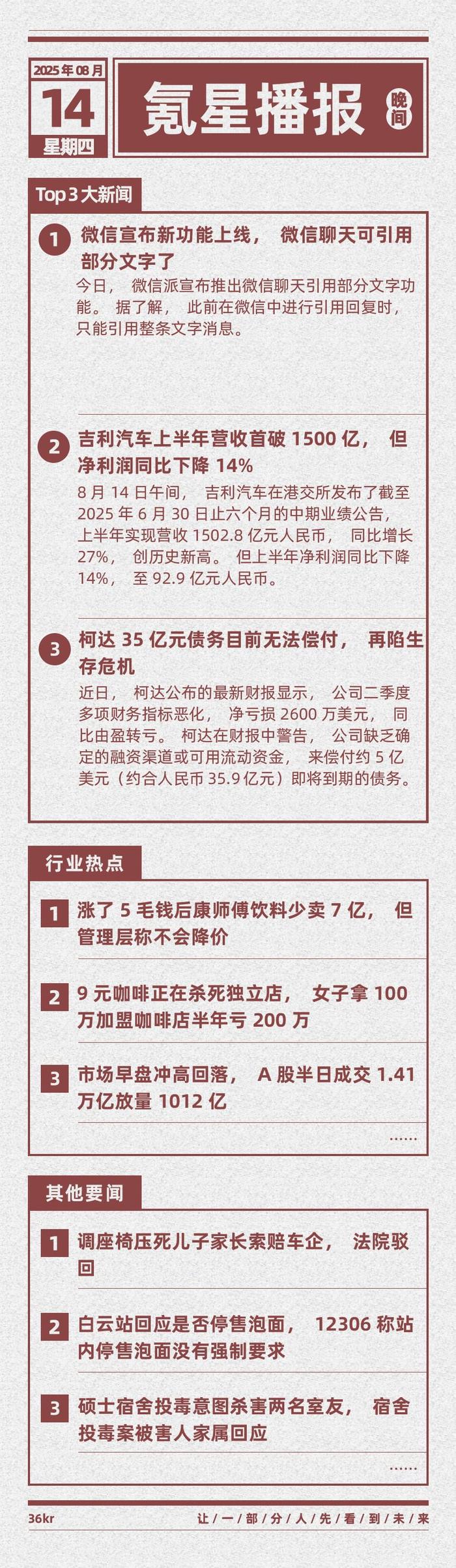
罗森青岛首店开业;余惠勇回应百果园水果太贵
Sou Hu Cai Jing· 2025-08-11 21:27
Group 1 - Lawson opened its first store in Qingdao, with a total of 7 stores launched simultaneously, marking a significant step in its expansion strategy in Shandong, aiming to establish 1,000 stores in the province [7] - Baiguoyuan's chairman addressed the issue of high fruit prices, emphasizing the company's commitment to quality and consumer education, stating that good fruit is in high demand and that they will not compromise on quality despite potential price reductions [9] - Pop Mart's flagship store in Thailand, which is the largest globally at 760 square meters, has been criticized for resembling Miniso's design, although neither company has officially responded to the claims [10] Group 2 - Hema released a consumption trend report for its 10th anniversary, focusing on "freshness, health, and self-satisfaction" as key product directions, and has built a large supply chain network to ensure the quality of fresh produce [12] - AliExpress reported a 100% year-on-year increase in overseas sales of domestic beauty products, with Europe, Mexico, Brazil, and Japan being the main growth markets [13] - Wahaha announced a 1 billion yuan investment in a new beverage production base in Xi'an, which will include multiple production lines for various beverages [14] Group 3 - The retail industry in China saw a CRPI of 50.1 in August, indicating a return to expansion, with a 0.5 percentage point increase from the previous month [19] - Tmall Supermarket expanded its same-day delivery service to 8 new cities, achieving a delivery punctuality rate of over 97%, with plans for further expansion [21] - On August 7, over 300,000 small restaurant businesses achieved peak sales on Taobao Flash Sale, with delivery riders on Ele.me increasing to 3.5 times last year's numbers [23]