无糖食品

Search documents
【提示】无糖食品真的不含糖分吗?来看科普→
Xin Lang Cai Jing· 2026-01-31 13:19
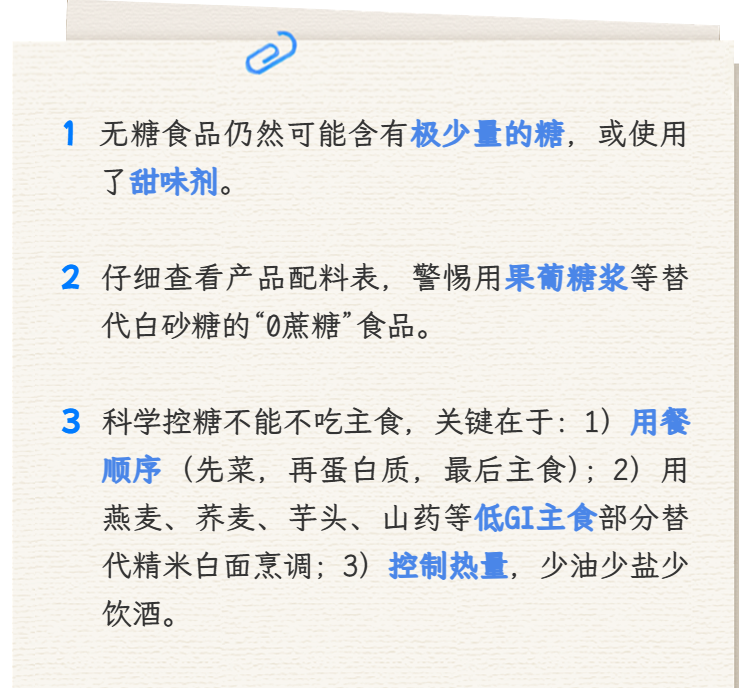
Core Viewpoint - The rise of "sugar-free" products in the market is misleading, as these items may still contain sugar or ingredients that can affect blood sugar levels, making it essential for consumers, especially those with diabetes, to be cautious and informed about their choices [1][3]. Group 1: Misconceptions about "Sugar-Free" Products - "Sugar-free" does not mean 100% free of sugar; products can be labeled as such if they contain ≤0.5 grams of sugar per 100 grams or 100 milliliters [3]. - Many "sugar-free" products use sweeteners but still contain ingredients like flour and fats that can convert to glucose, potentially leading to increased blood sugar levels if consumed excessively [3]. - The term "0 sugar" can be misleading, as some products may contain high-glycemic ingredients like starch syrup or maltose syrup, which can raise blood sugar levels more than regular sugar [3]. Group 2: Dietary Misconceptions for Diabetics - Misconception 1: Avoiding staple foods entirely can lead to low blood sugar or muscle loss; a balanced intake of 200-300 grams of staple foods daily is recommended, with an emphasis on whole grains and legumes [5]. - Misconception 2: A purely vegetarian diet may lead to protein deficiency; it is advised to include quality proteins from fish, poultry, and lean meats along with plenty of dark vegetables [6]. - Misconception 3: Not all fruits should be avoided; low-GI fruits can be consumed in moderation when blood sugar levels are stable [7]. Group 3: Guidelines for Healthy Eating - The 2023 "Adult Diabetes Dietary Guidelines" emphasize the importance of meal order and food variety, recommending starting with vegetables, followed by proteins, and then carbohydrates to slow sugar absorption [7]. - Preferred staple foods include oats and buckwheat, which can help improve blood sugar control [7]. - Cooking should adhere to the "three less" principle: limit daily oil to ≤25g, salt to ≤5g, and alcohol to ≤15g for women and ≤25g for men [7]. - Effective diabetes management focuses on total intake control and optimizing food structure rather than simply avoiding sweets; "sugar-free" products can be included but should be consumed with caution regarding total caloric intake and ingredient scrutiny [7].

【2025榜单】5万亿赛道,30个破局者,15条洞察:中国新银发消费品牌TOP30年度榜
新消费智库· 2026-01-19 14:32
Core Insights - The aging population in China is projected to exceed 297 million, creating a massive market for elderly products, estimated to surpass 50 trillion yuan [2] - Currently, there are over 60,000 types of elderly products globally, but only about 2,000 are produced at scale in China, indicating a significant supply-demand gap [2] - The purchasing power primarily lies with the children of the elderly, who are caught between emotional concerns and practical needs [6][7] Group 1: Consumption Trends - Elderly consumers are willing to spend on health and entertainment, prioritizing products that enhance their longevity and enjoyment of life [6] - The majority of purchases are made by children, who often pay for expensive items like smartwatches and massage chairs, emphasizing the need for dual marketing strategies targeting both generations [7][8] - Elderly individuals are increasingly tech-savvy, often outperforming younger generations in using smartphones and apps, indicating a demand for user-friendly designs rather than "senior versions" of products [10] Group 2: Product Design and Marketing - Effective elderly products should focus on simplicity, removing unnecessary features to avoid confusion [11][12] - Many elderly consumers buy health monitoring devices not for strict data tracking but for peace of mind, highlighting the emotional aspect of health management [13] - Community influencers, such as local shopkeepers, are more effective in promoting products than celebrity endorsements, emphasizing the importance of trust in marketing [14] Group 3: Emerging Business Models - The rental market for medical and rehabilitation equipment is growing, as it offers a cost-effective solution for short-term needs [15] - Companies must focus on genuine product quality and user needs rather than merely meeting subsidy standards to ensure long-term viability [16] - The market for elderly products is vast but under-supplied, with many existing products failing to meet the actual needs and preferences of elderly consumers [17] Group 4: Consumer Behavior - Elderly consumers are cautious decision-makers, often requiring extensive research before making purchases, leading to high brand loyalty once trust is established [20] - They are sensitive to price but prioritize perceived value and effectiveness over mere affordability [21] - Consumption is often driven by necessity rather than desire, with elderly consumers seeking solutions to specific life challenges [22] Group 5: Trust and Authority - Trust in authority figures has evolved, with elderly consumers now valuing advice from family members and community peers alongside traditional experts [24] - Many elderly individuals play a significant role in family purchasing decisions, acting as key financial managers and decision-makers for household needs [26] Group 6: Innovative Brands - The article highlights 30 innovative brands catering to elderly consumers, including those focused on health, home care, and lifestyle products, showcasing the diversity and potential within the silver economy [27][28][29]

四大控糖“陷阱” 你掉进几个
Bei Jing Qing Nian Bao· 2025-12-02 01:28
Core Viewpoint - The article discusses common misconceptions about sugar control diets and emphasizes the importance of understanding food labels and nutritional content for individuals managing their blood sugar levels [1] Group 1: Misconceptions about Sugar Control - Misconception 1: Consuming "sugar-free" foods is completely safe. "Sugar-free" only indicates sugar content ≤0.5g/100g, but these foods may still contain starch and sugar alcohols that can raise blood sugar levels [2] - Misconception 2: Avoiding staple foods will lower blood sugar. Not consuming staple foods can lead to low blood sugar, nutrient imbalance, and muscle loss, ultimately making weight control more difficult [3][4] Group 2: Fruit Consumption and Alcohol Intake - Misconception 3: Diabetics should not eat fruit. Fruits provide essential vitamins and fiber, and when consumed wisely, can aid in blood sugar management. It is important to choose low glycemic index fruits and control portion sizes [5][6] - Misconception 4: Stable blood sugar allows for increased alcohol consumption. Alcohol can significantly impact blood sugar levels and may lead to complications. It is recommended that diabetics limit alcohol intake and avoid drinking on an empty stomach [7]
有关糖尿病的7个误区,千万别再信了!丨中新真探
Zhong Guo Xin Wen Wang· 2025-11-14 08:41
Core Points - The article addresses common misconceptions about diabetes management, particularly regarding dietary restrictions for diabetic patients [1] - It emphasizes the importance of understanding glycemic index (GI) and glycemic load (GL) when considering food choices for blood sugar control [4][8] Dietary Misconceptions - Diabetic patients can consume sweet foods, but they should focus on low-GI options and manage portion sizes to avoid blood sugar spikes [5] - Water-rich fruits like watermelon can be consumed in moderation, as they have a low glycemic load (4.9) and can provide essential nutrients without causing significant blood sugar fluctuations [7][8] - "Sugar-free" foods are not necessarily safe for unlimited consumption, as they may still contain carbohydrates that can affect blood sugar levels [10][11] Carbohydrate Management - Limiting staple foods is necessary for controlling total caloric intake, but it does not mean that they should be completely eliminated from the diet [14] - Carbohydrates are essential for energy, and overly restricting them can lead to negative health effects, including low blood sugar [15] Insulin Resistance - The notion that feeling sleepy after eating indicates insulin resistance is unfounded; various factors contribute to post-meal drowsiness [18][19] Sugar Consumption - Excessive sugar intake does not directly cause diabetes but can lead to obesity, which is a significant risk factor for developing the disease [22][23] Dairy Consumption - Diabetic patients can consume yogurt, particularly low-sugar or sugar-free varieties, as they have a lower glycemic index compared to other carbohydrate sources [26]

无糖食品不升血糖?胰岛素有药物依赖?都是误区
Qi Lu Wan Bao· 2025-10-04 03:27
Group 1 - The article discusses common misconceptions about "sugar-free" foods and their impact on blood sugar levels [2][4] - "Sugar-free" foods are defined as those containing no more than 0.5 grams of sugar per 100 grams or 100 milliliters, but they may still contain other ingredients that can affect blood sugar [4] - The popularity of sugar-free beverages is noted, but these may include high glycemic index additives like dextrin or maltodextrin, which can raise blood sugar levels [4] Group 2 - Concerns about insulin dependency among diabetes patients are addressed, clarifying that insulin is necessary for blood sugar regulation and does not lead to drug dependency [6] - Experts emphasize that insulin use is a response to the body's inability to produce or utilize insulin effectively, and proper dosage does not harm the body [6]
错过了黄金、AI、比特币,普通人下一个赚钱风口是什么?
天天基金网· 2025-05-11 01:16
Core Viewpoint - The article highlights emerging business opportunities in various sectors driven by demographic trends and technological advancements, emphasizing the potential for profitability in these areas. Group 1: AI Economy - AI tools can be utilized for content creation, live streaming, and e-commerce, leading to low costs and high efficiency [1] - The maturity of AI technology allows ordinary individuals to leverage these tools for income generation, with some earning over 10,000 yuan monthly through AI-driven services [1] Group 2: Silver Economy - The aging population presents opportunities in elder care services, such as nursing homes and home care [2] - With nearly 320 million individuals aged 60 and above in China, the demand for related services is expected to grow significantly [2] Group 3: Singles Economy - Business opportunities include single-person dining establishments and mini-appliances tailored for solo living [3][4] - The single population in China is approximately 240 million, indicating a strong market for products and services catering to their lifestyle [4] Group 4: Pet Economy - The pet industry can capitalize on services like veterinary care and premium pet products [5] - Young consumers are willing to spend significantly on their pets, often prioritizing pet expenses over their own [6] Group 5: Cross-Border E-commerce - Opportunities exist in selling Chinese products internationally through platforms like Temu and TikTok Shop [6] - The competitive domestic market drives businesses to seek growth in overseas markets, where demand for cost-effective Chinese goods is high [7] Group 6: Low-altitude Economy - Business prospects include drone delivery services and the development of flying cars [8] - Policy changes and technological advancements are expected to drive growth in this sector, similar to the electric vehicle market [9] Group 7: Health and Wellness - The health sector offers opportunities in wellness products, traditional medicine services, and health management applications [10] - The increasing focus on health among both young and elderly populations ensures a steady demand for health-related products [11] Summary - Ordinary individuals can find low-barrier entry points in AI tools, pet services, and products for singles [12] - Long-term trends in the silver economy and low-altitude technology may require more investment but benefit from strong policy support [13] - The cross-border e-commerce and health sectors are identified as essential needs with relatively lower risks [14]