智慧医疗

Search documents
金观平:以人为本打造智慧城市
Jing Ji Ri Bao· 2026-02-10 03:08
Core Viewpoint - The construction of smart cities is essential for modernizing urban governance systems and capabilities, focusing on enhancing the efficiency and intelligence of urban management [1] Group 1: Smart City Development - Smart city development should align with the trend of digital intelligence, improving the precision and intelligence of urban governance [1] - Smart city initiatives are not merely hardware upgrades but should prioritize the sense of gain, happiness, and security of the people [1] - Successful examples include Beijing's "Immediate Response to Complaints" platform, Suzhou's smart elderly care services, and Chengdu's smart traffic systems, which effectively address public needs and improve livelihoods [1] Group 2: Challenges in Smart City Initiatives - Some regions have deviated from the original intent of serving the public, engaging in hardware procurement without practical application, leading to unused smart devices [2] - There is a tendency to create superficial "screen landscapes" that do not connect with public services, resulting in wasted resources and increased burdens on local governments [2] - The focus should be on integrating technology with public needs, ensuring that smart city initiatives are practical and beneficial to the community [2] Group 3: Building a Supportive Framework - A comprehensive support system is necessary for the sustainable operation of smart cities, including strengthening technical support and creating a unified digital infrastructure [3] - It is crucial to establish mechanisms for data security and personal information protection while promoting collaborative governance involving government, market, and social organizations [3] - Smart cities should enhance governance levels and optimize public services, ensuring that the benefits of digital advancements are shared by all citizens [3]
塞力医疗:预计2025年度净利润为-1.6亿元到-2.09亿元
Sou Hu Cai Jing· 2026-01-29 08:49
Core Viewpoint - The company, Saili Medical, anticipates a net loss attributable to shareholders of between -160 million RMB and -209 million RMB for the fiscal year 2025, indicating a reduction in losses compared to the previous year [1] Group 1: Financial Performance - The expected net loss for 2025 represents a decrease in losses by 49.2397 million RMB to 2.397 million RMB year-on-year [1] - The primary reason for the performance change is a decline in operating revenue [1] Group 2: Strategic Changes - The company is undergoing a strategic transformation, which includes the transfer of part of its controlling subsidiaries, resulting in these subsidiaries no longer being included in the consolidated financial statements [1] - The decision to not renew certain business contracts after their expiration has also contributed to the decline in operating revenue [1] Group 3: Research and Development - The company is increasing its investment in research and development within the smart medical field, which is impacting profitability due to higher R&D expenses [1]

聚焦优化医养护理、释放“体育+”消费潜力等,18位山东省政协委员作大会发言
Qi Lu Wan Bao· 2026-01-28 12:28
Group 1: Development of Health Service Industry - The health service industry is identified as a new engine for economic development, with a projected total scale of 16 trillion yuan by 2030, driven by factors such as population aging and consumer upgrades [2] - Recommendations include leveraging data resources from the National Health Medical Big Data Center to cultivate new business models like telemedicine and smart healthcare, integrating AI with medical robots and elderly monitoring devices [2] - The establishment of medical tourism centers in regions with significant advantages, such as Jinan, Qingdao, and Yantai, is suggested to enhance healthcare services and attract consumption [2] Group 2: Optimization of Elderly Care and Rehabilitation - A proposal to establish a collaborative mechanism for services for disabled elderly individuals at the municipal and county levels, integrating medical, elderly care, and rehabilitation resources [3] - The promotion of a "two-in-one" model combining hospitals and nursing homes at the township level to create comprehensive service complexes is recommended [3] - Suggestions include enhancing service quality through training programs for elderly care skills and implementing long-term care insurance to cover community rehabilitation and psychological support services [3] Group 3: Promotion of Sports and Fitness - The province achieved first place in both total gold and medal counts at the 15th National Games, emphasizing the importance of mobilizing public participation in fitness activities to improve health and quality of life [4] - Recommendations include enhancing the development of specialized and intelligent sports equipment to meet public demand and extending the sports industry chain through integrated services [4] - The establishment of a multi-level event system, including professional competitions and community sports events, is suggested to promote sports culture and regional consumption [4]
服务保障首都功能弘扬使命价值
Xin Lang Cai Jing· 2026-01-26 00:26
Core Viewpoint - The Dongcheng District aims to implement the spirit of the 20th National Congress and subsequent plenary sessions, focusing on enhancing capital functions and achieving a strong start in the 14th Five-Year Plan [1][2] Group 1: Economic Development - Dongcheng District will enhance economic momentum by constructing a "two axes, two belts, and multiple clusters" industrial layout, focusing on cultural, financial, and technological innovation industries [1] - The district plans to strengthen its headquarters economy and explore mechanisms for the evaluation of special medical foods, aiming to establish standardized pilot projects in traditional Chinese medicine and smart healthcare [1] - Efforts will be made to expand effective investment and promote the commencement of key projects [1] Group 2: Cultural Confidence - The district will emphasize its cultural identity by enhancing urban characteristics and launching renovation projects for key cultural heritage sites such as the Yongdingmen Tower and the Bell Tower [2] - There will be a focus on activating the cultural industry by innovating in emerging fields like animation, gaming, and digital performances, aiming to enhance both brand recognition and market sales [2] - The district plans to upgrade cultural venues and improve services for the Beijing Cultural Forum, contributing to a vibrant cultural landscape [2] Group 3: Social Welfare - Dongcheng District will prioritize employment stability, particularly for key groups such as recent graduates, and will work on comprehensive renovations of old residential areas [2] - The district aims to deepen educational reforms, expand secondary school capacities, and enhance healthcare services through integrated medical networks [2] - A three-year action plan for environmental quality improvement will be initiated, focusing on projects like the enhancement of the surrounding areas along the North-South River Avenue [2]
千年商都每五人有一个是“老板”
Nan Fang Du Shi Bao· 2026-01-22 23:10
Core Insights - The central economic work conference emphasizes expanding domestic demand and stimulating consumption potential, particularly in Guangzhou and Guangdong province, which are experiencing new development opportunities [3] Group 1: Business Vitality - Guangzhou's total business entities surpassed 4.2 million, with a year-on-year growth rate of 15.86% as of October 2025, indicating a robust entrepreneurial spirit in the city [3][4] - The city has achieved significant milestones in business growth, with the latest increase from 300,000 to 400,000 entities occurring in just three years, showcasing an unprecedented growth trend [4] - The number of enterprises has exceeded 2.6 million, with individual businesses making up 65% of this total, ranking second among major cities in China [5] Group 2: Employment Support - In 2025, Guangzhou added over 350,000 urban jobs, providing a solid foundation for income growth and consumer spending [6] - The top three industries contributing to new jobs are wholesale and retail (395,800 jobs, 38%), rental and business services (163,800 jobs, 15.7%), and information technology services (86,600 jobs, 8.3%) [6] - The growth of low-barrier sectors such as dining, leisure, and training reflects a dual-driven economy in Guangzhou, balancing basic and high-quality employment opportunities [6] Group 3: Consumption Activation - The diverse business ecosystem and strong employment base in Guangzhou are fostering a fertile ground for consumption potential, with significant events like the 138th Canton Fair generating a record export intention of $25.65 billion [8] - The upcoming 15th National Games is expected to drive total consumption to exceed 150 billion yuan, further energizing local businesses [8] - New consumer trends are emerging, with strategic industry clusters showing remarkable growth rates, such as fashion consumer goods (100.87%) and low-altitude economy (161.74%) [8] Group 4: Foreign Investment Quality - The Guangdong foreign enterprise top 100 list includes major companies like BASF and Siemens, with a total direct investment of $30.4 billion in the province [11] - Guangzhou is a key city for foreign investment, with 90 of the top 100 foreign enterprises concentrated in the Pearl River Delta, particularly in high-tech and knowledge-intensive sectors [12] - Long-term foreign enterprises in Guangzhou have introduced capital, technology, and international consumer concepts, enriching the local market [13] Group 5: Business Environment - Guangzhou has optimized its business environment, significantly reducing the time to process business licenses from 20 days to under 10 minutes, with a 99% online application rate [14] - Continuous improvements in government services and policies aim to support business growth and attract talent, which is crucial for high-end consumption [14] - Future recommendations include enhancing market access and addressing financing challenges for private enterprises [14]

海峡创新跌2.03%,成交额1.98亿元,主力资金净流出911.59万元
Xin Lang Cai Jing· 2026-01-19 02:16
Group 1 - The core viewpoint of the news is that Haixia Innovation's stock has experienced significant fluctuations, with a notable decline in recent trading days, while the company continues to operate in the smart city and smart healthcare sectors [1][2]. Group 2 - As of January 19, Haixia Innovation's stock price was 11.59 yuan per share, with a market capitalization of 7.729 billion yuan [1]. - The company has seen a year-to-date stock price decline of 22.89%, with a 5-day drop of 18.15% and a 20-day drop of 29.33%, although it has increased by 94.46% over the past 60 days [1]. - The company's main business revenue composition is 55.99% from smart city and finance, and 44.01% from smart healthcare and commerce [1]. - As of September 30, the number of shareholders increased by 29.92% to 28,100, while the average circulating shares per person decreased by 23.03% to 23,743 shares [2]. - For the period from January to September 2025, Haixia Innovation achieved operating revenue of 92.0578 million yuan, a year-on-year increase of 4.75%, while the net profit attributable to the parent company was -17.2383 million yuan, a year-on-year increase of 66.87% [2]. - The company has distributed a total of 97.1464 million yuan in dividends since its A-share listing, with no dividends distributed in the past three years [3].

荣科科技:公司当前主业经营收入保持稳定
Zheng Quan Ri Bao Wang· 2026-01-15 09:47
Core Viewpoint - The company, Rongke Technology, is currently experiencing stable revenue in its main business while facing operational pressures in the medical information industry, leading to performance losses due to project delivery delays, increased R&D investments for product upgrades, and historical bad debt provisions [1] Group 1: Company Performance - The company is focused on providing products and services in smart healthcare and smart city sectors [1] - The current performance losses are attributed to industry adjustment periods affecting project delivery and payment cycles [1] - The company has no plans to divest any assets at this time [1] Group 2: Future Strategy - The company aims to concentrate on core business areas and enhance technological innovation and market expansion efforts [1] - There is a commitment to optimize operational management to improve profitability [1] - The company emphasizes the importance of protecting the rights and interests of all shareholders [1]

荣科科技(300290.SZ):公司目前无剥离资产的相关计划
Ge Long Hui· 2026-01-15 07:24
Core Viewpoint - Rongke Technology (300290.SZ) is currently maintaining stable revenue from its core business, providing products and services in smart healthcare and smart city sectors. The company is facing operational pressures due to industry adjustments, which have led to project delivery and payment cycle delays, increased R&D investments for product upgrades, and historical bad debt provisions [1] Group 1: Company Performance - The company's current main business revenue remains stable [1] - The company is experiencing losses attributed to extended project delivery and payment cycles, R&D investments for product upgrades, and historical bad debt provisions [1] Group 2: Future Strategy - The company plans to focus on its core business, enhance technological innovation, and expand market development [1] - There are no plans for asset divestiture at this time [1]
以智慧城市建设推动加快形成新质生产力
Jin Rong Shi Bao· 2026-01-12 03:57
Core Viewpoint - The development of new quality productivity is an intrinsic requirement and important focus for promoting high-quality development in China, with smart city construction serving as a strategic pivot for this transformation [1]. Group 1: Smart City Construction as a Strategic Choice - Smart city construction is a practical carrier that adapts to the transformation of production methods, fundamentally reshaping urban governance through the integration of digital technologies [2]. - The Chinese government has been promoting smart city construction since 2016, emphasizing data-driven and people-centered approaches to optimize governance and resource integration [2]. - Smart cities enhance the efficiency of production factor allocation and are essential for optimizing urban functions and driving productivity growth [3]. Group 2: Goals of Smart City Construction - Smart cities represent a direct integration of advanced productivity, providing an environment for the reconfiguration of key production factors such as technology, capital, talent, and data [3]. - The urbanization rate in China has increased from 17.9% in 1978 to 66.2% in 2023, highlighting the need for smart city initiatives to address challenges like resource efficiency and environmental pressures [3]. - Empirical studies indicate that doubling urban scale can increase total factor productivity by 3.5% to 8%, with smart city initiatives potentially amplifying this effect [3]. Group 3: Government's Role in Smart City Development - Smart city construction is recognized globally as a core pathway for urban modernization, with various international initiatives emphasizing the importance of technology and management innovation [4][5]. - China has over 500 smart city pilot projects covering more than 95% of prefecture-level cities, indicating a strong governmental commitment to enhancing urban governance through digital platforms [5]. - The government plays a crucial role in guiding multi-stakeholder participation, ensuring effective alignment between technological innovation and urban needs [5]. Group 4: Value Orientation of Smart Cities - The concept of a "people's city" aligns with the people-centered philosophy of new quality productivity, emphasizing the active role of citizens in urban governance [6]. - Smart city initiatives have shifted from traditional monitoring models to collaborative governance, involving government, enterprises, and citizens in decision-making processes [6]. - The focus on human-centered values in smart city construction reflects the broader goal of meeting the growing needs of the population for a better quality of life [6]. Group 5: Key Focus Areas for Developing New Quality Productivity - Strengthening technological innovation is essential for enhancing the foundational capabilities of smart cities and fostering strategic emerging industries [7]. - Establishing a comprehensive digital transformation framework is necessary to support the development of smart cities, including investments in new infrastructure and optimizing regulatory arrangements [8]. - Improving urban governance through data-driven models and enhancing public service accessibility are critical for expanding the market for new quality productivity [9]. Group 6: Sustainable Development and Ecological Civilization - Promoting smart environmental practices and green industries is vital for effective resource management and environmental risk mitigation [10]. - Efficient utilization of resources and energy through smart technologies is essential for sustainable urban development [10]. - Encouraging eco-friendly lifestyles through smart city initiatives can enhance public engagement in sustainability efforts [10]. Group 7: Coordinating Development and Integration - Deepening the reform of smart city systems in alignment with national strategies is crucial for balancing new quality productivity and production relationships [11]. - Promoting regional integration and urban-rural development through smart city platforms can facilitate efficient resource allocation and governance [11]. - Establishing a long-term mechanism for public services and social security is necessary to address challenges such as population aging and economic restructuring [11].
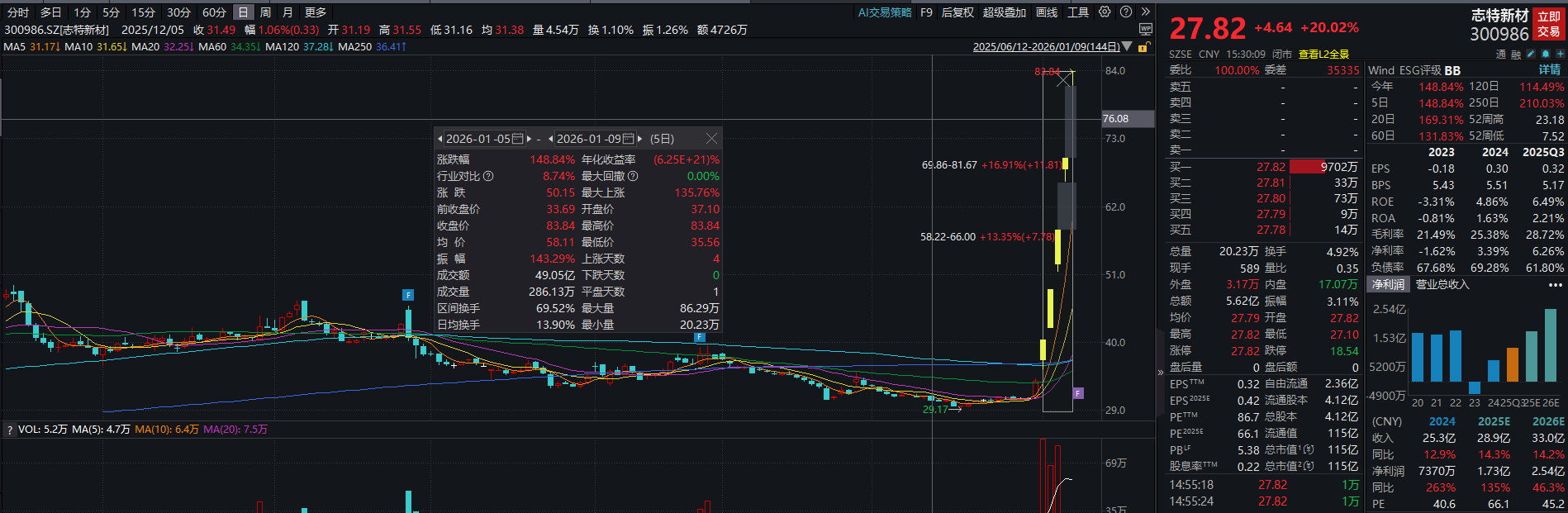
AI应用产品登上“科技春晚”,最牛股志特新材20CM五连板|透视一周牛熊股
2 1 Shi Ji Jing Ji Bao Dao· 2026-01-11 01:30
Market Performance - The three major stock indices collectively rose in the past week (January 5 - January 9), with the Shanghai Composite Index increasing by 3.82% to close at 4120.43, marking a 10-year high [1] - The Shenzhen Component Index rose by 4.40% to 14120.15, while the ChiNext Index increased by 3.89% to 3327.81 [1] - Over 86% of stocks experienced gains during the week, with 488 stocks rising over 15%, and only 7 stocks declining more than 15% [1] Top Performing Stocks - Zhite New Materials (300986.SZ) topped the weekly gainers with a 148.84% increase, followed by Shaoyang Hydraulic (301079.SZ) with an 84.91% rise [2] - Other notable stocks with gains exceeding 61% include Bibet-U (688759.SH), Kuaiji Elevator (002774.SZ), and Fenglong Co. (002931.SZ) [2] - The AI application sector saw significant growth, with Zhite New Materials achieving a 20CM five consecutive limit-up, bringing its market value to 11.5 billion [2] Industry Developments - The AI application sector received positive news, including Meta's acquisition of AI company Manus for potentially billions of dollars, marking its third-largest acquisition [4] - The Ministry of Industry and Information Technology and other departments issued a plan to promote the integration of AI and manufacturing, aiming to develop 3-5 general large models for deep application in the industry [4] - Various sectors, including smart hardware, finance, education, logistics, and agriculture, are increasingly adopting AI applications [4] Company Updates - Zhite New Materials is currently developing fireproof and heat-insulating materials, which are still in the experimental stage and have not yet reached mass production [5] - The company has formed a strategic partnership with a national key laboratory to explore AI and materials science collaboration, aiming to create an innovation platform [6] - Rongke Technology (300290.SZ) led the decline with a 26.59% drop, clarifying that it has no plans for a merger with Chaoguyuan Company [8][10][13]