
智能手机摄像头

Search documents
招银国际每日投资策略-20260401
Zhao Yin Guo Ji· 2026-04-01 05:12
Macro Commentary - China's manufacturing PMI rebounded significantly in March, partly due to the later and longer Spring Festival holiday in 2026, although it remains in a contraction state based on the three-month moving average. Both supply and demand have improved significantly, with inventory cycles and import/export orders showing recovery [2] - The non-manufacturing PMI slightly increased, indicating a return to expansion in the service sector, while the construction sector remains in contraction. The price indices for both manufacturing and services suggest that upstream input inflation may lead to a positive PPI in the coming months [2] - The overall resilience of the RMB is maintained, fluctuating around 6.9 against the USD despite a strong dollar backdrop [4] Company Analysis Sunny Optical Technology (2382 HK) - The company is expected to achieve a revenue and net profit growth of 21% and 85% year-on-year in the second half of 2025, reaching RMB 23.6 billion and RMB 3 billion respectively. The net profit aligns with previous positive forecasts and exceeds market consensus by 44% due to a one-time investment gain from GoerTek [5] - Management guidance for 2026 indicates revenue and net profit growth of no less than 7% each, driven by a 5-10% increase in smartphone revenue and a 60% increase in IoT revenue, offsetting weakness in XR business [5] Yongda Automobile (3669 HK) - The company anticipates a significant impairment in 2025, with revenue expected to decline by 15% to RMB 27.5 billion in the second half of 2025, leading to a historical low overall gross margin of 7.0%. A total impairment of approximately RMB 4.9 billion is expected, resulting in a net loss of RMB 1.7 billion in the second half of 2025 [5] - Management plans to close 15-20 stores in 2026, with most related asset impairments already accounted for in 2025, suggesting no major impairments in 2026 [6] Sanofi Pharmaceutical (1530 HK) - The company is projected to achieve a revenue of RMB 17.7 billion in 2025, a 94.3% year-on-year increase, primarily due to a RMB 9.4 billion licensing income from Pfizer. However, product sales are expected to decline by 10.3% to RMB 8 billion due to national procurement policies [7] - The company is expected to maintain high levels of R&D investment to accelerate pipeline progress, with significant clinical advancements anticipated from the collaboration with Pfizer [8] Kanglong Chemical (300759 CH) - The company reported a 14.8% year-on-year revenue growth to RMB 14.1 billion in 2025, with adjusted net profit increasing by 13.0% to RMB 1.82 billion, both exceeding previous forecasts [10] - Management expects a revenue growth of 12-18% in 2026, with currency fluctuations negatively impacting growth guidance by 3 percentage points [11] Zhongji Xuchuang (300308 CH) - The company reported a strong FY25 performance with a revenue growth of 60% to RMB 38.2 billion and a net profit increase of 109% to RMB 10.8 billion, aligning with market expectations [14] - The gross margin improved significantly from 34.7% in FY24 to 42.6% in FY25, driven by strong shipments of high-speed optical modules and an increase in the proportion of silicon photonics products [14] OmniVision Technologies (603501 CH) - The company achieved a revenue growth of 12.1% to RMB 28.9 billion in FY25, with a net profit increase of 21.7% to RMB 4 billion, although slightly below market expectations [15] - The gross margin improved from 29.4% in FY24 to 30.6% in FY25, primarily due to the optimization of CIS product structure and increased contributions from automotive CIS revenue [15]


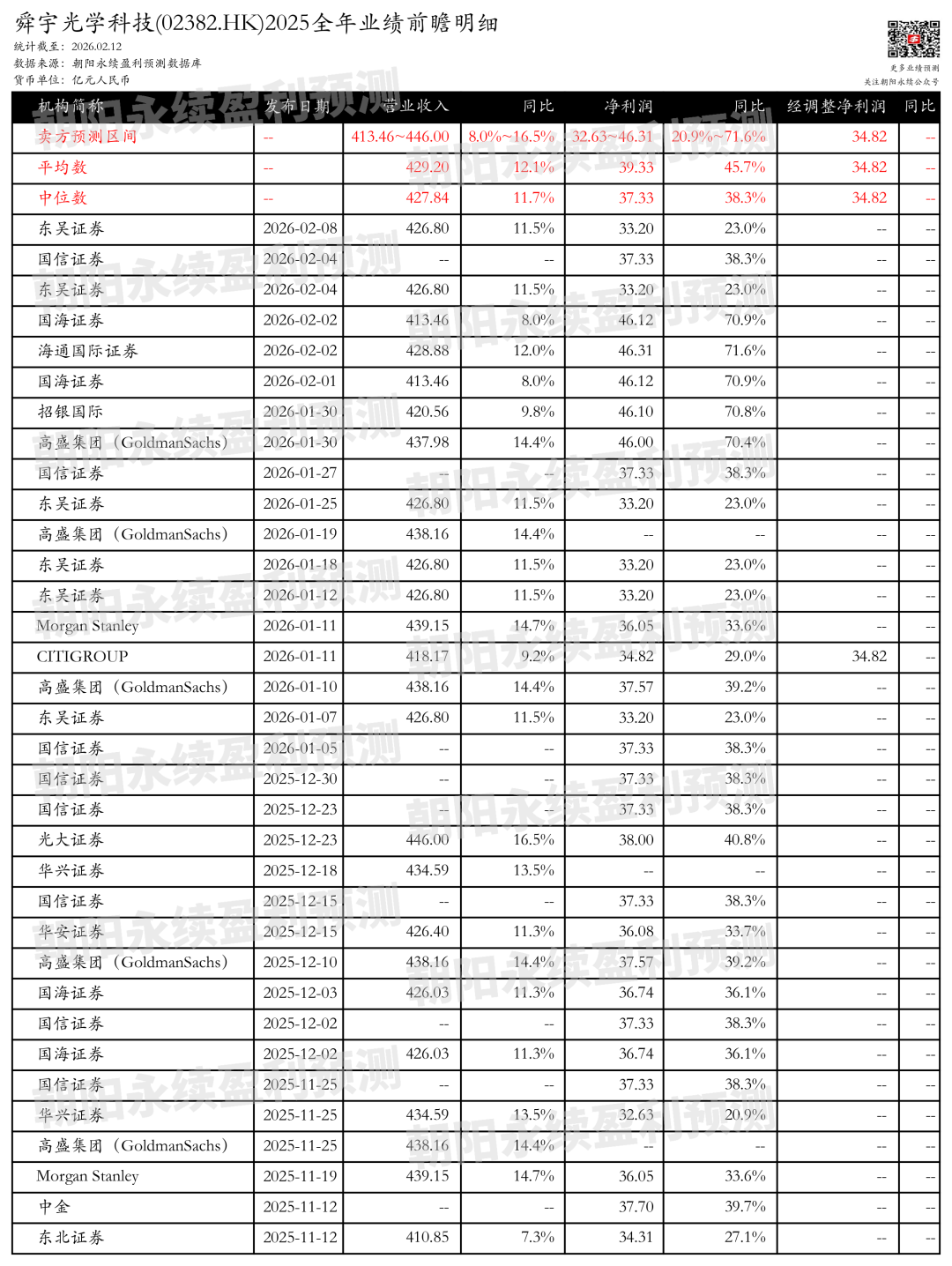
舜宇光学科技:业绩超预期,增长动能强劲,预测全年营业收入413.46~446.00亿元,同比增长8.0%~16.5%
Xin Lang Cai Jing· 2026-02-12 12:12
Core Viewpoint - Sunny Optical Technology is expected to achieve significant growth in net profit for 2025, reaching between 45.89 billion to 47.24 billion yuan, representing a year-on-year increase of 70% to 75%, which exceeds market expectations [3][8]. Financial Performance Forecast - The projected revenue for Sunny Optical Technology is between 413.46 billion to 446.00 billion yuan, with a year-on-year growth of 8.0% to 16.5% [1][5]. - The forecasted net profit is estimated to be between 32.63 billion to 46.31 billion yuan, with a year-on-year growth of 20.9% to 71.6% [1][5]. - The adjusted net profit is anticipated to be 34.82 billion yuan [1][5]. Business Segments - **Smartphone Camera Upgrades**: The company continues to benefit from upgrades in flagship and mid-to-high-end smartphone camera specifications, including variable aperture and periscope cameras, driving the development of high-value products such as 6P and above lenses, glass-plastic hybrid lenses, and large format modules [4][9]. - **Automotive Business Growth**: With the deepening trend of smart driving, the company's automotive lens and module business is expanding in both domestic and overseas markets, with laser radar projects expected to achieve rapid growth [10]. - **AI/AR Glasses Business**: The company holds a leading global market share in imaging modules for smart glasses, with strong growth anticipated in AI/AR glasses from 2026 to 2027, which is expected to be a significant driver of business growth [10].


港股速报 | 港股低开 贵金属剧震 黄金股走势分化
Mei Ri Jing Ji Xin Wen· 2026-01-30 02:49
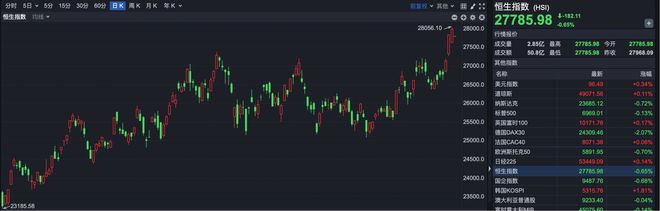
Market Overview - The Hong Kong stock market opened lower today, with the Hang Seng Index at 27,785.98 points, down 182.11 points, a decline of 0.65% [1] - The Hang Seng Tech Index opened at 5,789.49 points, down 51.61 points, a decrease of 0.88% [2] Market Highlights - Gold stocks showed mixed performance due to significant fluctuations in international gold prices last night. Chifeng Jilong Gold Mining (HK06693) fell over 6%, while Zijin Mining and Zhaojin Mining rose over 3% [4] - Analysts attribute the recent drop in spot gold and silver prices to increased profit-taking by investors after reaching historical highs [5] Company Earnings Forecasts - Tianqi Lithium (HK09696) expects a net profit of 369 million to 553 million yuan for 2025, turning from a loss to profit [5] - Tigermed (HK03347) anticipates a net profit of approximately 830 million to 1.23 billion yuan for 2025, representing a year-on-year growth of 105% to 204%. The stock rose over 10% today [5] - Sunny Optical Technology (HK02382) projects a net profit of 4.5886 billion to 4.7235 billion yuan for 2025, an increase of about 70% to 75%, driven by high-end smartphone camera specifications and improved product mix [5] - Meet You Noodle (HK02408) expects a net profit between 100 million to 115 million yuan for 2025, reflecting a year-on-year increase of 64.7% to 89.5% [6] Sector Performance - The technology sector saw widespread declines, with Kuaishou down over 2% and Alibaba, Bilibili, Baidu, Tencent, and Xiaomi all falling over 1% [6] - Oil stocks were active, with PetroChina rising over 1% [6] Market Outlook - Guoyuan International believes that the Hong Kong stock market may continue to outperform the US market, showing a trend of steady upward movement due to factors like fiscal cliffs and geopolitical issues affecting US dollar credibility [7] - Everbright Securities indicates that the current market is supported by earnings recovery, improved liquidity, low valuations, and policy support, suggesting a positive overall trend [7]
港股早报| SpaceX被曝拟合并xAI剑指超级IPO 2025年全球黄金总需求创历史新高
Xin Lang Cai Jing· 2026-01-29 23:13
Group 1: Company News - Guoquan (02517.HK) expects revenue for 2025 to be approximately 7.75 billion to 7.85 billion RMB, representing a year-on-year increase of about 19.8% to 21.3%. Net profit is projected to be between 443 million to 463 million RMB, up approximately 83.7% to 92.0% due to ongoing market expansion in rural areas and growth in per-store revenue [6] - Sunny Optical Technology (02382.HK) anticipates a net profit of 4.5886 billion to 4.7235 billion RMB for 2025, reflecting a year-on-year increase of about 70.0% to 75.0%. This growth is attributed to the high-end specifications of smartphone cameras and improved product mix, leading to higher gross margins [6] - Baidu (02315.HK) expects to achieve operating revenue of 1.369 billion to 1.389 billion RMB in 2025, with a year-on-year increase of 39.61% to 41.65%. Net profit is projected to be between 162 million to 182 million RMB, marking a significant increase of 384.26% to 443.88% due to continued expansion in overseas markets [6] - Nocare (09969.HK) forecasts total operating revenue of approximately 2.365 billion RMB for 2025, representing a year-on-year growth of around 134%. The company also expects to achieve profitability for the first time, with a net profit of about 633 million RMB [7] - Yujian Xiaomian (02408.HK) anticipates a net profit ranging from 100 million to 115 million RMB in 2025, reflecting a year-on-year increase of approximately 64.7% to 89.5% [7] - Heng Rui Pharmaceutical (01276.HK) has received acceptance for the listing application of a new indication for its innovative drug, which is expected to become a new clinical treatment option for patients with unresectable liver cancer [7] - Dazhong Public Utilities (01635.HK) expects a net profit attributable to shareholders for 2025 to be between 350 million to 500 million RMB, representing a year-on-year increase of 50.12% to 114.46% [7] - Tigermed (03347.HK) projects a net profit of approximately 830 million to 1.23 billion RMB for 2025, indicating a year-on-year growth of 105% to 204% [7]
“护城河”理论过时了:“共识平原”时代到来|狮也咨询《思想领袖系列》
Sou Hu Cai Jing· 2025-12-07 13:16
Core Argument - The article argues that the "moat" theory, which has dominated business strategy for the past three decades, is becoming obsolete as the world transitions to a new strategic paradigm called the "consensus plain" [2][3][5]. Group 1: The Decline of the Moat Theory - The moat theory, introduced by Warren Buffett in 1993, emphasized the importance of having a strong competitive advantage to protect investment returns from competitors [2]. - Historical examples illustrate how established companies like Coca-Cola, Kodak, and Walmart have seen their competitive advantages eroded by new entrants that leverage changing consumer preferences and technological advancements [3][5]. - The moat's effectiveness is diminishing as the business landscape shifts from a closed castle model to an open value network model, leading to a strategic paradigm shift [5]. Group 2: Characteristics of the Moat - The moat consists of three essential elements: scarcity, control, and isolation, which were relevant during the industrial era characterized by limited resources [9]. - Brand moats rely on monopolizing consumer perception through significant advertising investments [9]. - Patent moats utilize legal protections to create exclusive advantages based on technological scarcity [9]. - Scale moats achieve cost advantages through high production volumes, allowing companies to dominate pricing [9]. Group 3: Forces Eroding the Moat - Three converging forces are dismantling the moat: the abundance of resources, the networked nature of value creation, and the fluidity of consumer consensus [12][10]. - The abundance of resources, facilitated by cloud computing and open-source movements, has transformed previously scarce resources into accessible infrastructures [12]. - Value is increasingly generated within interconnected ecosystems rather than solely within individual companies, diminishing the relevance of traditional moats [12]. - Consumer loyalty is shifting from static brand recognition to dynamic engagement with values and narratives, making traditional brand moats vulnerable [12]. Group 4: The Consensus Plain Strategy - The "consensus plain" strategy emerges as a new approach when moat logic fails, characterized by an open value creation and exchange environment [13]. - The consensus plain is defined by a shared vision and collaborative rules, attracting participants who contribute to its value [15]. - A strong consensus plain consists of three layers: narrative consensus (the overarching story), rule consensus (operational guidelines), and value consensus (how value is shared) [16]. Group 5: Constructing the Consensus Plain - Building a consensus plain involves a four-step foundational method: identifying value vacuums, crafting a compelling narrative, designing initial rules, and initiating a "cold start flywheel" [22][23]. - Identifying areas with unmet needs is crucial for establishing a consensus plain, as demonstrated by Pinduoduo's focus on price-sensitive consumers [24]. - A powerful narrative serves as the gravitational force for the consensus plain, as seen in Huawei's vision for a unified operating system [29]. - Initial rules must be simple and transparent, facilitating participation and collaboration, as exemplified by BYD's open supply chain model [30]. Group 6: The Evolution of Rules in the Consensus Plain - The power lies in the continuous definition and evolution of rules within the consensus plain, requiring companies to transition from product managers to civilization architects [36]. - Rule definition grants significant commercial power, as illustrated by NVIDIA's dominance through its CUDA ecosystem [37]. - Rules must evolve to maintain vitality and balance, necessitating gradual experimentation and community governance [40]. Group 7: Interactions Between Consensus Plains - As multiple consensus plains coexist, competition and cooperation create a complex landscape, leading to various relationships such as absorption, bridging, and confrontation [50][51]. - The collaboration between national-level and regional plains exemplifies how different levels can resonate and enhance overall value creation [55].

光学黄金大赛道,终端创新拓疆土
GOLDEN SUN SECURITIES· 2025-03-25 01:38
Investment Rating - Maintain "Buy" rating for the optical industry [5] Core Insights - The optical upgrade trend is clear, opening multiple growth opportunities across various sectors [12] - The smartphone market is experiencing a recovery, with camera hardware upgrades becoming a key innovation direction [12] - The automotive sector is entering an era of equal access to intelligent driving, with a significant increase in demand for cameras and Lidar [2] - AI smart glasses are becoming a focal point for AI interaction, with a projected significant increase in sales [3] - The robotics sector is expanding with the integration of multiple visual sensors, indicating new opportunities in the optical field [4] Summary by Sections Smartphones - The global smartphone shipment is expected to reach 1.22 billion units in 2024, a 7% year-on-year increase, marking a rebound after two years of decline [12][18] - The demand for periscope lenses in smartphones is projected to grow from 46 million units in 2024 to 80 million units by 2026 [12] - The high-end smartphone camera module market is showing strong growth, with a 16% increase in shipments for mid-to-high-end modules [12][13] Automotive - China's new energy vehicle sales are projected to reach approximately 13.8 million units in 2024, a 46% year-on-year increase [2][14] - The penetration rate of new energy vehicles is expected to exceed 55% by 2025, surpassing traditional fuel vehicles for the first time [2] - The demand for automotive cameras is increasing, with an average of 7 cameras per vehicle expected by 2025 [15] Smart Glasses - Global sales of AI smart glasses are projected to reach 5.5 million units in 2025, a 135% increase from 2024 [3][16] - The integration of cameras in AI smart glasses is crucial for providing intelligent interaction experiences [3] Robotics - The Chinese machine vision market is expected to grow to 39.5 billion yuan by 2028, with a compound annual growth rate of approximately 17.5% from 2024 to 2028 [4][17] - The integration of multiple visual sensors in robotics is becoming increasingly important, with various companies adopting advanced visual systems [4][17]


