有色主题ETF

Search documents
资源行情接棒 资金借道ETF参与热门板块
Zhong Guo Zheng Quan Bao· 2026-02-11 20:57
Group 1 - The resource sector has strengthened again, with multiple rare metal-themed ETFs rising over 3%, and mining, non-ferrous, gold, rare earth, and chemical ETFs generally increasing over 2% [1] - After significant gains, the film, media, and online consumption ETFs experienced a collective pullback, with the film ETF (159855) dropping nearly 6% [1] - AI application-related sectors saw a surge, with over 1.3 billion yuan net inflow into ETFs tracking the film and media indices on February 10 [1] Group 2 - Huatai Fund suggests gradually shifting focus to post-holiday market trends, emphasizing three main lines: AI hardware driven by overseas influences, high-end manufacturing in new energy and innovative pharmaceuticals, and domestic price increase chains in chemicals, building materials, and steel [2] - Fuguo Fund recommends focusing on sectors with high elasticity and growth potential, such as electronics, computers, and communications, which are sensitive to liquidity improvements and rising risk appetite [2]
1165亿元!宽基ETF成交再放量 资金持续流出
Shang Hai Zheng Quan Bao· 2026-01-28 09:58
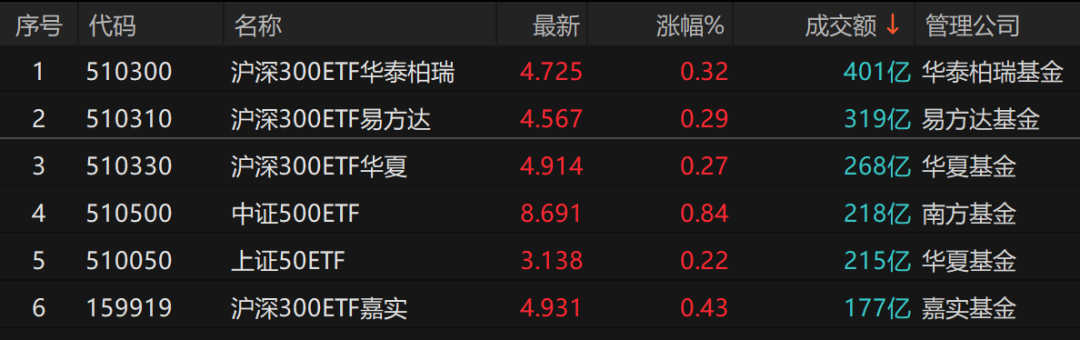
Core Viewpoint - On January 28, trading volume for major ETFs surged, with four "giant" CSI 300 ETFs reaching record transaction amounts, indicating strong market interest and activity in these investment vehicles [1][2]. Group 1: Trading Volume Highlights - The Huatai-PineBridge CSI 300 ETF achieved a transaction volume of 401 billion yuan, marking its highest since its launch in May 2012 [2][3]. - The E Fund CSI 300 ETF recorded a transaction volume of 319 billion yuan, while the Huaxia CSI 300 ETF and the Jiashi CSI 300 ETF reached 268 billion yuan and 177 billion yuan, respectively, all setting new records since their inception [2][3]. - The total transaction volume for these four leading CSI 300 ETFs amounted to 1,165 billion yuan [2]. Group 2: Market Performance - Despite the record trading volumes, the market showed resilience, with the CSI 300 Index rising by 0.22% and the Shanghai Composite Index increasing by 0.27%, while the ChiNext Index fell by 0.57% [7]. - The trading activity was concentrated in two time slots: 10:31-11:00 and 14:31-15:00, indicating specific periods of heightened investor interest [3]. Group 3: Fund Flows - On January 27, stock ETFs (excluding cross-border ETFs) experienced a net outflow of 474.82 billion yuan, with major broad-based ETFs facing significant withdrawals [8]. - The Huatai-PineBridge, Huaxia, E Fund, and Jiashi CSI 300 ETFs collectively saw a net outflow of 436.53 billion yuan [8]. - From January 14 to 27, broad-based ETFs had a total net outflow of 7,663.19 billion yuan, with the leading ETFs losing over 4,400 billion yuan in total [8]. Group 4: Sector Performance - In contrast to the outflows in broad-based ETFs, several thematic industry ETFs attracted significant inflows, particularly in the metals sector, with the Huaxia Nonferrous Metals ETF seeing a net inflow of 16.57 billion yuan [8][9]. - The performance of gold-related ETFs was notably strong, with several reaching their upper price limits and exhibiting premium rates above 2% [9][10]. - The total scale of domestic gold-related ETFs reached 3,141.41 billion yuan as of January 27, a significant increase from 704.42 billion yuan at the beginning of 2025 [10][11].

四大证券报精华摘要:1月28日
Xin Hua Cai Jing· 2026-01-28 05:55
Group 1 - The core focus of the news is on the strong performance of the non-ferrous metal sector in the A-share market, with fund managers adjusting their portfolios to include cyclical sectors like coal, oil and gas, and transportation to balance their holdings [1] - As of January 27, 2025, 1,201 A-share companies disclosed their annual performance forecasts, with 475 companies expecting positive results and 107 companies predicting a doubling of net profits year-on-year [2] - The public fund of funds (FOF) has shown a significant preference for resource-related assets, with the Huaan Gold ETF being heavily favored in the first three quarters of 2025, indicating a trend towards resource investment [3] Group 2 - The Hong Kong stock market has become a key focus for public funds, with 26 new products reported in 2026, primarily targeting technology, pharmaceuticals, and cyclical sectors, and a notable net inflow of nearly 30 billion yuan into Hong Kong-themed ETFs [4] - The gold and jewelry industry is expected to undergo significant changes in 2026 due to high gold prices, leading to a shift from price competition to value competition, favoring high-quality development [5] - The private equity fund management scale reached a record high of 22.15 trillion yuan by the end of 2025, with private securities investment funds being the main contributors to new registrations [7] Group 3 - Several listed brokerages have reported positive earnings forecasts for 2025, with net profits expected to grow significantly, indicating a strong performance across the brokerage sector [8] - Over 150 companies are projected to achieve record high net profits in 2025, with the electronics industry being the largest contributor, highlighting a robust recovery in various sectors [9] - Nearly 1,250 companies have disclosed performance forecasts, with a median net profit exceeding 173 billion yuan, reflecting a nearly 100% increase compared to the previous year, indicating a strong market recovery [10] Group 4 - Insurance capital is increasingly investing in private equity funds, with China Life announcing significant investments in two funds, reflecting a trend towards diversifying asset allocation [11] - The Ministry of Human Resources and Social Security plans to expand the scale of entrusted investments for basic pension insurance funds, indicating ongoing reforms in social security systems [12] - In 2025, profits of large-scale industrial enterprises in China increased by 0.6% compared to 2024, with a notable recovery in December, particularly in the manufacturing sector [13][14]
基金经理瞄准顺周期方向
Zhong Guo Zheng Quan Bao· 2026-01-27 20:57
Core Viewpoint - The non-ferrous metal sector has become a prominent investment focus in the A-share market since the beginning of 2026, with significant inflows into related ETFs and a rise in the popularity of fund managers specializing in this sector [1][2]. Group 1: Performance and Fund Inflows - The non-ferrous metal sector has shown remarkable performance, becoming the best-performing industry in the A-share market as of January 27, 2026, with ETFs tracking this sector collectively rising over 20% [1]. - As of January 26, 2026, non-ferrous themed ETFs have seen a net inflow exceeding 34 billion yuan, with leading products attracting significant investments, including over 13 billion yuan for the Southern CSI Non-Ferrous Metals ETF and over 9 billion yuan for the Huaxia CSI Sub-Sector Non-Ferrous Metals ETF [2]. Group 2: Fund Manager Strategies - Fund managers have adjusted their holdings within the non-ferrous sector, with notable increases in positions in companies like Shandong Gold and Zijin Mining, while reducing exposure to others like Tongling Nonferrous Metals [3]. - In addition to focusing on the non-ferrous sector, fund managers have diversified their portfolios by including cyclical sectors such as chemicals, oil and gas, coal, and transportation, aiming to balance their holdings [3][4]. Group 3: Future Outlook and Economic Indicators - Fund managers are optimistic about the potential recovery of domestic Producer Price Index (PPI) data, which could signal a mild recovery in the domestic economy over the next six months, driven by continued policy support [1][5]. - The anticipated changes in the PPI and the implementation of "anti-involution" policies are expected to enhance the competitive landscape for traditional industries, including steel, coal, and chemicals, leading to significant revaluation opportunities for leading companies in these sectors [5].
中信证券裘翔:多因素驱动 春节前A股结构性机会凸显
Zhong Guo Zheng Quan Bao· 2026-01-16 20:47
Core Viewpoint - The A-share market is experiencing a steady upward trend supported by policy, economic stabilization, and improved liquidity, with a focus on investment logic and layout direction as the Spring Festival approaches [1][2] Policy Support - Regulatory bodies are guiding the A-share market towards a "gradual rise" pattern, with mechanisms for long-term capital entering the market being continuously improved, enhancing market stability [2] - Policies aimed at boosting domestic demand, such as fertility subsidies, are being implemented, which are expected to stabilize and improve the return on equity (ROE) for related listed companies [2] Economic Signals - The overall revenue growth rate for A-shares improved from -0.02% in the first half of 2025 to 1.2% in the third quarter, while net profit growth increased from 2.5% to 5.3% during the same period, indicating a trend of improving profitability [2] - Forecasts for 2026 suggest a stable macroeconomic environment with net profit growth expected to be 4.8% for the year, peaking in the second quarter [2] Long-term Capital Inflow - Long-term capital, particularly from insurance funds, is becoming a major source of market liquidity, with an estimated potential inflow of approximately 1.73 trillion yuan based on 2025 insurance premium income [3] - This influx of stable capital is expected to reduce market volatility and enhance internal stability [3] Market Structure and Opportunities - Structural opportunities are evident, with 39 out of 360 industry or thematic ETFs reaching new highs in December 2025, particularly in sectors like telecommunications, non-ferrous metals, and military aerospace [3] - The market is characterized by a significant divergence in performance, with small-cap stocks and thematic sectors outperforming larger indices [5] Investor Sentiment - Investor sentiment is showing signs of recovery, with a sentiment index reading of 98.1 on January 9, 2026, indicating a high level of optimism [4] - The market is currently in a phase where emotional recovery and capital reallocation are key themes, especially as the Spring Festival approaches [4][5] Investment Strategy - Investment strategies should focus on three dimensions: consensus direction, counter-consensus direction, and long-term investments, while also considering the opportunities presented by the appreciation of the renminbi [6][8] - In the consensus direction, sectors like non-ferrous metals and semiconductors are highlighted as key areas for institutional investment [7] - For counter-consensus investments, sectors related to domestic demand, such as travel services and quality real estate developers, are recommended due to their potential for valuation recovery [7] Long-term Considerations - There is a growing demand for investments that reduce volatility, with a focus on sectors that have room for ROE improvement, such as chemicals and renewable energy [8] - The appreciation of the renminbi is expected to create investment opportunities, particularly in industries like paper and aviation, which have already seen positive effects [8]

盘前资讯 | 央行1月8日将开展11000亿元买断式逆回购操作
Sou Hu Cai Jing· 2026-01-08 01:17
Group 1 - The People's Bank of China announced a reverse repurchase operation of 1.1 trillion yuan with a term of 3 months, set to take place on January 8, as a continuation of the same amount maturing within the month [1][1][1] - Data from Wind indicates that in the first two trading days of 2026, funds have flowed significantly into broad-based, non-ferrous, and gold sectors, with over 5 billion yuan entering non-ferrous themed ETFs in the last three trading days of 2025 [1][1][1] - Multiple cross-border ETFs have issued premium risk alerts at the start of 2026, advising investors to be cautious of premium risks in secondary market trading [1][1][1]
科创、有色等板块获资金显著流入
Zhong Zheng Wang· 2025-10-13 01:29
Group 1 - Significant capital inflow was observed in the technology and non-ferrous metal sectors during the last two trading days, with over 3 billion yuan net inflow into the Jiashi Shanghai Stock Exchange Science and Technology Innovation Board Chip ETF and over 2 billion yuan into the Huaxia Shanghai Stock Exchange Science and Technology Innovation Board 50 ETF and the Southern CSI Shenwan Non-ferrous Metals ETF [1] - The non-ferrous metal sector showed notable gains, with several public fund institutions' non-ferrous themed ETFs reporting over 5% increase in value from October 9 to October 10 [1] - As of October 10, multiple gold stock ETFs have seen year-to-date gains exceeding 90%, with Yongying Fund's gold stock ETF rising over 96% this year, driven by various macroeconomic factors and a strong upward trend in gold prices [1]
共享基经丨与AI一起读懂ETF(十五):同样是有色主题,这三个指数有何不同?
Mei Ri Jing Ji Xin Wen· 2025-05-21 09:51
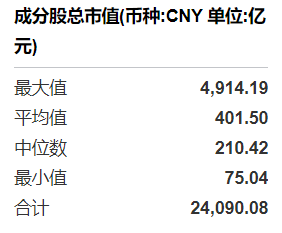
Core Viewpoint - The article discusses the recent collective rise of gold-themed ETFs and related non-ferrous metal ETFs, highlighting the differences among three key indices: the China Securities Non-Ferrous Metals Index, the China Securities Sub-Industry Non-Ferrous Metals Theme Index, and the National Non-Ferrous Metals Industry Index [1]. Group 1: Differences Among Indices - **Constituent Stock Composition**: The China Securities Non-Ferrous Metals Index includes a broad range of listed companies involved in the mining, smelting, and processing of non-ferrous metals, with an average market capitalization of approximately 40.2 billion CNY [2]. The China Securities Sub-Industry Non-Ferrous Metals Theme Index focuses on larger, more liquid companies within specific sub-industries, with an average market capitalization of about 45.9 billion CNY [3]. The National Non-Ferrous Metals Industry Index selects 50 prominent securities based on industry classification standards, with an average market capitalization of around 46.7 billion CNY [4]. - **Industry Distribution**: The top five industries in the China Securities Non-Ferrous Metals Index are copper, gold, aluminum, rare earths, and lithium, with a relatively balanced distribution [6]. The China Securities Sub-Industry Non-Ferrous Metals Theme Index also lists the same top five industries, but copper's share exceeds 30% [8]. Similarly, the National Non-Ferrous Metals Industry Index has a comparable distribution, with copper also exceeding 30% [10]. - **Top Ten Weightings**: The cumulative weighting of the top ten stocks in the China Securities Non-Ferrous Metals Index is 45.91% [12]. In contrast, the China Securities Sub-Industry Non-Ferrous Metals Theme Index has a cumulative weighting of 51.22% [12], while the National Non-Ferrous Metals Industry Index stands at 52.1% [12]. Notably, the largest stock, Zijin Mining, has a weight of less than 11% in the China Securities Non-Ferrous Metals Index, but exceeds 16% in the other two indices [12]. Group 2: Similarities Among Indices - **Industry Focus**: All three indices concentrate on the non-ferrous metals sector, reflecting the performance of listed companies in this industry, closely tied to the overall development trends, market supply and demand, and price fluctuations of non-ferrous metals [18]. - **Constituent Stock Selection Rules**: Each index selects stocks from the Shanghai and Shenzhen markets (with the National Non-Ferrous Metals Industry Index also including the Beijing Stock Exchange) based on liquidity and market capitalization to ensure a representative sample of the industry [18]. - **Valuation Levels**: The valuation levels of the three indices are consistent, with all having a TTM price-to-earnings ratio below the historical 20th percentile, indicating a historically low valuation [18].