林肯航海家

Search documents
林肯在华销量连跌4年
第一财经· 2026-02-08 05:07
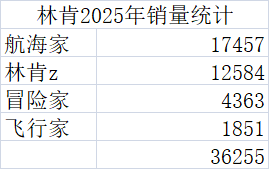
Core Viewpoint - Lincoln is facing a significant decline in sales in the Chinese market, with a recall announcement highlighting safety issues and reflecting broader challenges within the luxury automotive sector [3][4]. Sales Performance - In 2025, Lincoln sold only 36,255 vehicles in China, a year-on-year decline of over 30%, averaging just over 3,000 units per month [5][6]. - The sales breakdown for 2025 is as follows: Nautilus (17,457 units), Lincoln Z (12,584 units), Aviator (4,363 units), and Navigator (1,851 units), indicating a heavy reliance on Nautilus and Lincoln Z for total sales [6]. - Lincoln's sales have been in continuous decline for four years, dropping from over 90,000 units in 2021 to 53,000 units in 2024, with year-on-year declines of 13%, 9%, 26%, and 31% respectively [6]. Market Context - The traditional luxury car market is shrinking, with major brands like Mercedes-Benz, BMW, and Audi also experiencing sales declines in China [6]. - Lincoln's sales drop is more pronounced than that of its competitors, attributed to decreased brand appeal, slow transition to electric vehicles, and insufficient product competitiveness [6]. Broader Industry Trends - The partnership between Ford China and Changan Automobile has also seen a significant drop in sales, with wholesale sales halving from 2024 to 2025 [7].


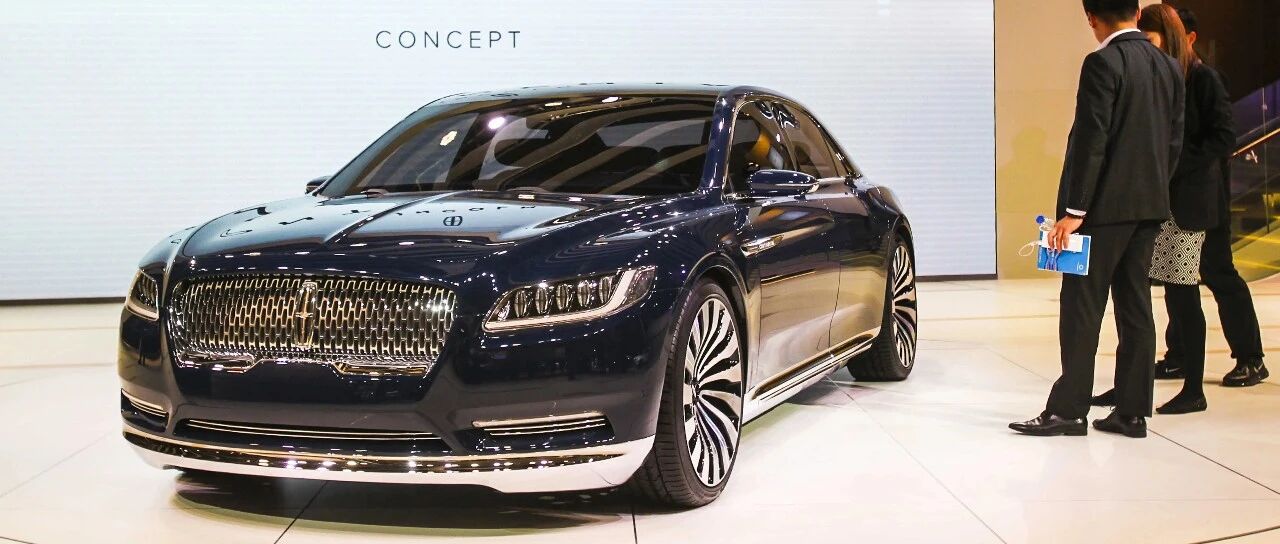
林肯在华销量连跌4年
Di Yi Cai Jing· 2026-02-08 04:54
Group 1 - Lincoln's sales in China have declined for four consecutive years, with 2025 sales dropping over 30% year-on-year to 36,255 units [1][3] - The recall of 1,706 Lincoln Nautilus vehicles due to safety issues with the left exterior mirror highlights ongoing challenges for the brand in the Chinese market [1] - The sales figures indicate that Lincoln's reliance on the Nautilus and Lincoln Z models is significant, as these two models account for nearly 83% of total sales [1][2] Group 2 - In 2025, Lincoln's sales were significantly lower than its peak of over 90,000 units in 2021, with a steady decline to 53,000 units in 2024 [3] - The luxury car market in China is shrinking, with major brands like Mercedes-Benz, BMW, and Audi also experiencing sales declines, although Lincoln's drop is more pronounced [3] - The partnership between Ford China and Changan Automobile has not mitigated the sales decline, as Changan Ford's wholesale and retail sales in 2025 were both halved compared to 2024 [4]
最新召回!川AG车主注意
Xin Lang Cai Jing· 2026-02-07 08:26
Core Viewpoint - Several automotive companies in China have announced vehicle recalls due to safety concerns related to manufacturing defects and design issues, affecting thousands of vehicles across different brands. Group 1: Audi Recall - FAW-Volkswagen is recalling 206,012 units of the Audi Q2L produced between August 2, 2018, and January 19, 2025, due to potential adhesive failure in the C-pillar cover under high temperature and humidity conditions, posing a safety risk [1] - The company will replace the affected C-pillar assemblies for free through authorized Audi dealers [1][2] Group 2: Lincoln Recall - Ford Motor (China) is recalling 1,706 units of the Lincoln Nautilus produced between August 5, 2025, and November 27, 2025, due to a manufacturing issue where the left outer rearview mirror may have been fitted with a flat mirror, reducing the driver's visibility [2][3] - Authorized Lincoln dealers will check and replace the flat mirror with a convex mirror at no cost [2][3] Group 3: Volvo Recall - Zhejiang Haoqing Automobile Manufacturing is recalling 14,768 units of the Volvo XC70 produced between May 7, 2025, and December 22, 2025, due to a design and manufacturing issue with the left rear half axle that may detach from the rear drive motor, posing a safety risk [4][5] - The company will inspect the vehicles and replace the half axle or the retaining ring as necessary, along with servicing the lubrication oil in the rear drive motor [5] Group 4: Alfa Romeo Recall - Stellantis (Shanghai) is recalling 91 units of the imported Alfa Romeo Giulia produced between May 8, 2024, and September 12, 2025, due to a manufacturing issue where the front headlight control unit wiring harness may not be secured, potentially leading to interference with the wheel arch liner [6][7] - The company will inspect and repair or replace the damaged wiring harness and wheel arch liner for free [6][7] Group 5: Jaguar Land Rover Recall - Jaguar Land Rover (China) is recalling 24 units of the imported 2019 Range Rover Sport PHEV produced between July 24, 2018, and August 30, 2018, due to a production process issue that may damage the battery cell cathode, risking loss of electric drive functionality and potential thermal runaway [7][8] - The company will replace the battery assembly for free to eliminate safety hazards [7][8]
跳出参数“红海”,林肯以“全维实力”开辟新赛道
Mei Ri Jing Ji Xin Wen· 2026-01-27 03:34
Core Insights - The luxury car market is currently facing a homogenization issue, with brands competing on technology and fuel efficiency, leading to a price war that compresses profit margins [1] - Consumer preferences have shifted from brand-centric purchases to a focus on emotional satisfaction, practical experiences, and long-term service [1][3] - Lincoln has identified this market trend and is building a differentiated competitive barrier through its focus on comfort, all-terrain luxury, and a new pricing strategy based on deep user experiences [1][5] Market Trends - The luxury brand's core competitiveness now extends beyond the product itself to include emotional value and stability promises, which are critical in consumer decision-making [3] - The current consumer trend emphasizes the need for products that provide immersive relaxation experiences, with Lincoln positioning "comfort" as its brand core [3][5] - Lincoln's approach to comfort is a comprehensive system that enhances visual, tactile, and auditory experiences, addressing the core demand for physical and mental comfort [3][6] Product Positioning - Lincoln's "all-terrain luxury" positioning fills a market gap by addressing the dual needs of urban commuting and outdoor adventures, catering to diverse user scenarios [6] - The brand's product offerings, including the Navigator and Aviator, are designed to provide a seamless experience across various driving conditions, enhancing both luxury and practicality [8] Business Model Innovation - Lincoln is transitioning from a product sales model to a user lifecycle management strategy with its "Lincoln Way Pro" service, aligning with the trend of service premium in the luxury car market [9] - The company is focusing on dealer health and user experience by reducing financial burdens on dealers and enhancing service quality through various initiatives [9][10] - The implementation of digital tools and systems has significantly improved service efficiency, creating a win-win situation for manufacturers, dealers, and users [10][12] Competitive Strategy - In a market characterized by intense price competition, Lincoln is adopting a service-driven strategy to enhance user loyalty and brand value, setting a new benchmark for service-driven growth in the industry [12] - The company's strategic layout reflects a deep understanding of market trends and a commitment to long-term business principles, emphasizing the combination of brand warmth, product strength, and service value as the future core competitiveness in the luxury car market [12]
崔东树:11月B级豪华SUV市场同比下滑22.6% 环比增长14.6% 月度走势好于B级主流燃油SUV市场
智通财经网· 2025-12-17 09:08
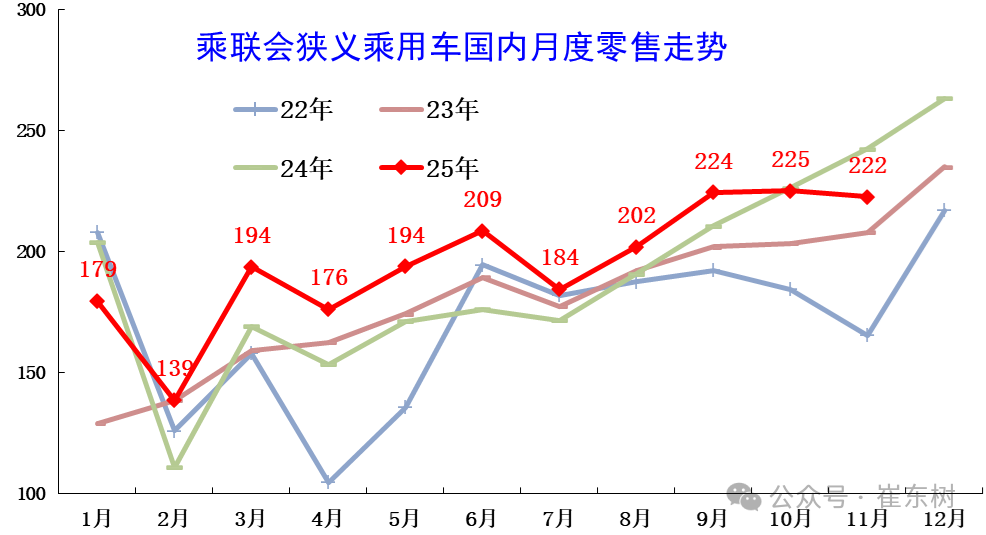
Core Insights - The B-class fuel SUV market experienced a year-on-year decline of 27% in November, with a month-on-month increase of 6% compared to October, indicating significant growth pressure [1][13] - The luxury B-class SUV segment saw a year-on-year decline of 22.6% in November, but a month-on-month increase of 14.6%, showing better monthly performance than the mainstream B-class fuel SUV market [1][13] - The traditional winter market is underperforming, with a severe drop in sales of homogeneous products, while differentiated products are performing well, reflecting a clear trend of high-end consumer upgrades [1] Market Trends - The retail growth rate of the domestic passenger car market fluctuated significantly in 2025, starting with a 1.2% increase in January-February, peaking at 15% from March to June, and then declining to -8% in November [1][4] - The market is currently in a transitional phase due to the adjustment of subsidy policies, which has led to a slowdown in sales [7][20] - The overall retail sales in the fourth quarter are expected to create a favorable growth space for the "15th Five-Year Plan" period, following strong performance during the "14th Five-Year Plan" [19][20] Sales Performance - In November, the retail sales of fuel passenger vehicles dropped by 22% year-on-year and 7% month-on-month, indicating a challenging market environment [10][11] - The luxury B-class SUV market saw significant declines, with major brands like Audi, Mercedes-Benz, and BMW experiencing year-on-year drops exceeding 20% [14][15] - The only model showing positive growth in this segment was the Cadillac XT5, which achieved a 7% year-on-year increase in sales, highlighting potential opportunities in a contracting market [14][15] Consumer Behavior - Consumers are increasingly rational, focusing on the practical value of products rather than just luxury branding, which is reshaping the luxury vehicle market [15] - Safety has become a critical concern in the automotive industry, with brands like Cadillac emphasizing safety features to enhance consumer value perception [15] Future Outlook - The automotive market is expected to continue facing challenges in 2026, with intensified competition and the need for brands to maintain distinctiveness and differentiation [19][20] - The continuation and optimization of the "old-for-new" subsidy policy is anticipated to significantly boost automotive consumption potential in the coming years [20]


【联合发布】一周新车快讯(2025年11月22日-11月28日)
乘联分会· 2025-11-28 08:42
Core Insights - The article provides an overview of new vehicle launches scheduled for November 2025, highlighting various manufacturers and their respective models, specifications, and market segments. Group 1: Manufacturer Launches - Changan Lincoln is set to launch the Navigator on November 21, 2025, positioned as a B SUV with a starting MSRP of 326,800 CNY [2][6]. - GAC Aion will introduce the Wu Bo SSR on November 22, 2025, classified as a COUPE with a starting MSRP of 1,486,000 CNY [2][14]. - Chery Automobile will release the Jetour Traveler on November 25, 2025, categorized as an A SUV with a starting MSRP of 191,900 CNY [2][22]. - Beijing Benz will launch the Mercedes EQE on November 26, 2025, in the C NB segment with an MSRP range of 478,000 to 627,000 CNY [2][30]. - FAW-Volkswagen will debut the Volkswagen Magotan on November 26, 2025, in the B NB segment with an MSRP range of 179,900 to 246,900 CNY [2][35]. - Leap Motor will introduce the Lafa5 on November 27, 2025, classified as an A HB with an MSRP range of 97,800 to 121,800 CNY [2][44]. - Geely Automobile will launch the Geely Haoyue L on November 27, 2025, positioned as a B SUV with an MSRP range of 99,900 to 129,900 CNY [2][52]. Group 2: Vehicle Specifications - The Changan Lincoln Navigator features a 2.0T engine, 8AT transmission, and dimensions of 4,908mm x 1,952mm x 1,717mm with a wheelbase of 2,900mm [6]. - The GAC Aion Wu Bo SSR is equipped with a pure electric engine, EVT transmission, and dimensions of 4,556mm x 1,988mm x 1,230mm with a wheelbase of 2,650mm, offering a range of 506 km [14]. - The Chery Jetour Traveler has a 2.0T engine, DCT7 transmission, and dimensions of 4,795mm x 2,006mm x 1,880mm with a wheelbase of 2,800mm [22]. - The Mercedes EQE features a pure electric engine, EVT transmission, and dimensions of 4,969mm x 1,906mm x 1,514mm with a wheelbase of 3,120mm, providing a range of 681 km [30]. - The Volkswagen Magotan offers a 1.5T engine and 2.0T engine options with DCT7 transmission, dimensions of 4,990mm x 1,854mm x 1,487mm, and a wheelbase of 2,871mm [35]. - The Leap Motor Lafa5 is powered by a pure electric engine with EVT transmission, dimensions of 4,430mm x 1,880mm x 1,520mm, and a wheelbase of 2,735mm, with ranges of 515 km and 605 km [44]. - The Geely Haoyue L features 1.5T and 2.0T engine options with DCT7 transmission, dimensions of 4,865mm x 1,910mm x 1,770mm, and a wheelbase of 2,825mm [52].
关税战未完待续,福特已无路可退
Hu Xiu· 2025-05-13 11:31
Core Viewpoint - Ford's strategy in China has shifted from ambitious growth plans to a more conservative approach focused on profitability, with recent signs of recovery in 2024 after years of losses [5][6][23]. Group 1: Strategic Shifts and Performance - In 2017, Ford announced its "China 2025 Plan," aiming to launch over 50 new models by the end of 2025, including 8 new SUVs and at least 15 electric vehicles [1][2]. - After six years of declining sales and losses, Ford China finally achieved profitability in 2024, earning $600 million, a significant turnaround from a $1.1 billion loss in 2018 [6][20]. - Ford's global revenue reached $176.2 billion, with the Ford Blue segment (traditional vehicles) generating $101.9 billion in revenue and $5.3 billion in profit, while the electric vehicle segment (Model e) reported $3.9 billion in revenue but a loss of $5.1 billion [7][13]. Group 2: Market Adaptation and Challenges - Ford's recent profitability in China is attributed to a strategic shift towards high-margin products and a reduction in low-margin offerings, focusing on personalized models [14][15]. - The company has leveraged its partnerships with Changan and Jiangling to establish China as a global export hub, with a 60% increase in exports in 2024, totaling 170,000 vehicles [16][17]. - Despite the positive performance, Ford faces challenges due to potential trade wars and tariffs, which could jeopardize its export strategy and profitability [4][22]. Group 3: Future Directions and Recommendations - Ford must accelerate local R&D efforts to develop a robust vehicle platform in China, addressing the unique preferences of Chinese consumers [29]. - The company needs to enhance its electric vehicle strategy, moving beyond a few imported models to a comprehensive platform that caters to the A and B segments [29]. - Ford's commercial vehicle segment remains a potential growth area, with opportunities to digitize fleet management and enhance after-sales services [30]. Group 4: Brand Perception and Market Position - Ford's brand image among younger consumers is mixed, necessitating a comprehensive rebranding strategy to resonate with the under-30 demographic [31]. - The competitive landscape in China is increasingly challenging, with local brands advancing rapidly in technology and pricing, leaving Ford at risk of falling behind [37]. - The year 2025 will be critical for Ford to demonstrate its ability to adapt and thrive in the Chinese market, moving beyond mere survival to a more aggressive market presence [38][40].

一季度利润跌64%,福特称中国稀土限制将产生深远影响
Guan Cha Zhe Wang· 2025-05-07 03:17
Core Viewpoint - Ford's Q1 2025 financial results show a decline in revenue and net profit, attributed to decreased vehicle sales and losses in the electric vehicle segment [1][2]. Financial Performance - Ford reported Q1 revenue of $40.659 billion (approximately 293.4 billion RMB), a year-over-year decrease of 4.95% [1]. - The net profit for the quarter was $473 million (approximately 3.4 billion RMB), down 64.49% year-over-year [1]. Sales and Production - The wholesale delivery volume for Ford in Q1 was 971,000 units, reflecting a 7% year-over-year decline [2]. - The decline in sales is linked to production slowdowns for certain models and losses in the electric vehicle business [2]. Cost Factors - Lower material costs and higher sales prices helped reduce losses in Ford's electric vehicle segment from $1.3 billion (approximately 9.4 billion RMB) in the same quarter last year to $800 million (approximately 5.8 billion RMB) [2]. - Ford anticipates that costs related to tariffs from the Trump administration will reduce its adjusted pre-tax earnings by approximately $1.5 billion (approximately 10.8 billion RMB) [2]. Guidance and Market Conditions - Ford has suspended its full-year earnings guidance due to uncertainties surrounding the impact of tariffs on its business [2]. - The company initially expected a decline in car prices from historical highs but now predicts a slight increase in prices by summer, with a slowdown in sales [2]. Tariff Impact - Approximately 80% of Ford's vehicles sold in the U.S. are assembled domestically, which mitigates the impact of tariffs compared to competitors [3]. - Ford's CFO announced a temporary halt on importing the Lincoln Navigator from China and exporting U.S.-made vehicles to China to avoid tariff impacts [3]. Industry Implications - The trade war and tariffs are expected to have significant effects on the entire automotive industry, with other manufacturers like General Motors and Tesla also expressing concerns about potential earnings reductions due to tariffs [5]. - Recent comments from Trump suggest a potential softening of his stance on tariffs, indicating that manufacturers should not be penalized if they cannot obtain parts [5].

宝马中国宣布接入DeepSeek,传日产计划关闭武汉工厂 | 汽车早参
Mei Ri Jing Ji Xin Wen· 2025-04-27 22:40
Group 1 - BMW China announced the integration of DeepSeek, enhancing its AI ecosystem and improving human-machine interaction in new models starting in Q3 2025 [1] - The partnership with Alibaba aims to boost product competitiveness and provide consumers with a stronger smart experience, potentially driving innovation in the high-end automotive sector [1] Group 2 - Nissan plans to close its Wuhan factory by March 31, 2026, due to low production capacity utilization, with only 10,000 units produced since its opening in 2022 [2] - Despite the closure, Nissan will invest $1.4 billion in China and launch around 10 new electrified models by 2027, indicating a commitment to transformation [2] Group 3 - Bosch and Remote have upgraded their strategic partnership to focus on comprehensive collaboration in hydrogen and electric technologies, aiming to develop a hydrogen-electric ecosystem [3] - The first batch of 1,000 new energy commercial vehicles developed jointly will be launched in domestic and international markets in the second half of this year [3] Group 4 - Ford has suspended exports of SUVs, pickups, and sports cars to China due to a significant increase in import tariffs, affecting approximately 5,500 vehicles in 2024 [4] - The decision reflects the challenges faced by American automakers due to retaliatory tariffs, impacting market share and brand perception in China [4] Group 5 - Volkswagen will maintain vehicle prices in the U.S. until the end of May, addressing concerns over rising costs due to tariffs and high inflation [5] - This decision aligns with strategies from other automakers to alleviate consumer purchasing pressure in a high-interest-rate environment [5]