智能化汽车

Search documents
长城汽车(601633):新能源、海外销量稳步提升,归元平台助力新车势能向上
Western Securities· 2026-03-29 06:53
Investment Rating - The investment rating for the company is "Buy" [5] Core Insights - The company achieved a revenue of 222.8 billion yuan in 2025, representing a year-on-year increase of 10%. However, the net profit attributable to shareholders decreased by 22% to 9.9 billion yuan, and the net profit excluding non-recurring items fell by 38% to 6.1 billion yuan [1][5] - In Q4 2025, the company reported a revenue of 69.2 billion yuan, with a quarter-on-quarter increase of 16% and a year-on-year increase of 13%. The net profit for Q4 was 1.2 billion yuan, showing a significant decline of 46% both quarter-on-quarter and year-on-year [1][2] Summary by Sections Revenue and Profitability - In 2025, the company sold 1.32 million vehicles, a 7.3% increase year-on-year. Of these, approximately 510,000 were sold overseas, marking an 11.7% increase and accounting for 38% of total sales, up by 12.1 percentage points. The sales of new energy vehicles reached 400,000 units, a 25.4% increase, representing 30% of total sales, up by 4.4 percentage points [2] - The company's gross margin and net margin for 2025 were 18.0% and 4.4%, respectively, down by 1.5 and 1.9 percentage points year-on-year. The decline in net margin was primarily due to the accelerated establishment of new channel models, the launch of new models and technologies, and brand enhancement efforts [2] Product and Market Development - The company launched the "Guiyuan" platform, the world's first native AI all-powertrain automotive platform, which supports various power forms and seven vehicle categories, enhancing brand momentum [3] - The "Tank" brand has made significant strides in the off-road segment, with the introduction of the Hi4-Z architecture and advanced intelligent features. The new Tank 500 and Tank 400 models achieved monthly sales exceeding 6,000 units by year-end [3] - The "Ora" brand underwent a strategic transformation, evolving from a pure electric brand to a comprehensive power brand, accelerating its global strategy [3] Future Projections - Revenue projections for 2026-2028 are estimated at 265.1 billion yuan, 310.8 billion yuan, and 357.2 billion yuan, reflecting year-on-year growth rates of 19%, 17%, and 15%, respectively. The net profit attributable to shareholders is expected to reach 12.8 billion yuan, 16.4 billion yuan, and 20.6 billion yuan during the same period, with growth rates of 30%, 28%, and 25% [3][4]

长城汽车(02333) - 2025 H2 - 电话会议演示
2026-03-27 14:05
年方35,开场而已 35 years young – and it is only the beginning 2026年3月 Mar. 2026 声明Disclaimer 本介绍片由长城汽车股份有限公司(「公司」)编制,只作企业通讯和一般参考之用。公司无意在任何司 法管辖区使用本介绍片作为出售和招揽他人购买公司任何证券的要约,或用作投资公司证券的决定基础。 未经咨询专业意见的情况下,不得使用或依赖此等全部资料。本介绍纯属简报性质,并非完整地描述公司、 公司业务、目前或过去的经营业绩或业务未来前景。 公司不会为本介绍片发出任何明文或隐含的保证或声明。公司特此强调,不会对任何人使用或依赖本介绍 片的任何资料(财务或其它资料)承担任何责任。 This presentation is prepared by Great Wall Motor Company Limited (the "Company") and is solely for the purpose of corporate communication and general reference only. The presentation is no ...
今日新闻丨尚界Z7/Z7T、问界M6开启预售!享界S9/S9T、 智界R7、智界新S7、问界M8/M7等车型更新896线激光雷达!
电动车公社· 2026-03-23 14:11
Core Viewpoint - The article discusses the pre-sale of several new electric vehicle models, highlighting their specifications, pricing, and features, indicating a competitive landscape in the electric vehicle market. Group 1: Pre-sale Information - The Shangjie Z7 and Z7T have commenced pre-sale with starting prices of 229,800 and 239,800 yuan respectively [2][5] - The Wenjie M6 has also started pre-sale, with prices ranging from 269,800 to 309,800 yuan [10] Group 2: Vehicle Specifications - The Shangjie Z7 features a sporty coupe design, dimensions of 5036/1976/1465mm, and a wheelbase of 3000mm, positioning it as a mid-large vehicle [4] - The Wenjie M6 maintains a family design but targets a younger demographic, with dimensions of 4960/1985/1736mm and a wheelbase of 2950mm [12][18] Group 3: Technology and Performance - Both the Shangjie Z7 and Z7T will be equipped with 896-line LiDAR and the Huawei Qian Kun intelligent driving ADS 4.1 system [7] - The Shangjie Z7 offers a powertrain with a single motor producing 264kW or a dual motor producing 434kW, with a maximum range of 905km and acceleration from 0-100km/h in 3.44 seconds [8] - The Wenjie M6 features a pure electric version with a single motor producing 227kW or a dual motor producing 340kW, with a range of 760/705km [16] Group 4: Market Positioning - The introduction of the 896-line LiDAR in models like the Shangjie Z7 and Wenjie M6 is expected to enhance their autonomous driving and safety capabilities, with a price increase of approximately 10,000 yuan compared to current models [22]


跨国车企,正拱手把电动车市场让给比亚迪们
Di Yi Cai Jing· 2026-03-19 09:47
Core Insights - Major multinational automakers have collectively announced a pause in their electrification transitions due to disappointing growth, resulting in nearly 500 billion yuan in losses for companies like Stellantis, Ford, General Motors, Honda, and Porsche by 2025 [2] - Despite the setbacks, the global automotive industry is moving towards electrification and smart technology, with the penetration rate of new energy vehicles expected to rise from 13% in 2022 to 23.5% by 2025 [2] - The automotive market is experiencing significant regional disparities, with China's new energy vehicle penetration expected to reach 45.5% by 2025, while the U.S. and Europe lag behind at 9.7% and 23.4%, respectively [3] Group 1: Market Dynamics - The U.S. market, despite being the third largest for new energy vehicles, has a low penetration rate due to weak policy support and limited infrastructure [3] - Changes in U.S. policy, such as rejoining the Paris Agreement, have influenced the strategies of major automakers like Honda and Ford, which primarily rely on the North American market [4] - The withdrawal of favorable policies under the Trump administration and the EU's abandonment of aggressive plans to ban gasoline and diesel cars have further complicated the situation for multinational automakers [4] Group 2: Competitive Landscape - By 2025, Honda's global electrification penetration is projected to be below 9%, while Ford's electric models have seen significant sales declines [4] - The imbalance between the pace of electric vehicle scaling and substantial R&D investments has led to increasing losses for multinational automakers, forcing them to revert to traditional combustion engine vehicles [4] - The market for hybrid electric vehicles (HEVs) remains strong, allowing traditional automakers to leverage their existing strengths in engine and transmission technology [4] Group 3: Future Challenges - The global penetration rate of new energy vehicles is projected to reach 23.6% by 2025, with significant growth in Europe and North America [5] - Multinational automakers face increasing competition from Chinese companies, which have advanced in battery technology and are expected to dominate the global market [5] - Chinese automakers have rapidly expanded their new energy vehicle offerings and are increasing exports, with projections showing a rise from 1.203 million units in 2023 to 2.615 million units by 2025 [6] Group 4: Strategic Responses - In response to competitive pressures, multinational automakers are seeking partnerships with Chinese companies to accelerate their electrification and smart technology initiatives [6] - Companies like Ford have acknowledged the competitive edge of Chinese manufacturers in terms of cost control and vehicle quality, indicating a potential shift in strategy [6] - The competitive landscape is shifting, with companies like BYD and Geely making significant strides in global sales rankings, highlighting the urgency for multinational automakers to adapt [7]



狂降27万!宝马神车伤透3亿中产
商业洞察· 2026-03-05 09:18
Core Viewpoint - The luxury car market, particularly for brands like BMW, is experiencing significant challenges, including price cuts and declining sales, indicating a shift in consumer preferences and market dynamics [5][9][21]. Group 1: BMW's Market Performance - BMW has adjusted the suggested retail prices for 31 models, with 24 models seeing price cuts exceeding 10% and some over 20%, including a maximum reduction of 301,000 yuan for the i7 M70L [7]. - In 2025, BMW's global deliveries reached 2,463,715 units, a slight increase of 0.5%, but in China, deliveries fell to 625,527 units, a decline of 12.5% [9]. - This marks the second consecutive year of declining sales in China, with a total drop of approximately 200,000 units compared to the peak of 825,000 units in 2023 [11]. Group 2: Competitive Landscape - The Chinese luxury car market is highly competitive, with brands like Audi and domestic manufacturers gaining ground, leading to BMW losing its market share in key segments [12][13]. - BMW's core models, such as the 5 Series and X5, have seen significant drops in sales, with the 5 Series selling fewer than 8,000 units and the X5 around 5,000 units [12]. - The decline in sales has resulted in over 50 BMW dealerships closing or losing authorization, indicating a severe impact on the dealership network [14]. Group 3: Price Wars and Brand Perception - The luxury car segment is facing a price war, with brands like Mercedes and Audi also slashing prices to maintain market share, which could harm their brand image [22][21]. - The drastic price reductions have led to concerns about the perception of luxury brands, as consumers may associate lower prices with diminished quality [22][19]. - The overall decline in the luxury car market is reflected in the sales figures for major brands, with Mercedes, BMW, and Audi experiencing significant year-over-year declines [19]. Group 4: Transition to Electric Vehicles - The luxury car manufacturers are under pressure to transition to electric vehicles, but many are struggling to adapt, with some brands retracting previous commitments to phase out internal combustion engines [30][31]. - BMW is attempting to accelerate its electric vehicle offerings, such as the iX3, and is engaging in partnerships to enhance its technological capabilities [34][32]. - The future success of these brands will depend on their ability to innovate and meet changing consumer expectations in a rapidly evolving market [35].

理想将推出L9 Livis版本 售价55.98万元
Cai Jing Wang· 2026-02-06 09:17
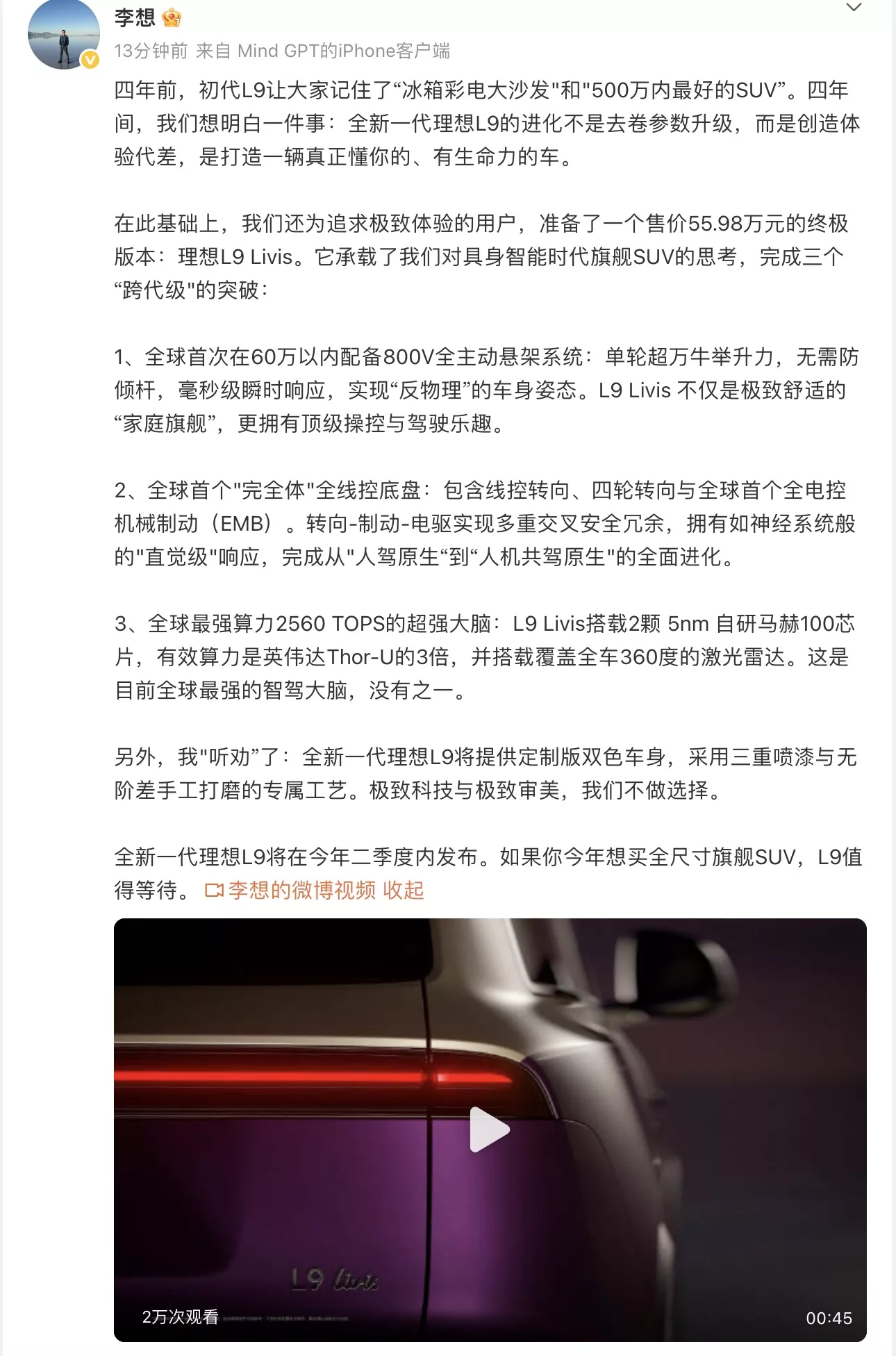
Core Insights - The company is set to launch a new version of the Li Auto L9, named the L9 Livis, priced at 559,800 yuan [1] Group 1: Product Features - The new Li Auto L9 Livis version is equipped with two self-developed "Mach 100" chips, boasting the world's strongest computing power of 2560 TOPS [3] - It features the world's first 800V fully active suspension system within a price range of 600,000 yuan [3] - The vehicle incorporates the first "complete" fully steerable chassis, integrating key technologies such as steer-by-wire, four-wheel steering, and fully electric mechanical braking (EMB) [3] Group 2: Technological Advancements - The "Mach 100" chip is a core technology developed by Li Auto since 2022, which, along with the company's self-developed large model and operating system, significantly enhances the intelligence level of the new Li Auto L9 [3]

广汽丰田,携「新」篇杀进2026
3 6 Ke· 2026-02-01 23:03
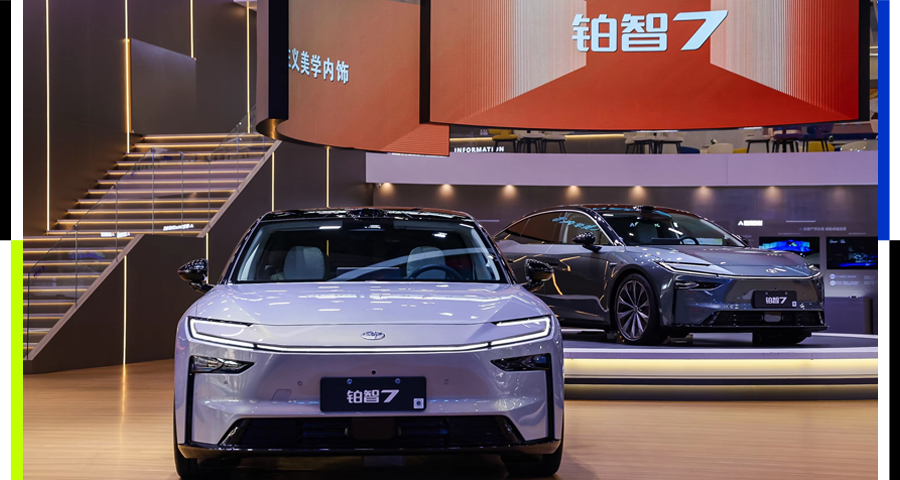
Core Insights - The entry of joint venture companies is set to redefine the rules of the new energy vehicle market [2] - The automotive industry is shifting focus from speed to value competition, favoring established joint venture brands that have adapted to electric vehicle demands [3][4] Group 1: Market Dynamics - The new energy vehicle market is transitioning from a focus on rapid innovation to a more balanced approach that emphasizes safety, reliability, and overall consumer experience [3][15] - Joint venture companies like GAC Toyota are leveraging their brand strength, scale, and manufacturing expertise to create systematic advantages in the market [3][4] Group 2: Product Development - GAC Toyota's upcoming model, the Platinum 7, is positioned as a benchmark for the new era of "water bucket cars," which prioritize safety and reliability alongside performance and technology [5][14] - The Platinum 7 features a spacious design and advanced configurations that challenge the perception of joint venture brands as lagging in smart technology [7][10] Group 3: Competitive Landscape - The competition in the new energy vehicle sector is intensifying, with a clear divide emerging between products that prioritize safety and reliability versus those that focus solely on performance or technology [15][16] - GAC Toyota's commitment to safety and quality, backed by decades of experience, provides a competitive edge that newer brands may struggle to match [12][14] Group 4: Strategic Initiatives - GAC Toyota is implementing a "Chief Engineer System" to enhance decision-making and product development, ensuring that products meet market demands effectively [17][19] - The company is not only focusing on electric vehicles but is also evolving its existing fuel models, indicating a comprehensive approach to market leadership [20]

BBA,势败如山倒
商业洞察· 2026-01-21 09:24
Core Viewpoint - The article discusses the significant decline in sales of traditional luxury car brands (BBA: BMW, Benz, Audi) in China for 2025, attributing this downturn to the rise of domestic electric vehicle brands and changing consumer preferences [6][9]. Group 1: Sales Performance - In 2025, the sales figures for BBA in China were as follows: BMW (including MINI) sold 625,500 units, down 12.5%; Audi (from FAW and SAIC) sold approximately 617,000 units, down 5%; and Mercedes-Benz (including commercial vehicles) sold 575,000 units, down 19% [6][8]. - The collective decline in sales for BBA is not seen as a short-term fluctuation but rather a structural loss due to the surge in new energy vehicles, with the penetration rate nearing 60% and domestic brands capturing 65% of the market share [9]. Group 2: Market Dynamics - The article highlights that the traditional luxury brands are struggling to maintain their market position as consumers shift away from brand loyalty, with BBA's user intent loyalty dropping below 18% in 2025 [13][14]. - The competition from new energy brands like NIO, Li Auto, Tesla, and Xiaomi is evident, with a significant percentage of their potential repeat customers coming from former BBA users [14]. Group 3: Strategic Responses - BMW has initiated price cuts on over 30 models to attract customers, with the entry-level electric iX1 dropping to 187,500 yuan, but the effectiveness of this strategy in boosting sales remains uncertain [10][11]. - Audi plans to launch new models like the A6L e-tron and E7X in 2026 to address its technological shortcomings, while Mercedes-Benz aims to introduce 15 new models, including a locally produced electric GLC [16][18]. - BMW's upcoming iX3, set to launch in late 2026, will feature advanced technology and pricing will be crucial for its success in the new energy market [17].

“难以解释”!业绩暴增,股价微涨
Zhong Guo Ji Jin Bao· 2026-01-18 11:31
Core Viewpoint - SAIC Motor Corporation has announced a significant increase in expected net profit for 2025, projecting a year-on-year growth of 438% to 558%, yet its stock price remains under pressure, reflecting a mismatch between market valuation and performance [2][3]. Group 1: Company Performance and Market Reaction - On January 15, SAIC Motor released an impressive earnings forecast, leading to a brief stock price increase of over 3% on January 16, but it closed with only a 0.81% gain, still trading below its net asset value [1][2]. - As of January 16, SAIC Motor's market capitalization stood at 172.3 billion yuan, significantly lower than BYD's 874 billion yuan, highlighting a substantial valuation gap among leading automotive companies [3][8]. - The company is currently in a "broken net" state, with its stock price at 14.99 yuan per share, below the latest audited net asset value of 25.71 yuan per share [7][8]. Group 2: Investor Concerns and Market Management - Investors have raised questions regarding SAIC Motor's market value management, expressing skepticism about the effectiveness of its strategies [4][11]. - The company has not announced any share repurchase plans since the release of its 2025 valuation enhancement plan, which is a key measure for market value management [12][13]. - Despite having executed three rounds of share repurchase plans totaling 4.747 billion yuan, the results have been deemed unsatisfactory [14][13]. Group 3: Industry Context and Challenges - The automotive industry is facing intense competition and rapid transformation towards new energy and smart technologies, complicating investment prospects [19][20]. - Many listed automotive companies are struggling with market valuations below 200 billion yuan, with only a few like BYD and Great Wall Motors exceeding this threshold [18]. - The market is characterized by a high number of listed automotive companies, which diminishes individual company visibility compared to global players like Tesla [20]. Group 4: Strategic Focus and Future Outlook - Industry experts emphasize the importance of improving operational quality as a core aspect of market value management, rather than relying solely on share buybacks or short-term market trends [22][29]. - Companies are encouraged to focus on developing standout products to enhance their market valuation directly, as seen with NIO's recent successful model launches [24][29]. - The consensus among industry leaders is that the automotive sector is entering a critical phase, with a clearer picture of market dynamics expected in the next five years [21].

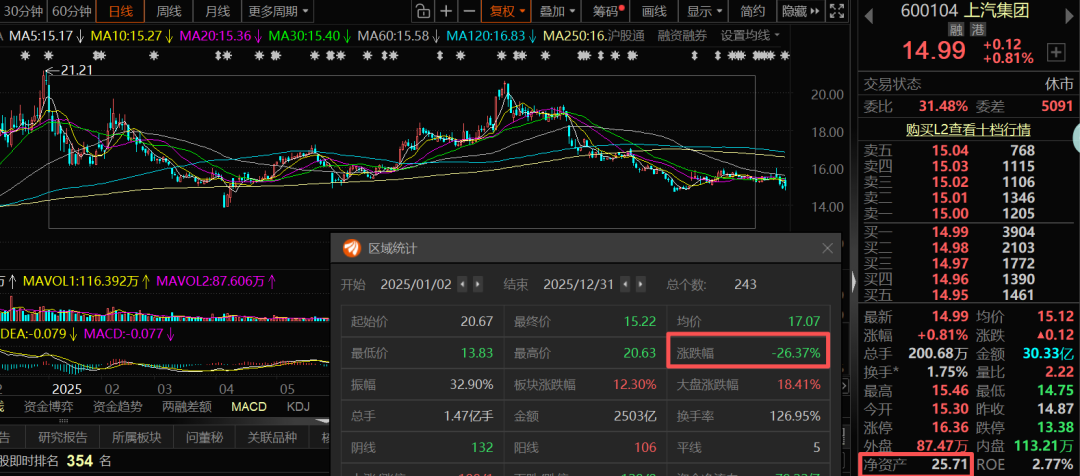
上汽集团业绩大幅预增后股价微涨,上市车企集体遭遇市值烦恼
Zhong Guo Ji Jin Bao· 2026-01-18 11:06
Core Viewpoint - SAIC Motor Corporation has announced a significant profit forecast for 2025, expecting a year-on-year increase in net profit attributable to shareholders of 438% to 558%, yet its stock price remains undervalued and in a state of net asset deficit [4][8]. Group 1: Company Performance - On January 15, SAIC Motor released a profit forecast that surprised the market, but its stock price only rose by 0.81% on January 16, indicating a mismatch between market valuation and company performance [4][6]. - As of January 16, 2026, SAIC Motor's market capitalization was 172.3 billion yuan, significantly lower than BYD's 874 billion yuan, highlighting the valuation gap among leading automotive companies [4][5]. Group 2: Market Valuation Issues - Many listed automotive companies, including SAIC Motor, are facing challenges with market capitalization that does not reflect their performance, leading to calls for a re-evaluation of their value in the capital market [4][10]. - SAIC Motor's price-to-earnings ratio is 15.95, and its price-to-book ratio is 0.58, both of which are below industry averages, indicating a potential undervaluation [5][8]. Group 3: Shareholder Concerns - Investors have been actively inquiring about SAIC Motor's market value management strategies, questioning whether the company is effectively addressing its valuation issues [10][11]. - Despite previous share buyback plans totaling 4.747 billion yuan, the effectiveness of these measures has been questioned, as the company remains in a state of net asset deficit [11][12]. Group 4: Industry Context - The automotive industry is undergoing rapid transformation towards electrification and smart technology, which increases competition and investment challenges, contributing to the undervaluation of many companies [14][15]. - The market is saturated with numerous listed automotive companies, making it difficult for individual firms to stand out and achieve premium valuations [14][15].