
炭仌咖啡

Search documents
华源晨会精粹20260326-20260326
Hua Yuan Zheng Quan· 2026-03-26 11:26
Group 1: Robotics - Woan Robotics (06600.HK) - The company achieved revenue of 900 million yuan in 2025, a year-on-year increase of 48%, with a gross profit of 490 million yuan, up 54%, resulting in a gross margin of 54%, an increase of 2.3 percentage points year-on-year [2][8] - The global market strategy has shown significant results, with revenue growth in core markets such as Germany, which saw a 108.9% increase [9] - The product lines, including enhanced execution robots and AI solutions, have all experienced high growth, validating the sustainability of core category growth [9][10] Group 2: Utilities - China Resources Power (00836.HK) - The company reported a net profit of 14.519 billion HKD in 2025, a slight increase of 0.9% compared to 2024, with core business profit rising by 9.9% [14][15] - The growth in 2025 was primarily driven by a decline in coal prices and new power generation units, despite a decrease in renewable energy performance due to accounting changes [15] - The company plans to add 5.45 million kilowatts of wind and solar capacity in 2026, focusing on comprehensive energy services as a new growth engine [18] Group 3: Food and Beverage - Nongfu Spring (09633.HK) - The company achieved total revenue of 52.553 billion yuan in 2025, a year-on-year increase of 22.51%, with a net profit of 15.868 billion yuan, up 30.89% [21][22] - The tea beverage segment has become the largest revenue source, with a 29% increase in revenue to 21.6 billion yuan, accounting for 41.1% of total revenue [22][23] - The packaging water business has shown a strong recovery, with revenue increasing by 17.3% to 18.71 billion yuan, demonstrating the company's robust brand and channel capabilities [22][23] Group 4: North Exchange - Audiwei (920491.BJ) - The company reported revenue of 683 million yuan in 2025, an 11% year-on-year increase, with a net profit of 94.03 million yuan, up 7% [25][26] - The sensor business revenue grew by 20% due to increased applications in smart homes and enhanced collaboration with automotive manufacturers [26][27] - The company has initiated the construction of a high-performance sensor R&D base in Guangzhou, aiming to enhance its technological capabilities [27] Group 5: North Exchange - Xingtux Control (920116.BJ) - The company achieved revenue of 321 million yuan in 2025, an 11% increase, with a net profit of 100.83 million yuan, up 19% [30][31] - The commercial aerospace sector saw a 62% revenue increase, driven by the expansion of services to mainstream commercial satellite companies [31][32] - The company plans to build an AI-enabled space cloud product system to meet the growing demand for low-orbit internet constellations [33] Group 6: North Exchange - Lechuang Technology (920425.BJ) - The company is focused on the adhesive control system market, with expected revenue of 123 million yuan in 2025, a 58% year-on-year increase, and a net profit of 33.69 million yuan, up 100% [38][39] - The company is expanding its applications in AI glasses and power batteries, enhancing its market share in the adhesive control system sector [39][40] - The overall market for adhesive machines in China is projected to grow significantly, with a CAGR of 18% from 2025 to 2029 [37]


农夫山泉(09633.HK)2025 年报点评
Huachuang Securities· 2026-03-25 10:25
Investment Rating - The report maintains a "Strong Buy" rating for Nongfu Spring (09633.HK) with a target price of HKD 57 [2][7]. Core Views - The company reported a revenue of HKD 52.553 billion for 2025, representing a year-on-year growth of 22.5%, and a net profit of HKD 15.868 billion, up 30.9% year-on-year [2][7]. - The second half of 2025 saw a significant recovery in packaging water and an unexpected high growth in tea beverages, with total revenue reaching HKD 26.931 billion, a 30% increase year-on-year [7]. - The company plans to distribute a cash dividend of HKD 0.99 per share, resulting in a payout ratio of 70.2% [2]. Financial Performance Summary - **Revenue and Profit Forecasts**: - 2025A Revenue: HKD 52.553 billion - 2026E Revenue: HKD 60.242 billion (14.6% growth) - 2027E Revenue: HKD 67.658 billion (12.3% growth) - 2028E Revenue: HKD 74.896 billion (10.7% growth) - 2025A Net Profit: HKD 15.868 billion - 2026E Net Profit: HKD 17.636 billion (11.1% growth) - 2027E Net Profit: HKD 19.856 billion (12.6% growth) - 2028E Net Profit: HKD 22.320 billion (12.4% growth) [2][11]. - **Earnings Per Share (EPS)**: - 2025A EPS: HKD 1.41 - 2026E EPS: HKD 1.57 - 2027E EPS: HKD 1.77 - 2028E EPS: HKD 1.98 [2][11]. - **Valuation Ratios**: - 2026E Price-to-Earnings (P/E) ratio: 24 - 2027E P/E ratio: 21 - 2028E P/E ratio: 19 - 2026E Price-to-Book (P/B) ratio: 9.6 - 2027E P/B ratio: 8.5 - 2028E P/B ratio: 7.5 [2][11]. Market Performance - The company’s stock price as of March 25, 2026, was HKD 42.44, with a total market capitalization of HKD 477.3 billion [3][7]. - The stock has shown a significant performance compared to the Hang Seng Index, with a 55% increase over the past year [5].
农夫山泉(09633):2025年报点评:业绩超预期,竞争力强化
Huachuang Securities· 2026-03-25 03:53
Investment Rating - The report maintains a "Strong Buy" rating for Nongfu Spring (09633.HK) with a target price of HKD 57 [2][7]. Core Insights - The company reported a revenue of HKD 52.553 billion for 2025, representing a year-on-year growth of 22.5%, and a net profit of HKD 15.868 billion, up 30.9% year-on-year [2][7]. - In the second half of 2025, the company achieved a revenue of HKD 26.931 billion, a 30% increase year-on-year, with a net profit of HKD 8.246 billion, reflecting a 40.2% growth [2][7]. - The company plans to distribute a cash dividend of HKD 0.99 per share, resulting in a payout ratio of 70.2% [2][7]. Financial Performance Summary - **Revenue and Profit Forecasts**: - 2025A Revenue: HKD 52.553 billion, 2026E: HKD 60.242 billion, 2027E: HKD 67.658 billion, 2028E: HKD 74.896 billion [2][11]. - 2025A Net Profit: HKD 15.868 billion, 2026E: HKD 17.636 billion, 2027E: HKD 19.856 billion, 2028E: HKD 22.320 billion [2][11]. - **Earnings Per Share (EPS)**: - 2025A: HKD 1.41, 2026E: HKD 1.57, 2027E: HKD 1.77, 2028E: HKD 1.98 [2][11]. - **Valuation Ratios**: - Price-to-Earnings (P/E) Ratio: 2025A: 26, 2026E: 24, 2027E: 21, 2028E: 19 [2][11]. - Price-to-Book (P/B) Ratio: 2025A: 10.6, 2026E: 9.6, 2027E: 8.5, 2028E: 7.5 [2][11]. Market Performance - The company’s market performance shows a significant recovery in the second half of 2025, with a notable increase in market share and revenue from various product lines, including packaged water and tea beverages [7][8]. - The gross margin for the second half of 2025 reached a historical high of 60.72%, benefiting from lower raw material costs and improved product mix [7][8].
周观点:年底关注渠道反馈,餐供龙头率先复苏-20251207
GOLDEN SUN SECURITIES· 2025-12-07 08:24
Investment Rating - The report maintains an "Increase" rating for the food and beverage industry, indicating a positive outlook for selected stocks and sectors within the industry [4]. Core Insights - The white liquor sector is showing signs of recovery, with Shanxi Fenjiu focusing on national expansion, youth engagement, and internationalization strategies for 2026. The company is optimizing inventory and enhancing market capacity, which is expected to support growth [2]. - In the beverage sector, companies like Nongfu Spring are planning to strengthen their water and tea product lines while introducing new products. The beer segment is diversifying with new flavors to cater to changing consumer preferences [3]. - The report highlights the potential for growth in consumer staples, with companies like Three Squirrels expanding into a full-category strategy and Mengniu Dairy leading in deep processing innovations [7]. Summary by Sections White Liquor - Shanxi Fenjiu's 2026 marketing strategy focuses on nationalization, youth engagement, and precise consumer service. The company is targeting key markets and optimizing inventory to enhance growth potential [2]. - The white liquor industry is characterized by bottoming out in sales, clearing financial reports, and low expectations, suggesting a favorable environment for quality asset allocation [2]. Beer and Beverage - The beer sector is witnessing the launch of new products like Jin Xing Beer’s winter flavor, reflecting a shift in consumption patterns towards home and outdoor settings [3]. - Nongfu Spring's strategy for 2026 includes strengthening its core water products and expanding its tea offerings, indicating a focus on product diversification and market penetration [3]. Consumer Staples - Three Squirrels is advancing its full-category strategy with the opening of flagship stores, emphasizing community engagement and a wide range of products [7]. - Mengniu Dairy is enhancing its product line with deep processing innovations, which are expected to drive demand and improve the utilization of raw milk [7]. - The frozen food sector is recovering, with companies like Anjuke benefiting from new product launches and channel optimizations, indicating a positive market response [7].






食品饮料行业周度市场观察-20251205
Ai Rui Zi Xun· 2025-12-05 05:39
Investment Rating - The report does not explicitly provide an investment rating for the food and beverage industry Core Insights - The sports nutrition sector is experiencing rapid growth, with the global market expected to increase from 188.13 billion yuan in 2025 to 306.47 billion yuan by 2032, reflecting a compound annual growth rate (CAGR) of 7.22%. In China, the market is projected to reach 20.93 billion yuan by 2030, with a CAGR of 11.56% [2] - The beverage market in China is witnessing a trend of "market position certification," where non-first-tier brands obtain certifications like "sales leader" and "category pioneer" to differentiate themselves in a saturated market [2] - The Japanese ready-to-drink coffee market is shifting from canned to PET bottle packaging, with PET bottles increasing from 30% in 2017 to over 40% in 2023, reflecting changing consumer preferences towards convenience and emotional connection [5] Industry Trends - The sports nutrition industry is a rapidly growing segment of the health supplement market, with a focus on serving active individuals. The market is highly concentrated in China, with the top three companies holding a 70% market share [2] - The beverage market is seeing a rise in "market position certification," which is a strategy for non-first-tier brands to establish credibility and differentiate themselves amid intense competition [2] - The dairy industry is focusing on deep processing technologies to enhance the nutritional value of milk, aiming for a transformation from quantity accumulation to quality improvement [5] - The ready-to-drink coffee market in Japan is experiencing a shift towards PET packaging, driven by consumer demand for convenience and a more leisurely drinking experience [5] - The health beverage sector is rapidly evolving, with products like birch sap showing a compound annual growth rate of over 300% in the past three years, indicating a strong consumer preference for natural and functional drinks [8] - The no-sugar tea market is transitioning from growth to maturity, with established brands gaining market share while new entrants face significant competition [8] - The sports drink market is rapidly expanding, with brands like Dongpeng's "Bushi La" gaining significant market share through competitive pricing and promotional activities [12] Top Brand News - Starbucks has launched a themed marketing campaign featuring classic millennium songs to enhance customer experience and promote seasonal products [14] - The ready-to-drink yogurt market is seeing significant growth, with brands like "Mo Yoghurt" leveraging celebrity endorsements to enhance brand visibility and consumer engagement [14] - Sanyuan Foods reported a 124.84% increase in net profit, driven by its low-temperature milk segment, showcasing the potential for growth in the dairy market [17] - JD.com has established a dedicated department for prepared food, indicating a strategic focus on the growing market for convenience foods [19] - Farmers Spring has introduced new ready-to-drink coffee products, aiming to capture market share in a competitive landscape dominated by established brands [20]
农夫山泉开经销商会议:2026要做强包装水,做大无糖茶,还要“死磕”5元咖啡
3 6 Ke· 2025-12-03 04:39
Core Insights - The article highlights that the largest domestic beverage company in China, Nongfu Spring, is focusing on three strategic areas for 2026: strengthening its bottled water business, expanding its tea beverage offerings, and promoting new products like ready-to-drink coffee [1][3][9] Bottled Water Business - Nongfu Spring aims to solidify its bottled water segment as a strategic priority, focusing on wholesale and traditional customers while enhancing water knowledge education and sports marketing [3][5] - The company holds a leading market share of approximately 30% in the bottled water category, indicating its commitment to deepening its competitive advantage [3][5] - Recent financial reports show a revenue of 9.443 billion yuan from bottled water, reflecting a year-on-year growth of 10.7%, contributing to 36.9% of total revenue [5][8] Tea Beverage Expansion - The company plans to increase its presence in the tea beverage market by introducing new packaging sizes, including 900ml and 335ml options for its Oriental Leaf brand [7][8] - Tea beverages generated 10.089 billion yuan in revenue, making it the largest revenue contributor among all business segments [8][10] - Despite the slowdown in the growth of sugar-free tea, Nongfu Spring is strategically expanding its product specifications to capture a larger market share [8][9] Ready-to-Drink Coffee Development - Nongfu Spring is set to promote its ready-to-drink coffee products, particularly the newly launched "Tanru Coffee" priced at 5 yuan for 400ml, targeting a gap in the market [9][13] - The ready-to-drink coffee segment currently holds less than 2% market share, with a year-on-year decline of 13.48% expected in 2024 [9][14] - The company leverages its extensive distribution network of over 2 million retail terminals to facilitate the introduction of its coffee products [14][15]

研判2025!中国即饮咖啡行业发展历程、市场政策、产业链图谱、销售现状、竞争格局及发展趋势分析:雀巢咖啡龙头优势明显[图]
Chan Ye Xin Xi Wang· 2025-11-29 05:27
Core Insights - The ready-to-drink (RTD) coffee market in China has seen significant growth, with 2023 offline sales reaching 3.76 billion liters and a revenue of 10.653 billion yuan, but a decline is expected in 2024 due to economic slowdown and competition from freshly brewed coffee [1][5]. Overview - RTD coffee refers to coffee products that can be consumed directly without brewing, primarily packaged in bottles and cans, characterized by convenience and stable shelf life [1]. Development History - The development of China's RTD coffee industry can be divided into four stages: initial enlightenment, steady growth, diversified competition, and high-quality upgrade, with a focus on health, premium quality, and localization since 2020 [2]. Regulatory Policies - The food and beverage industry is facing stricter regulations, impacting the RTD coffee sector, which must comply with various food safety laws throughout the production process [3]. Industry Chain - The RTD coffee industry chain includes upstream suppliers of raw materials (coffee beans, milk, etc.), midstream production processes, and downstream sales channels such as convenience stores and e-commerce [4]. Upstream Supply - Yunnan province is the primary coffee bean production area in China, contributing over 90% of the national output, with 2024 production expected to reach 150,200 tons [4]. Consumer Demographics - By 2024, the number of coffee consumers in China is projected to reach 417 million, with a significant portion of the core consumer group aged 25-35, primarily urban professionals [5]. Current Market Status - The RTD coffee market is becoming mainstream in China, with a notable increase in consumer adoption, although a decline in sales volume is anticipated for 2024 [1][5]. Competitive Landscape - The market is highly concentrated, with the top five companies holding an 87.2% market share. Nestlé leads with a 60.4% share, while new brands are emerging, intensifying competition [6][7]. Company Analysis - **China Resources Beverage**: A state-owned enterprise with a revenue of 6.206 billion yuan and a gross profit margin of 46.67% in the first half of 2025 [8]. - **Nongfu Spring**: A leading beverage company with a revenue of 25.62 billion yuan and a gross profit margin of 60.3% in the first half of 2025 [8]. Future Trends - Health-oriented products, including sugar-free and plant-based options, are expected to dominate the market, along with the introduction of functional ingredients in RTD coffee [9].


农夫山泉、怡宝入局,巨头抢滩即饮咖啡赛道
Bei Jing Shang Bao· 2025-11-09 12:49
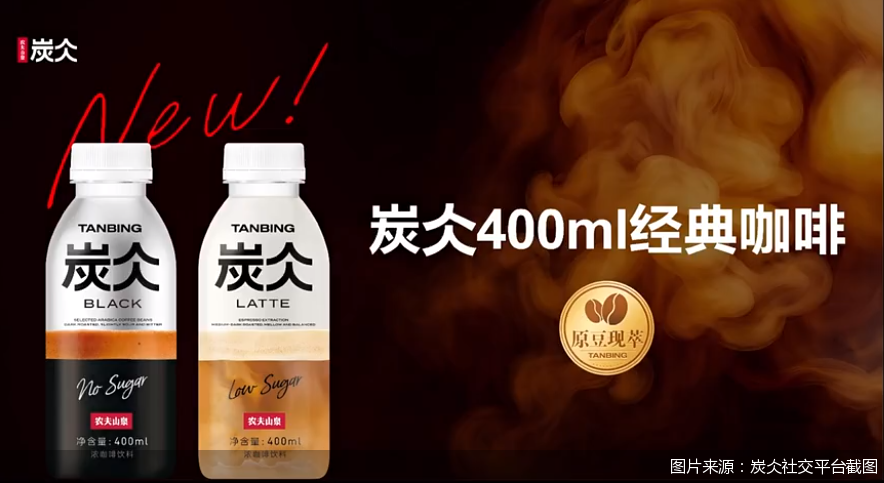
Core Insights - The recent launch of new coffee products by Nongfu Spring and Yibao indicates a strategic move by beverage companies to enter the ready-to-drink coffee market, which has significant growth potential despite competition from freshly brewed coffee [1][4] Product Launches - Nongfu Spring's new coffee brand, Tanxi, has introduced two products: a sugar-free Americano and a low-sugar latte, focusing on high-quality coffee [1] - The new 400ml Tanxi coffee is priced at approximately 5 yuan per bottle, making it more affordable compared to previous offerings [3] - Yibao has launched the "Yanhui Xiaoruan Can" series, featuring two flavors priced at 1.98 yuan per bottle in a 180ml format, which is competitive against Tanxi's offerings [3] Market Dynamics - The ready-to-drink coffee market is experiencing a concentration of brands, with the top five brands increasing their market share from 84.32% to 85.35% between 2023 and 2024 [5] - Traditional coffee giants like Nestlé, Starbucks, and Coca-Cola dominate the market, while Nongfu Spring aims to penetrate the mid-to-high-end coffee segment [5] Strategic Considerations - Beverage companies are entering the ready-to-drink coffee market due to its rapid growth and potential for new revenue streams, with a focus on product differentiation and appealing to younger consumers [4] - The competitive landscape is influenced by the rise of freshly brewed coffee, which has pressured ready-to-drink coffee brands to adopt competitive pricing strategies [6] Emerging Trends - The trend of "Chinese herbal coffee" is gaining traction, with products incorporating traditional Chinese medicinal ingredients like ginseng and goji berries, appealing to health-conscious consumers [7][8] - Brands like Jiangren Liuyin and Most Coffee are introducing products that combine coffee with herbal ingredients, although there are concerns about potential health risks associated with such combinations [8]
农夫山泉做好即饮咖啡,还需要一个「Manner」
36氪· 2025-07-24 10:36
Core Viewpoint - The article discusses the challenges faced by Nongfu Spring's ready-to-drink coffee brand, "Tanru," and suggests a potential collaboration with the coffee chain Manner to enhance market performance and brand positioning [4][5][6][40]. Group 1: Tanru's Market Performance - Tanru has struggled to establish a strong market position in the ready-to-drink coffee sector despite various product explorations over the past six years, including different packaging and pricing strategies [9][11][12]. - The brand's attempts to create a clear identity have been inconsistent, leading to a lack of consumer recognition compared to established coffee brands like Starbucks and Luckin Coffee [14][15]. - The ready-to-drink coffee market has been shrinking for five consecutive years, with significant competition from chain coffee brands that are experiencing growth [16][17][18]. Group 2: Market Dynamics - The ready-to-drink coffee market in China remains small and crowded, with a consistent market size of over 100 billion but failing to exceed 200 billion, indicating a challenging environment for new entrants [26]. - The article categorizes participants in the ready-to-drink coffee market into three types: instant coffee brands, beverage companies, and chain coffee brands, with the latter showing growth potential [20][21][24]. - Chain coffee brands benefit from their physical stores, which provide consumer trust and brand recognition, crucial for the success of ready-to-drink products [25][27]. Group 3: Collaboration Potential - A partnership between Nongfu Spring and Manner could address Tanru's core issues by leveraging Manner's established brand and market presence, potentially leading to innovative collaboration in the coffee sector [40][46]. - Manner's existing infrastructure and focus on coffee could complement Nongfu Spring's distribution capabilities, creating a mutually beneficial relationship [43][45]. - The collaboration could enhance Manner's brand visibility and market penetration while allowing Nongfu Spring to tap into Manner's coffee expertise and consumer base [44][46].
农夫山泉推出冰块产品 冰块生意为何成新风口?
Xin Lang Zheng Quan· 2025-07-04 08:24
Core Insights - The collaboration between Nongfu Spring and Sam's Club to launch "Pure Transparent Edible Ice" has unexpectedly become a consumer sensation, highlighting the competition for innovative consumption scenarios in the food and beverage industry [1] Pricing Strategy - The 2 kg bag of ice is priced at 22.8 yuan, emphasizing two main selling points: "sourced from the natural water of Qiandao Lake" and "24-32 hours of ultra-low-speed freezing process," which reportedly reduces melting speed by about 20% compared to traditional methods [2] - The pricing strategy shows a significant premium, as the ice is priced at four times that of bottled water, with consumer feedback indicating mixed reactions regarding its affordability [2] - Compared to competitors, Nongfu Spring's pricing is competitive, with similar products priced significantly lower, indicating a strategic positioning towards high-end consumers [2][3] Market Dynamics - The ice market is becoming increasingly competitive, with various players including traditional ice manufacturers, supermarkets, and beverage giants like Yili and Mengniu entering the space [3] - Nongfu Spring's advantage lies in its brand recognition and supply chain capabilities, as it invests in self-owned production lines to ensure quality control [3][4] Cost Structure - The cost structure of industrial ice production differs significantly from home ice-making, with substantial costs associated with water purification and energy consumption during the freezing process [3] - The packaging and cold chain logistics represent a significant portion of the total costs, with cold chain expenses accounting for over 50% of the total cost [3] Profitability Challenges - The profit margins in the ice business are extremely thin, with traditional ice manufacturers facing pressure from packaging, transportation, and labor costs [4] - Nongfu Spring's strategy of using larger packaging sizes helps to dilute the cost per unit, allowing for higher pricing [4] Future Market Potential - The ice market is projected to grow significantly, with a forecasted market size exceeding 63 billion yuan by 2026, driven by increasing consumer demand for ice products [5] - However, there are concerns regarding regulatory standards for ice products, as current regulations lack clarity on hygiene standards for freshly made ice [5][6] - Nongfu Spring's strategy appears to focus on creating a "consumption ecosystem" around ice products, aiming to enhance brand perception and drive sales of other beverages [6]