
熊猫

Search documents
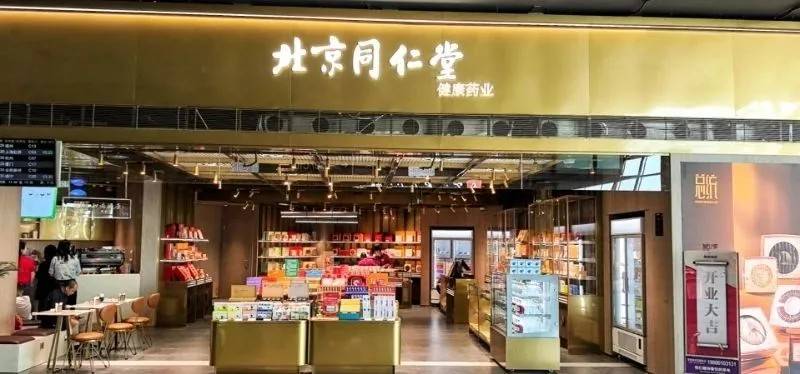
春熙路商圈迎新店:北京同仁堂入驻成都中免市内免税店
Sou Hu Cai Jing· 2025-12-31 19:08
Core Insights - Beijing Tongrentang Health has entered the Chengdu Duty-Free Store, enhancing health consumption with a new retail and experience model [1][3] - The Chengdu Duty-Free Store opened on September 25, 2025, covering approximately 3,140 square meters and featuring both duty-free and taxable areas [2] - The Chinese government has initiated a policy to establish duty-free stores in several cities, including Chengdu, to cater to outbound travelers [2] Group 1 - Beijing Tongrentang Health's new store combines duty-free and taxable products, as well as online and offline experiences, focusing on health and cultural integration [3] - The store features a health tea and light food experience area, health consultations, and cultural products to promote traditional Chinese medicine [3] - The brand's historical significance and quality support its entry into high-end retail channels, enhancing its appeal to both outbound and inbound travelers [3] Group 2 - The duty-free area is restricted to outbound travelers, while the taxable area is open to all consumers, allowing for immediate purchases [5] - The operational model aims to effectively combine health services with compliant retail, providing a reference for other markets in Sichuan [5]


西方民调:全球年轻人对华好感度上涨,认为中国才是世界领导力量
Sou Hu Cai Jing· 2025-12-30 09:19
Core Viewpoint - The latest global survey indicates a significant increase in positive perceptions of China among young people worldwide, contradicting the narrative that China is "misunderstood" in the West [1]. Group 1: Survey Methodology - The survey, titled "2025 China International Image Global Survey Report," included a substantial sample size of 51,700 valid questionnaires from 46 countries, ensuring a comprehensive representation of both developed and developing nations [3]. - The methodology was adaptable to different national contexts, utilizing face-to-face interviews, phone surveys, and online questionnaires to gather data [3]. Group 2: Young People's Affection for China - Young respondents showed a strong preference for Chinese symbols, with the Great Wall and high-speed rail receiving approval rates of 67% and 65% respectively, while pandas and smartphones also garnered over 60% approval [5]. - The survey revealed three main reasons for this affection: China's openness through visa-free transit policies, impressive development achievements in technology and infrastructure, and engaging cultural products that present a multifaceted image of China [7][9]. Group 3: Impact of the Survey - Following the survey's release, a subsequent poll indicated that a significant portion of American youth believes the U.S. should learn from China, with this view being more prevalent than dissenting opinions [11]. - The survey's influence has led to increased interest in Chinese culture among young people globally, with a rise in social media sharing of Chinese travel vlogs and a growing number of students applying for exchanges or studies in China [14]. Group 4: Global Youth Perspectives on China - Over 70% of young people worldwide hope for stable or improved U.S.-China relations, with a higher proportion favoring China over the U.S. in terms of goodwill [16]. - The survey results indicate that nearly 70% of foreign respondents have a favorable view of China, with even higher approval rates among youth in Africa and BRICS nations [18]. Group 5: Recognition of China's Governance Concepts - The concepts of "building a community with a shared future for mankind" and "green mountains and clear waters are as valuable as mountains of gold and silver" received recognition from nearly 80% of global youth, particularly in Africa and BRICS countries [19]. Group 6: Media and Government Reactions - The survey's findings have prompted Western media to adjust their narratives, leading to more balanced reporting on China's achievements, as young audiences are less receptive to one-sided negative portrayals [21]. - Governments worldwide are increasingly prioritizing cooperation with China, particularly in technology, trade, and cultural exchanges, as they implement policies to attract Chinese investment and promote youth engagement [21]. Group 7: Long-term Implications - The recognition of China among young people is based on tangible benefits and experiences, as evidenced by rising support for the Belt and Road Initiative, which is seen as contributing to infrastructure improvements and job opportunities in various countries [23]. - The growing appreciation for China's development and leadership reflects a broader desire for a fair and just international order, indicating that the choices of young people will shape the future of global relations [25][26].

吉利汽车(0175.HK):极氪私有化落地 2026年将推出多款新车 建议“买进”
Ge Long Hui· 2025-12-29 22:11
Group 1 - The company announced the completion of the privatization of Zeekr and its delisting from the New York Stock Exchange, making Zeekr a wholly-owned subsidiary [1][2] - Approximately 70.8% of shareholders opted for stock exchange, resulting in the issuance of 777 million shares, while 29.2% chose cash compensation, leading to a cash payment of $701 million [2] - The integration of Zeekr is expected to enhance operational efficiency, with R&D investments potentially decreasing by 10% to 20%, BOM costs reducing by 5% to 8%, and capacity utilization improving by 3% to 5% [2] Group 2 - The company's electric vehicle transformation is accelerating, with total vehicle sales reaching 2.7878 million units from January to November, a year-on-year increase of 41.8%, and new energy vehicle sales at 1.5335 million units, up 97% [3] - The company plans to launch multiple new models in 2026, including three SUVs and two sedans under the Galaxy brand, and aims to strengthen its electric vehicle exports, expecting a 50% year-on-year increase [4] - The projected net profits for 2025, 2026, and 2027 are estimated at 17.06 billion, 21.85 billion, and 28.18 billion yuan respectively, with year-on-year growth rates of +80%, +28%, and +29% [1][4]

群益证券:建议吉利汽车“买进”评级 2026年将推出多款新车
Zhi Tong Cai Jing· 2025-12-29 06:07
Core Viewpoint - Geely Auto has completed the privatization of Zeekr and its delisting from the New York Stock Exchange, which is expected to enhance operational efficiency through further integration of its automotive business [1][2] Group 1: Privatization and Integration - The privatization involved approximately 70.8% of shareholders opting for stock exchange, resulting in the issuance of 777 million shares, which accounts for 7.7% of the company's total issued share capital [2] - The remaining 29.2% of shareholders chose cash compensation, amounting to $701 million, with the company planning to finance up to $420 million for this transaction [2] - Post-merger, the integration of automotive operations is expected to reduce R&D costs by 10% to 20%, lower BOM costs by 5% to 8%, and improve capacity utilization by 3% to 5% [2] Group 2: Electric Vehicle Strategy - Geely's electric vehicle transition is accelerating, with total vehicle sales reaching 2.7878 million units from January to November, representing a year-over-year increase of 41.8% [3] - Sales of new energy vehicles (NEVs) reached 1.5335 million units, up 97% year-over-year, with NEVs accounting for 55% of total sales, an increase of 14.2 percentage points compared to the full year of 2024 [3] - The company plans to launch multiple new models in 2026, including three SUVs and two sedans under the Galaxy brand, and aims to strengthen its NEV exports, expecting a 50% year-over-year increase [3] Group 3: Profit Forecast - The company is projected to achieve net profits of 17.06 billion, 21.85 billion, and 28.18 billion yuan for the years 2025, 2026, and 2027, respectively, with year-over-year growth rates of +80%, +28%, and +29% after excluding one-time gains [4] - Earnings per share (EPS) are expected to be 1.59, 2.04, and 2.62 yuan for the same years, with current price-to-earnings (P/E) ratios of 9.6, 7.5, and 5.8 times [4]
群益证券:建议吉利汽车(00175)“买进”评级 2026年将推出多款新车
智通财经网· 2025-12-29 06:06
Core Viewpoint - Geely Automobile has completed the privatization of Zeekr and will delist from the New York Stock Exchange, aiming to enhance operational efficiency through integration of its automotive business [1][3] Group 1: Privatization and Integration - The privatization of Zeekr was completed on December 22, with approximately 70.8% of shareholders opting for stock exchange and 29.2% for cash compensation, resulting in a cash payment of $701 million [1][3] - Following the merger, the company expects to reduce R&D investment by 10% to 20%, lower BOM costs by 5% to 8%, and improve capacity utilization by 3% to 5% [3] Group 2: Electric Vehicle Strategy - The company is accelerating its electrification process, with total vehicle sales reaching 2.7878 million units from January to November, a year-on-year increase of 41.8%, and new energy vehicle sales reaching 1.5335 million units, up 97% [4] - The company plans to launch multiple new models in 2026, including three SUVs and two sedans under the Galaxy brand, and aims to strengthen its export of new energy vehicles, expecting a 50% year-on-year increase [4] Group 3: Financial Projections - The company is projected to achieve net profits of 17.06 billion, 21.85 billion, and 28.18 billion yuan for 2025, 2026, and 2027 respectively, with year-on-year growth rates of 80%, 28%, and 29% [2][5] - The current stock price corresponds to P/E ratios of 9.6, 7.5, and 5.8 for the years 2025, 2026, and 2027, respectively, with a recommendation to "buy" [2][5]
吉利汽车(0175.HK):降本效果显著 高端化挑战仍大
Ge Long Hui· 2025-08-20 03:59
Core Viewpoint - The company reported a strong performance in the first half of 2025, with a significant increase in revenue but a decline in net profit, indicating a mixed financial outlook for the year [1][2]. Group 1: Financial Performance - In the first half of 2025, the company achieved revenue of 150.3 billion yuan, a year-on-year increase of 27% [1] - The net profit attributable to shareholders was 9.29 billion yuan, a year-on-year decrease of 14% [1] - The core net profit attributable to shareholders reached 6.66 billion yuan, a year-on-year increase of 102% [1] - The company’s average selling price (ASP) per vehicle was 95,500 yuan, down 12.9% year-on-year, while the gross margin was 16.4%, a decline of 0.3 percentage points [2] - The company’s net profit per vehicle was 4,724 yuan, an increase of 37% year-on-year [2] Group 2: Sales and Market Performance - The company’s sales volume for the first half of 2025 reached 1.503 million units, with a target increase to 3 million units for the full year [1][2] - The sales of fuel vehicles grew to 684,000 units, while pure electric vehicle sales reached 511,000 units, a year-on-year increase of 173% [2] - The company’s export sales in the first half of 2025 were 184,000 units, a year-on-year decrease of 8% [1] Group 3: Product Development and Strategy - The company plans to enhance its product offerings by organizing into five major battle zones and customizing products by region [1] - The launch of multiple "9" series models aims to penetrate the high-end market, with the Lynk & Co 900 model showing promising sales [3] - The company’s upcoming models, including the Zeekr 9X and Galaxy M9, are expected to improve brand recognition in high-end intelligent driving solutions [3] Group 4: Profit Forecast and Investment Recommendations - The profit forecast for the company has been adjusted, with expected net profits of 15.96 billion yuan, 16.70 billion yuan, and 19.76 billion yuan for 2025, 2026, and 2027 respectively [4] - The company maintains a "recommended" rating despite the competitive challenges it faces in the market [4]