
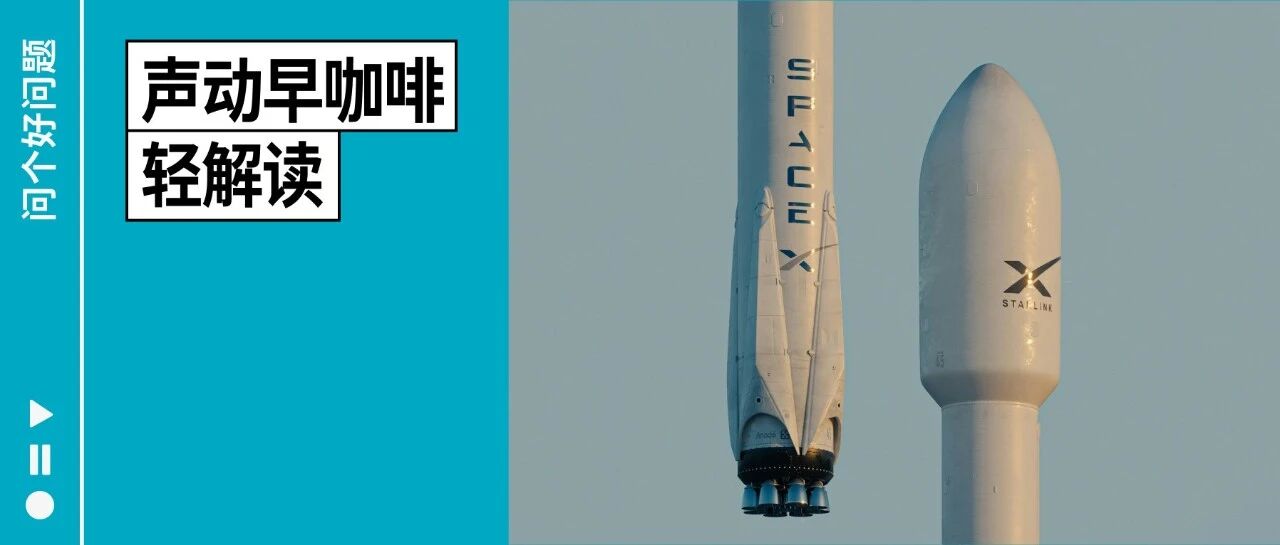
猎鹰九号火箭

Search documents
频繁发射火箭的 SpaceX 今年上市,为什么星链服务是其价值关键? | 声动早咖啡
声动活泼· 2026-01-05 09:01
Core Viewpoint - SpaceX, founded by Elon Musk in 2002, aims to revolutionize space travel and establish human life on Mars, with a significant focus on both rocket manufacturing and satellite internet services through its Starlink project [3][4]. Group 1: SpaceX and Starlink Development - SpaceX has significantly reduced rocket launch costs through reusable technology and in-house component manufacturing, which has positioned it as a leader in the commercial launch market [4][6]. - The Starlink satellite division was established in 2015, with the goal of providing satellite-based internet services to generate long-term revenue for Mars colonization efforts [4][5]. - Starlink satellites operate at a lower altitude (approximately 1200 km) compared to traditional satellites, improving data transmission speed and reducing latency [5][7]. Group 2: Market Position and Financial Performance - In 2022, Starlink generated approximately $12.8 billion in revenue, accounting for about 70% of SpaceX's total revenue, indicating strong market demand for its services [7][8]. - SpaceX's valuation is heavily influenced by expectations of future Starlink revenues, with 70% of its current valuation attributed to this segment [7]. Group 3: Customer Base and Service Expansion - Starlink's customer base includes a significant number of affluent residential users in the U.S., with 57% of users willing to pay a premium for satellite internet services [8]. - The company is expanding its services to maritime and aviation sectors, partnering with major airlines to provide faster and more stable internet services on flights [8][9]. Group 4: Regulatory and Technological Developments - SpaceX has partnered with T-Mobile to offer mobile internet services via Starlink, although regulatory approval for this service is expected in 2024 [9][10]. - The acquisition of EchoStar's wireless spectrum licenses for $17 billion is a strategic move to enhance mobile communication capabilities, allowing for improved data transmission rates [10]. Group 5: Future Innovations and AI Integration - SpaceX is exploring the development of space-based data centers, leveraging advancements in satellite technology to process and store data in orbit, which could address energy and cooling challenges faced by terrestrial data centers [12].

商业航天+太空算力+3D打印,最硬核的16家公司
Sou Hu Cai Jing· 2025-12-29 15:28
Group 1: Policy and Capital - The policy environment is clearing obstacles for commercial aerospace, with Shanghai emphasizing the construction of a world-class industrial cluster and supporting commercial aerospace companies in satellite internet constellation construction [2] - The new regulations from the Shanghai Stock Exchange specifically target commercial rocket companies, signaling a key move to accelerate innovation in commercial aerospace [2] - The National Space Administration has issued a plan for high-quality and safe development of commercial aerospace, outlining 22 key measures, including the establishment of a national commercial aerospace development fund [2][24] Group 2: Rocket Technology Costs - The core bottleneck in commercial aerospace is insufficient capacity and high costs, with domestic commercial rocket launch prices ranging from 60,000 to 150,000 RMB per kilogram, compared to SpaceX's Falcon 9 at approximately 21,000 RMB per kilogram [3] - Domestic reusable technology is still under development, with recent test flights indicating progress but not yet achieving successful landings [3] - The use of 3D printing technology is revolutionizing rocket engine production, significantly reducing costs and manufacturing time [4] Group 3: Satellite Constellation Networking - The competition in satellite internet is fundamentally about the allocation of orbital and frequency resources, with strict deadlines imposed by the International Telecommunication Union (ITU) [5] - China has multiple large-scale satellite constellation plans, including the G60 constellation aiming to deploy 1,296 satellites by 2027 and over 10,000 by 2030 [5][6] - The pace of satellite launches has accelerated significantly since the second half of 2025, indicating a shift from planning to actual deployment [6] Group 4: Space Computing - The demand for computing power is growing exponentially, with space offering unique advantages for data processing, such as low cooling requirements and abundant solar energy [7] - Companies like Google and NVIDIA are leading initiatives to establish space-based data centers, with plans to deploy satellites equipped with AI chips for data processing [7][30][31] - China is also advancing in this area, with plans for a space computing constellation and the first space computing center expected to be operational within five years [8] Group 5: Industry Chain Extension and Ecosystem - The technological spillover from commercial aerospace is empowering other industries, particularly in automotive intelligence and low-altitude economy [9] - Various initiatives are being launched to enhance data assetization and promote the integration of data elements into rural revitalization efforts [9] - The convergence of commercial aerospace with the digital economy is forming a closed-loop ecosystem, linking satellites, vehicles, and data centers [9] Group 6: Key Companies to Watch - Companies to focus on include those involved in space computing and data, such as Shunhao Co., Putian Technology, and Yuke Technology [10] - In rocket manufacturing and 3D printing, key players include Aerospace Power, Western Materials, and Aerospace Electromechanical [10] - For satellite communication and payload, notable companies include China Satellite, Shanghai Hanhua, and Aerospace Hongtu [10]
SPARC方案搅局 华尔街投行激烈竞逐SpaceX IPO
2 1 Shi Ji Jing Ji Bao Dao· 2025-12-23 16:31
Group 1: SpaceX IPO Overview - SpaceX is planning an IPO that could surpass Saudi Aramco's record of nearly $29 billion, potentially becoming the largest IPO in history [1] - The company is currently valued at $800 billion, making it the highest-valued private company globally, with IPO rumors suggesting a target valuation as high as $1.5 trillion [1] - SpaceX has entered a "quiet period," indicating preparations for a potential SEC filing for the IPO [1] Group 2: Bill Ackman's Proposal - Billionaire Bill Ackman has proposed that SpaceX skip traditional investment banks and utilize a new acquisition tool called SPARC for its IPO [2] - Ackman's plan includes offering Tesla shareholders preferential rights to invest in SpaceX, aligning with Elon Musk's vision of sharing SpaceX's growth with Tesla supporters [2] - The proposal suggests that SpaceX could raise between $42 billion and $148.7 billion, depending on the exercise price of the SPARs [3] Group 3: Investment Banking Competition - Traditional investment banks are competing for the role of underwriter for SpaceX's IPO, with firms like Morgan Stanley, Goldman Sachs, and JPMorgan Chase in the running [4] - Morgan Stanley is seen as a strong contender for the lead underwriter role due to its previous involvement with Tesla and support during Musk's acquisition of Twitter [4] Group 4: Space Data Center Concept - SpaceX's IPO is viewed as a critical step in the broader context of artificial intelligence and deep space exploration, with Musk's focus shifting towards the feasibility of "space data centers" [5] - The need for funding is driven by the challenges faced by terrestrial data centers, such as land scarcity and power grid overloads, making space-based solutions increasingly attractive [5] Group 5: Competitive Landscape - SpaceX's competitive advantage in the space data center market includes its low launch costs and existing infrastructure, such as over 9,000 Starlink satellites [6] - The company is positioned to leverage its vertical integration and existing technology to establish a leading role in the emerging space data center sector [6] Group 6: Challenges and Opportunities - Building space data centers presents significant engineering challenges, including radiation exposure and thermal management issues [6][7] - The financial requirements for developing space data centers are substantial, necessitating significant capital investment across various technological aspects [7] Group 7: Chinese Commercial Space Industry - Concurrently, Chinese commercial space companies are also pursuing IPOs, with several firms initiating the process on the STAR Market [8] - The combined valuation of these Chinese companies is approximately $12.2 billion, indicating potential for significant value appreciation in the future [8] - Technological advancements, particularly in rocket reusability, are critical for the growth of China's commercial space sector [9]
SPARC方案搅局,华尔街投行激烈竞逐SpaceX IPO
2 1 Shi Ji Jing Ji Bao Dao· 2025-12-23 11:08
Core Insights - SpaceX is preparing for an IPO that could surpass Saudi Aramco's record of nearly $29 billion, potentially becoming the largest IPO in history [1] - The company is currently valued at $800 billion, making it the highest-valued private company globally, with IPO rumors suggesting a target valuation as high as $1.5 trillion [1] - SpaceX has entered a "quiet period," indicating compliance steps before filing with the SEC for its IPO [1] Group 1: IPO Preparation - SpaceX is planning a new round of internal share sales as part of its IPO preparations [1] - Billionaire Bill Ackman has proposed that SpaceX utilize a new acquisition tool, SPARC, to go public, suggesting a direct offering to Tesla shareholders [3][4] - Ackman's plan includes a zero-underwriting fee structure and a simplified capital structure for the IPO, with a potential fundraising of $42 billion to $1.487 trillion depending on the exercise price of SPARs [4] Group 2: Competitive Landscape - Traditional investment banks are competing for the role of underwriters for SpaceX's IPO, with Morgan Stanley, Goldman Sachs, and JPMorgan among the contenders [5] - Morgan Stanley is seen as a strong candidate for the lead underwriter due to its previous involvement with Tesla [5] Group 3: Market Context and Strategic Importance - SpaceX's IPO is viewed as a significant event not just for the company but for advancements in artificial intelligence and deep space exploration [6] - The company aims to leverage the IPO to fund the development of "space data centers," which could address challenges faced by terrestrial data centers [6][8] - Competitors like Google and Nvidia are also exploring space-based computing solutions, indicating a growing interest in this sector [7][8] Group 4: Challenges and Opportunities - Building space data centers presents significant engineering challenges, including radiation exposure and thermal management issues [8][9] - The financial requirements for developing these technologies are substantial, necessitating significant capital investment [9] - Chinese commercial space companies are also pursuing IPOs, indicating a competitive landscape that could reshape market dynamics [10]
SpaceX估值创新高 马斯克身家突破6000亿美元大关
智通财经网· 2025-12-15 23:26
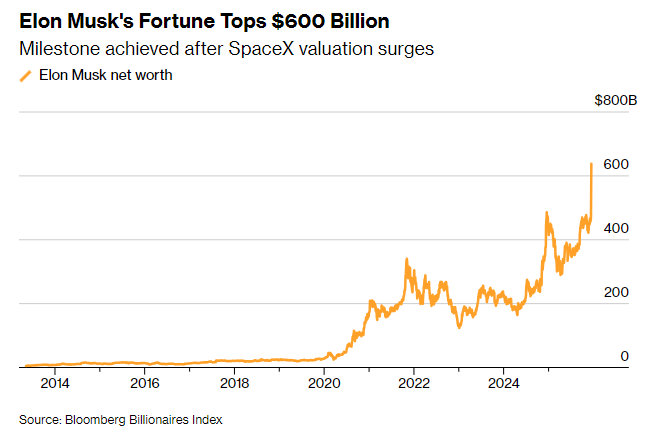
Group 1 - SpaceX has achieved a new valuation of approximately $800 billion, making it the most valuable private company globally, contributing to Elon Musk's personal wealth reaching nearly $638 billion [1] - Musk's 42% stake in SpaceX is valued at around $317 billion after applying liquidity discounts for private companies [1] - This marks the first time Bloomberg's Billionaires Index has recorded an individual's wealth exceeding $600 billion, with Musk's wealth growing significantly since he was first included in the index in 2013 with a net worth of $4.8 billion [1] Group 2 - If SpaceX successfully conducts its initial public offering (IPO) as planned next year and achieves a target valuation of $1.5 trillion, Musk's wealth could increase further, with his holdings potentially valued at over $625 billion [3] - SpaceX is a leader in the orbital launch sector with its Falcon 9 rocket and provides internet services through its Starlink satellite system [3] - Recently, Musk has been promoting plans for building a space-based artificial intelligence data center [3]
打通商业航天发射链路,构建共赢新生态
Guo Ji Jin Rong Bao· 2025-11-04 04:34
Core Insights - China is rapidly advancing its satellite internet capabilities, with significant recent launches marking a shift towards high-density deployment of satellite constellations [1][5][16] - The country is developing two major satellite internet projects: the State Grid Constellation (GW Constellation) and the Qianfan Constellation, both aiming for extensive global coverage [2][5][7] Group 1: GW Constellation - The GW Constellation, managed by China Satellite Network Group, aims to create a global integrated communication system and has successfully launched over 100 satellites [1][5] - The recent launch of the 12th batch of satellites occurred just 20 days after the previous mission, indicating a significant increase in launch frequency [5][16] - The long-term goal for the GW Constellation is to deploy a total of 12,992 satellites in low Earth orbit by 2027 [5][8] Group 2: Qianfan Constellation - The Qianfan Constellation, developed by Shanghai Yanshin Satellite Technology, is China's second large-scale satellite internet project and has also entered the network deployment phase [2][5] - The company completed a record A-round financing of 6.7 billion yuan in February 2024, highlighting strong investor interest in the satellite industry [2][7] - Qianfan plans to have 324 satellites in orbit by mid-2026, increasing to 648 by the end of that year, and aims for 1,296 satellites by 2027 [7] Group 3: Market Dynamics - The rapid deployment of satellite constellations is driven by the urgency to secure orbital resources and frequency allocations, as countries must launch a percentage of their planned satellites within a specified timeframe [8] - The cost of manufacturing low Earth orbit satellites has significantly decreased, now ranging from 30 to 40 million yuan per satellite, facilitating faster deployment [8] - The commercial rocket sector is expected to benefit significantly from the satellite constellation construction, with market potential reaching hundreds of billions in the next decade [16] Group 4: Technological Advancements - The success of satellite internet constellations relies on high-capacity, low-cost launch capabilities, with China's Long March series rockets playing a crucial role [17] - The development of reusable rocket technology is essential for reducing launch costs and increasing frequency, with the industry aiming for rockets to be reused multiple times [17] - The competitive landscape is influenced by the ability to achieve lower costs and higher launch frequencies, with companies focusing on technological advancements to meet these demands [17]
马斯克,活该成功!
Sou Hu Cai Jing· 2025-05-10 14:23
Group 1 - The core idea of the article revolves around Elon Musk's entrepreneurial journey and his mission to make humanity a multi-planetary species, particularly through SpaceX and Mars colonization [3][10][41] - Musk's entrepreneurial history is marked by several key ventures, including Zip2, PayPal, Tesla, and SpaceX, showcasing his evolution from internet entrepreneur to space pioneer [6][8][10] - Musk's motivations are deeply rooted in his vision for the future, focusing on sustainable energy and space exploration, which he considers essential for the survival of humanity [14][20][22] Group 2 - Musk's ultimate goal is to establish a human presence on Mars, driven by the belief that Earth is vulnerable to extinction events, and that humanity needs a backup plan [41][44][49] - The article discusses Musk's approach to innovation, emphasizing the importance of combining grand visions with practical business strategies, which has led to the success of companies like SpaceX and Tesla [20][66][70] - SpaceX's Starlink project aims to create a global satellite internet network, which not only serves as a revenue source for funding Mars colonization but also addresses global connectivity issues [76][87][90] Group 3 - The development of the Starship rocket is a critical component of Musk's plan to transport humans to Mars, with innovative designs aimed at reducing costs and increasing efficiency [92][94][110] - Musk's unique approach to risk and failure is highlighted, showcasing his willingness to experiment and learn from setbacks, which is essential for groundbreaking advancements in space travel [100][104][106] - The article concludes with a reflection on Musk's broader vision for humanity, suggesting that his endeavors are not just about business success but about ensuring the survival and advancement of human civilization [150][166]


2025年中国民营航天及地月经济带商业发展前瞻(简版)
Ai Rui Zi Xun· 2025-03-18 06:53
Investment Rating - The report does not explicitly provide an investment rating for the industry Core Insights - The commercial space industry is transitioning towards a reusable rocket paradigm, enhancing overall space technology capabilities and infrastructure development in the lunar economic zone [3][6] - The lunar economic zone is expected to evolve from concept validation to large-scale development, driven by commercial activities and infrastructure construction [20][36] - The report highlights the importance of technological iteration and stability in the private space sector, emphasizing the need for long-term strategic planning [24][32] Summary by Sections Global Trends - The global space industry is increasingly focusing on reusable technologies, with significant advancements in rocket capabilities and interactions between humans and machines [3] - The frequency of rocket launches is expected to increase, with China projected to achieve breakthroughs in reusable technology by 2025-2026 [6] Potential Risks - The private space sector in China faces challenges due to a lack of focus on long-term strategies and technological iterations, which could hinder future development [24][26] - Recent launch failures have impacted commercial trust and financing environments, highlighting the need for a balanced perception of innovation and failure [32] Lunar Economic Development - The lunar economic zone is anticipated to become a strategic high ground, with commercial lunar exploration activities expected to surge [20][36] - Companies involved in lunar resource extraction and infrastructure development are likely to gain significant market advantages by 2040 [38] Possible Changes - The commercialization of space technology is expected to accelerate, with significant reductions in launch costs projected due to advancements in reusable rocket technology [41][45] - The report indicates that the future of space exploration will involve more original attempts and a shift towards a two-phase development model [41][44]