第一代刀片电池

Search documents
恒指收跌348点,两万五关失而复得
Guodu Securities Hongkong· 2026-03-10 02:03
Market Overview - The Hang Seng Index closed down by 348 points, or 1.35%, at 25,408 points after initially dropping to a low of 24,906 points, losing the 25,000 mark [3] - The market saw a total turnover of HKD 39.23 billion, with a net inflow of HKD 37.214 billion from northbound trading [3] Company Performance - Among 88 blue-chip stocks, 72 saw declines, with notable drops in tech stocks such as Alibaba down 1.5% to HKD 128.7, Tencent down 0.6% to HKD 516, and Baidu down 1.8% to HKD 117.4 [4] - HSBC Holdings fell by 3.9% to HKD 129.9, while AIA Group dropped 4.4% to HKD 81.8 [4] - NIO reported a significant increase in profitability, with a net profit of RMB 72.201 billion, marking a 42.28% year-on-year growth [11] Industry Insights - The Hong Kong Productivity Council has launched the "Future Technology Center for Life and Health," aimed at accelerating the development of life and health technology, indicating a focus on innovation in this sector [8] - The Consumer Price Index (CPI) in mainland China rose by 1.3% year-on-year in February, the highest increase in over three years, driven by food prices which increased by 1.7% [9]
信达国际控股港股晨报-20260310
Xin Da Guo Ji Kong Gu· 2026-03-10 01:59
Market Overview - The Hang Seng Index (HSI) is currently facing support at 24,696 points due to escalating geopolitical tensions, particularly the conflict between the US and Iran, and the potential implementation of a 15% global tariff by the US [2] - The Chinese government's GDP growth target for 2026 is set between 4.5% and 5%, with a focus on more proactive fiscal policies and moderate monetary easing [2] - The HSI has formed a head-and-shoulders pattern since January, and if it falls below 25,000 points, it may test the support level of 24,696 points [2] Sector Focus - The AI sector is expected to see significant growth due to intensive upgrades in AI models and the semiconductor industry [3] - The Chinese Consumer Price Index (CPI) rose by 1.3% in February, marking the highest increase in over three years, driven by food prices [6] - Major smartphone brands in China, including Xiaomi and OPPO, are planning to raise prices for new models by 600 to 1,000 RMB, with flagship models potentially increasing by 2,000 to 3,000 RMB [7] Company News - Meig Smart (3268) priced its shares at 28.86 RMB, raising approximately 1.1 billion RMB, with a public offering oversubscribed by 173.12 times [8] - Shenghong Technology (300476.SZ) is expected to list in Hong Kong in April, aiming to raise over 2 billion USD for expansion and R&D [8] - Alibaba's cloud division is accelerating the construction of a large-scale computing center in Shanghai, with a total investment of 40 billion RMB [8]



比亚迪李云飞:第一代刀片电池不会停产 新一代技术有望推动市场回暖
Xin Lang Cai Jing· 2026-03-09 09:39
Core Insights - BYD has officially launched its second-generation blade battery and fast-charging technology, achieving record charging speeds that allow for a 5-minute charge to 70% and a 9-minute charge to 97% in normal conditions [1] - The new technology addresses global challenges in electric vehicle charging, particularly slow charging and difficulties in low-temperature environments [1] - The first-generation blade battery will continue to be produced alongside the new version, providing customers with more options [1] Charging Infrastructure - BYD plans to build 20,000 fast-charging stations by the end of the year, with a focus on a "fast-charging station within a station" model in collaboration with national charging network operators [2] - The fast-charging stations will cover nearly one-third of highway service areas, with 2,000 stations expected to be completed by year-end [2] - An innovative solution for urban public charging stations has been introduced, requiring only three parking spaces to set up a system that includes a storage host and charging piles [2] Market Outlook - The release of the second-generation blade battery and fast-charging technology is expected to have a profound impact on the industry, with a potential market rebound anticipated in the second quarter as new technologies and charging infrastructure are deployed [3] - Despite a decline in overall sales due to subsidy reductions and policy adjustments, there is confidence in the future performance of the market [2]

比亚迪的关键时刻:6年两代刀片电池,牌桌却变了
Di Yi Cai Jing· 2026-03-09 09:11
Core Viewpoint - BYD has launched its second-generation blade battery, which boasts the fastest charging speed for mass-produced batteries globally, amidst a slowing sales growth in the competitive Chinese electric vehicle market [1][2][4]. Group 1: Battery Technology Advancements - The second-generation blade battery has over a 5% increase in energy density compared to the first generation, with charging times significantly reduced [3]. - Charging from 10% to 70% takes only 5 minutes, and from 10% to 97% takes 9 minutes, while in extreme cold conditions, charging from 20% to 97% takes 12 minutes [3]. - The peak charging power of the new fast-charging stations has increased from 1000 kW to 1500 kW, with plans to build 20,000 fast-charging stations across China [3]. Group 2: Market Dynamics and Sales Performance - BYD's sales growth has slowed, with a mere 7.7% increase in 2025 compared to previous years of 61.9% and 41.3% [2][8]. - In early 2023, sales dropped over 30% year-on-year, indicating a challenging market environment [2][8]. - The company aims to launch new models equipped with the second-generation blade battery in March-April 2026, which will be crucial for validating the return on investment in new technology [4]. Group 3: Competitive Landscape - The Chinese electric vehicle market has matured, leading to intensified competition, with companies adopting strategies like model iterations and international expansion [8]. - BYD's high-end brand Yangwang has launched models priced over 1 million yuan, aiming to capture a differentiated market segment [8]. - The company has set a target of selling 1.3 million vehicles overseas in 2026, following a significant increase in overseas sales in 2023 [9]. Group 4: Cost and Profitability Challenges - The rising prices of precious metals for battery production may increase the cost of the second-generation blade battery by over 1500 yuan per unit [3]. - The investment required for building fast-charging stations is substantial, with estimates exceeding 5 billion yuan for the planned 20,000 stations [3]. - The balance between new technology costs and profitability will be critical for BYD's stock performance and market position [4].
刀片再出鞘,王传福能否杀出“逆风局”?
虎嗅APP· 2026-03-08 11:42
Core Viewpoint - BYD's second-generation blade battery and new fast-charging technology are expected to enhance charging efficiency significantly, potentially disrupting competitors like NIO [6][8]. Group 1: Product Launch and Technology - The second-generation blade battery was the highlight of BYD's technology launch, boasting a charging speed improvement of approximately 30% to 50% compared to existing models [6]. - Charging times for the new battery are notably reduced: from 10% to 70% in 5 minutes, and from 10% to 97% in 9 minutes, with minimal impact in low temperatures [9]. - The launch included 10 new models equipped with the second-generation blade battery and fast-charging technology, which are crucial for BYD's upcoming market strategy [15]. Group 2: Market Challenges and Strategy - BYD has faced a decline in domestic sales for three consecutive months, attributed to increased competition and a slowdown in technological advancement [13][14]. - The company is strategically reducing wholesale shipments to manage inventory and align production with the new product launch cycle [15]. - Despite current challenges, BYD aims to leverage its technological advancements to regain market momentum [15]. Group 3: Future Outlook and International Expansion - BYD's future growth is expected to be driven by international expansion, with a target of 1.3 million overseas sales by 2026 [20]. - The company has established production facilities in several countries, including Thailand and Brazil, and is planning further expansions in Hungary and Malaysia [19]. - The long-term goal is to position BYD as a global automotive leader, akin to Toyota, rather than solely dominating the domestic market [21].


港股异动 | 汽车股集体回暖 比亚迪将发布第二代刀片电池及闪充技术 机构看好乘用车景气度复苏
智通财经网· 2026-03-05 02:59
Core Viewpoint - The automotive sector is experiencing a collective rebound, with notable stock price increases for several companies, indicating positive market sentiment towards the industry [1] Group 1: Stock Performance - Xpeng Motors (09868) increased by 4.83%, reaching HKD 65.15 [1] - NIO Inc. (09866) rose by 4.37%, reaching HKD 37.74 [1] - Geely Automobile (00175) saw a 2.38% increase, reaching HKD 15.49 [1] - BYD Company (01211) experienced a modest rise of 0.37%, reaching HKD 95.4 [1] Group 2: Technological Developments - BYD is set to launch its second-generation blade battery and fast-charging technology on March 5 [1] - The first-generation blade battery, released in 2020, significantly contributed to BYD's rapid business growth [1] - The anticipated release of the second-generation blade battery is expected to enhance BYD's technological lead and market optimism regarding cost reduction and efficiency improvements in the electric vehicle supply chain [1] Group 3: Market Outlook - According to Everbright Securities, multiple major new car models from various manufacturers are expected to be launched in March and April [1] - Dongwu Securities indicates that the industry subsidy policies have been implemented, and there is optimism for a recovery in passenger vehicle demand in Q1 2026 [1] - The overall outlook for the domestic market suggests a focus on stability amid fluctuations, while exports are expected to favor certainty [1]
比亚迪第二代刀片电池要来了!续航1006km!
Xin Lang Cai Jing· 2026-03-04 12:05
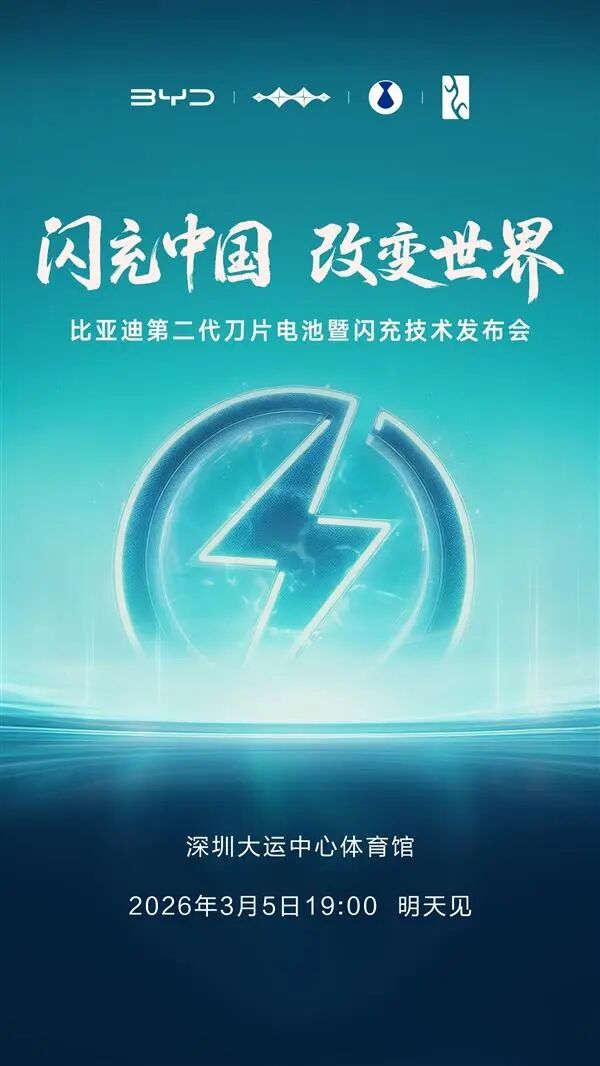
Core Viewpoint - BYD has officially announced the launch event for its second-generation blade battery and flash charging technology, scheduled for March 5 at 19:00 in Shenzhen, which is seen as a significant step in leading the transformation of the electric vehicle industry [1][10]. Group 1: Market Reaction - Following the announcement of the upcoming technology event, BYD's stock price reversed its downward trend, increasing by over 8% during the day, with a closing increase of 8.36%, resulting in a market capitalization surge of several billion [3][12][13]. - The positive market response is attributed to BYD's past technological breakthroughs and strong expectations for the upcoming disruptive technology [3][13]. Group 2: First-Generation Blade Battery - The first-generation blade battery was launched in 2020, featuring a structural innovation that eliminated traditional module designs, enhancing volume utilization by over 50% and providing high safety, long lifespan, and extended range [3][13]. - The first model equipped with this battery, the BYD Han EV, achieved a comprehensive range of 605 kilometers and a 0-100 km/h acceleration time of just 3.9 seconds, leading to significant sales and establishing the blade battery as an industry benchmark [3][13]. Group 3: Second-Generation Blade Battery - The second-generation blade battery is expected to significantly improve energy density, range, charge and discharge rates, low-temperature performance, and safety compared to the first generation, with a CLTC range potentially exceeding 1000 kilometers [5][15]. - The first model to feature the second-generation blade battery is the BYD Yangwang U7, which boasts a range of 1006 kilometers (CLTC) [5][15]. Group 4: Flash Charging Technology - The newly introduced megawatt flash charging system will allow for a charging experience comparable to traditional fuel vehicles, enabling a recharge of over 400 kilometers in just 5 minutes [7][17]. - This technology includes a full liquid cooling temperature control design, improving charging efficiency in low-temperature environments, addressing winter charging concerns for users in northern regions [7][17]. Group 5: Strategic Implications - BYD's investment in research and development has created a competitive barrier that is difficult for others to replicate, positioning the company as a leader in the electric vehicle sector [8][18]. - The release of the second-generation blade battery and flash charging technology is expected to challenge the notion that high-end technology must come with high prices, making advanced technology more accessible to mainstream models and accelerating the transition away from fuel vehicles [8][18].