索尼电视

Search documents
索尼电视卖身TCL,“中产白月光”还能卖上万块吗?
3 6 Ke· 2026-01-29 01:07
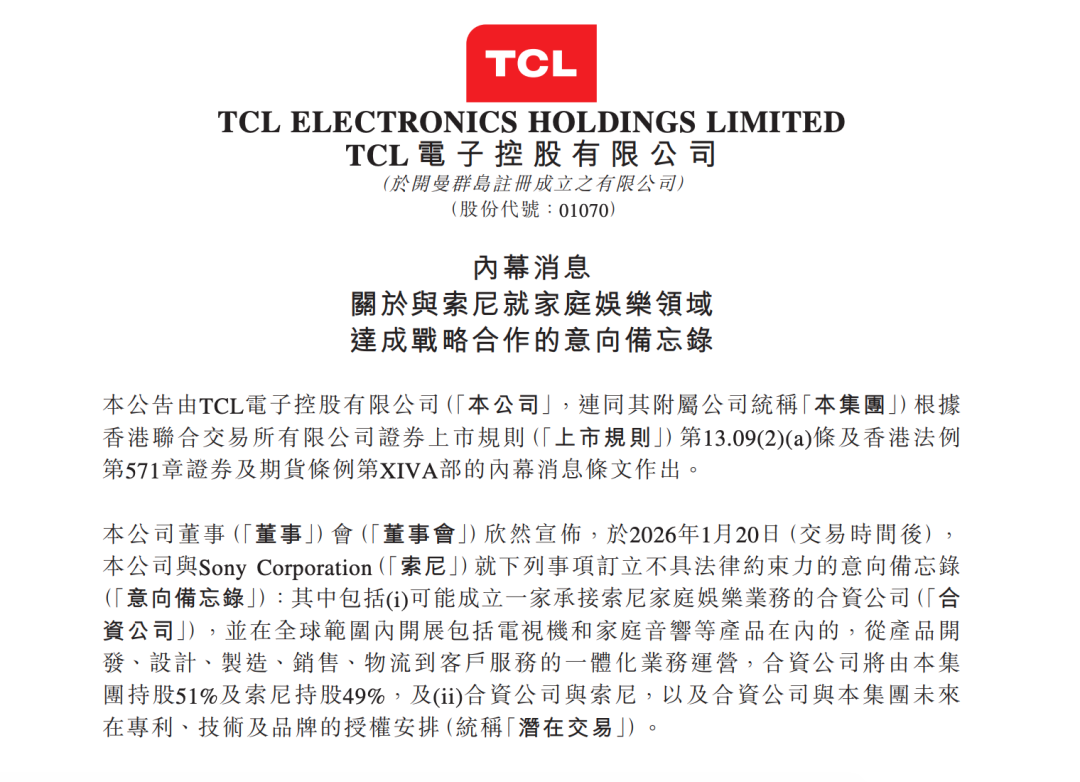
Core Viewpoint - The collaboration between TCL and Sony marks the end of the Japanese television era and signifies the rise of the Chinese television industry on a global scale [2][3][10]. Group 1: Company Collaboration - TCL and Sony have signed a memorandum of understanding to establish a joint venture, with TCL holding 51% and Sony 49%, focusing on global operations of Sony's television and home audio businesses [2][3]. - The joint venture is expected to begin operations in April 2027, pending regulatory approvals [3][4]. - This partnership aims to leverage Sony's expertise in audio-visual technology and TCL's strengths in display technology and cost control to create innovative products [6][11]. Group 2: Market Dynamics - The global television market is projected to see a total shipment of 220 million units in 2025, with TCL expected to ship approximately 30.4 million units, capturing a market share of 13.8% [6][11]. - Sony's television market share has significantly declined to about 1.25% in China, indicating a shift in consumer preferences and market dynamics [10][11]. - The competition in the television market is increasingly dominated by Chinese brands, with TCL and Hisense gaining substantial market shares, particularly in Japan [18][19]. Group 3: Industry Trends - The Japanese television giants have been gradually exiting the market, with significant sales and transfers of their businesses to Chinese companies over the past decade [17][19]. - The shift from traditional television to smart home integration is evident, as consumers increasingly seek multifunctional and aesthetically pleasing devices [27][30]. - The future of television is evolving towards becoming a central hub for smart home technology, with a focus on user experience and integration into daily life [29][30].


突发!又一日企巨头爆雷
商业洞察· 2026-01-23 09:35
Core Viewpoint - Sony's decision to divest its television business to TCL marks the end of an era for Japanese brands in the global TV market, highlighting the rise of Chinese brands and the challenges faced by traditional players [12][14][26]. Group 1: Sony's Business Restructuring - Sony announced a major restructuring on October 20, 2023, to divest its television business, transferring it to a joint venture with TCL, where TCL will hold a 51% stake [12][14]. - This move signifies the end of Japanese dominance in global TV hardware manufacturing, as Sony relinquishes control over a once-proud segment of its business [14][26]. - The joint venture will continue to use the Sony and BRAVIA brands, ensuring brand recognition and customer loyalty while allowing Sony to focus on higher-margin areas like gaming and content [15][18]. Group 2: Market Dynamics and Competition - Chinese brands have captured over 50% of the Japanese TV market, with TCL holding a 13.8% global market share, positioning it as the second-largest TV brand worldwide [7][26][40]. - By 2024, foreign brands, including Sony, will collectively hold less than 5% of the Chinese market, indicating a significant decline in their competitive position [27]. - The partnership between TCL and Sony is seen as a strategic move to enhance TCL's brand prestige and global influence while allowing Sony to reduce operational pressures in a highly competitive market [17][18][44]. Group 3: Challenges Faced by Sony - Sony's television division has seen its global market share drop to 1.9%, reflecting a broader trend of declining Japanese brands in the consumer electronics space [26][34]. - Issues such as poor software adaptation, service delays, and customer dissatisfaction have contributed to a loss of trust among consumers, leading to a significant decline in brand loyalty [30][33]. - The overall decline of Japanese TV brands is evident, with significant drops in OLED TV shipments and a general retreat from the high-end market [34][35]. Group 4: TCL's Growth and Future Prospects - TCL has experienced substantial growth, with a 14.8% increase in global TV shipments in 2024, and is projected to surpass 30 million units in 2025 [40][41]. - The acquisition of Sony's TV business is expected to enhance TCL's capabilities in high-end markets, leveraging Sony's technology and brand reputation [44]. - The competitive landscape in the TV industry is shifting, with TCL's partnership with Sony potentially creating a formidable entity that could reshape market dynamics [45].
索尼委身TCL,日企时代终落幕了
阿尔法工场研究院· 2026-01-23 04:09
Core Viewpoint - The collaboration between Sony and TCL marks a significant shift in the consumer electronics industry, highlighting the transition from traditional Japanese brands to Chinese manufacturers as key players in the market [5][24]. Group 1: Sony and TCL Collaboration - TCL announced a memorandum of understanding with Sony to establish a joint venture for Sony's home entertainment business, with TCL holding 51% and Sony 49% of the shares [5][7]. - The joint venture will focus on an integrated model for operating television and home audio businesses globally, indicating a shift in control from Sony to TCL [7][22]. - This partnership aims to combine Sony's high-quality audio-visual technology and brand value with TCL's advanced display technology and cost efficiency [20][22]. Group 2: Historical Context of Sony - Sony was once a dominant player in the television market, with its Trinitron technology setting the standard for picture quality in the 1980s and 1990s [9][10]. - The company enjoyed a long period of brand loyalty in China, despite higher prices compared to local brands [12]. - However, the rise of Chinese brands like TCL and Hisense, which offered lower prices and competitive technology, began to erode Sony's market share starting in the early 2000s [12][17]. Group 3: Challenges Faced by Sony - Sony's television business has faced significant challenges, including complaints about product reliability and a decline in brand trust among consumers [17]. - By 2025, Sony's television shipments had dropped to 2.6 million units, ranking it tenth in the market, far behind Chinese competitors [22][24]. - The company has been shifting its focus away from hardware to more profitable sectors like gaming, music, and image sensors, indicating a strategic realignment [24]. Group 4: Rise of Chinese Brands - Chinese brands have transitioned from being price competitors to leaders in technological innovation, with TCL and Hisense achieving significant market shares globally [31][33]. - By 2025, TCL's global television shipments reached 20.8 million units, marking a 4.1% increase year-on-year, while Hisense led the Chinese market in shipments [31][33]. - The collaboration between Sony and TCL symbolizes a broader trend of power shifting in the consumer electronics industry, with Chinese companies increasingly defining market standards [22][24].

索尼把电视交给了TCL
36氪· 2026-01-23 00:00
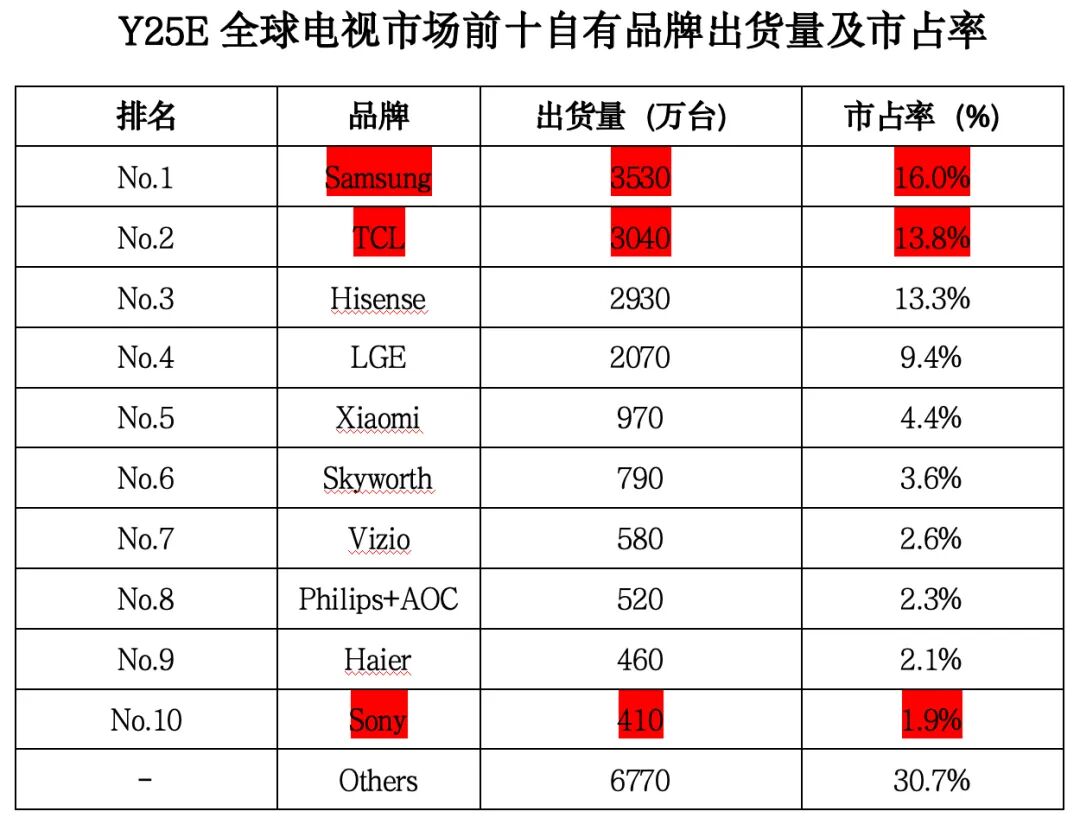
Core Viewpoint - The collaboration between Sony and TCL is expected to reshape the global television market, with TCL taking a leading role in the joint venture, which may significantly enhance both companies' market shares and competitiveness [5][9]. Group 1: Joint Venture Details - Sony and TCL have signed a memorandum of understanding to potentially establish a joint venture focused on Sony's home entertainment business, including television and audio products [6]. - TCL will hold a 51% stake in the joint venture, while Sony will hold 49%, allowing TCL to take the lead in operations [7]. - The joint venture aims to leverage Sony's advanced technology and brand value alongside TCL's global scale and cost efficiency, potentially increasing the market share of both Sony and BRAVIA brands [7]. Group 2: Market Position and Competition - Samsung has maintained its position as the global television market leader for 20 consecutive years, while TCL is rapidly closing the gap as the second-largest player [10][12]. - By 2025, market share projections indicate Samsung at approximately 16.0%, with TCL and Hisense at 13.8% and 13.3%, respectively, forming a competitive top tier [12]. - Following the joint venture, Sony's projected global television shipment volume for 2025 is around 4 million units, ranking it tenth, indicating a significant opportunity for TCL to narrow the gap with Samsung [12]. Group 3: Historical Context and Challenges - Sony, once a dominant force in the television market, has struggled to keep pace with technological advancements and market shifts, leading to a decline in its market position [15][20]. - The company's failure to adapt quickly to the transition from CRT to LCD and plasma technologies has allowed competitors like Samsung and LG to surpass it [16][17]. - Sony's television business is now categorized under "other businesses" in its financial reports, reflecting a strategic shift towards more profitable segments like image sensors and gaming [20]. Group 4: TCL's Growth and Performance - TCL has experienced significant growth, with a 4.1% year-over-year increase in global television shipments, reaching 20.8 million units in the first three quarters of 2025 [25]. - The company's Mini LED televisions have seen a remarkable 153.3% increase in shipments, making it a standout product in the market [25]. - TCL's projected adjusted net profit for 2025 is expected to be between HKD 2.33 billion and 2.57 billion, representing a year-over-year growth of 45% to 60% [26].
格局重塑!TCL控股索尼电视业务
Guan Cha Zhe Wang· 2026-01-22 13:28
Core Viewpoint - The collaboration between Sony and TCL represents a strategic response to the shifting dynamics of the global television industry, moving from incremental expansion to a focus on existing market competition and complementary advantages [1][3]. Group 1: Company Collaboration - Sony and TCL announced plans to establish a joint venture, with TCL holding 51% and leading operations, while Sony retains 49% ownership [1]. - The new company will take over Sony's global television and home audio equipment business, including R&D, design, manufacturing, sales, logistics, and customer service, while continuing to use the Sony and BRAVIA brands [1][4]. - The partnership is seen as a necessary adaptation to the challenges posed by rising costs and declining profits in the television market, with both companies aiming to leverage their respective strengths [3][4]. Group 2: Market Context - The global television market is projected to see a slight decline in shipment volume, with an expected 2.21 million units in 2025, down 0.7% year-on-year [3]. - Sony's global television shipment is forecasted to be around 4.1 million units in 2025, giving it a market share of 1.9%, ranking it tenth globally [3]. - TCL is expected to ship approximately 30.4 million televisions in 2025, capturing a market share of 13.8%, making it the second-largest player after Samsung [4]. Group 3: Strategic Advantages - Sony's focus on high-end markets and its technological advantages, such as the XR cognitive chip, allow it to maintain premium pricing in the OLED segment, despite challenges in profitability [3][4]. - TCL's strengths lie in its scale and supply chain capabilities, particularly in Mini LED technology, where it holds over 40% of the global market share [4]. - The collaboration is expected to combine Sony's brand and technology with TCL's manufacturing and operational expertise, creating a synergistic effect that enhances competitiveness in the market [5].
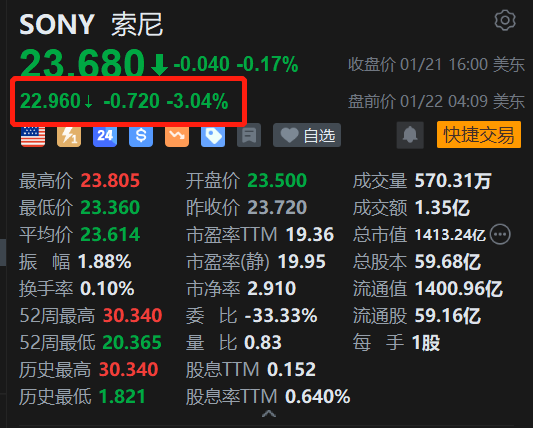
美股异动丨出售电视业务,索尼盘前跌3%,开盘势将再创阶段新低
Ge Long Hui· 2026-01-22 09:32
Group 1 - Sony's stock price fell by 3% to $22.96 in pre-market trading, indicating a potential new low at the opening [1] - Sony and TCL Electronics have signed a strategic cooperation agreement in the home entertainment sector, planning to establish a joint venture where TCL will hold 51% and Sony will hold 49% [1] - The announcement has caused significant concern among Sony fans, with many expressing their dissatisfaction and threatening to stop purchasing Sony televisions [1]
对手变盟友!索尼、TCL联手背后的算盘
Guo Ji Jin Rong Bao· 2026-01-21 12:57
Core Viewpoint - The collaboration between TCL and Sony marks a significant shift in the global television market, indicating the decline of Japanese brands in the industry and the rise of Chinese companies like TCL and South Korean giants Samsung and LG [1][2]. Group 1: Partnership Details - TCL and Sony have signed a non-binding memorandum of understanding to establish a joint venture, with TCL holding 51% and Sony 49% [1]. - The new company will focus on Sony's home entertainment business, including the development, manufacturing, sales, and customer service of televisions and home audio products [1]. - A timeline has been set for finalizing the legal agreement by March 2026, with the new company expected to commence operations by April 2027 [1]. Group 2: Market Position and Trends - Sony's television business is facing significant challenges, with a projected shipment of only 410,000 units in 2025, resulting in a market share below 2% [4]. - In contrast, TCL is expected to ship 3.04 million units in 2025, achieving a 13.8% market share, narrowing the gap with Samsung [3][4]. - The global television market is entering a phase of inventory competition, with a slight decline in overall shipment volume expected [2]. Group 3: Strategic Implications - The partnership is seen as a necessary move for Sony, which has shifted its focus towards more profitable sectors like gaming and entertainment, leading to underinvestment in its television business [6]. - TCL's advantage lies in its vertical integration, with nearly 60% of its TV panels sourced from its subsidiary, TCL Huaxing, compared to Sony's reliance on external suppliers [6]. - If the joint venture succeeds, it could lead to a combined market share of 16.7% for TCL and Sony, potentially surpassing Samsung and reshaping the competitive landscape of the global television market [7].
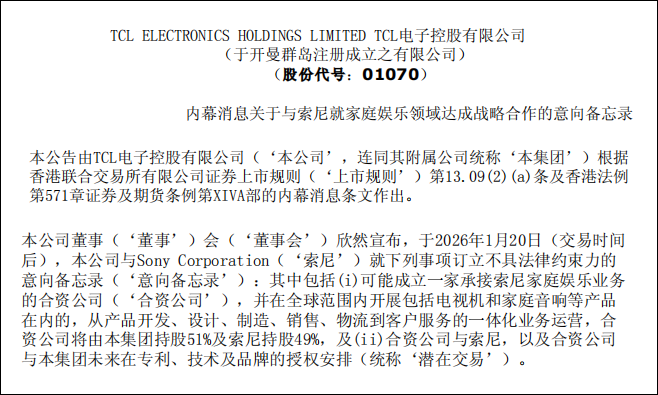
TCL电子(01070.HK)开涨近15%,公司拟与索尼成立合资公司运营索尼电视等业务。
Jin Rong Jie· 2026-01-21 01:30
Core Viewpoint - TCL Electronics (01070.HK) shares surged nearly 15% following the announcement of a joint venture with Sony to operate Sony's television and related businesses [1] Group 1 - TCL Electronics plans to establish a joint venture with Sony [1] - The collaboration will focus on the operation of Sony's television business [1] - The market reacted positively, resulting in a significant increase in TCL's stock price [1]
一天两起车辆起火事件!小米回应:动力电池均处于正常状态;俞敏洪宣布聘请陈行甲,年薪150万;日本电视荣光不再!TCL拟控股索尼电视业务
雷峰网· 2026-01-21 00:26
Key Points - Sony officially announced the spin-off of its television business, forming a joint venture with TCL, where TCL will hold 51% and Sony 49% [4][5] - The new company will manage the entire global operations of television and home audio equipment, with plans to start operations by April 2027, pending regulatory approvals [4][5] - Sony's market share in China has significantly declined, with foreign brands collectively holding less than 5% of the market share in 2024, averaging around 1.25% each [4][5] - The overall shipment of televisions in China is projected to drop by 8.5% in 2025, reaching a new low since 2010, with the top eight brands dominating 94.1% of the market [5] - Xiaomi responded to two vehicle fire incidents, stating that the power batteries were functioning normally at the time of the incidents [10][11] - MiHoYo announced the closure of the Genshin Impact server operated in partnership with Xiaomi, effective January 20, 2025, due to strategic adjustments [12] - New Oriental's founder, Yu Minhong, announced the hiring of Chen Xingjia as a consultant with an annual salary of 1.5 million RMB, amidst controversy over high salaries in the nonprofit sector [7][8] - The mobile phone market in China for 2025 shows Vivo, Xiaomi, and Apple as the top three brands by activation volume, with Xiaomi's growth attributed to the success of its 17 series [21][22] - Hikvision reported a slight increase in revenue for 2025, achieving 92.517 billion RMB, with a net profit of 14.188 billion RMB, reflecting a growth of 18.46% year-on-year [30]




索尼委身TCL,日企时代终落幕了
Feng Huang Wang· 2026-01-20 13:07
Core Viewpoint - The collaboration between Sony and TCL marks a significant shift in the consumer electronics industry, highlighting the transition from traditional Japanese brands to Chinese manufacturers as key players in the market [1][21]. Group 1: Partnership Details - TCL announced a memorandum of understanding with Sony to establish a joint venture focused on Sony's home entertainment business, which will operate globally in an integrated manner [2][11]. - The joint venture will have TCL holding a 51% stake and Sony holding 49%, indicating that a Chinese company will lead the future of Sony's once-iconic television brand [5][12]. - The partnership aims to combine Sony's high-quality audio-visual technology and brand value with TCL's advanced display technology and cost efficiency [11][12]. Group 2: Historical Context - Sony was once a dominant player in the television market, with its Trinitron technology setting quality standards in the 1980s and 1990s, but has since faced challenges from emerging Chinese brands [6][9]. - The rise of Chinese brands like TCL and Hisense began in the early 2000s, leveraging lower costs and innovative technologies to capture market share from Japanese manufacturers [6][18]. - By 2025, Sony's television shipments had significantly declined, ranking tenth globally, while TCL and other Chinese brands surged ahead in market share [15][19]. Group 3: Industry Transformation - The collaboration reflects a broader trend in the consumer electronics industry, where traditional vertical integration models are being replaced by more flexible cooperative networks [12][16]. - As Chinese brands evolve from being price competitors to technology innovators, the dynamics of global competition are shifting, with a focus on collaboration rather than direct competition [16][20]. - The partnership symbolizes a strategic pivot for Sony, allowing it to concentrate on higher-margin businesses while leveraging TCL's manufacturing capabilities to sustain its legacy in the consumer electronics space [15][16].