
美国货币市场基金

Search documents
美股突变!大规模抛售,千亿资金出逃!
券商中国· 2026-03-07 03:14
Core Viewpoint - The escalation of conflict in the Middle East has significantly impacted global markets, leading to substantial sell-offs in U.S. stock funds and rising concerns over inflation and interest rates [1][2][6]. Group 1: Market Reactions - Investors sold off U.S. stock funds, with a net outflow of $21.92 billion (approximately 150 billion RMB), marking the largest weekly outflow in eight weeks [1][2]. - The U.S. growth funds experienced a net outflow of $11.15 billion, the largest since December 2025 [2]. - The Dow Jones Industrial Average dropped over 900 points during trading, with major tech stocks like Intel and Nvidia falling by more than 5% and 3% respectively [1]. Group 2: Sector Performance - Despite the overall sell-off, value funds saw a net inflow of $1.46 million, marking the fourth consecutive week of net buying [2]. - Industry funds in the U.S. attracted $1.2 billion, with significant inflows into industrials ($1.65 billion), utilities ($671 million), and metals and mining ($582 million) [2]. Group 3: Global Market Trends - The MSCI global index fell over 2.5%, heading towards its worst week since early April 2025, with global stock funds experiencing a net outflow of approximately $1.44 billion [3]. - European stock funds saw a decrease in inflows from approximately $11.88 billion to $8.8 billion, while Asian funds attracted $7.43 billion in net inflows [3]. Group 4: Commodity and Energy Markets - International oil prices surged, with WTI crude oil futures rising over 12% to $91.27 per barrel, and Brent crude increasing by over 9% to above $93 per barrel [6]. - The ongoing conflict has led to a near-total halt in shipping through the Strait of Hormuz, raising concerns about global oil supply and potential price spikes [7]. - Goldman Sachs warned that if supply disruptions continue, oil prices could exceed $100 per barrel, with some forecasts suggesting prices could reach $150 [6][7].


美联储决议前,投资者大量涌入美国货币市场基金,连续第二周卖出美股基金
Hua Er Jie Jian Wen· 2025-12-09 14:02
Group 1 - The core sentiment in the U.S. market is dominated by risk aversion as investors withdraw from high-risk equity funds and shift significant capital into safer money market funds ahead of the Federal Reserve's policy announcement [1] - Investors net purchased approximately $104.75 billion in U.S. money market funds in the week ending December 3, marking the largest single-week net inflow since November 5, indicating a highly defensive stance in the market [1] - U.S. equity funds experienced a net sell-off of about $3.52 billion for the second consecutive week, reflecting a growing preference for safer assets amid concerns over high valuations in large-cap tech stocks [1] Group 2 - Despite expectations of potential interest rate cuts typically benefiting the stock market, investors are reducing their exposure to risk assets, with mid-cap stock funds facing net outflows for the seventh consecutive week, totaling $49.492 million [2] - Large-cap and small-cap stock funds also recorded net disposals of $476 million and $1.18 billion, respectively, indicating a widespread cautious sentiment across various market segments [2] - Defensive sectors have shown relative resilience, attracting approximately $510 million in net inflows, with industrial sector funds receiving $510 million and gold and precious metals stock funds garnering $293 million in net inflows [2] Group 3 - The fixed income market reflects a cautious investor attitude, with overall net inflows significantly shrinking [3] - Short- to medium-term investment-grade bond funds attracted $1.45 billion in net inflows, while municipal bond funds saw inflows of $737 million [3] - In contrast, short- to medium-term government and treasury bond funds experienced a reversal, recording outflows of $1.58 billion, indicating a defensive adjustment in bond portfolio allocations [3]
美联储降息也挡不住!美国货币市场基金规模飙破8万亿
Jin Shi Shu Ju· 2025-12-03 06:36
Core Insights - The total assets under management in U.S. money market funds have surpassed $8 trillion, marking a significant milestone for the industry [1][4] - Despite the Federal Reserve's interest rate cuts, investors continue to flock to money market funds due to their yield advantages over other investment vehicles, particularly bank deposits [4][5] Group 1: Asset Growth - As of the latest week, U.S. money market fund assets increased by approximately $105 billion, reaching a historical high [1] - Year-to-date, over $848 billion has flowed into these funds, indicating strong investor interest [5] Group 2: Yield and Interest Rates - The Crane 100 Money Fund Index reported a seven-day annualized yield of 3.80% as of December 1, showcasing the competitive returns offered by money market funds [4] - The Federal Reserve has lowered the policy interest rate by 25 basis points in both September and October, now ranging from 3.75% to 4.00% [4] Group 3: Investor Behavior - Institutional and corporate treasurers are increasingly outsourcing cash management to money market funds for better yields, rather than managing it internally [5] - Retail investors currently allocate about 15% to 20% of their portfolios to money market funds, consistent with historical averages, suggesting stability in fund inflows [5]
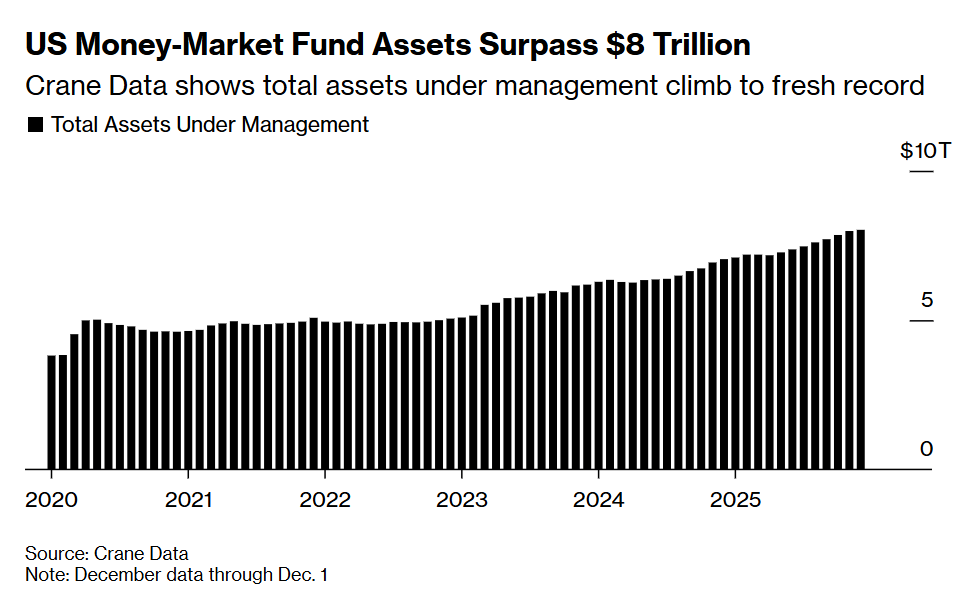
再创新高,美国货币市场基金规模首次突破8万亿美元
Sou Hu Cai Jing· 2025-12-02 16:03
Core Insights - The U.S. money market fund industry has surpassed $8 trillion in managed assets, marking a significant milestone as it continues to attract investor interest despite the Federal Reserve's interest rate cuts [1] - According to Crane Data, the total asset value increased by approximately $105 billion in the week ending Monday, setting a new record for the industry [1] Industry Overview - The money market fund sector is experiencing rapid growth, driven by high yields that remain attractive to investors even in a declining interest rate environment [1] - The recent surge in assets indicates strong investor confidence and a shift towards safer investment vehicles amid economic uncertainties [1]
全球资产配置资金流向月报(2025年6月):中国固收基金获大幅流入,全球资金增配美股减配欧股-20250712
Shenwan Hongyuan Securities· 2025-07-12 08:28
Group 1 - The report highlights a significant inflow into Chinese fixed-income funds, with a total inflow of $130.44 billion in June 2025, compared to $49.07 billion in the previous month [29][18][49] - In contrast, the Chinese equity market experienced a marginal outflow of $37.16 billion, indicating a shift in investor preference towards fixed-income assets [15][18][48] - Emerging markets saw a notable inflow of $210.85 billion in fixed-income funds, with China being a major contributor [29][49] Group 2 - The report indicates that global funds have been reallocating towards U.S. equities, with a net inflow of $168.62 billion in June 2025, while European equities saw a decrease in allocation [15][4] - The U.S. equity market experienced a shift in sector allocations, with significant outflows from technology and healthcare sectors, while essential consumer goods, industrials, and utilities saw inflows [38][41] - Emerging markets, particularly India, have shown a relatively higher inflow into equity funds, contrasting with the outflows observed in the Chinese equity market [16][48]
美国投资公司协会(ICI):美国货币市场基金资产规模降至7.07万亿美元。
news flash· 2025-07-10 19:27
Core Viewpoint - The total assets of U.S. money market funds have decreased to $7.07 trillion, indicating a significant shift in the investment landscape [1] Group 1 - The decline in assets reflects changing investor sentiment and potential shifts in market dynamics [1] - The current asset level of $7.07 trillion represents a notable decrease compared to previous periods, highlighting a trend that may impact liquidity in the financial markets [1]
6月全球投资十大主线
一瑜中的· 2025-07-07 15:02
Core Viewpoint - The article highlights the performance of global asset classes in June, with global stocks leading at 4.40%, followed by commodities at 3.52%, and global bonds at 1.89%, while the US dollar showed a decline of 2.47% [2]. Group 1: Global Asset Performance - In June, global stocks outperformed other asset classes, with a return of 4.40% [2]. - Commodities followed with a return of 3.52%, while global bonds returned 1.89% [2]. - The US dollar experienced a decline of 2.47%, indicating a shift in investor sentiment [2]. Group 2: Oil Price Volatility - The geopolitical situation in the Middle East led to significant fluctuations in oil prices, particularly through the Strait of Hormuz, which is crucial for global oil trade [4][12]. - In June, oil prices surged due to heightened geopolitical tensions but quickly retreated as concerns over supply disruptions eased [4][12]. Group 3: US Market Dynamics - The divergence between the performance of the seven major US tech stocks and the 2-year Treasury yield indicates a shift in market sentiment from recession fears to expectations of interest rate cuts [4][14]. - The decline in the 2-year Treasury yield, previously interpreted as a recession signal, did not deter the rise of tech stocks in June [4][14]. Group 4: Emerging Market Strategies - A successful arbitrage strategy involving dollar financing and investment in six emerging market currencies yielded a return of 8% since 2025, outperforming similar strategies using yen or euro financing [4][17]. - The reduced correlation between the dollar and the S&P 500 index enhances the attractiveness of the dollar for arbitrage trading [4][17]. Group 5: Fund Manager Allocations - Global fund managers have increased their allocations to emerging markets, stocks, energy, banks, and communications, while reducing exposure to euros, utilities, cash, and bonds [4][21]. - The survey indicates a significant overweight in eurozone and emerging market assets compared to US dollar assets [4][21]. Group 6: Money Market Fund Growth - The total assets under management in US money market funds reached a record high of $7 trillion in 2025, driven by their attractive yields and investor preference for safety amid market uncertainties [4][26]. - Despite the Federal Reserve entering a rate-cutting cycle, money market funds maintained yields around 4%, appealing to risk-averse investors [4][26]. Group 7: Dollar Index and Foreign Investment - The dollar index serves as a leading indicator for net foreign investment in US equities, with a notable correlation observed over a 12-month period [4][29]. - An increase in the dollar index typically leads to higher foreign capital inflows into US assets [4][29]. Group 8: Correlation Between Dollar and Oil - The correlation between oil prices and the dollar index has shifted from negative to positive over the past two decades, reflecting changes in global economic dynamics and energy demand [4][32]. Group 9: Historical Gold-Oil Ratio - The historical analysis of the gold-oil ratio from 1920 to 2025 shows a significant decline in its central tendency post-1970s, attributed to the decoupling of the dollar from gold and the strengthening of oil's financial attributes [4][37]. Group 10: Currency Sensitivity to Oil Prices - The Indian rupee's performance is highly sensitive to oil price fluctuations, with rising oil prices leading to increased import costs and inflationary pressures [4][40]. - The Reserve Bank of India may intervene in the forex market to stabilize the rupee amid these external pressures [4][40]. Group 11: New Taiwan Dollar Hedging Costs - The New Taiwan Dollar experienced an 11% appreciation in Q2 2025, leading to significant foreign exchange losses for Taiwanese life insurers [4][42]. - The hedging costs for the New Taiwan Dollar reached nearly 15%, reflecting heightened market volatility and increased demand for currency protection [4][42].

美国货币市场基金资产降至6.95万亿美元。
news flash· 2025-05-29 19:13
Core Insights - The total assets of U.S. money market funds have decreased to $6.95 trillion [1] Group 1 - The decline in assets indicates a potential shift in investor sentiment towards riskier assets or alternative investment vehicles [1] - The current asset level represents a significant change from previous highs, suggesting a possible trend in the money market fund industry [1]