
胶囊咖啡

Search documents
蓝瓶咖啡的中国新老板
投中网· 2026-03-04 12:36
Core Viewpoint - The coffee industry is undergoing a significant capital reshuffle, highlighted by the acquisition of Blue Bottle Coffee's global store operations by Dazhong Capital from Nestlé for an estimated valuation of under $400 million, a substantial decrease from its previous valuation of $700 million in 2017 when Nestlé acquired a 68% stake [4][10]. Group 1: Acquisition Details - Dazhong Capital has officially reached an agreement with Nestlé to acquire Blue Bottle Coffee's global store operations, with the deal valued at less than $400 million [4]. - The transaction does not include Blue Bottle's fast-moving consumer goods (FMCG) business, such as capsule coffee and instant beverages, which Nestlé will retain [4]. - Dazhong Capital, known for its expertise in the coffee sector, has a management scale exceeding $7 billion and is recognized for rescuing Luckin Coffee during its financial crisis [5]. Group 2: Blue Bottle Coffee's Background - Blue Bottle Coffee was founded in 2002 by James Freeman in Oakland, California, focusing on fresh, high-quality coffee, which quickly gained a loyal following [9]. - The brand expanded globally after receiving significant venture capital investments, including $120 million from notable investors between 2012 and 2015 [9]. - After Nestlé's acquisition in 2017, Blue Bottle maintained a slow expansion pace, growing from 55 stores to over 100 by 2025, despite facing high operational costs and ongoing losses [10]. Group 3: Nestlé's Strategic Shift - Nestlé's management, under new CEO Philipp Navratil, is pursuing a strategy to streamline operations by divesting from less profitable retail businesses, including Blue Bottle Coffee [11]. - The decision to sell Blue Bottle is part of a broader plan to focus on core strengths, retaining the more profitable capsule and machine segments while offloading the less efficient store operations [11]. Group 4: Future Prospects for Blue Bottle Coffee - Dazhong Capital's acquisition is seen as a new beginning for Blue Bottle, leveraging its existing expertise in the coffee supply chain to enhance operational efficiency [15]. - Despite current losses, there are optimistic projections for profitability by 2026, supported by market expansion opportunities, particularly in the Asia-Pacific region [15]. - The competitive landscape in the U.S. coffee market is intensifying, with local brands like Manner and Seesaw challenging Blue Bottle's premium positioning [15].




“涨价”策略失灵叠加“黑天鹅”事件,雀巢忙“瘦身”自救
Jing Ji Guan Cha Wang· 2026-02-22 12:03
Core Insights - Nestlé is facing significant challenges due to inflationary pressures and demand fluctuations, leading to a peak in its price increase strategy that is now failing in global markets [1] - The company reported a 2% decline in sales for 2025, with total sales reaching 89.49 billion Swiss francs (approximately 728.53 billion RMB) [1] - The aggressive pricing strategy contributed 2.8% to annual sales growth, but the actual internal growth rate was only 0.8%, indicating reliance on pricing rather than volume [1] Group 1: Financial Performance - In 2025, Nestlé's net profit fell by 17% to 9 billion Swiss francs, marking a rare and significant decline [3] - The Greater China region experienced an organic growth rate of -6.4%, with an internal growth rate of -4.5% and a pricing contribution rate of -1.9%, significantly dragging down overall performance [2] Group 2: Strategic Adjustments - The company is shifting its business model from distribution-driven to consumer demand-driven, focusing on reducing channel inventory and rebuilding marketing and innovation capabilities [3] - Nestlé has identified four core pillars for future growth: coffee, pet care, nutrition, and food & snacks, which together account for 70% of its sales [3] Group 3: Operational Challenges - A recall of infant formula due to contamination resulted in a non-operating loss of approximately 110 million Swiss francs (about 895 million RMB) and potential sales losses of up to 1.2 billion Swiss francs (about 9.77 billion RMB) in 2026 [2] - The company is negotiating the sale of its remaining ice cream business, which is a significant strategic move following the divestiture of its water business [4] Group 4: Market Competition - Nestlé's coffee business is facing intense competition from brands like Luckin Coffee and Kudi, which are impacting its supply chain costs [4] - The company is attempting to innovate within the coffee segment by introducing new products to adapt to changing consumer preferences [4] Group 5: Workforce Optimization - Nestlé plans to reduce approximately 16,000 jobs, equivalent to 6% of its total workforce, as part of a broader effort to optimize its organizational structure [5] - The company is under pressure to adjust its human resources in response to performance challenges across various product lines [5]
云南临沧:构建咖啡“从种到杯”全产业链
Xin Hua She· 2026-01-24 04:46
Core Viewpoint - Lincang City in Yunnan Province is recognized as a prime area for coffee cultivation due to its unique low-latitude plateau climate, with a projected coffee planting area of 290,000 mu by the end of 2025 [1] Industry Overview - The coffee industry in Lincang has been developing since the 1950s, currently featuring 51 coffee enterprises [1] - The product range includes specialty green beans, roasted beans, coffee powder, coffee liquid, capsule coffee, and coffee fruit tea, establishing a complete "seed to cup" industry chain [1] Quality and Recognition - Lincang coffee has gained recognition for its outstanding quality, winning honors in various coffee competitions, which has enhanced its influence [1]
世界中餐业联合会&黑峪投资:中国咖啡产业报告2025
Xin Lang Cai Jing· 2026-01-21 10:26
Core Insights - The global coffee industry is experiencing significant changes, with key events shaping its future, including extreme weather impacts, mergers, and technological advancements in coffee production and processing [3][4][13]. Group 1: Industry Trends - The global coffee production is projected to reach approximately 178.8 million bags (60kg each) in the 2025/26 season, with a notable increase in Robusta production by 10.9% to 8.33 million tons, while Arabica production is expected to decline by 4.7% to 9.55 million tons [4]. - The coffee market is becoming increasingly competitive, with major players like Nestlé, JDE Peet's, and Starbucks dominating the roasting segment, accounting for about 40% of the market share [15][17]. - The introduction of the EU Deforestation Regulation (EUDR) is pushing companies towards sustainable practices, impacting supply chain costs [3]. Group 2: Market Dynamics - The price of coffee futures has reached a 47-year high, exceeding 430 cents per pound, driven by extreme weather conditions and shipping disruptions [3][13]. - The Chinese coffee market is evolving, with a projected consumption of over 400,000 tons by 2025, reflecting a compound annual growth rate (CAGR) of 10% [39][40]. - The coffee roasting capacity in China is expected to surpass 350,000 tons by 2024, with major brands like Luckin Coffee and Starbucks expanding their production capabilities [41][44]. Group 3: Technological Innovations - Advances in coffee processing technology, such as the development of non-caffeinated coffee through molecular restructuring, are emerging as significant trends [3]. - The integration of AI in coffee production is enhancing yield predictions and flavor profiling, marking a shift towards more data-driven approaches in the industry [3][4]. Group 4: Regional Developments - Indonesia's Fore Coffee has successfully listed on the IDX, highlighting the growth of local coffee brands in emerging markets [3]. - China's coffee cultivation is transitioning from expansion to quality improvement, with a diversification of coffee varieties, particularly in Yunnan, where over 80% of coffee is Arabica [23][24][26].

2025中国咖啡产业报告
世界中餐业联合会&黑峪投资· 2026-01-21 01:20
Investment Rating - The report indicates a positive outlook for the coffee industry, particularly in China, with a projected compound annual growth rate (CAGR) of approximately 20% for the next five years in terminal consumption [6][25]. Core Insights - The global coffee production for the 2025/26 season is expected to reach 178.8 million bags (60kg per bag), with a notable increase in Robusta production by 10.9% to 83.33 million bags, while Arabica production is projected to decline by 4.7% to 95.51 million bags due to adverse weather conditions in Brazil [6][10]. - The coffee market is experiencing significant changes, including the introduction of new technologies in production and brewing, the rise of functional coffee products, and the increasing importance of local brands in China [3][17]. - The Chinese coffee market is evolving from a focus on instant coffee to a more diverse range of products, with an emphasis on quality and specialty coffee, as evidenced by the growth of local brands and the increasing variety of coffee beans being cultivated [25][40]. Summary by Sections Coffee Industry Value Chain - The coffee value chain is highly concentrated, with major players controlling significant portions of production, trade, and retail. The top four traders dominate the upstream segment, while brands like Nestlé and JDE control a large share of the downstream market [6][20]. - The global coffee market is estimated to exceed $100 billion, with the terminal market in China projected to surpass 150 billion yuan [8][10]. Coffee Production and Quality - Coffee quality is influenced by various factors, including the type of beans, processing methods, and roasting techniques. The report highlights the importance of maintaining high standards in each stage of the coffee production process [8][21]. - The report notes that Arabica beans account for nearly 60% of global coffee production, with a focus on quality and flavor driving market trends [10][11]. Chinese Coffee Market - China's coffee planting area is stabilizing, with a shift towards quality improvement and diversification of coffee varieties. By 2025, the production value is expected to rise significantly due to enhanced processing techniques and a growing emphasis on specialty coffee [25][29]. - The consumption of coffee in China is projected to exceed 400,000 tons by 2025, reflecting a growing trend towards premium and specialty coffee products [40][41]. Competitive Landscape - The competitive landscape in the coffee industry is characterized by a mix of global giants and emerging local brands. Companies like Luckin Coffee are expanding rapidly, while traditional players are adapting to new market dynamics [18][46]. - The report identifies a trend towards vertical integration among leading brands, with companies investing in their own roasting facilities to ensure quality control and cost efficiency [46][47].

内蒙古空港贵宾服务公司升级“能量站”撬动员工幸福感
Zhong Guo Min Hang Wang· 2025-12-30 08:24
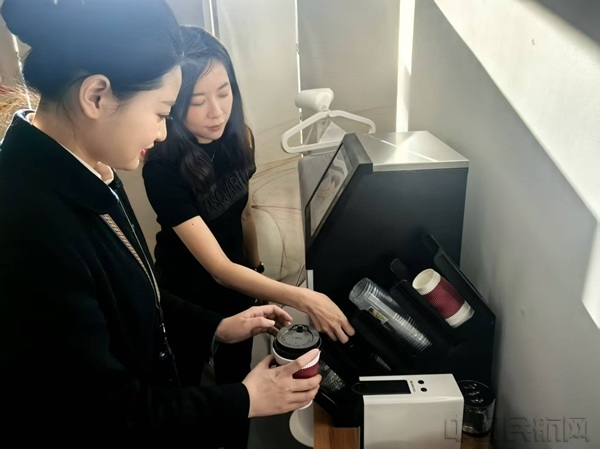
Core Viewpoint - The Inner Mongolia Airport VIP Service Company has upgraded its employee activity room into a multifunctional "energy supply station," focusing on employee needs and enhancing workplace comfort and health [1][5]. Group 1: Facility Upgrades - The upgraded facility features a variety of beverages, including capsule coffee and health teas, catering to employees' preferences for quality drinks [1]. - The coffee area includes a fully automatic capsule coffee machine and an ice maker, offering multiple coffee flavors and health-oriented tea options [1][2]. Group 2: Health and Wellness Features - The energy supply station has added a medical kit, electronic blood pressure monitor, and a garment steamer to address health and appearance management needs [2][4]. - Employees can now monitor their blood pressure conveniently, which has been positively received, especially by those concerned about health issues [2]. Group 3: Employee Engagement and Feedback - The daily usage of the activity room has increased by 40% since the upgrades, indicating its popularity among employees [5]. - Employees report feeling valued and motivated due to the company's attention to detail in enhancing their work environment [5].
咖啡“卷”到2.9元/杯,雀巢这家公司靠高附加值咖啡能否抢赢中国市场?
Mei Ri Jing Ji Xin Wen· 2025-11-13 13:32
Core Insights - The Chinese coffee market has experienced rapid growth since the 1980s, with various coffee formats emerging, including instant, ready-to-drink, capsule, and freshly brewed coffee [1][2] - Intense competition has characterized the market, particularly in 2023, with significant price reductions and the expansion of coffee shops into lower-tier cities [1][4] - Nestlé's Nespresso views China as a high-priority market with substantial growth potential, although consumption levels still lag behind mature markets [1][4] Market Dynamics - The coffee market in China has seen a shift in brand rankings due to increased competition, with major players like Starbucks adjusting their strategies, including the sale of a majority stake in its Chinese operations [1][4] - Nespresso's sales in 2022 reached 6.378 billion Swiss francs, highlighting its significant contribution to Nestlé's overall performance [2] Consumer Trends - There is a growing preference for larger coffee servings in China, with over 60% of consumers favoring milk-based coffee, contrasting with European habits of consuming smaller espresso shots [6][7] - The trend of "specialty" coffee and innovative ingredients is becoming popular among younger consumers, indicating a shift towards more personalized coffee experiences [6][7] Product Development - Nespresso aims to differentiate itself by emphasizing its unique brand story and product offerings, particularly in the context of the growing capsule coffee segment, which has seen a 226.8% year-on-year growth, albeit from a low sales base [5][6] - The company recognizes the need to adapt its marketing strategies to resonate with local cultural preferences and consumer behaviors, moving away from a one-size-fits-all approach [6][9] Emotional Connection - Chinese consumers are increasingly seeking emotional value from their coffee experiences, desiring not just product innovation but also meaningful connections through promotions and collaborations [7][9] - Nespresso's partnership with table tennis athlete Wang Chuqin as a brand ambassador reflects the company's strategy to localize its brand presence and appeal to younger demographics [9]

「碰杯站」完成5000万融资,想让更多人喝上「平价星巴克」 | 早起看早期
36氪· 2025-07-18 15:48
Core Viewpoint - The article discusses the emergence of "Pengbei Station," a smart beverage retail brand that aims to provide high-quality coffee at a significantly lower price point, leveraging advanced technology and innovative supply chain solutions to capture the growing coffee market in China [1][2]. Company Overview - "Pengbei Station" is operated by Hangzhou Huading Acoustic Technology Co., Ltd., which focuses on AIOT solutions for unmanned retail and aims to become the leading brand in the smart beverage machine sector [1][3]. - The company recently completed a financing round of 50 million yuan, primarily to accelerate market deployment, channel expansion, and operational optimization [1][6]. Market Context - The Chinese coffee market has been expanding rapidly, with an average annual growth rate exceeding 25% in recent years, driven by brands like Luckin Coffee [1][2]. - Despite a per capita annual coffee consumption of 22.24 cups in 2024, there remains a significant gap compared to Japan and South Korea, which have consumption rates of 281 cups and 353 cups, respectively [1][2]. Product Innovation - "Pengbei Station" offers a shared smart beverage machine that can deliver coffee for as low as 9.9 yuan, utilizing nitrogen-sealed capsules to maintain flavor and freshness for up to 18 months [3][4]. - The machines are designed to address common issues with traditional self-service coffee machines, such as food safety concerns and flavor inconsistency, by employing a closed capsule system and automated cleaning features [4][5]. Technological Advancements - The beverage machines are equipped with five precision robotic arms to simulate manual brewing processes, ensuring consistent quality and the ability to serve both hot and cold drinks [4][5]. - The machines can accommodate up to 20 different SKUs, allowing for a diverse range of beverage options beyond coffee, including milk tea and juice [4][5]. Strategic Expansion - "Pengbei Station" is pursuing a "thousand cities, ten thousand stores" plan, aiming to deploy over 20,000 machines across approximately 1,000 districts and counties in China [6][7]. - The partnership with Nantian Shujin, which has connections to Yunnan's coffee production, enhances the supply chain efficiency and quality of coffee beans used in their machines [6][7].

海南澄迈咖啡产业向亿元级迈进
Zhong Guo Chan Ye Jing Ji Xin Xi Wang· 2025-07-16 00:46
Core Insights - The coffee industry in Chengmai County, Hainan, is undergoing a transformation towards a full industrial chain, enhancing the quality and branding of local coffee products [1][2][3] Group 1: Industrial Development - Chengmai County has accelerated the development of its agricultural industry chain, focusing on the entire process from coffee bean to cup, aiming to elevate ordinary coffee to specialty coffee [1][2] - The county has approved 10 enterprises for a duty-free processing policy, with 4 of them being coffee companies, which will significantly reduce raw material costs and enhance market competitiveness [2][3] Group 2: Economic Impact - The first batch of imported coffee beans, weighing 19.2 tons and valued over 1.1 million yuan, marks a significant breakthrough for local enterprises under the Hainan Free Trade Port policy [2] - The coffee industry is expected to drive economic growth by creating job opportunities and increasing income for local farmers, with initiatives like the shared coffee farm benefiting 1,599 households [3] Group 3: Education and Talent Development - The establishment of the Bolan Coffee Academy in Chengmai aims to enhance the training of coffee professionals, with a focus on both enthusiasts and industry entrants [4] - The collaboration between the academy and local coffee enterprises is set to standardize and internationalize the coffee industry in Hainan, providing a robust talent pipeline [4] Group 4: Tourism Integration - The Fushan Coffee Cultural Town is attracting tourists and coffee lovers, offering immersive experiences in coffee production and related activities [5] - Chengmai County plans to innovate a dual-driven model of coffee-themed cultural tourism, integrating agriculture, culture, tourism, sports, and commerce [5]
36氪首发|「碰杯站」完成5000万融资,想让更多人喝上“平价星巴克”
3 6 Ke· 2025-07-04 09:29
Core Insights - The smart beverage retail brand "Pengbei Station" has recently completed a financing round of 50 million yuan, aimed at accelerating market deployment, channel expansion, and operational optimization [1] - "Pengbei Station" is positioned to become the leading brand in the smart beverage machine sector, leveraging AIOT solutions for unmanned retail [1][5] - The Chinese coffee market is experiencing rapid growth, with an annual compound growth rate exceeding 25%, driven by brands like Luckin Coffee [1][2] Company Overview - "Pengbei Station" was established in 2022 and is operated by Hangzhou Huading Acoustic Technology Co., Ltd., which focuses on AIOT solutions for unmanned retail [1] - The company has invested nearly 200 million yuan in equipment development, achieving a low equipment failure rate of 0.1% after extensive market validation and product iterations [5] Product Features - The shared smart beverage machine utilizes nitrogen-deoxygenation technology to preserve the flavor of high-quality Arabica coffee beans for up to 18 months [2][3] - The machine is designed to address common issues in traditional self-service coffee machines, such as food safety concerns and flavor inconsistency, by employing a closed capsule system and automatic cleaning features [3] - "Pengbei Station" can accommodate up to 20 different SKUs, allowing for a diverse range of beverages including coffee, milk tea, and juice [3] Market Strategy - The company aims to implement a "thousand cities, ten thousand stores" plan, targeting to deploy over 20,000 machines across approximately 1,000 districts nationwide [5] - The investment from Nantian Shujin, linked to Yunnan Green Food Co., Ltd., enhances the supply chain for high-quality coffee beans, potentially shortening the supply chain from Yunnan to consumers [4] Competitive Landscape - Starbucks has recently reduced prices on several popular products, which may intensify competition in the coffee market [2] - "Pengbei Station" offers a competitive price point, with its coffee priced at 9.9 yuan compared to over 20 yuan in traditional stores, aiming to democratize coffee access [2][5]