腾讯乐享知识库

Search documents
传媒行业周报系列2026年第11周:腾讯推出“龙虾”产品矩阵,苹果下调中国应用商店佣金率
HUAXI Securities· 2026-03-15 13:20
Investment Rating - Industry rating: Recommended [4] Core Insights & Investment Recommendations - Tencent has launched a tiered "Lobster" product matrix, promoting OpenClaw as a universal application. This series targets different user groups, creating a complete intelligent ecosystem that includes WorkBuddy for general users, QClaw for remote control via WeChat, and Tencent Cloud Lighthouse for enterprise users [2][20] - Apple has reduced its App Store commission rate in mainland China for the first time in six years, lowering the standard rate from 30% to 25% and the small business plan rate from 15% to 12%. This adjustment reflects a balance of interests between platforms and developers, particularly benefiting small developers and the mini-program ecosystem [3][21] - The rapid development of AI applications, combined with a recovery in entertainment consumption, presents investment opportunities in several areas: leading internet companies in Hong Kong, the gaming industry, and the film and cultural tourism sectors. Beneficiaries include Tencent, Alibaba, and several other companies [6][22] Market Overview - During the 11th week of 2026 (March 9-13), the Shanghai Composite Index fell by 0.7%, while the CSI 300 Index rose by 0.19% and the ChiNext Index increased by 2.51%. The SW Media Index dropped by 3.23%, ranking 26th among 31 industries [1][11] - In the sub-industries, advertising and marketing, film, and broadcasting were the top performers, with increases of 0.99% and 0.54%, while broadcasting saw a decline of 1.45% [1][11] Sub-Industry Data Film Industry - The top three films by box office for the week were "Fast Life 3" with 64.015 million yuan (35.20% market share), "Biao Ren: Wind Rises in the Desert" with 35.836 million yuan (19.70%), and "Silent Awakening" with 32.181 million yuan (17.70%) [23][24] Gaming Industry - The top three iOS games by revenue were "Honor of Kings," "Peacekeeper Elite," and "Delta Force," while the top three Android games were "Heart Town," "Diver Dave," and "Goose Duck Kill" [25][26] TV Series Industry - The top three TV series by broadcast index were "Love in the Pure Age" (80.9), "Zhu Yu" (80.2), and "My Mountain and Sea" (77.5) [27][28] Variety and Animation - The top variety show was "The Universe Sparkles, Please Pay Attention" with a broadcast index of 67.2, followed by "Hello Saturday 2026" and "Now Departing Season 3" [29][30] - The top three animated shows were "Beyond Time" (270.8), "Cang Yuan Tu" (237.4), and "Xian Ni" (237.1) [31]


传媒行业周报系列2026年第11周:腾讯推出“龙虾”产品矩阵,苹果下调中国应用商店佣金率-20260315
HUAXI Securities· 2026-03-15 12:23
Investment Rating - Industry rating: Recommended [4] Core Insights & Investment Recommendations - Tencent has launched a tiered "Lobster" product matrix, promoting OpenClaw as a universal application. This series targets different user groups, creating a complete intelligent ecosystem that includes WorkBuddy for general users, QClaw for remote control via WeChat, and Tencent Cloud Lighthouse for enterprise users [2][20] - Apple has reduced the commission rate for the App Store in mainland China from 30% to 25%, and for small business plans from 15% to 12%. This adjustment reflects a balance of interests between platforms and developers, particularly benefiting small developers and the mini-program ecosystem [3][21] - The rapid development of AI applications, combined with a recovery in entertainment consumption, presents investment opportunities in several areas: leading internet companies in Hong Kong, the gaming industry, and the film and cultural tourism sectors. Beneficiaries include Tencent, Alibaba, and several other companies [6][22] Market Overview - In the week of March 9-13, 2026, the Shanghai Composite Index fell by 0.7%, while the CSI 300 Index rose by 0.19% and the ChiNext Index increased by 2.51%. The SW Media Index dropped by 3.23%, ranking 26th among 31 industries [1][11] - The top three sub-industries were advertising and marketing, film, and broadcasting, with respective changes of +0.99%, +0.54%, and -1.45% [1][11] Sub-Industry Data Film Industry - The top three films by box office for the week were "Fast Life 3" with 64.015 million yuan (35.20% market share), "Biao Ren: Wind Rises in the Desert" with 35.836 million yuan (19.70%), and "Silent Awakening" with 32.181 million yuan (17.70%) [23][24] Gaming Industry - The top three iOS games by revenue were "Honor of Kings," "Peacekeeper Elite," and "Delta Force." The top three Android games by popularity were "Heart Town," "Diver Dave," and "Goose Duck Kill" [25][26] TV Series Industry - The top three TV series by broadcast index were "Pure Love in the Era of Innocence," "Zhu Yu," and "My Mountain and Sea," with indices of 80.9, 80.2, and 77.5 respectively [27][28] Variety and Animation - The top variety show was "The Universe Sparkles, Please Pay Attention," followed by "Hello Saturday 2026" and "Now Departing Season 3" [29][30] - The top three animated shows were "Beyond Time," "Cang Yuan Tu," and "Xian Ni," with viewership indices of 270.8, 237.4, and 237.1 respectively [31]
散落各处且AI“读不懂”的企业文件 如何被“盘活变现”
2 1 Shi Ji Jing Ji Bao Dao· 2025-10-31 11:29
Core Insights - The integration of AI large models with enterprise knowledge bases is emerging as a solution to address the gap between general AI capabilities and specific business knowledge [2][5][8] - The global knowledge management software market is projected to reach approximately $20 billion in 2024, with significant growth expected in the coming years [3][14] - Financial institutions are actively participating in the development and implementation of AI and knowledge management solutions, driven by their unique compliance and information accuracy requirements [9][10] Group 1: Challenges in Financial Sector - AI large models often struggle to adapt to specific enterprise contexts, leading to issues such as misinformation and outdated knowledge, which are critical in the financial industry [4][11] - The financial sector has stringent demands for security, compliance, and timely information, making the integration of AI models more complex [2][11] - The need for a structured knowledge management system is emphasized, as many financial institutions have vast amounts of knowledge scattered across various formats [6][7] Group 2: Solutions and Innovations - The concept of an enterprise knowledge base involves centralizing and managing accumulated business knowledge, which can enhance the effectiveness of AI models [5][12] - Companies like Tencent are developing knowledge management solutions that incorporate advanced features such as multi-level permission management and data security [13][14] - The market for knowledge management solutions is diversifying, with traditional knowledge bases, AI infrastructure, and instant messaging-derived systems all contributing to growth [15][16] Group 3: Market Trends and Projections - The knowledge management software market is expected to grow at a compound annual growth rate (CAGR) of 13.6%, reaching approximately $62.15 billion by 2033 [14] - The domestic market for knowledge management solutions is estimated to be in the range of tens of billions to over a hundred billion [15] - Companies are increasingly recognizing the direct impact of knowledge management on business outcomes, particularly in sectors where knowledge is critical to revenue generation [16][17]
腾讯高管回应全面适配主流国产芯片
21世纪经济报道· 2025-09-16 23:53
Core Viewpoint - Tencent is fully opening its AI capabilities, positioning it as a core engine for driving industrial efficiency transformation [1][3] Group 1: AI Technology and Product Development - Tencent aims to enhance industrial efficiency through "intelligentization" and expand revenue through "globalization," which are seen as the two core growth drivers for enterprises [3] - The company is transitioning AI from a technical concept to a practical productivity tool, using its vast internal operations as a testing ground to develop a comprehensive AI service system [4] - Tencent's AI inference computing demand is surging, with a shift in market focus from AI training to AI inference capabilities expected by 2025 [4][5] Group 2: AI Infrastructure and Solutions - Tencent has launched the "Agent Runtime" solution for intelligent agents, featuring a "cloud sandbox" with a startup time of approximately 100 milliseconds and supporting tens of thousands of concurrent instances [4] - The company has adapted its heterogeneous computing platform to mainstream domestic chips, providing high-cost performance AI computing power to alleviate supply pressure [3][4] Group 3: Market Trends and Projections - The demand for AI inference indicates a more diverse range of application scenarios and increased sensitivity to costs, leading to a rise in demand for diversified and cost-effective computing solutions [5] - Tencent's AI-native application "Tencent IMA" saw its monthly active users increase 80 times within six months, and the "Yuanbao" service provided 150 million answers related to college entrance examination questions [5] Group 4: Developer Productivity and Internal Use - Over 90% of Tencent's engineers use the AI coding tool CodeBuddy, which has reduced coding time by over 40%, with AI-generated code accounting for more than 50% of new code [6] - The AI features in Tencent Meeting have seen a 150% year-on-year increase in user numbers, reflecting the tangible impact of AI on work processes [6] Group 5: Global Expansion Efforts - Tencent plans to invest $150 million in building its first data center in Saudi Arabia and a third data center in Osaka, Japan, as part of its internationalization strategy [8] - The company has successfully migrated multiple services of Indonesia's GoTo Group to Tencent Cloud, marking a significant achievement in its cloud migration capabilities [9]


腾讯出牌 全面开放AI能力,适配国产芯片
2 1 Shi Ji Jing Ji Bao Dao· 2025-09-16 23:10
Core Insights - Tencent is fully opening its AI capabilities, viewing it as a core engine for driving industrial efficiency transformation [1] - The company aims to shift from scale expansion to efficiency competition amid rising costs and profit pressures [1] - Tencent's strategy includes leveraging its vast internal business as a testing ground for AI applications before offering them externally through Tencent Cloud [2] AI Implementation Acceleration - Tencent is accelerating the transition of AI from a technical concept to a practical productivity tool, focusing on internal large-scale scenarios for validation [2] - The company has launched the "Agent Runtime" solution, which supports rapid deployment and high concurrency for AI applications [2] - Tencent's heterogeneous computing platform is now compatible with mainstream domestic chips, providing cost-effective AI computing power [2] Shift in AI Demand - The industry is witnessing a shift from AI training to inference, with 2025 seen as a pivotal year for this transition [3] - There is a significant increase in demand for AI inference computing power, reflecting a broader range of application scenarios and cost sensitivity [3] - Tencent's AI-native application "Tencent IMA" saw its monthly active users increase 80 times in six months, indicating a surge in AI application usage [3] Model and Platform Development - Tencent's self-developed "Hunyuan" model has upgraded its modeling accuracy by three times [4] - The intelligent agent development platform (ADP) has undergone nearly 600 feature iterations in three months to meet enterprise needs [4] - Over 90% of Tencent's engineers use the AI programming tool CodeBuddy, which has reduced coding time by over 40% [4] Global Expansion Efforts - Tencent is accelerating its internationalization process to support Chinese enterprises going global [6] - The company plans to invest $150 million in building its first data center in Saudi Arabia and a third data center in Osaka, Japan [6] - Tencent Cloud successfully migrated multiple services of Indonesia's GoTo Group from other cloud platforms, marking a significant achievement in its migration capabilities [6][7] Performance in Overseas Markets - Tencent Cloud's overseas business has seen remarkable growth, with the number of overseas clients doubling in the past year [7] - More than 90% of leading outbound internet companies and 95% of top outbound gaming companies have chosen Tencent Cloud [7]
腾讯出牌:全面开放AI能力,适配国产芯片
2 1 Shi Ji Jing Ji Bao Dao· 2025-09-16 12:08
Core Insights - Tencent is fully opening its AI capabilities, viewing it as a core engine for driving industrial efficiency transformation [1] - The company aims to shift from scale expansion to efficiency competition in response to rising costs and profit pressures [1][8] AI Implementation Acceleration - Tencent is accelerating the transition of AI from a technical concept to a practical productivity tool, using its vast business as the first testing ground [2] - The company has launched the "Agent Runtime" solution, which supports rapid startup times and high concurrency for AI applications [2] Shift in AI Demand - The industry is witnessing a shift from AI training to AI inference, with a significant increase in demand for inference computing power expected by 2025 [3] - Tencent's AI-native application "Tencent IMA" saw its monthly active users increase by 80 times in six months, indicating a surge in AI application usage [3] Model and Platform Development - Tencent's self-developed "Hunyuan" model has upgraded its modeling accuracy by three times, and the intelligent agent development platform has undergone nearly 600 feature iterations in three months [4] - Over 90% of Tencent's engineers are using the AI programming tool CodeBuddy, which has reduced coding time by over 40% [4] Globalization Efforts - Tencent is accelerating its internationalization process to support Chinese enterprises going global, with plans to invest $150 million in a data center in Saudi Arabia [6] - The company has successfully migrated multiple services of Indonesia's GoTo Group to Tencent Cloud, showcasing its migration capabilities [6][7] New Paradigm for Efficiency Growth - Tencent's dual focus on "intelligentization" and "globalization" aims to provide a technology-driven efficiency model for growth amid economic pressures [8] - Collaborations with companies like Huazhu Group and Midea Group demonstrate the effectiveness of Tencent's solutions in enhancing operational efficiency [8]
Agent大潮里,知识库落地走到哪了?
3 6 Ke· 2025-05-28 08:53
Core Insights - The battlefield of AI knowledge bases is becoming clearer, representing the essence of enterprise intelligent transformation. The key to success lies in reshaping organizational data culture and management paradigms through knowledge bases, enabling companies to gain valuable "cognitive dividends" in the AI era [2][21] Knowledge Base Evolution - The traditional view of knowledge bases as static information "warehouses" is shifting. AI is transforming them into "engines" for enterprise intelligent services, as evidenced by Morgan Stanley's consultant usage rate increasing from 20% to 80%, significantly reducing search times and allowing more focus on client interactions [4][10] - The emergence of new tools like DeepSeek is enhancing the maturity and usability of large model technologies, making knowledge management capabilities essential for building intelligent enterprises [5][6] Market Demand and Supply - There has been a significant surge in demand for knowledge bases, with growth rates reaching two to three times this year. Major model vendors are providing foundational large language models and retrieval-augmented generation (RAG) technologies to enhance knowledge base capabilities [8][9] - SaaS knowledge base providers are focusing on enterprise knowledge management and online Q&A services, facilitating the rapid establishment of centralized knowledge bases integrated with AI chatbots [9] Operational Efficiency - The integration of AI with knowledge bases has led to substantial improvements in operational efficiency. For instance, a health consulting platform reduced human customer service inquiries by 65%, saving over $50,000 annually [5] - AI technology has streamlined the construction and maintenance of knowledge bases, allowing for automatic generation of Q&A content and reducing reliance on manual input, thus shortening the cold start period [11] Challenges and Limitations - Current AI knowledge bases are primarily suited for standardized processes and fixed content scenarios, facing limitations in highly creative or unstructured tasks. Issues such as data integration, scene adaptation, and organizational inertia pose significant challenges [13][18] - The complexity of managing large-scale knowledge bases, ensuring information accuracy and timeliness, and maintaining security and permissions are critical pain points for enterprises [14][15] Future Directions - The future of AI knowledge bases will depend on building sustainable operational and governance mechanisms within enterprises to transition from pilot projects to large-scale implementations [17][20] - Companies must navigate the balance between standardized tools and customized needs, with a focus on industry-specific knowledge bases becoming a competitive focal point [19][20]

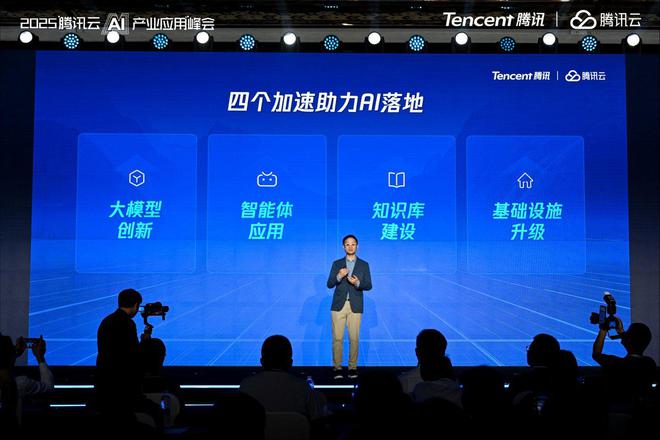
关于大模型落地,腾讯给了两个方向:智能体和知识库
Tai Mei Ti A P P· 2025-05-26 12:08
Core Insights - The development of practical and efficient AI agents is a significant challenge for the industry, as highlighted by Tencent's focus on creating products that address real business needs [2][3] - Tencent emphasizes the importance of user experience in AI agent development, ensuring that agents not only provide answers but also take responsibility for those answers in real business scenarios [3] Group 1: AI Agent Development - Key considerations in AI agent design include intelligent rollback, document comparison, and reinforcement of Q&A pairs to enhance accuracy and usability [2][4] - The essence of AI agents in B2B scenarios is their ability to autonomously plan and execute tasks based on natural language instructions, distinguishing them from traditional software [5] - Tencent's QQ browser has been upgraded to an AI browser with the introduction of QBot, indicating a shift towards AI integration in traditional browsing experiences [5][6] Group 2: Knowledge Base Integration - The combination of AI agents with enterprise knowledge bases is seen as a critical need, enhancing the precision of decision-making and execution in businesses [8][9] - Tencent's LeXiang has been upgraded to serve as a knowledge management tool, integrating with large models to improve knowledge flow and efficiency [10] - The evolution of large models has significantly improved language understanding capabilities, allowing for better integration of AI technologies into business processes [11]