
英伟达财报

Search documents
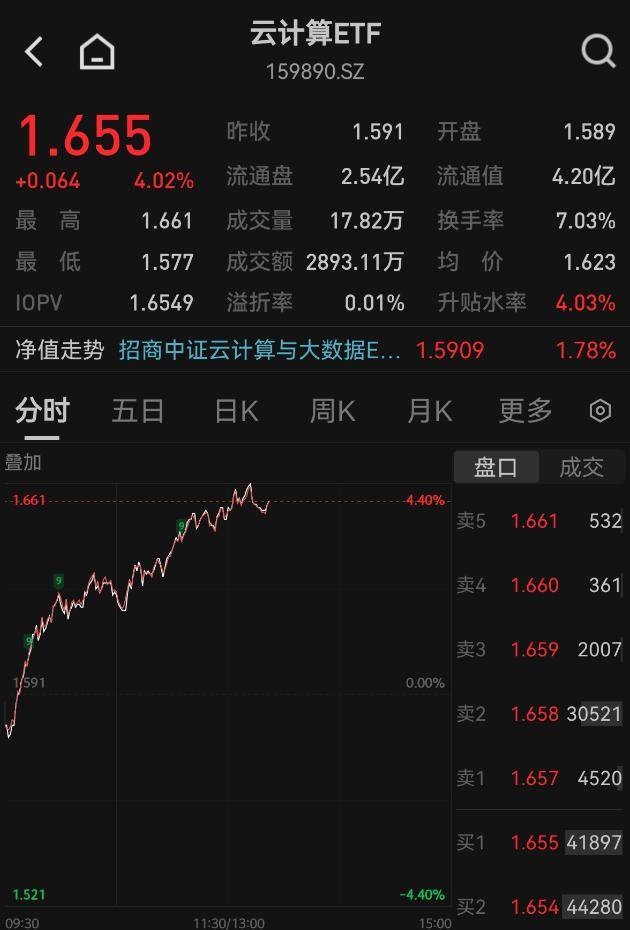
云计算ETF(159890)午后飙涨4%、日K冲击三连阳!机构:AI应用生态全面形成,算力需求持续强劲
Sou Hu Cai Jing· 2025-11-26 05:43
Core Viewpoint - The cloud computing ETF (159890) has shown significant growth, driven by strong performance in key component stocks, reflecting a robust demand for AI-related technologies and services [1][5]. Group 1: ETF Performance - The cloud computing ETF (159890) increased by 4.02%, with a peak price of 1.661 and a closing price of 1.655 on November 26 [2]. - Major component stocks such as Zhongji Xuchuang and Xinyi Sheng surged by 15.49% and 11.57%, respectively, while other stocks like Zhongke Shuguang and Inspur Information also saw gains exceeding 4% [1][2]. Group 2: AI Industry Developments - The AI application ecosystem is evolving, with major players like Alibaba and Ant Group launching new AI products, indicating a competitive landscape for AI super entry points [3]. - Nvidia reported a quarterly revenue of $57.006 billion, a 62% year-over-year increase, reinforcing market confidence in sustained AI demand [4]. - Google's introduction of the Gemini 3 AI model is positioned as a significant advancement in AI technology, further driving interest in AI capabilities [4]. Group 3: Investment Opportunities - The cloud computing ETF encompasses leading companies in both AI infrastructure and applications, suggesting a comprehensive investment opportunity in the AI era [5]. - Key component stocks include Zhongji Xuchuang (16.41% weight) and Xinyi Sheng (11.20% weight), highlighting the ETF's focus on critical sectors within the AI supply chain [6].

全球!跨资产!比惨大会
Xin Lang Cai Jing· 2025-11-22 01:26
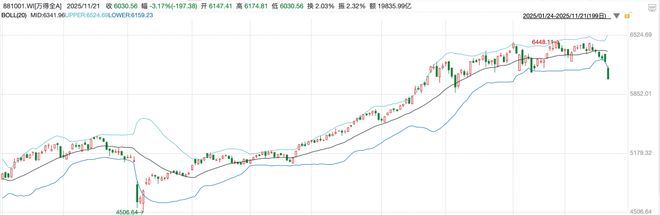
Market Overview - A-shares experienced a significant decline, with the Wande All A index dropping by 3.17% and the Wande All A Equal Weight Index falling by 3.74% [1] - The Shanghai Composite Index closed down 2.45% at 3834.89 points, breaching the 3900-point level [1] - The market's performance indicates a bearish trend, as the Wande All A index fell below the lower Bollinger Band [1][5] Global Market Influence - The decline in A-shares is part of a global market trend, initiated by a sharp drop in U.S. stocks, particularly the Nasdaq 100, which fell over 2% after opening more than 2% higher [2] - Nvidia's earnings report, which exceeded analyst expectations, led to a 3.15% drop in its stock, indicating that the market is trading on "whisper numbers" rather than consensus estimates [4][6] - The U.S. labor market report showed a surprising increase in non-farm payrolls but also a rise in the unemployment rate, creating uncertainty for the Federal Reserve regarding interest rate cuts [6] Sector Performance - The "consumption downgrade" narrative is emerging in the U.S., with Walmart's stock rising by 6.46% due to strong earnings, while Target's stock fell by 2.79% due to disappointing results [7] - In the A-share market, micro-cap stocks led the decline, with the Wande Micro-cap Index dropping by 4.87%, reflecting a retreat in risk appetite [11] - Traditional defensive sectors, such as banks and insurance, showed some resilience, but overall market sentiment remains weak [31][34] Technical Analysis - The S&P 500 index is approaching its 100-day moving average, which has historically served as a support level [8] - A significant number of sectors, including steel and chemicals, experienced declines of around 4%, indicating a broad-based sell-off [19] - The market's risk appetite has diminished significantly, as evidenced by the sharp declines in traditionally lower-risk sectors [19] Investment Sentiment - Analysts suggest a cautious approach, with recommendations to reduce positions in light of the current market conditions [20][22] - The sentiment among different models varies, with some suggesting a reduction in exposure to 20% while others maintain a more optimistic stance [21][22] - The overall market outlook remains uncertain, heavily influenced by external factors such as U.S. market stability and economic indicators [31][34]

海外AI回调,通信ETF(515880)回调超4%,还能相信“光”吗?
Sou Hu Cai Jing· 2025-11-21 05:23
Core Viewpoint - Nvidia reported strong earnings, but investor sentiment shifted from excitement to caution, leading to a broad market pullback in the US stock market [1][3] Group 1: Nvidia's Financial Performance - Nvidia's Q3 revenue for fiscal year 2026 reached $57.01 billion, with an expected Q4 revenue of approximately $65 billion, both exceeding Wall Street expectations [3] - Despite the strong financial results, concerns about Nvidia's growth potential and market share nearing its peak persist among investors [3] Group 2: Market Reactions and Economic Indicators - The communication ETF (515880), which has over 50% exposure to optical modules and is closely linked to the overseas AI industry, experienced a significant pullback of over 4% [1] - The US non-farm payroll report for September showed an increase of 119,000 jobs, surpassing the expected 50,000, while the unemployment rate rose to 4.4%, the highest since October 2021 [3] Group 3: AI Industry Fundamentals - The AI industry continues to accelerate, with significant advancements in domestic GPU production and strong performance in AI benchmarks by Google's Gemini 3 Pro [4] - The optical module market is experiencing growth due to increased shipments of computing chips and clear upgrades in technology, with expectations for continued expansion in market size and penetration rates [4] Group 4: Future Outlook - The AI industry trend remains positive, with capital expenditures expected to grow, particularly in high-end products like optical modules [5] - The communication ETF (515880) has a scale of nearly 13 billion yuan, ranking first among similar products, with optical modules accounting for 52% of its holdings [5][6]

周度策略:美股迎关键一周,A股续震荡运行-20251117
Huaxin Securities· 2025-11-17 14:01
Group 1 - The report highlights a critical week for the US stock market, focusing on Nvidia's earnings report and non-farm payroll data, with expectations of liquidity improvement and sentiment recovery [3][13][20] - The A-share market is expected to experience fluctuations, with attention on price increases in sectors like new energy, non-ferrous metals, and chemicals, as well as low-level rebounds in dividend-paying sectors such as banking and coal [3][29] Group 2 - The report indicates that the overall A-share index has declined, with small-cap stocks outperforming, while the ChiNext index has shown weakness [4][30] - In terms of sector performance, industries such as consumer goods, retail, and basic chemicals have led gains, while sectors like telecommunications, electronics, and military defense have faced declines [4][31] Group 3 - The report notes a slight recovery in trading activity within the A-share market, with an increase in average daily trading volume and turnover rate [5][39] - The report also mentions a rise in panic sentiment domestically, with the implied volatility of the CSI 300 ETF increasing [5][43] Group 4 - The report discusses the weak performance of social financing and credit in October, with new loans significantly below expectations, indicating a cooling economy [23][26] - It highlights that the economic indicators, including exports and fixed asset investment, have shown a downward trend, with retail sales continuing to decline for five consecutive months [26][27] Group 5 - The report emphasizes the focus on sectors experiencing price increases, low-level rebounds, and technology themes, including military industry, domestic semiconductors, AI applications, and new energy [29][30] - It also points out that the electronic industry is nearing historical high valuation levels in terms of PE and PB ratios [33][35]