
酒店预订服务

Search documents
F1赛事拉动周边酒店预订量大增125%
第一财经· 2026-03-12 06:39
Group 1 - The core viewpoint of the article highlights a significant increase in hotel bookings around the F1 event, with an average surge of 125% within a 3-kilometer radius of the venue [2] - Official data indicates that the expected attendance during the three-day event will reach 230,000, potentially setting a new record for spectator numbers [2]


假期前三天,飞猪酒店履约间夜量劲增80%以上
Xin Lang Cai Jing· 2026-02-17 06:32
Core Insights - The Spring Festival holiday has reached its peak travel period, with significant increases in travel service bookings compared to last year [1][2] Travel Service Bookings - Hotel night bookings have increased by over 80% year-on-year, while ticket sales have risen by 54% [1][2] - Popular cities for travel during the holiday include Guangzhou, Shanghai, Beijing, Shenzhen, Hangzhou, Chengdu, Chongqing, Kunming, and Xiamen [1][2] Cross-Border Travel - Orders for outbound travel services, including flight tickets and local activities, have grown by over 30% year-on-year [1][2] - The number of inbound flight tickets for overseas tourists has surged by 345% compared to last year [1][2] AI in Travel Booking - The use of AI for booking travel services has become a new trend during this year's Spring Festival [1][2] - A promotional event by Qianwen, in collaboration with Fliggy and Damai, has extended the Spring Festival invitation activity by three days, allowing users to receive additional discount cards for booking [1][2] - Within two days of the Qianwen event, AI bookings for scenic spot tickets increased by 22 times, while AI bookings for flight tickets surged over 7 times and hotel bookings more than doubled, with an average hotel price of 325 yuan per night [1][2] - The top five cities for AI-assisted hotel bookings are Hangzhou, Shanghai, Chongqing, Guangzhou, and Xi'an [1][2]
假期首日60岁以上旅客入住酒店增60% “反向过年”的爸妈涌入北上广深
Di Yi Cai Jing· 2026-02-15 11:36
Core Insights - The first day of the Spring Festival holiday on February 15 saw a significant increase in travel activity, particularly among older travelers, indicating a shift in holiday traditions and travel patterns [1][2][3] Group 1: Travel Trends - Data from Qunar indicates that hotel bookings for travelers aged 60 and above surged by 60% compared to the previous day and increased by 54% compared to the first day of the Spring Festival in 2025 [1] - Major cities like Guangzhou, Beijing, Shenzhen, and Shanghai saw the highest hotel occupancy rates, with Guangzhou experiencing a 30% increase [1] - The trend of "reverse Spring Festival" travel, where older generations travel to major cities to reunite with their children, has contributed to a more vibrant tourism market in these urban areas [1][2] Group 2: Tourist Preferences - Tourists are increasingly opting for theme hotels, family-friendly resorts, and boutique accommodations, with a notable rise in bookings for smaller, less traditional destinations like Chaozhou and Shantou [2] - There was a 30% year-on-year increase in ticket bookings for scenic spots from travelers coming from third-tier cities and below, with a 10% increase in bookings from travelers aged 60 and above [2] Group 3: Event and Activity Engagement - In Shanghai, 2.56 million visitors were received on the first day of the holiday, marking a 38.97% year-on-year increase, supported by 2,570 cultural and entertainment activities [3] - The "reverse Spring Festival" trend is seen as a practical economic decision, helping to alleviate congestion in transportation and stimulating the cultural tourism market in major cities [3] Group 4: International Travel - On February 15, Chinese tourists traveled to 475 cities worldwide, with popular destinations including the Maldives, Malaysia, and Thailand, reflecting a growing interest in international travel [3] - There was a nearly 20% year-on-year increase in bookings for domestic flights by foreign passport holders, with significant growth in visitors from Australia and Spain [4]

假期首日60岁以上旅客入住酒店增60%,“反向过年”的爸妈涌入北上广深
Di Yi Cai Jing· 2026-02-15 11:17
Group 1 - The peak of "reverse New Year" travel was observed on February 15, coinciding with the start of the longest Spring Festival holiday, as many travelers from working cities returned home, particularly those aged 60 and above [1][2] - Data from Qunar indicates a significant increase in hotel bookings for travelers aged 60 and above, with a 60% rise compared to the previous day and a 54% increase compared to the same day in 2025 [1] - Major cities like Guangzhou, Beijing, Shenzhen, and Shanghai saw the highest hotel occupancy rates, with Guangzhou experiencing a 30% increase in bookings [1][2] Group 2 - Tuniu reported a strong surge in travel bookings starting from February 10, with the first peak of tourist flow occurring on February 15, driven by both holiday travel and family visits [2] - Popular destinations for hotel bookings included Beijing, Guangzhou, Xiamen, and Shanghai, with a notable rise in interest for themed hotels and boutique accommodations [2] - There was a 30% year-on-year increase in ticket bookings for attractions from visitors coming from third-tier cities and below, with a 10% increase for those aged 60 and above [2] Group 3 - In Shanghai, 2.56 million tourists were received on the first day of the Spring Festival, marking a 38.97% year-on-year increase, supported by various cultural and entertainment activities [4] - The trend of "reverse New Year" is seen as a reflection of changing family reunion concepts and a practical economic decision, helping to alleviate congestion in transportation and stimulating the tourism market in major cities [4] - On the first day of the holiday, outbound travel was also notable, with Chinese tourists flying to 475 cities globally, and popular destinations included Maldives, Malaysia, and Thailand [4] Group 4 - Foreign tourists increasingly chose to experience the Chinese New Year, with a nearly 20% year-on-year increase in domestic flight bookings by non-Chinese passport holders [5] - The most popular cities for foreign visitors included Shanghai, Beijing, and Chengdu, with Sanya seeing a more than threefold increase in bookings from non-Chinese passport holders [5] - The primary source countries for tourists celebrating the New Year in China included Australia, Vietnam, and the UK, with significant growth in bookings from these regions [5]

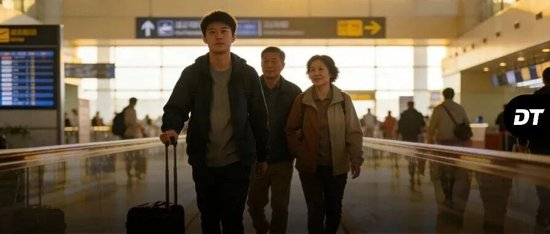
越来越多年轻人选择异地过年
Xin Lang Cai Jing· 2026-02-11 12:21
Core Viewpoint - The traditional practice of returning home for the Spring Festival is increasingly being reconsidered by many, with a growing trend of alternative ways to celebrate the holiday, such as "reverse New Year" where young people invite their parents to big cities instead of going home [2][3][4]. Group 1: Reverse New Year Trend - There is a significant increase in the booking of "reverse" tickets from smaller airports to major cities like Beijing and Shanghai, with a reported 84% year-on-year growth in ticket reservations for this trend [4][6]. - Popular routes for "reverse New Year" include flights from cities like Yulin to Shanghai and Hengyang to Beijing, indicating a shift in travel patterns during the holiday season [4]. - The convenience of obtaining tickets for "reverse New Year" is a major factor, as many find it easier and more affordable compared to the difficulty of securing tickets for returning home [6]. Group 2: Family Dynamics and Travel - Young individuals are increasingly motivated to bring their families to urban areas for the holiday, as seen in the case of a worker in Shenzhen who invited her grandparents to experience the city [7]. - The trend of "split New Year" is emerging, where individuals spend part of the holiday with family and then travel to other destinations, reflecting a desire for both family connection and leisure [8][10]. - Smaller cities are gaining popularity as travel destinations during the Spring Festival, with hotel bookings in places like Pu'er and Jieyang seeing over 80% year-on-year increases [8]. Group 3: Changing Perceptions of the Holiday - Many young people are choosing to spend the holiday alone in their rented apartments, with a shift in narrative around "spending New Year alone" becoming more positive and anticipated [11][13]. - The traditional family gathering atmosphere is diminishing for some, with individuals expressing a desire for a more personal and less stressful holiday experience [10][14]. - The concept of "New Year" is evolving, with individuals redefining what it means to celebrate, moving away from collective traditions to more personalized expressions of the holiday [16].
越来越多年轻人选择异地过年
第一财经· 2026-02-11 09:32
Core Viewpoint - The article discusses the evolving attitudes of young people towards the traditional practice of returning home for the Chinese New Year, highlighting a shift towards alternative ways of celebrating the holiday, such as "reverse New Year" and "individual New Year" experiences [4][21]. Group 1: Reverse New Year - A significant number of young people are opting to bring their parents to major cities for the New Year instead of returning home, with a notable increase in ticket bookings for flights from smaller airports to cities like Beijing and Shanghai [4][5]. - Data from Meituan indicates that from early February to mid-February, the booking volume for "reverse New Year" flights increased by 84% compared to the previous year [5]. - The difficulty in securing tickets for returning home is a major factor driving this trend, as urban areas experience high demand during the Spring Festival [7][8]. Group 2: Segmenting the Holiday - Some individuals are choosing to split their holiday into two parts: spending the first part at home with family and then traveling for leisure afterward [9][10]. - This approach allows families to maintain traditional celebrations while also enjoying a vacation, reflecting a desire for both familial connection and personal enjoyment [9][10]. Group 3: Individual New Year - A growing number of young people are choosing to spend the New Year alone in their rented accommodations, a shift from previous years where this was often seen as a lonely choice [15][21]. - Many are actively preparing for a solo celebration by decorating their spaces and purchasing their favorite foods, indicating a positive attitude towards this new way of celebrating [17][21]. - The article notes that the perception of spending the New Year alone is changing, with individuals finding joy and excitement in the experience [15][19]. Group 4: Changing Definitions of "New Year Flavor" - The concept of "New Year flavor" is becoming more personalized, with individuals defining it based on their own experiences rather than traditional expectations [21][22]. - Factors such as urbanization, transportation advancements, and changing family structures are contributing to this shift, allowing for more diverse and individualized celebrations [22][23]. - The article suggests that these emerging trends, while currently seen as niche, may become mainstream as more people seek to define the New Year in their own terms [22][23].

携程被反垄断一点不冤:问题不在高市占率,而是“控价”
Sou Hu Cai Jing· 2026-02-11 09:27
Core Viewpoint - Ctrip's antitrust investigation is primarily due to its price control practices rather than its high market share, which disrupts the normal price transmission mechanism in the hotel and travel industry [2][13]. Group 1: Market Share and Price Control - Ctrip holds over 70% market share in the travel industry, including its ecosystem platforms like Tongcheng, Qunar, and Tuniu, giving it significant pricing power [4]. - The investigation highlights that Ctrip's control over pricing is detrimental to the overall profit distribution within the industry, as it requires travel businesses to offer special price discounts to the platform [12][13]. Group 2: Regulatory Focus - Recent regulatory efforts have shifted from managing market share to behavioral regulation, emphasizing the importance of price transmission in the economy [3][14]. - The government has increased scrutiny on platform economies, as seen in recent actions against companies like Gaode for price suppression [14]. Group 3: Economic Indicators - The Average Daily Rate (ADR) for hotels showed a rebound in 2023 but is expected to decline in 2024, despite a recovery in travel demand, indicating a sensitivity to pricing among consumers [6][8]. - Revenue Per Available Room (RevPAR) is declining in 2024, suggesting that external forces, likely influenced by Ctrip's pricing strategies, are pushing the industry towards lower prices [10][11]. Group 4: Implications for the Industry - The current pricing strategies employed by Ctrip may hinder the overall profitability of the hotel industry, as businesses are forced to lower prices to remain competitive [13][18]. - The regulatory actions against Ctrip are seen as necessary to restore fair competition and pricing in the industry, potentially benefiting new entrants and the overall travel sector [18].


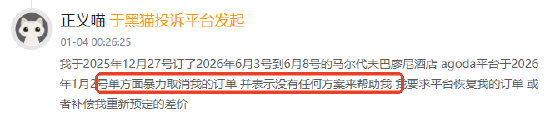
1月黑猫投诉OTA红黑榜:Agoda暴力取消订单差价损失无人赔
Xin Lang Cai Jing· 2026-02-11 07:22
Core Insights - The article discusses the January complaint handling red and black list published by the Black Cat Complaint platform, reflecting the complaint resolution status of various companies [1][7] - As of the end of January 2026, the platform has received nearly 32.74 million valid consumer complaints, with approximately 790,000 valid complaints in January alone [1][7] Group 1: Complaint Statistics - The Black Cat Complaint platform has accumulated nearly 32.74 million valid consumer complaints as of January 2026 [1][7] - In January 2026, the platform received nearly 790,000 valid complaints [1][7] Group 2: Red and Black Lists by Industry - **Shared Services**: - Blacklist includes companies like Guangyu Koste, Smart Xiaolian, and Hello [10] - Whitelist includes companies like Monster Charging and Street Electric [10] - **Shopping Platforms**: - Blacklist includes major platforms such as Taobao Mall, Tmall, and JD.com [10] - Whitelist includes Heart Joy Mall and Tmall Supermarket [10] - **Travel and Accommodation**: - Blacklist includes airlines like Capital Airlines and Shenzhen Airlines [10] - Whitelist includes companies like Chengdu Ocean Travel and Jinjiang Star [10] - **Entertainment and Lifestyle**: - Blacklist includes Tencent and WeChat [10] - Whitelist includes iQIYI and various tech companies [10] - **Education and Training**: - Blacklist includes companies like Zhonggong Education and Duolingo [10] - Whitelist includes companies like Beifuli Family Education and Yuanfudao [10] Group 3: Consumer Warnings - The Black Cat platform emphasizes that it does not charge consumers for resolving disputes and warns against fraudulent activities [11] - Consumers are advised to use official channels for complaints and to be cautious of third-party claims for refunds [11][12]
春节小城游催热酒店房价:泉州亚朵房价超2000元、一线城市高端酒店微降
Bei Jing Shang Bao· 2026-02-05 09:58
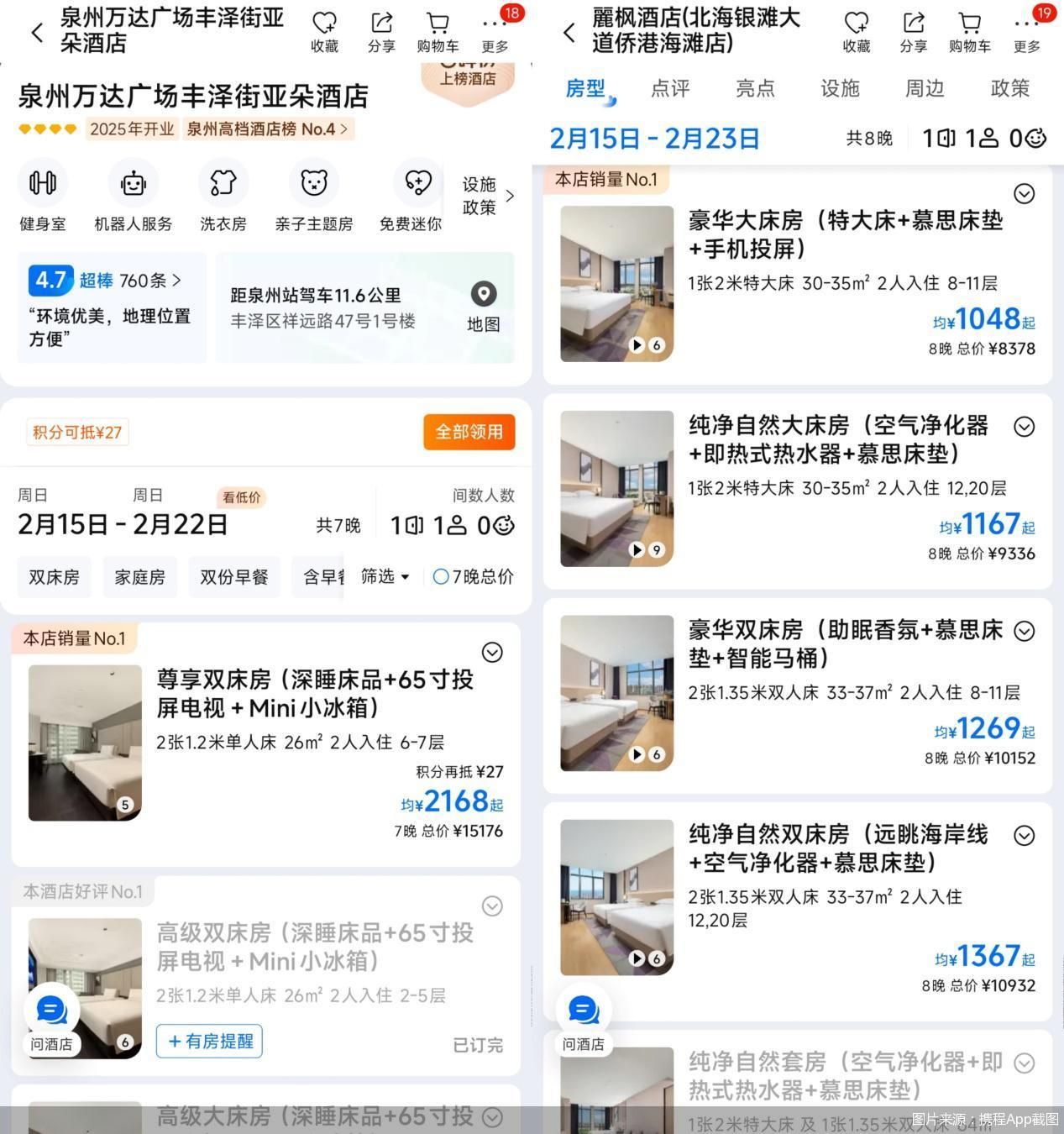
Core Insights - The domestic tourism market is experiencing a significant "two-way flow" as the Spring Festival approaches, with hotel prices in popular small cities surging while prices in major cities remain stable [1][3][10] Group 1: Hotel Price Trends - Hotel prices in small cities like Quanzhou and Beihai have skyrocketed, with some mid-to-high-end hotels exceeding 2000 yuan per night and price increases over 350% [1][3][5] - In contrast, major cities such as Beijing, Shanghai, Guangzhou, and Shenzhen are seeing stable hotel prices, with some high-end hotels even experiencing slight price reductions [7][8] - For example, the price for a luxury room at the Quanzhou Wanda Plaza Atour Hotel reached 2142 yuan per night during the Spring Festival, while similar hotels in other small cities have seen price hikes of 275% to 375% [4][5] Group 2: Consumer Behavior - Many families are focusing on "reverse tourism," opting to travel to major cities instead of returning home, as they seek better value for their travel expenses [10][11] - Data shows that the booking volume for hotels in major cities has increased significantly, with a notable rise in bookings from travelers aged 60 and above [10][11] - The trend indicates a shift in consumer preferences, with travelers looking for unique experiences in urban settings rather than traditional family reunions [10][11] Group 3: Market Dynamics - The supply-demand dynamics in small cities lead to significant price increases due to limited hotel capacity during peak travel times [1][8] - In major cities, the ample supply of hotel rooms and strong reception capabilities help stabilize prices, even during high-demand periods like the Spring Festival [8][10] - The tourism industry is encouraged to leverage local cultural activities and unique experiences to attract visitors, especially in smaller cities [11]
春节订房翻车,遭遇坐地起价、拒绝退款怎么办?
Xin Lang Cai Jing· 2026-02-03 11:24
Core Viewpoint - The article discusses consumer rights protection during the Spring Festival, highlighting common issues faced by consumers in the hospitality sector and providing guidance on how to effectively voice complaints and seek resolutions. Group 1: Complaint Channels - The first step in consumer rights protection is to identify the complaint subject and channel, with different platforms suited for various issues [1][3][10] - Official channels like 12315 and 12345 are emphasized for their authority and legal backing, making them reliable for addressing consumer disputes [3][10] Group 2: Third-Party Platforms - Third-party complaint platforms have emerged, leveraging internet technology to offer more flexible and efficient complaint avenues [2][11] - Black Cat Complaint, a public welfare platform under Sina, allows users to submit complaints through multiple channels, making it user-friendly for those unfamiliar with traditional processes [2][11] Group 3: Types of Complaints - Common issues include temporary price increases, refusal to refund, and discrepancies between service and advertising, which may involve price fraud or unreasonable charges [3][10] - Specific platforms are recommended for different types of complaints, such as contacting travel agencies or local tourism departments for issues related to online travel bookings [10] Group 4: Evidence and Clarity - Retaining evidence such as order screenshots, payment records, and communication logs is crucial for substantiating complaints [5][14] - Clearly defining the desired outcome, whether it be a refund or an apology, increases the likelihood of a complaint being addressed [5][14] Group 5: Effective Use of Platforms - Some platforms offer features like collective complaints to enhance visibility and pressure on companies, as well as public ratings of service quality [6][12] - The Black Cat Complaint platform includes a mechanism for rapid resolution and an AI legal assistant to help users navigate legal issues [6][12] Group 6: Consumer Reminders - Consumers are advised to read terms carefully before booking, choose reputable platforms, and maintain communication records [9][15] - A calm and rational approach is encouraged when dealing with disputes, prioritizing negotiation with the service provider before escalating to formal complaints [9][15]