
钨铜偏滤器

Search documents
年内核聚变相关项目中标总额超24亿元,行业进入资本开支扩张周期
Jin Rong Jie· 2025-12-18 00:35
Group 1 - The total amount of projects announced by the Hefei Institute of Plasma Physics and Fusion Energy in Anhui exceeded 2.4 billion yuan, with 9 projects having a budget over 50 million yuan [1] - From January 1 to December 12, 2025, the BEST project had 43 tenders with a budget of 2.043 billion yuan, while the EAST and CRAFT projects had 10 and 12 tenders with budgets of 18 million yuan and 77 million yuan respectively [1] - The industry is transitioning from intensive bidding to concentrated winning bids, indicating a validation of capital expenditure expansion logic [1] Group 2 - The global controllable nuclear fusion market is projected to reach 496.5 billion dollars by 2030 and may exceed 1 trillion dollars by 2050, with 35 major companies planning to operate commercial demonstration reactors between 2030 and 2035 [2] - The market for high-temperature superconducting materials used in controllable nuclear fusion technology verification devices is expected to experience exponential growth, potentially becoming a core sector worth hundreds of billions or even trillions by 2035 [2] - The A-share market has included controllable nuclear fusion in its "future industries" top-level planning, indicating that industry capital expenditure is entering an upward cycle [2]
可控核聚变突破在即,重构全球能源格局
3 6 Ke· 2025-12-15 02:50
Group 1 - Controlled nuclear fusion is crucial for national energy security and technological independence, with its industrialization progressing from experimental validation to engineering demonstration stages [1] - The domestic production rate of key nuclear fusion equipment has exceeded 96%, with core components like tungsten-based divertors and high-temperature superconducting materials now being produced independently [1] - The nuclear fusion industry is entering a new phase characterized by competition among multiple technological routes and concentrated capital investment, driven by advancements in projects like the BEST device and the EAST device [1][3] Group 2 - The capital market has shown significant interest in the controlled nuclear fusion sector, with a continuous rise in stock prices since 2025, indicating the potential for a new market cycle [3] - The nuclear fusion industry is currently in the experimental phase, with a three-step development plan outlined: experimental pile, demonstration pile, and commercial pile, aiming for completion of the experimental pile by 2035 and commercial demonstration by 2050 [4] - Global investments in nuclear fusion research are increasing, with many countries advancing their demonstration pile plans and accelerating the commercialization process [7] Group 3 - The industry anticipates that nuclear fusion could achieve commercial power supply within the next decade, with 2031-2035 being a widely accepted timeframe for this milestone [8] - AI technology is playing a significant role in advancing nuclear fusion development by optimizing reaction conditions and predicting plasma behavior, thus accelerating commercialization [8][12] - Material innovation is critical for overcoming bottlenecks in the nuclear fusion industry, focusing on surface and structural innovations, optimizing superconducting materials, and material modification [13] Group 4 - Superconducting materials are essential for controlled nuclear fusion devices, directly impacting the efficiency of energy production and plasma confinement [14] - Leading companies in the nuclear fusion sector are making significant progress in developing core components, with a clear path toward industrialization in areas such as superconductors and divertor materials [15][17] - Key companies include: - Four Creation Electronics, the only domestic company to achieve localization of superconducting magnet power modules for fusion devices [18] - Parker New Materials, the only company capable of mass-producing core components for nuclear fusion [19] - Antai Technology, a global supplier of core materials for controlled nuclear fusion devices [20]


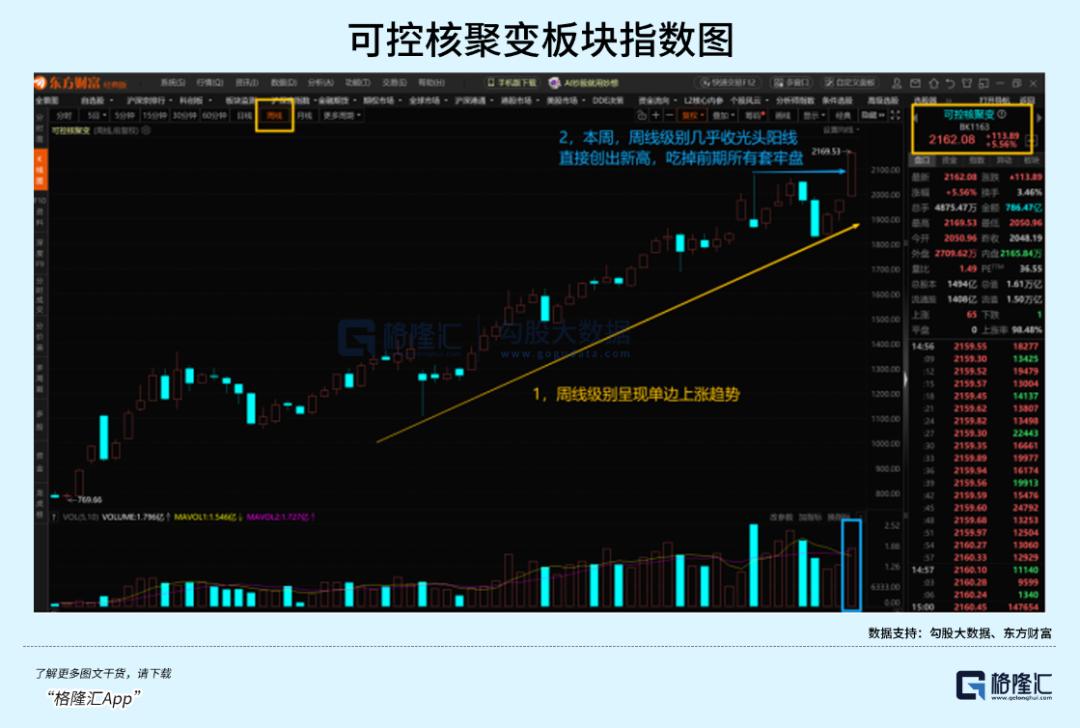
可控核聚变突破在即,重构全球能源格局!
格隆汇APP· 2025-12-14 10:06
Core Viewpoint - The article emphasizes the accelerating industrialization of controlled nuclear fusion, highlighting its importance for national energy security and technological independence. The industry is transitioning from experimental validation to engineering demonstration, with significant advancements in material performance and domestic production capabilities [5][11][14]. Industry Overview - Controlled nuclear fusion is entering a new phase characterized by multiple competitive technological routes and concentrated capital investment, with key equipment's domestic production rate exceeding 96% [5][8]. - The nuclear fusion industry is expected to achieve commercial power generation within the next decade, with 2031-2035 being the widely recognized timeframe for commercialization [15]. Investment Opportunities - The capital market has shown sustained interest in the controlled nuclear fusion sector, with stock performance indicating a potential new market cycle. Recent trading activity has seen significant gains in related stocks, suggesting a bullish trend [8][30]. - Investors are encouraged to focus on core enterprises within the nuclear fusion sector to seize investment opportunities as the industry progresses towards commercialization [9]. Technological Development - The development of controlled nuclear fusion is structured into five stages: scientific theory, scientific feasibility, engineering feasibility, commercial feasibility, and commercial reactor. The industry is currently advancing towards engineering feasibility [10]. - AI technology is playing a crucial role in accelerating the commercialization of nuclear fusion by optimizing reaction conditions and predicting plasma behavior, significantly enhancing research efficiency [15][19]. Material Innovation - Material innovation is critical for overcoming bottlenecks in the nuclear fusion industry, with research focusing on surface and structural innovations, superconducting materials optimization, and material modification [22][28]. - Superconducting materials are essential for the operation of controlled nuclear fusion devices, directly impacting energy efficiency and plasma confinement capabilities [25][26]. Key Enterprises - Several leading companies are making significant strides in the nuclear fusion sector, including: - **Sichuan Four Creation Electronics (四创电子)**: The only domestic company to achieve the localization of superconducting magnet power supply modules for fusion devices [36]. - **Parker New Materials (派克新材)**: The only company capable of mass-producing core components for nuclear fusion, continuously enhancing its technological advantages [38]. - **Antai Technology (安泰科技)**: A global supplier of core components for controlled nuclear fusion, providing a range of tungsten-related products for nuclear power technologies [39].


可控核聚变行业深度报告:核聚变产业化提速,聚焦链主及核心供应公司
CMS· 2025-11-04 05:32
Investment Rating - The report maintains an investment rating of "Recommended" for the controllable nuclear fusion industry [2][3]. Core Insights - The controllable nuclear fusion industry is accelerating its industrialization process, transitioning from experimental validation to engineering demonstration, with a focus on key suppliers and core component manufacturers that have achieved domestic substitution [2]. - The overall domestic production rate of key nuclear fusion equipment exceeds 96%, with significant advancements in materials performance being a core bottleneck for the feasibility of the technology route [2]. - The industry is entering a new phase characterized by "multiple routes racing + capital resonance," with significant milestones expected, such as the BEST device demonstrating power generation by 2027 [2]. Industry Scale - The industry comprises 118 listed companies, with a total market capitalization of 2114.6 billion and a circulating market capitalization of 1755.9 billion [3]. Performance Metrics - The absolute performance over 1 month, 6 months, and 12 months is 3.2%, 27.0%, and 26.1% respectively, while the relative performance is -0.5%, 2.4%, and 6.9% [5]. Key Companies and Financial Indicators - Notable companies include: - Xibu Superconductor (688122.SH) with a market cap of 50.1 billion and a strong recommendation [7]. - Antai Technology (000969.SZ) also strongly recommended with a market cap of 22.3 billion [7]. - Jiu Li Special Materials (002318.SZ) with a market cap of 25.0 billion and a strong recommendation [7]. - Other companies such as Guoguang Electric (688776.SH), Hezhu Intelligent (603011.SH), and Lianchuang Optoelectronics (600363.SH) are also highlighted, though they do not have specific investment ratings [7]. Material Innovation - Material innovation is identified as the current core bottleneck and breakthrough point for industrialization, with extreme operational environments requiring materials with high melting points, radiation resistance, and thermal fatigue performance [6]. - Domestic companies like Antai Technology and West Superconductor have made breakthroughs in tungsten-copper filters and superconducting materials, overcoming foreign monopolies [6]. Market Opportunities - The industry chain is witnessing incremental market growth across multiple segments, with energy equipment leaders establishing significant layouts and core component manufacturers benefiting from clear development paths [6]. - Companies such as Guoguang Electric, Hezhu Intelligent, and Lianchuang Optoelectronics are positioned to benefit significantly from local support [6].


【大涨解读】核聚变:人类历史首个聚变发电建成时间确定,行业发展全面提速,已资本开支扩张阶段
Xuan Gu Bao· 2025-10-28 03:17
Market Performance - On October 28, the nuclear fusion sector strengthened again, with companies such as Antai Technology and Dongfang Tanye achieving consecutive gains, while Western Superconducting and Yongding shares also rose [1] - Antai Technology's stock price reached 22.98, with a 10.00% increase, and it is a core supplier for global controllable nuclear fusion devices [2] - Western Superconducting, the only Chinese supplier of low-temperature superconducting wire for the ITER project, saw its stock rise by 8.28% to 83.16 [2] - Yongding shares increased by 7.86% to 16.20, with its subsidiary being the only mass producer of second-generation high-temperature superconducting tape in China [2] Domestic and International Developments - Helical Fusion, a Tokyo-based startup, announced progress in developing high-temperature superconducting magnets crucial for fusion reactors, marking a significant step towards commercial fusion energy [3] - Helion Energy received conditional use permits for its fusion generator facility in Washington, clearing obstacles for construction [4] - In China, a research team from the Institute of Metal Research successfully industrialized high-purity ton-level Hastelloy (C276) metal substrates for second-generation high-temperature superconducting tapes [5] - The compact fusion energy experimental device in Hefei is expected to be completed by 2027, potentially becoming the first facility to achieve fusion power generation [5] Industry Insights - The controllable nuclear fusion industry in China is entering a phase of significant capital expenditure, with over 150 billion yuan planned or under construction by September 2025 [6] - The industry is diversifying its technological routes, with the Tokamak being the most mature. Key components such as magnets and vacuum chambers constitute major costs [6] - The global nuclear fusion market is projected to reach approximately $843.46 billion by 2040, with a compound annual growth rate (CAGR) of about 6% from 2030 to 2040. China's market is expected to grow to around $53.68 billion by 2040, with a CAGR of 6.4%, slightly higher than the global average [6] Project Updates - The EAST project has reached a mature stage, with core component tenders nearly complete, while the BEST project is in mid-construction with key component tenders ongoing [7] - The CFEDR project is still in the research phase, with concentrated tendering expected between 2027 and 2029 [7] - The CRAFT project has completed some tenders and is advancing in the procurement of magnets, power supplies, and diagnostic systems [7]
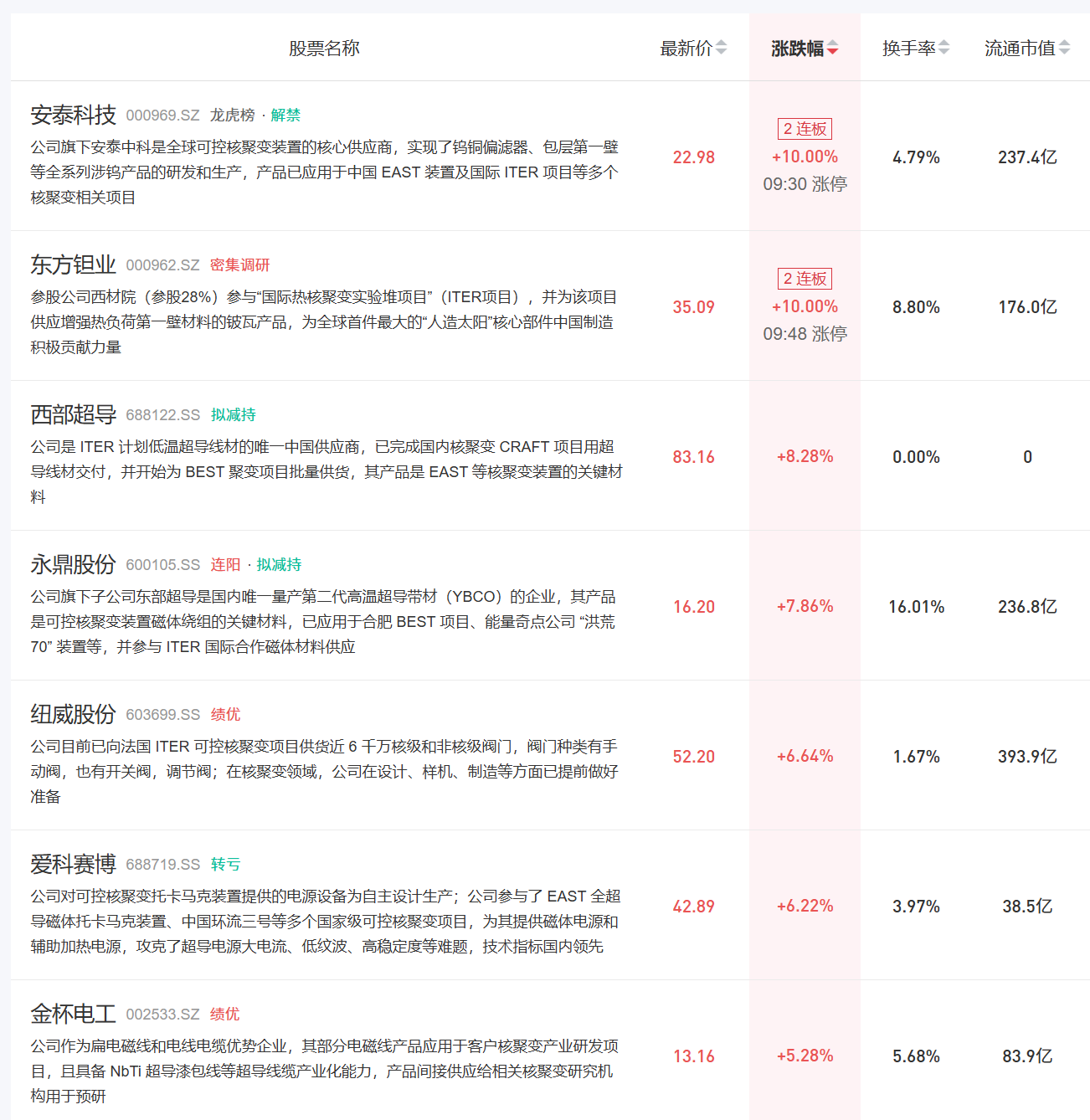
行业迎密集利好 可控核聚变板块掀涨停潮
Zhong Guo Zheng Quan Bao· 2025-10-09 20:53
Core Viewpoint - The recent surge in China's controllable nuclear fusion sector is driven by a combination of domestic and international favorable factors, indicating a potential acceleration towards the controllable nuclear fusion era, despite the technology still being in the developmental stage and facing uncertainties in commercialization [1][2][6]. Market Performance - On October 9, A-shares in the controllable nuclear fusion sector experienced a significant rally, with the Wind nuclear fusion index rising by 7.82%, and several stocks, including Haohan Huadong and Xibu Superconductor, hitting the daily limit [1][2]. Domestic Developments - The establishment of China Fusion Energy Co. and the recent progress in the BEST project, including the successful installation of a key component, have contributed to the positive market sentiment [2][4]. - The upcoming International Atomic Energy Agency Fusion Energy Conference (FEC2025) in Chengdu is expected to showcase significant advancements in the industry [2]. International Trends - Major economies are increasing investments in nuclear power, with Japan planning to close oil-fired plants and restart nuclear stations, and Italy's Eni Group signing a $1 billion electricity sale agreement with a U.S. fusion company [2][3]. - A new agreement between the UK and the U.S. aims to expedite nuclear power development, reducing the average licensing period from four years to two [3]. Company Involvement - Companies like Hezhong Intelligent and Xibu Superconductor are actively participating in the BEST project, with Hezhong securing a contract worth 209 million RMB for vacuum chamber manufacturing [4]. - Yonding Co. has accelerated the industrialization of high-temperature superconducting materials, reporting a 24.07% year-on-year revenue increase [5]. Industry Outlook - The controllable nuclear fusion sector is viewed as a significant clean energy direction, with long-term growth potential. The global fusion industry has seen explosive growth, with total investments rising from $1.9 billion in 2021 to an expected $9.7 billion by 2025 [6][7]. - The construction of 37 new fusion power plants is anticipated globally between 2025 and 2035, with a projected market space of approximately $203.5 billion by 2055 [7].
10月可控核聚变大会召开,谁能受益?| 0928 张博划重点
Hu Xiu· 2025-09-28 14:44
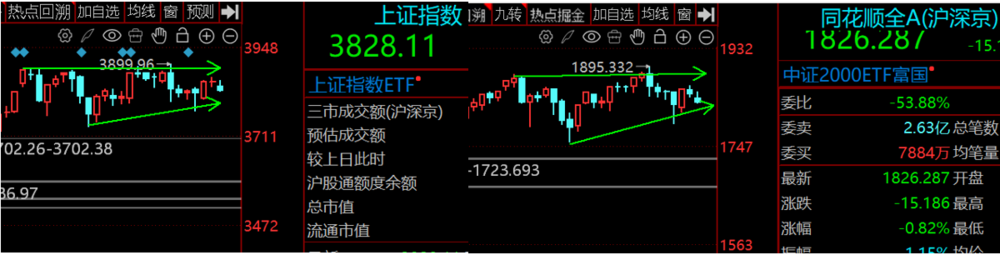
Market Analysis - The market remains cautious ahead of the holiday, with the Shanghai Composite Index at 3828.1 and a significant drop in trading volume, down 53.88% compared to the previous day [1]. Macroeconomic Insights - Economic data shows signs of recovery, indicating potential positive trends in the broader economy [2]. International Trade Dynamics - Trump's recent comments about Japan and South Korea needing to "prepay" for tariff agreements have sparked concerns, with South Korea warning of a potential repeat of the 1997 financial crisis if such measures are enforced [7]. Industry Developments - Moore Threads has successfully passed the IPO approval process, becoming the first domestic GPU company to go public. The company reported a revenue of 702 million yuan in the first half of 2025, surpassing the total revenue of the previous three years, with a compound annual growth rate exceeding 208% [9][10]. - The company's gross margin improved significantly from -70.08% in 2022 to 70.71% in 2024, indicating a strong turnaround [10]. - Moore Threads is in discussions for orders exceeding 2 billion yuan, with a focus on AI computing and graphics acceleration products [11]. Renewable Energy Sector - Daikin Heavy Industries holds an order backlog of 10 billion yuan, benefiting from a surge in offshore wind energy demand in Europe, with expectations of a 50% growth in installation rates from 2025 to 2026 [18][20]. - The European offshore wind market is projected to see a significant increase in demand, with a forecasted installation of 43.1 GW during the 14th Five-Year Plan period [20]. Nuclear Fusion Industry - The Chinese government has introduced supportive policies for the nuclear fusion industry, including the inclusion of fusion projects in major infrastructure initiatives and the establishment of a national venture capital fund [21][23]. - Upcoming international conferences and technology validations in October 2025 will focus on the commercialization pathways for nuclear fusion technology [22]. Robotics Sector - Hongrun Construction is expanding its presence in the robotics field, focusing on humanoid, industrial, and engineering robots, with strategic partnerships to enhance its technological capabilities [35][36]. - The company has made significant advancements in four-legged robot technology and is developing engineering robots to improve efficiency in construction projects [37][38].

能源领域终极畅享,行业卖铲人率先受益 | 投研报告
Zhong Guo Neng Yuan Wang· 2025-09-19 02:51
Core Insights - The report highlights the rapid development and commercialization potential of controlled nuclear fusion technology, which is seen as a key direction for future energy strategies globally [2][3][4] - The introduction of the Atomic Energy Law in China is expected to promote sustainable development in the nuclear energy sector and support research and technology development in controlled nuclear fusion [2][3] - The industry is experiencing significant growth opportunities, particularly in upstream materials and midstream processing sectors, driven by the bidding and construction activities of leading domestic fusion enterprises [4][5] Industry Overview - Controlled nuclear fusion is regarded as the "ultimate solution" in the energy sector, with the potential to lead a new technological revolution similar to the advent of the steam engine and electrification [2] - The commercialization of Tokamak fusion reactors is anticipated to occur between 2031 and 2035, according to a survey by FIA [2] Market Dynamics - The report indicates that high-temperature superconductors, first wall materials, low-temperature systems, heat exchangers, and vacuum chambers are considered critical components for fusion devices [4][5] - The domestic fusion supply chain is expected to benefit from the initial high growth phase, with upstream material suppliers and midstream processing companies poised to share in the industry's growth [4] Key Components and Technologies - High-temperature superconductors are projected to see a significant market expansion, with expectations that they will capture 25% of the global superconducting materials market by 2030 [4] - The blanket module, which includes the first wall, is identified as a critical component for the future of controlled nuclear fusion, with companies like Guoguang Electric being highlighted for their production capabilities [5] - Tungsten-copper divertors are noted as a promising solution for managing plasma contamination and heat, with companies such as Antai Technology recommended for their supply capabilities [6] Manufacturing and Processing - The vacuum chamber is emphasized for its high processing barriers and critical role in the safe operation of fusion reactors, with companies like Hezhong Intelligent suggested for their manufacturing experience [6][7] - The report suggests that companies with integrated solutions for vacuum chamber manufacturing and processing will have a competitive advantage in the market [6][7]
聚焦“新天工开物”:三项金属材料科技成果发布
Huan Qiu Wang· 2025-08-29 08:26
Core Achievements in Metal Materials - The "New Tian Gong Kai Wu - Technology Achievements Release Conference" highlighted China's independent innovation in the metal materials sector, showcasing high-performance rare earth permanent magnet materials, tungsten-copper components for nuclear fusion reactors, and advanced metal porous materials [1][3]. - China has made significant advancements in the metal materials field since the 21st century, establishing itself among the top global players, particularly in high-end metal materials [1][3]. Rare Earth Permanent Magnet Materials - High-performance rare earth permanent magnet materials are essential for high-end equipment in sectors like electric vehicles, wind power, robotics, and aerospace [3]. - The unique "cerium magnet" material developed in China has gained global attention due to its resource adaptability and cost advantages [3][5]. - The Chinese Steel Research Team has achieved four technological breakthroughs in rare earth permanent magnet research, resulting in five series of products with nearly one hundred specifications [5]. Tungsten-Copper Components for Nuclear Fusion - The tungsten-copper filter developed by Antai Technology is crucial for protecting nuclear fusion reactors, capable of withstanding extreme temperatures [5][7]. - The EAST (Experimental Advanced Superconducting Tokamak) has set world records, demonstrating the effectiveness of these materials in nuclear fusion applications [5][7]. - China's advancements in this area position it as a leader in the global nuclear fusion research landscape, contributing significantly to sustainable energy exploration [7]. Advanced Metal Porous Materials - Advanced metal porous materials are being utilized in various industrial applications, including high-grade gasoline production and coal chemical processes, acting as a key component in reducing carbon emissions [8][10]. - These materials possess unique properties such as high porosity, high permeability, and low density, making them suitable for a wide range of industrial uses [8][10]. - The integration of emerging technologies like big data and industrial IoT is expected to enhance the development and lifecycle management of advanced metal porous materials [10].

安泰科技20250826
2025-08-26 15:02
Summary of AnTai Technology Conference Call Company Overview - **Company**: AnTai Technology - **Date**: August 26, 2025 Key Points Financial Performance - In the first half of 2025, AnTai Technology's revenue decreased by 5%, primarily due to the absence of a merger project that contributed 131 million last year. [3] - Net profit dropped by 33%, but when excluding the merger project, net profit increased by 25% year-on-year, indicating stable operational performance. [3][2] - The adjusted net profit (excluding non-recurring items) grew by 19%, maintaining an overall growth rate of around 20%. [2][3] Business Segment Performance - **Tungsten and Molybdenum**: Revenue fell by 18% and net profit by 9% due to export restrictions. However, contract amounts remained stable. [4][2] - **Stone Business**: Contract amounts increased by 9%, but revenue and profit declined due to falling prices and export backlogs. The company is shifting focus to Southeast Asian markets. [5][2] - **AnTai Feijin**: Benefited from the widespread application of amorphous materials in energy-saving and environmental protection, achieving high growth. [2][6] - **High-Speed Tool Steel**: Continued high growth with revenue increasing by over 10% and net profit up by more than 90%. Expected to remain a major domestic product in the next 3-5 years. [9][2] - **Controlled Nuclear Fusion Projects**: Significant increase in bid amounts, but revenue recognition is affected by settlement cycles. [10][2] Market Trends and Future Outlook - The tungsten and molybdenum sectors are expected to see stable growth in the second half of 2025, with a forecast for stone prices to stabilize, potentially improving revenue. [6][2] - The amorphous materials market is projected to continue growing due to increasing demand for energy-efficient products, particularly in electric vehicles. [7][2] - The rare earth market showed a downward trend in the first half of 2025 but is expected to stabilize in the second half. [8][2] Challenges and Strategic Initiatives - The stone business faces challenges from price declines and intense market competition, prompting a shift towards Southeast Asian markets. [5][2] - The company is focusing on enhancing product technology and stability to meet future market demands, particularly in the controlled nuclear fusion sector. [19][2] - The commercialization of tungsten-copper filters faces high costs and loss challenges, but the company aims to improve product technology to meet customer needs. [17][2][19] Additional Insights - Nanocrystalline materials are expected to see significant growth in applications across various sectors, including new energy vehicles and consumer electronics. [11][12] - The company has achieved the largest global production of nanocrystalline materials, with expectations to maintain this growth trajectory. [12][2] - The controlled nuclear fusion technology is anticipated to enter practical stages between 2026 and 2027, with the company adjusting its organizational structure to meet production demands. [10][2] This summary encapsulates the key insights from AnTai Technology's conference call, highlighting financial performance, business segment dynamics, market trends, and strategic initiatives.