
锡矿砂及其精矿

Search documents
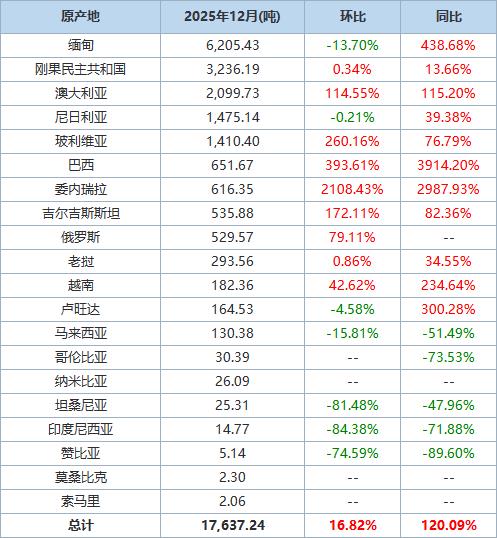
海关总署:中国12月锡矿砂及其精矿进口量环比增加16.82% 分项数据一览
Wen Hua Cai Jing· 2026-01-21 10:58
Core Insights - China's imports of tin ore and concentrates in December 2025 reached 17,637.24 tons, representing a month-on-month increase of 16.82% and a year-on-year increase of 120.09% [1] Import Sources - Myanmar remains the largest source of imports, with 6,205.43 tons imported in December 2025, showing a month-on-month decrease of 13.70% but a year-on-year increase of 438.68% [1] - The Democratic Republic of the Congo is the second-largest source, with imports of 3,236.19 tons, reflecting a month-on-month increase of 0.34% and a year-on-year increase of 13.66% [1] - Australia saw significant growth, with imports of 2,099.73 tons, marking a month-on-month increase of 114.55% and a year-on-year increase of 115.20% [1] Other Notable Sources - Nigeria's imports were 1,475.14 tons, with a slight month-on-month decrease of 0.21% but a year-on-year increase of 39.38% [1] - Bolivia's imports surged to 1,410.40 tons, showing a month-on-month increase of 260.16% and a year-on-year increase of 76.79% [1] - Venezuela experienced a dramatic rise in imports to 616.35 tons, with a month-on-month increase of 2,108.43% and a year-on-year increase of 2,987.93% [1] Summary of Import Data - The total imports of tin ore and concentrates for December 2025 are summarized in a table format, highlighting the tonnage, month-on-month, and year-on-year changes for various countries [1]

锡月报:短期宏观氛围积极,预计锡价震荡运行-20260104
Wu Kuang Qi Huo· 2026-01-04 13:30
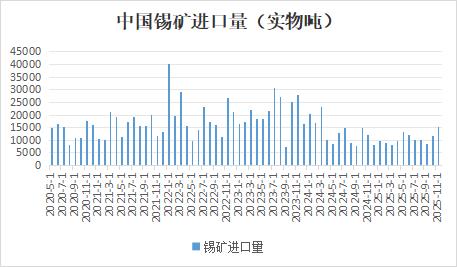
1. Report Industry Investment Rating - Not provided in the content 2. Core Viewpoints of the Report - In December 2025, tin prices were high and strong. In terms of supply, the operation of tin ingot smelters in Jiangxi and Yunnan remained stable at a high level. In terms of demand, the demand for consumer electronics entered the traditional off - season at the end of the year, but the operating rate of tin solder enterprises remained stable supported by new - energy vehicles and AI servers. In the spot market, downstream enterprises adopted a low - inventory strategy with weak purchasing willingness. Tin inventory increased for three consecutive weeks. High prices significantly inhibited tin demand, and it is expected that tin prices will fluctuate and weaken in the future [11][13] 3. Summaries According to Relevant Catalogs 3.1 Monthly Evaluation and Strategy Recommendation - Cost side: In November 2025, the import of tin concentrates in China increased significantly, and the shortage of raw material supply was alleviated. The import volume of tin ore and its concentrates was 15,099 tons, a month - on - month increase of 29.81% and a year - on - year increase of 24.42%. The imports from Myanmar (the largest source) and the Democratic Republic of the Congo (the second - largest source) changed differently [12] - Supply side: The resumption of tin mines in Wa State, Myanmar, advanced, and the export volume increased significantly. However, the shortage of raw materials for smelting enterprises in Yunnan still existed, and the short - term operating rate remained stable with limited upward momentum. In Jiangxi, due to the significant reduction in scrap, the supply of crude tin was insufficient, and the output of refined tin remained at a low level. Overall, it is difficult to further improve the operating level of smelters in the short term [12] - Demand side: At the end of the year, the demand for consumer electronics entered the traditional off - season, but the operating rate of tin solder enterprises remained stable supported by new - energy vehicles and AI servers. In November, the output of tin solder of sample enterprises increased by 0.95% month - on - month, and the operating rate rose slightly by 0.69% compared with October. In the现货 market, downstream enterprises adopted a low - inventory strategy, resulting in a three - week increase in tin inventory. As of December 26, 2025, the social inventory of tin ingots in major domestic markets was 10,367 tons, an increase of 186 tons from the previous Friday [12] 3.2 Futures and Spot Market - Not provided with specific text analysis content, only relevant data graphs are presented, including the basis of Shanghai tin main contract and the LME tin premium (0 - 3) [19][20] 3.3 Cost Side - Not provided with specific text analysis content, only relevant data graphs are presented, including China's monthly tin ore production, tin ore import volume, tin concentrate price, and tin concentrate processing fee [24][26] 3.4 Supply Side - Not provided with specific text analysis content, only relevant data graphs are presented, including domestic refined tin monthly output, domestic recycled tin monthly output, tin output and operating rate in Yunnan and Jiangxi regions, refined tin export and import profits, domestic refined tin import volume, and Indonesia's refined tin import and export [30][32][35] 3.5 Demand Side - The year - on - year growth rate of China's semiconductor sales rebounded slightly, and the global semiconductor sales maintained high growth. The report also presented data graphs of domestic computer production, smartphone production, output of household appliances (washing machines, air conditioners, refrigerators, color TVs), China's photovoltaic cell production, domestic key enterprise tin - plated strip production, domestic PVC monthly output, downstream solder enterprise operating rate, and domestic tin apparent consumption [43][44][46] 3.6 Supply - Demand Balance (Inventory) - Not provided with specific text analysis content, only relevant data graphs are presented, including China's social inventory and LME inventory [60]
海关总署:缅甸复产推进 11月中国锡矿进口增长明显
Wen Hua Cai Jing· 2025-12-23 06:38
Group 1 - The core point of the article highlights that China's imports of tin ore and concentrates in November 2025 showed a year-on-year decrease of 0.67% but a month-on-month increase of 12.73% [1] - Imports from Myanmar significantly increased, with a total of 7,190.21 tons (approximately 1,636.05 metal tons), marking a year-on-year increase of 92.16% and a month-on-month increase of 89.94% [1] - The total imports from other countries, excluding Myanmar, amounted to 7,909.13 tons (approximately 3,941.99 metal tons), reflecting a year-on-year decrease of 17.29% and a month-on-month decrease of 3.58% [1] Group 2 - The cumulative imports of tin concentrates from January to November reached approximately 118,100 tons, with a year-on-year decrease of 1.88% [1] - The significant increase in tin ore imports from Myanmar indicates a gradual recovery in production resumption [1]
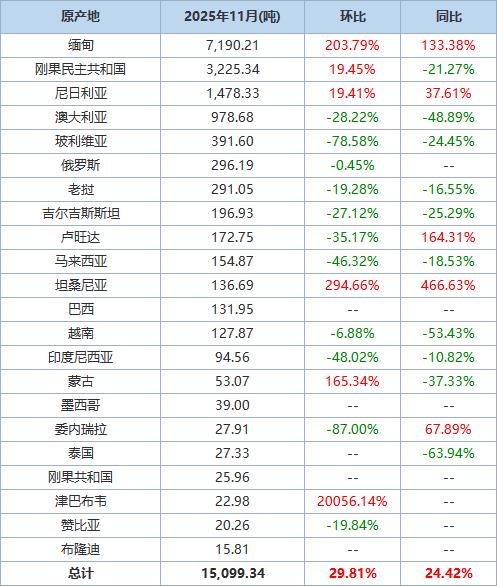
海关总署:中国11月锡矿砂及其精矿进口量环比上升29.81% 分项数据一览
Wen Hua Cai Jing· 2025-12-23 00:56
Core Insights - China's import volume of tin ore and concentrates in November 2025 reached 15,099.34 tons, representing a month-on-month increase of 29.81% and a year-on-year increase of 24.42% [1] Import Sources - Myanmar was the largest source of imports, with 7,190.21 tons imported in November 2025, showing a month-on-month increase of 203.79% and a year-on-year increase of 133.38% [1] - The Democratic Republic of the Congo ranked second, with imports of 3,225.34 tons, reflecting a month-on-month growth of 19.45% but a year-on-year decrease of 21.27% [1] Detailed Import Data - The following table summarizes the import data by origin for November 2025: - Myanmar: 7,190.21 tons (MoM: +203.79%, YoY: +133.38%) [1] - Democratic Republic of the Congo: 3,225.34 tons (MoM: +19.45%, YoY: -21.27%) [1] - Nigeria: 1,478.33 tons (MoM: +19.41%, YoY: +37.61%) [1] - Australia: 978.68 tons (MoM: -28.22%, YoY: -48.89%) [1] - Bolivia: 391.60 tons (MoM: -78.58%, YoY: -24.45%) [1] - Russia: 296.19 tons (MoM: -0.45%) [1] - Laos: 291.05 tons (MoM: -19.28%, YoY: -16.55%) [1] - Kyrgyzstan: 196.93 tons (MoM: -27.12%, YoY: -25.29%) [1] - Rwanda: 172.75 tons (MoM: -35.17%, YoY: +164.31%) [1] - Tanzania: 136.69 tons (MoM: +294.66%, YoY: +466.63%) [1] - Brazil: 131.95 tons [1] - Vietnam: 127.87 tons (MoM: -6.88%, YoY: -53.43%) [1] - Indonesia: 94.56 tons (MoM: -48.02%, YoY: -10.82%) [1] - Mongolia: 53.07 tons (MoM: +165.34%, YoY: -37.33%) [1] - Other countries included various smaller amounts with notable changes [1]
锡月报:短期供给扰动,预计锡价偏强震荡-20251205
Wu Kuang Qi Huo· 2025-12-05 14:21
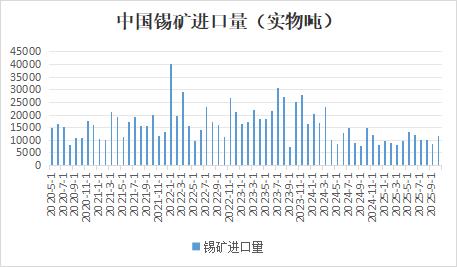
1. Report Industry Investment Rating No information provided. 2. Core View of the Report - In November, tin prices continued to strengthen under the influence of supply disturbances at the mine end, reaching a new high for the year. Although the current demand in the tin market is weak, with low downstream inventories and limited bargaining power, supply - side disturbances are the determining factor for short - term prices. Therefore, it is more likely that tin prices will fluctuate strongly in the short term [11][13]. 3. Summary of Each Section According to the Table of Contents 3.1 Monthly Evaluation and Strategy Recommendation - Cost side: In October, the import volume of tin concentrates in China increased significantly, and the shortage of raw material supply was slightly alleviated. However, the recent deterioration of the conflict in the Democratic Republic of the Congo has disrupted tin ore transportation, raising market concerns. In October, the import volume of tin ore and concentrates was 11,632 physical tons (equivalent to about 4,938 metal tons), a year - on - year decrease of 15.74% and a month - on - month increase of 43.36% [12]. - Supply side: The resumption of tin mines in Wa State, Myanmar, has been slow, with low export volumes. Smelting enterprises in Yunnan still face a shortage of raw materials, and their short - term operating rates are stable but lack further upward momentum. In Jiangxi, due to a significant reduction in scrap materials, the supply of crude tin is insufficient, and refined tin production remains at a low level. Overall, it is expected that the overall operating level of smelters in the two regions will be difficult to further improve in the short term [11][12]. - Demand side: Although the consumption in traditional fields such as consumer electronics and tinplate is slightly weak, the long - term demand expectations brought by emerging fields such as new energy vehicles and AI servers support tin prices. In the peak season, the operating rate of domestic tin solder enterprises showed a slight recovery in October. In October, the domestic integrated circuit output was 4.18 billion pieces, with a year - on - year growth rate of 17.7%. Downstream enterprises mainly replenish inventory at low prices. Recently, due to the large short - term price increase, downstream acceptance is limited, and inventories have increased significantly. This week, the total social inventory of tin ingots in major Chinese regions was 8,245 tons, an increase of 311 tons from last week [11][12]. 3.2 Futures and Spot Market No specific text analysis content provided, only relevant data graphs are presented [17][19][20]. 3.3 Cost Side No specific text analysis content provided, only relevant data graphs are presented, including the monthly output of Chinese tin ore, import volume, tin concentrate price, and tin concentrate processing fee [22][24][26]. 3.4 Supply Side No specific text analysis content provided, only relevant data graphs are presented, including domestic refined tin monthly output, domestic recycled tin monthly output, tin production and operating rate in Yunnan and Jiangxi regions, refined tin export and import profits, domestic refined tin import volume, and Indonesia's refined tin import and export [28][30][32][36][38][39]. 3.5 Demand Side - The year - on - year growth rate of China's semiconductor sales has rebounded slightly, and global semiconductor sales have maintained high growth [45]. - No specific text analysis content provided for other indicators, only relevant data graphs are presented, including domestic computer and smartphone production, output of household appliances (washing machines, air conditioners, refrigerators, color TVs), China's photovoltaic cell output and photovoltaic installation, domestic key enterprise tin - plated strip production, domestic PVC monthly output, downstream solder enterprise operating rate, and domestic apparent tin consumption [42][44][47][49][51][53][55][57]. 3.6 Supply - Demand Balance (Inventory) No specific text analysis content provided, only relevant data graphs are presented, including Chinese social inventory and LME inventory [59][60][61].
海关总署:缅甸供应恢复缓慢 中国锡矿进口维持低位
Wen Hua Cai Jing· 2025-11-21 11:04
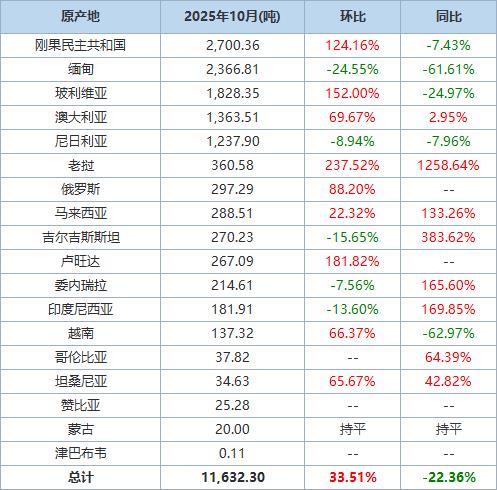
Group 1 - The core point of the article highlights the changes in China's tin ore and concentrate imports for October 2025, showing a month-on-month increase but a year-on-year decrease [1] - In October 2025, China's total imports of tin ore and concentrates reached 11,632.30 tons, reflecting a month-on-month increase of 33.51% but a year-on-year decrease of 22.36% [1] - Imports from the Democratic Republic of the Congo (DRC) saw a significant month-on-month increase of 124.16%, totaling 2,700.36 tons, although this represents a year-on-year decline of 7.43% [1] Group 2 - Tin ore supply from Myanmar is recovering slowly, with imports in October 2025 amounting to 2,366.81 tons, which is a month-on-month decrease of 24.55% and a year-on-year decrease of 61.61% [1]
海关总署:中国10月锡矿砂及其精矿进口量环比增长33.51% 分项数据一览
Wen Hua Cai Jing· 2025-11-21 01:25
Core Insights - In October 2025, China's imports of tin ore and concentrates reached 11,632.30 tons, representing a month-on-month increase of 33.51% but a year-on-year decrease of 22.36% [1] Import Sources - The Democratic Republic of the Congo was the largest source of imports, supplying 2,700.36 tons, which is a significant month-on-month increase of 124.16% but a year-on-year decrease of 7.43% [1] - Myanmar ranked second, with imports of 2,366.81 tons, showing a month-on-month decrease of 24.55% and a year-on-year decrease of 61.61% [1] - Bolivia saw a month-on-month increase of 152.00% in imports, totaling 1,828.35 tons, but a year-on-year decrease of 24.97% [1] - Australia contributed 1,363.51 tons, with a month-on-month increase of 69.67% and a year-on-year increase of 2.95% [1] - Laos experienced a remarkable month-on-month increase of 237.52%, totaling 360.58 tons, and a year-on-year increase of 1258.64% [1] Additional Import Data - Other notable sources include Nigeria (1,237.90 tons, -8.94% MoM, -7.96% YoY), Malaysia (288.51 tons, +22.32% MoM, +133.26% YoY), and Rwanda (267.09 tons, +181.82% MoM) [1] - The total import volume for October 2025 reflects a diverse range of sources, with significant fluctuations in both month-on-month and year-on-year comparisons across different countries [1]
复产缓慢与进口收缩共筑供应壁垒,锡价高位运行有依【文华解读】
Wen Hua Cai Jing· 2025-10-22 09:26
Supply Dynamics - The supply side has been a crucial factor influencing tin prices, with prices surpassing 290,000 yuan due to Indonesia's crackdown on illegal mining, reaching a six-month high [2] - Following the reduction of supply disruptions in Indonesia, tin prices have retreated to around 280,000 yuan, but the market is currently overestimating the price based on valuation lines [2] - China's imports of tin ore and concentrates for September 2025 reached 8,713.60 physical tons (approximately 3,444.62 metal tons), marking a year-on-year decline of 11.87% and a month-on-month decline of 26.59%, the lowest level this year [2] Import Trends - In September, imports from Myanmar increased significantly, with 3,136.76 tons (approximately 848.91 metal tons) imported, reflecting a year-on-year increase of 49.55% and a month-on-month increase of 43.00% [5] - Other major supply countries, including the Democratic Republic of the Congo, Australia, and Nigeria, saw a notable decline in supply, with total imports from these countries down 22.30% year-on-year and 36.66% month-on-month [7] - The decline in imports from the Democratic Republic of the Congo and Australia was attributed to shipping delays rather than a decrease in local production [8] Market Outlook - The overall supply situation remains tight, with domestic tin supply not significantly improving, which continues to restrict the operating levels of smelting enterprises [9] - Despite a seasonal recovery in production expected in October, the motivation for sustained increases in operating rates is lacking due to ongoing tightness in raw material supply and low processing fees [9] - The market is closely monitoring the recovery of production in the Wa region of Myanmar, which is gradually returning to normal, although current output remains below expectations [9]

缅甸复产节奏缓慢 沪锡区间波动【6月25日SHFE市场收盘评论】
Wen Hua Cai Jing· 2025-06-25 07:47
Group 1 - The core viewpoint indicates that tin prices are experiencing fluctuations around the 260,000 yuan per ton mark, with a slight decline of 0.07% in the main contract, closing at 263,000 yuan per ton. The market is currently in a vacuum period with strong supply realities but weak expectations, limiting the upward potential of tin prices [1] - The operating rates of refined tin smelting enterprises in Yunnan and Jiangxi remain low, with a combined operating rate of only 46.84% as of last week. The processing fees for 40% grade tin concentrate in Yunnan have dropped to historical lows, severely squeezing profit margins and forcing some enterprises to reduce production or undergo maintenance [1] - In Jiangxi, there is a shortage of recycled tin raw materials, with the recovery of waste tin post-Spring Festival falling below 70% of the annual average, and electronic waste supply decreasing by 30% month-on-month. This situation is exacerbated by policy uncertainties regarding recycled resources [1] Group 2 - In May 2025, China's imports of tin ore and concentrates reached 13,448.80 physical tons (equivalent to 6,752.11 metal tons), marking a year-on-year increase of 98.56% and a month-on-month increase of 44.70%. However, the import volume remains at historical lows, indicating a slight alleviation of domestic raw material supply shortages [2] - The main increases in imports are concentrated in Africa and South America, particularly from the Democratic Republic of the Congo, Nigeria, and Bolivia. Conversely, imports from Myanmar saw a significant decline, with May figures showing a 37.13% month-on-month decrease and a 32.01% year-on-year decrease [2] - The market outlook suggests a weakening supply and demand scenario, with smelting plants facing reduced operating rates due to insufficient tin concentrate supply. Additionally, the end of the solar market's installation phase may lead to a sharp decline in orders for tin bar manufacturers, making it difficult for tin prices to exhibit a clear trend [2]