
精锡

Search documents
《有色》日报-20260313
Guang Fa Qi Huo· 2026-03-13 01:51
Report Industry Investment Rating - Not provided in the content Core Viewpoints Tin - The short - term market sentiment is volatile, and it is recommended to be cautious. There is still a long - term bullish logic for tin prices, and short - term adjustments may provide opportunities for long - term long positions [3] Copper - In the short - term, due to multiple factors, copper prices are oscillating around 100,000 yuan/ton. In the long - term, the center of copper prices is expected to rise. Short - term adjustments may provide opportunities for long - term long positions [5] Zinc - The zinc fundamentals are generally good. The price downside space may be limited without significant recession risks at the macro level. However, if the downstream production resumption in the peak season fails to meet expectations, the domestic inventory pressure may suppress the upside space [7] Industrial Silicon - The cost increase may strongly support the bottom of industrial silicon prices. In March, supply and demand are expected to be strong. Attention should be paid to the production and sales recovery and cost fluctuations [9] Polysilicon - The polysilicon market is currently oversupplied, but the low - cost photovoltaic power may be beneficial to the long - term development of photovoltaic demand. It is recommended to wait and see for now [10] Aluminum - Alumina prices are expected to continue wide - range oscillations, and short - selling on rallies is recommended. Aluminum prices are expected to oscillate at high levels in the short - term, and the long - term bullish logic remains unchanged [11] Nickel - The overseas macro uncertainty increases, and the raw material end contradictions support the price. The demand has improved slightly, but high inventory restricts the price increase. The disk is expected to oscillate strongly [12] Stainless Steel - The overseas macro risk uncertainty increases, the raw material end is tight, and the cost supports the price. The supply and demand are in a continuous game, and the short - term is expected to oscillate and adjust [16] Lithium Carbonate - The macro risk persists, and the fundamentals maintain resilience but lack strong drivers. The disk is expected to oscillate widely around the macro expectations, and it is recommended to wait and see for now [19] Aluminum Alloy - The short - term market will continue to oscillate in the context of weak supply and demand. The key turning points of the market lie in the downstream production resumption rhythm, order recovery, and scrap aluminum circulation improvement [21] Summary by Directory Tin Price and Spread - The price of Yangtze River 1 tin is 394,000 yuan/ton, down 1,350 yuan or 0.34%. The LME 0 - 3 spread is 400, up 40.00%. The import profit and loss is - 8,294.19 yuan/ton, up 870.91 yuan or 9.50%. The Shanghai - London ratio is 7.89 [1] Fundamental Data - In December, the tin ore import volume was 17,637 tons, up 16.81% month - on - month. In February, the SMM refined tin output was 11,490 tons, down 23.91% month - on - month [2] Inventory - The SHEF weekly inventory is 11,663 tons, down 4.82%. The social inventory is 13,082 tons, down 0.21%. The SHEF daily warehouse receipt is 12,360 tons, up 23.22%. The LME daily inventory is 8,630 tons, up 0.29% [3] Copper Price and Spread - The SMM 1 electrolytic copper price is 100,670 yuan/ton, down 0.64%. The SMM 1 electrolytic copper spread is 82 yuan/ton, up 40 yuan [5] Fundamental Data - In February, the electrolytic copper output was 114.24 million tons, down 3.13% month - on - month. In December, the electrolytic copper import volume was 26.02 million tons, down 4.02% month - on - month [5] Inventory - The domestic social inventory is 57.39 million tons, down 0.57%. The bonded area inventory is 0 million tons, down 100%. The SHFE inventory is 42.51 million tons, up 8.59% [5] Zinc Price and Spread - The SMM 0 zinc ingot price is 24,310 yuan/ton, up 0.08%. The import profit and loss is - 2,665 yuan/ton, up 82.05 yuan [7] Fundamental Data - In February, the refined zinc output was 50.46 million tons, down 9.99% month - on - month. In December, the refined zinc import volume was 0.88 million tons, down 51.94% month - on - month [7] Inventory - The Chinese zinc ingot seven - region social inventory is 26.88 million tons, up 4.88%. The LME inventory is 0.02 million tons, down 0.15% [7] Industrial Silicon Price and Spread - The price of East China oxygen - passing SI5530 industrial silicon is 9,200 yuan/ton, unchanged. The price of South China SI4210 industrial silicon is 9,600 yuan/ton, unchanged [9] Fundamental Data - The national industrial silicon output is 27.57 million tons, down 26.58% month - on - month. The national operating rate is 38.02%, down 21.33% month - on - month [9] Inventory - The Xinjiang factory warehouse inventory is 13.98 million tons, up 0.58%. The social inventory is 55.20 million tons, down 0.18% [9] Polysilicon Price and Spread - The average price of N - type re -投料 is 46,000 yuan/ton, down 2.65%. The主力 contract price is 42,760 yuan/ton, up 0.40% [10] Fundamental Data - The weekly polysilicon output is 1.90 million tons, up 1.06%. The monthly polysilicon output is 7.70 million tons, down 23.61% [10] Inventory - The polysilicon inventory is 35.70 million tons, up 2.59%. The silicon wafer inventory is 28.35 million tons, down 2.28% [10] Aluminum Price and Spread - The SMM A00 aluminum price is 25,260 yuan/ton, up 0.92%. The import profit and loss of electrolytic aluminum is - 3,974 yuan/ton, down 3368 yuan [11] Fundamental Data - In February, the alumina output was 660.02 million tons, down 10.63% month - on - month. The domestic electrolytic aluminum output was 346.00 million tons, down 8.91% month - on - month [11] Inventory - The Chinese electrolytic aluminum social inventory is 129.40 million tons, up 3.03%. The LME inventory is 44.7 million tons, down 0.63% [11] Nickel Price and Spread - The SMM 1 electrolytic nickel price is 140,950 yuan/ton, up 0.86%. The 1 Jinchuan nickel price is 144,350 yuan/ton, up 0.80% [12] Fundamental Data - The Chinese refined nickel output is 32,600 tons, down 7.45% month - on - month. The refined nickel import volume is 23,394 tons, up 84.63% [12] Inventory - The SHFE inventory is 61,769 tons, up 1.61%. The social inventory is 84,537 tons, up 10.45%. The LME inventory is 286,248 tons, down 0.29% [12] Stainless Steel Price and Spread - The price of 304/2B (Wuxi Hongwang 2.0 coil) is 14,450 yuan/ton, unchanged. The price of 304/2B (Foshan Hongwang 2.0 coil) is 14,350 yuan/ton, unchanged [16] Fundamental Data - The Chinese 300 - series stainless steel crude steel output (43 companies) is 190.08 million tons, up 44.07% month - on - month. The stainless steel import volume is 14.50 million tons, up 29.32% [16] Inventory - The 300 - series social inventory (Wuxi + Foshan) is 53.21 million tons, down 1.19%. The SHFE warehouse receipt is 5.13 million tons, down 0.34% [16] Lithium Carbonate Price and Spread - The SMM battery - grade lithium carbonate average price is 158,000 yuan/ton, down 0.63%. The SMM industrial - grade lithium carbonate average price is 154,500 yuan/ton, down 0.80% [19] Fundamental Data - In February, the lithium carbonate output was 83,090 tons, down 15.13% month - on - month. The lithium carbonate demand was 111,503 tons, down 10.57% [19] Inventory - The lithium carbonate total inventory in February was 28,323 tons, down 4.76%. The lithium carbonate downstream inventory was 39,997 tons, down 5.01% [19] Aluminum Alloy Price and Spread - The SMM aluminum alloy ADC12 price is 25,200 yuan/ton, up 0.40%. The Foshan crushed raw aluminum refined - scrap spread is 3,066 yuan/ton, up 11.45% [21] Fundamental Data - In February, the recycled aluminum alloy ingot output was 35.80 million tons, down 41.31% month - on - month. The primary aluminum alloy ingot output was 20.93 million tons, down 30.99% [21] Inventory - The recycled aluminum alloy ingot weekly social inventory is 3.91 million tons, down 5.56%. The recycled aluminum alloy factory finished product inventory is 13.60 million tons, down 8.11% [21]
对话专家-锡市暗流涌动-真实缺口有多大
2026-03-04 14:17
Summary of Key Points from Conference Call Records Industry Overview - The conference call primarily discusses the tin mining industry, focusing on supply constraints, geopolitical risks, and market dynamics affecting tin prices and production levels [1][3][4]. Core Insights and Arguments Supply Constraints - Tin supply is constrained, with Myanmar's Wa State production recovery below expectations, achieving only 60%-70% of pre-ban capacity due to regulatory hurdles and profit-sharing issues [1][6]. - The global third-largest tin mine, Bisie in the Democratic Republic of Congo (DRC), is affected by M23 armed conflict, leading to unmet production targets for 2025 and limited growth in 2026 [1][8]. - China's tin import structure has shifted dramatically, with Myanmar's share dropping from 80% to less than 30%, while the DRC has become the largest supplier at 28% [1][10]. Profitability and Cost Pressures - Smelting profits are under pressure due to low Treatment Charges (TC), with some small to medium enterprises reducing or halting production [1][3][13]. - The cost of tin mining in Wa State has increased to 190,000-310,000 CNY per ton, with declining ore grades supporting a long-term cost increase [2][19]. Demand Dynamics - Demand is structurally diverging, with traditional sectors like construction suffering from declining sales, while emerging sectors like AI and semiconductors have not yet fully compensated for this decline [1][3][14]. - A slight global tin deficit of 5,000-7,000 tons is expected to persist through 2025-2026 [1][19]. Additional Important Insights Geopolitical Risks - The geopolitical situation in the DRC remains unstable, with ongoing conflicts affecting production and supply chain stability [8][9]. - The M23 conflict has led to temporary disruptions in mining and processing activities, although the overall impact on the Bisie mine has been limited [9][10]. Regulatory Changes - The Wa State has undergone significant regulatory changes, transitioning from a complete mining ban to partial reopening and tax reforms that have altered export tax structures [5][6]. - The new tax regime has removed restrictions on export grades, allowing for higher quality exports without additional tax burdens [5]. Inventory and Market Sentiment - Domestic tin inventories are currently high due to the realization of "hidden inventories" and delivery of hedged short positions, rather than a reflection of weak demand [2][18][23]. - The market sentiment is influenced by geopolitical risks and supply chain costs, which may overshadow traditional inventory-demand relationships [23]. Future Outlook - The recovery of tin production in Myanmar and the DRC's ability to meet production targets will be critical in determining the supply-demand balance in the coming years [19]. - The potential for increased production from secondary resources (recycled tin) is limited due to economic pressures on recycling operations [20]. This summary encapsulates the key points discussed in the conference call, highlighting the challenges and dynamics within the tin mining industry.
锡业分会:2025年我国进口锡精矿微增约2% 精锡贸易呈现净出口
智通财经网· 2026-01-21 01:29
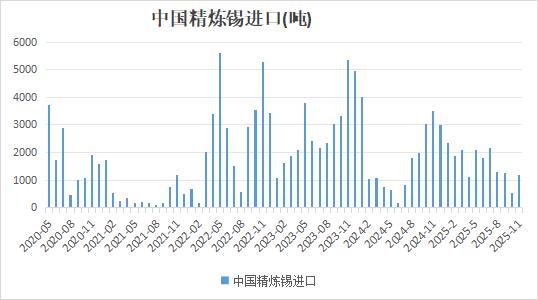
Core Viewpoint - The China Nonferrous Metals Industry Association's Tin Branch reported significant growth in tin ore imports and exports for December 2025, indicating a robust demand and trade activity in the tin market [1] Import Data - In December 2025, China imported 17,637 tons of tin ore, equivalent to 5,191.6 tons of metal, representing a month-on-month increase of 13.3% and a year-on-year increase of 40.2% [1] - Major import sources included Africa (2,375 tons, down 11.1%), Myanmar (993 tons, up 14.3%), Australia (912 tons, up 91.5%), and South America (426 tons, up 118.5%) [1] - Total tin ore imports for 2025 reached 295,000 tons, with a metal equivalent of 53,000 tons, reflecting a slight year-on-year increase of 1.7% [1] Refined Tin Trade - In December, refined tin imports and exports both saw growth, with imports at 1,548 tons, a month-on-month increase of 29.5% but a year-on-year decrease of 48.2% [1] - The primary sources for refined tin imports were Peru (678 tons), Indonesia (636 tons), and Bolivia (148 tons), collectively accounting for 94.5% of total imports [1] - Refined tin exports reached 2,763 tons, marking a month-on-month increase of 43.3% and a year-on-year increase of 32.6%, with active re-export trade to Hong Kong [1] - Total refined tin imports for 2025 amounted to 19,000 tons, a year-on-year decrease of 10.7%, while total exports reached 23,000 tons, a year-on-year increase of 32.3%, resulting in a net export of nearly 3,500 tons for the year [1]
全球宏观预期偏暖 后市锡价中枢或有望维持高位
Jin Tou Wang· 2026-01-13 06:11
Group 1 - The core viewpoint indicates that the strong performance of tin futures is supported by increased imports and stable domestic production, with the main contract reaching 381,800.00 yuan/ton, a rise of 4.80% [1] - In November, China imported 15,099 tons of tin ore, a year-on-year increase of 24.43%, marking the highest monthly import since March 2024, with Myanmar contributing 7,190 tons, also a new high since March 2024 [1] - Domestic refined tin production in December was 15,895 tons, a month-on-month increase of 2.61%, with a total annual output of 174,400 tons, reflecting a cumulative decrease of 1.65% [1] Group 2 - Citic Futures anticipates that the weak dollar and the commencement of China's 14th Five-Year Plan will provide clear support for tin prices, with expectations of maintaining high price levels in the future [3] - The firm notes that while macroeconomic sentiment may drive prices to new highs, there are concerns about potential selling pressure as prices approach historical peaks, and the actual supply may face risks due to the fragility of overseas mining operations [3] - Newhu Futures highlights that the cancellation of export tax rebates for photovoltaic components may lead to a temporary surge in exports and production, but the actual impact on tin consumption remains uncertain [3]


金属锡工艺品摆件创意有哪些?金属锡工业原料有哪些?
Xin Lang Cai Jing· 2025-12-25 11:10
Group 1 - The metal tin is experiencing a unique "dual life" in 2025, serving both as a cultural product in the consumer market and as a critical industrial material in the global supply chain [1] - The transformation of tin crafts has shifted from mere decoration to a blend of "practical aesthetics" and "emotional interaction," appealing to modern consumers [1][2] - Innovative designs such as "mortise and tenon tin art" have emerged, allowing for customizable and interactive products that resonate with traditional craftsmanship [2] Group 2 - The demand for tin, particularly solder tin, has surged due to the rapid growth in global photovoltaic installations and electric vehicle production, highlighting its essential role in the energy transition [3] - The industrial sector is increasingly focusing on high-value custom orders, driven by the unexpected popularity of cultural products, while also adapting to stricter environmental regulations [3] - Recycling technologies for tin are gaining attention as a means to address resource and environmental pressures, enabling efficient extraction from electronic waste and industrial residues [3][5] Group 3 - The tin industry encompasses a complete value chain from resource acquisition to refined products, with the primary raw material being tin ore, which is processed into refined tin with a purity of over 99.9% [4] - Most refined tin is alloyed to create functional materials tailored for various industrial applications, such as lead-free solder alloys for electronics and bronze for wear-resistant parts [4] - Recycled tin is becoming increasingly important in green manufacturing, sourced from electronic waste and achieving electronic-grade quality, thus supporting supply chain resilience and circular economy practices [5] Conclusion - The resilience of tin as a metal is evident in its ability to adapt to modern demands, merging cultural significance with industrial necessity, and showcasing a potential for similar transformations in other traditional materials [5]

海关总署:11月精锡进口维持低位 出口小幅增长
Wen Hua Cai Jing· 2025-12-23 06:38
Group 1 - In November 2025, China's refined tin imports amounted to 1,195 tons, representing a year-on-year decrease of 66.05% and a month-on-month increase of 127.04% [1] - The total refined tin imports for China from January to November 2025 reached 17,700 tons [1] - The November import window was largely closed, with most of the imported tin coming from previous unilateral orders made by traders on the LME tin market, resulting in limited actual quantities [1] Group 2 - In November 2025, China exported 1,946 tons of refined tin, which is a year-on-year increase of 33.57% and a month-on-month increase of 31.46% [1] - The exports were primarily for processing trade, with major destinations including the Netherlands, South Korea, India, and Japan [1] - From January to November 2025, China's total refined tin exports reached 20,000 tons, reflecting a year-on-year growth of 32.41%, with a cumulative net export of 2,298 tons [1]
期货看“五”评 | 价格再创短期新高,如何看待锡价后续走势?
Sou Hu Cai Jing· 2025-12-12 02:09
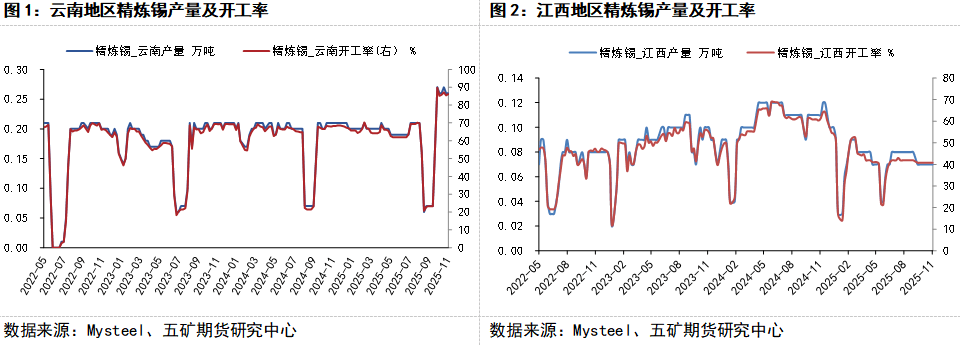
Supply Side - In October 2025, domestic tin ore imports increased to 11,600 tons (approximately 5,050 metal tons), a month-on-month rise of 33.49% but a year-on-year decline of 22.54% [1] - Cumulative imports from January to October reached 103,000 tons, reflecting a year-on-year decrease of 26.23% [1] - Tin ingot imports in October were 526 tons, down 58.55% month-on-month and 82.72% year-on-year, with cumulative imports for the year at 16,552 tons, showing a year-on-year increase of 10.84% [1] - Imports from Congo (DRC) showed a recovery, while imports from Myanmar slightly declined but are expected to increase by over 2,000 tons in November due to mining permit approvals [1] Production Side - November's refined tin production is expected to remain stable, with Yunnan and Jiangxi's smelting enterprises maintaining high operating rates [2] - Yunnan's large smelting plants have resumed operations after seasonal maintenance, while Jiangxi faces a shortage of recycled raw materials, leading to lower production levels [2] - Overall, production recovery is constrained by raw material supply bottlenecks and weak demand, with no significant short-term increase in operating levels anticipated [2] Demand Side - The semiconductor industry continues to show resilience, with tin solder enterprises maintaining stable operating rates; November production increased by 0.95% month-on-month [4] - Southern China’s tin solder manufacturers are performing better due to their integration into emerging sectors like automotive and AI servers, which have robust order expectations [4] - In contrast, Eastern China’s tin solder enterprises are facing pressure due to slower order recovery in traditional consumer electronics, leading to weaker trading sentiment [4] Price Outlook - The tin market is currently in a tight balance, with improved supply from increased domestic imports in October, although concerns remain due to worsening conflicts in Congo affecting transport [10] - Traditional sectors like consumer electronics show signs of fatigue, while long-term demand from new sectors like electric vehicles and AI servers supports tin prices [10] - As Myanmar's tin ore supply gradually increases and demand weakens slightly, the supply-demand situation is expected to improve, potentially putting pressure on tin prices [10]
国内库存明显增加 短期锡价缺乏持续上冲动能
Jin Tou Wang· 2025-12-10 08:04
Group 1 - The domestic futures market for non-ferrous metals saw significant declines, with Shanghai tin futures experiencing fluctuations, reaching a high of 324,210.00 CNY/ton and a low of 312,350.00 CNY/ton, resulting in a 2.22% increase [1] - A survey of 20 domestic tin smelting plants indicates that the refined tin output for November 2025 is projected to be 15,490 tons, reflecting a month-on-month decrease of 0.82% and a year-on-year decrease of 6% [2] - The operating rate of smelting plants in November was reported at 61.14%, indicating a cautious production environment [2] Group 2 - As of December 9, LME tin inventory recorded 3,050 tons, a decrease of 25 tons or 0.81% from the previous day, with a cumulative decrease of 95 tons or 3.02% over the past week [2] - The Shanghai Futures Exchange reported a tin warehouse receipt of 7,237 tons on December 9, which is a decrease of 29 tons from the previous trading day [2] - Market sentiment is cautious ahead of the Federal Reserve's meeting, with expectations of a 25 basis point rate cut, but any signs of a slowdown in the rate cut pace for 2026 could negatively impact risk assets [2][3] Group 3 - The ongoing armed conflict in eastern Congo has not shown signs of easing, which has already been priced into the market, with no substantial impact on production yet [3] - High tin prices are further suppressing consumption, leading to a continuous increase in social inventory, indicating a lack of upward momentum for tin prices in the short term [3] - The market is expected to maintain a high-level slight adjustment for tin prices while awaiting further guidance [3]
《有色》日报-20251114
Guang Fa Qi Huo· 2025-11-14 02:34
1. Report Industry Investment Ratings No industry investment ratings are provided in the reports. 2. Core Views Zinc - The fundamentals and macro - environment have limited changes. The supply is generally loose, and the subsequent supply pressure may be limited due to the decline in smelting profits. The demand is average, and the domestic zinc ingot remains at a discount. The LME zinc has upward pressure, while the export window of zinc ingots may boost the domestic zinc price. The Shanghai - London ratio may be repaired, with the main contract referring to 22300 - 23000 [2]. Copper - After the implementation of interest - rate cuts and tariffs, the market may enter a macro "vacuum period" in November. The supply of copper ore is in short supply, and the downstream demand has strong resilience. The medium - and long - term supply - demand contradiction supports the upward movement of the copper price bottom. The main contract refers to 86500 - 88000 [4]. Tin - The supply of tin ore is tight, and the demand shows regional differentiation. The fundamentals are strong, and long positions should be held. Attention should be paid to macro - level changes and the supply recovery in Myanmar [7]. Aluminum - The alumina market is in a state of loose supply and demand, and the price is expected to maintain a weak shock pattern. The electrolytic aluminum market is driven by the macro - environment, but the fundamentals are weak. The aluminum price will fluctuate between macro - level benefits and weak fundamentals in the short term, and attention should be paid to the risk of high - level callback [9]. Aluminum Alloy - The cost of aluminum alloy is strongly supported, and the demand is differentiated. The inventory is accumulating. The ADC12 price is expected to maintain a strong shock pattern, with the main contract referring to 20800 - 21400 [11]. Nickel - The nickel market is in a state of long - short interweaving. The refined nickel production is at a high level, and the supply of nickel ore is generally stable. The nickel - iron price is under pressure, and the stainless - steel demand is weak. The nickel price is expected to maintain a weak shock pattern, with the main contract referring to 118000 - 124000 [13]. Stainless Steel - The stainless - steel market is in a weak shock state. The macro - level drive is weakened, the nickel - ore market is temporarily stable, and the nickel - iron price is under pressure. The supply is under pressure, and the demand is insufficient. The price is expected to continue to be weak and volatile, with the main contract referring to 12400 - 12800 [16]. Lithium Carbonate - The lithium carbonate market is running strongly. The supply is increasing, and the demand is optimistic. The short - term supply and demand are expected to increase simultaneously, but attention should be paid to the sustainability of demand improvement. The price may fluctuate and adjust in the short term [17]. Industrial Silicon - The industrial silicon spot price is stable, and the futures price is falling. If the organic silicon enterprises cut production, the inventory pressure will increase. The price is expected to fluctuate at a low level, with the main price range being 8500 - 9500 [18]. Polysilicon - The polysilicon spot price is stable, and the futures price is rising. The supply and demand are both weak. The price is expected to fluctuate in a high - level range. Attention should be paid to the support of the spot price and the digestion of warehouse receipts [19]. 3. Summaries According to Relevant Catalogs Zinc - **Price and Spread**: The SMM 0 zinc ingot price increased by 0.09% to 22630 yuan/ton, and the import loss was - 4587 yuan/ton. The Shanghai - London ratio decreased to 7.36 [2]. - **Fundamental Data**: In October, the refined zinc output was 61.72 million tons, a month - on - month increase of 2.85%. The galvanizing and other开工 rates showed different changes [2]. Copper - **Price and Basis**: The SMM 1 electrolytic copper price increased by 0.48% to 87210 yuan/ton, and the import loss was - 827 yuan/ton [4]. - **Fundamental Data**: In October, the electrolytic copper output was 109.16 million tons, a month - on - month decrease of 2.62%. The copper rod and other开工 rates increased [4]. Tin - **Spot Price and Basis**: The SMM 1 tin price increased by 1.72% to 296000 yuan/ton, and the import loss was - 15428.41 yuan/ton [7]. - **Fundamental Data (Monthly)**: In September, the tin ore import decreased by 15.13%, and the SMM refined tin output in October increased by 53.09% [7]. Aluminum - **Price and Spread**: The SMM A00 aluminum price increased by 1.15% to 21920 yuan/ton, and the alumina price in some regions decreased slightly [9]. - **Fundamental Data**: In October, the alumina output was 778.53 million tons, a month - on - month increase of 2.39%, and the electrolytic aluminum output was 374.21 million tons, a month - on - month increase of 3.52% [9]. Aluminum Alloy - **Price and Spread**: The SMM ADC12 price increased by 0.70% to 21650 yuan/ton, and the scrap - to - refined aluminum price difference in some regions increased [11]. - **Fundamental Data**: In October, the recycled aluminum alloy ingot output decreased by 2.42%, and the primary aluminum alloy ingot output increased by 1.06% [11]. Nickel - **Price and Basis**: The SMM 1 electrolytic nickel price increased by 0.17% to 120650 yuan/ton, and the import loss was - 1765 yuan/ton [13]. - **Supply and Inventory**: The domestic refined nickel output increased, and the LME inventory decreased by 0.47% [13]. Stainless Steel - **Price and Spread**: The 304/2B (Wuxi Hongwang 2.0 coil) price increased by 0.39% to 12750 yuan/ton, and the nickel - iron price decreased by 0.22% [16]. - **Fundamental Data**: The 300 - series stainless - steel crude steel output in China increased by 0.38%, and the social inventory increased by 1.73% [16]. Lithium Carbonate - **Price and Basis**: The SMM battery - grade lithium carbonate price increased by 1.26% to 84350 yuan/ton, and the lithium spodumene concentrate price increased by 1.73% [17]. - **Fundamental Data**: In October, the lithium carbonate output was 92260 tons, a month - on - month increase of 5.73%, and the demand increased by 8.70% [17]. Industrial Silicon - **Spot Price and Basis**: The East China oxygen - containing S15530 industrial silicon price remained unchanged at 9500 yuan/ton, and the basis increased [18]. - **Fundamental Data (Monthly)**: The national industrial silicon output was 45.22 million tons, a month - on - month increase of 7.46%, and the social inventory decreased by 1.09% [18]. Polysilicon - **Spot Price and Basis**: The N - type re - feed material average price remained unchanged at 52150 yuan/ton, and the N - type silicon wafer price was stable [19]. - **Fundamental Data**: The polysilicon output was 13.40 million tons, a month - on - month increase of 3.08%, and the inventory increased by 3.09% [19].
锡月报:短期供需紧平衡,关注缅甸复产进展-20251107
Wu Kuang Qi Huo· 2025-11-07 14:37
1. Report Industry Investment Rating - No relevant content provided 2. Core View of the Report - The supply of tin ore is currently tight, with slow resumption of production in Myanmar's Wa State. Although the mining permits have been approved, the export volume of tin ore is still far below the normal level, and the supply gap cannot be effectively filled. The long - term demand expectations from emerging fields such as new energy vehicles and AI servers support the tin price. It is expected that the tin price will remain stable or have a slight rebound [12][13]. 3. Summary by Directory 3.1 Monthly Assessment and Strategy Recommendation - Cost side: The mining permits in Myanmar's Wa State have been approved, but the resumption of production is slow. It is expected that the supply of tin ore will significantly recover in the fourth quarter. In September 2025, China's imported tin concentrate physical volume was 8714 tons, a significant decline from the previous month. The import volume from countries like Congo (Kinshasa) decreased due to shipping, but it is at a normal level. The import volume from Myanmar is increasing, and short - term supply shows improvement [12]. - Supply side: The resumption of tin mining in Myanmar's Wa State is slow and difficult to increase production before November. The raw material shortage in Yunnan's smelting enterprises persists, and the tin concentrate processing fee (TC) in Yunnan remains low. In Jiangxi, the supply of crude tin is insufficient due to a significant reduction in scrap, and the refined tin output remains low. The raw material inventory of domestic smelters is generally less than 30 days, and some enterprises carried out maintenance in September, with capacity utilization likely to remain low [12]. - Demand side: Traditional fields such as consumer electronics and tinplate show weak consumption, but emerging fields like new energy vehicles and AI servers provide long - term demand support for the tin price. In the peak season of October, the operating rate of domestic tin solder enterprises showed a slight recovery. Downstream enterprises mainly replenish inventory at low prices. As of the end of October, the total social inventory of major tin ingots in China was 7698 tons, a decrease of 654 tons from September [12]. - Conclusion: In October, the tin price fluctuated mainly following the non - ferrous metal sector. The supply tension supports the tin price, and it is expected to remain stable or have a slight rebound [12][13]. 3.2 Futures and Spot Market - No specific text summary content provided, only relevant charts such as the basis of Shanghai tin main contract and LME tin premium (0 - 3) are presented [19] 3.3 Cost Side - The short - term supply of tin ore is generally tight, and the processing fee remains low [26]. 3.4 Supply Side - No specific text summary content provided, only relevant charts such as domestic refined tin monthly output, domestic recycled tin monthly output, tin output and operating rate in Yunnan and Jiangxi regions, refined tin export and import profits, domestic refined tin import volume, and Indonesia's refined tin import and export are presented [30][32][35] 3.5 Demand Side - Semiconductor sales: China's semiconductor sales growth rate rebounded slightly, and global semiconductor sales maintained high growth [44]. - Consumer electronics: The production of domestic computers and smartphones is presented in charts, but no specific text summary is provided [46]. - Household appliances: The production of household appliances such as washing machines, air conditioners, refrigerators, and color TVs is presented in charts, but no specific text summary is provided [48][50]. - Photovoltaic: The production of photovoltaic cells and cumulative photovoltaic installation in China are presented in charts, but no specific text summary is provided [52]. - Other fields: Tin consumption in the tinplate field continues to decline as aluminum cans have almost completely replaced tinplate cans in the beverage packaging field. PVC production increased slightly year - on - year in the first half of the year, and PVC stabilizers are a major consumer of tin compounds [55]. - Downstream enterprises: The operating rate of downstream solder enterprises and domestic apparent tin consumption are presented in charts, but no specific text summary is provided [57]. 3.6 Supply - Demand Balance - No specific text summary content provided, only relevant charts such as China's social inventory and LME inventory are presented [61]