
闲鱼平台

Search documents
闲鱼平台惊现“代坐”服务:二手平台的边界与治理难题
Xi Niu Cai Jing· 2026-01-13 13:44
Group 1 - A recent incident on the Xianyu platform involved users offering "seat reservation" services on Shanghai Metro lines for a fee of 1.99 yuan, which has sparked widespread discussion [1] - Xianyu's customer service has acknowledged the situation and stated that it will be reported to relevant departments for investigation [1] Group 2 - Xianyu, as a leading second-hand trading platform in China, transitioned from a free model to charging a 1% service fee for high-frequency sellers in 2023, with plans to expand this to all sellers at a 0.6% fee starting September 2024 [4] - The platform has faced controversies that have affected user trust, including a data security breach involving a user operations manager who was dismissed for violating company policies [4] - Refund disputes have arisen, such as a case where a user complained about the platform's unclear stance on refund policies for unused movie tickets [4] Group 3 - A significant controversy arose regarding the use of Xianyu coins after a feature upgrade in April 2025, which changed the rules for how sellers receive payments, leading to confusion and dissatisfaction among sellers [5] - The platform's rapid commercialization has not been matched by its governance capabilities, leading to issues such as the recent "seat reservation" service and previous concerns over hidden services and disputes [6] - The transition from a non-profit model to one with revenue targets has increased operational costs for sellers, highlighting the need for a better balance between platform growth, seller rights, and buyer experience [6]


闲鱼跨界破局:从闲置流转到多元业态
Sou Hu Cai Jing· 2026-01-10 11:59
Core Insights - Xianyu has transformed from a platform focused on second-hand goods to a diverse incubator for various innovative business models, expanding its operational boundaries significantly [1] - The total registered user base of Xianyu has surpassed 600 million, with users born after 1995 and 2000 accounting for 43% and 22% respectively, becoming the core driving force behind the platform's growth [1] - Despite its growth, Xianyu faces multiple challenges, including an unclear profit path, an immature content operation system, and persistent issues like counterfeit goods and after-sales disputes that hinder sustainable development [1] Revenue Model and User Engagement - Xianyu is gradually implementing a strategy to charge a basic service fee to all sellers, linking revenue growth to user scale and transaction activity [3] - The platform aims to attract more users to participate in transactions to achieve steady revenue growth [3] Offline Expansion and Service Improvement - Xianyu is actively expanding its offline business by establishing community service stores in various cities, enhancing user service experience and gaining insights into consumer demand [3] - These offline stores are expected to help optimize the service system and further explore new user groups [3] Challenges in Non-standard Goods Trading - The non-standard goods trading sector faces issues such as information opacity and lack of unified quality assessment standards, facilitating the influx of counterfeit products [3] - The large-scale entry of professional sellers has exacerbated the counterfeit problem, while systemic shortcomings in after-sales processes leave users in a "rights protection dilemma" during transaction disputes [3] Trust and Transaction Framework - To address these challenges, Xianyu needs to reconstruct the underlying logic of transaction trust by establishing a comprehensive responsibility closure system [3] - This includes seller qualification verification, rapid dispute response mechanisms, and efficient complaint handling channels, aiming to create a service framework that ensures every transaction is based on demand, trust, and efficiency [3]

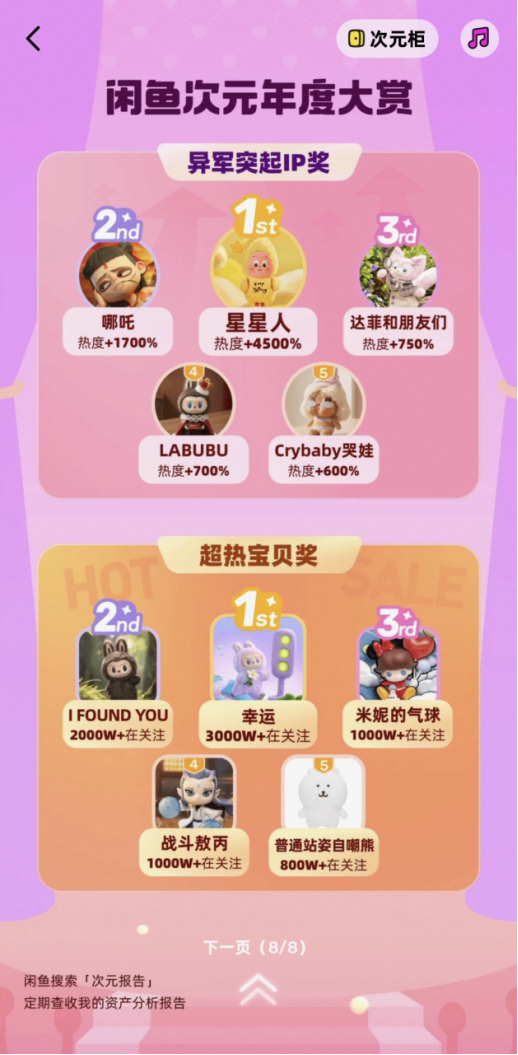
闲鱼次元年度报告发布:二次元用户突破1.6亿,“LABUBU幸运”登顶年度超热宝贝
Jin Rong Jie Zi Xun· 2026-01-09 06:34
Core Insights - The "2025 Xianyu Dimension Annual Report" reveals a significant growth in the platform's two-dimensional user base, surpassing 160 million users by the end of 2025, with a 47% year-on-year increase in annual two-dimensional consumers, establishing Xianyu as a primary platform for youth interest-based consumption [1] User Behavior - Two-dimensional users on Xianyu show peak purchasing activity after work hours and late at night, with many users placing orders as late as 11 PM. Additionally, users demonstrate a strong "recovery" ability, with an average annual sale of two-dimensional items generating 2,541 yuan and an average two-dimensional appreciation income of 282 yuan, creating a unique cycle of interest-based consumption [1] Market Trends - The report highlights the most active trading categories within the two-dimensional community, including trendy blind boxes, plush toys, and various merchandise, with trendy blind boxes experiencing a remarkable 250% increase in order volume year-on-year, indicating robust community engagement [1] Awards and Recognition - The first "Xianyu Dimension Annual Awards" showcased the evolving trends in the two-dimensional consumption market, with notable IPs like LABUBU and Nezha receiving accolades for their rapid order volume growth. The "Hottest IP Award" recognized top IPs such as LABUBU and the Time Youth Team, reflecting the highest trading popularity on the platform [2] User Engagement - Following the report's release, a wave of social media activity emerged, with users sharing their annual spending experiences, highlighting a willingness to invest significantly in their interests while also achieving asset appreciation through strategic purchases [4] Personalization Features - The report introduces personalized tags for users based on their consumption behavior, allowing them to connect with classic two-dimensional characters and share their identities within the community. Users can access their annual consumption history by searching for "Dimension Report" on Xianyu [6]

马云养的闲鱼,正变异为一条“食人鱼”
商业洞察· 2026-01-03 09:21
Core Viewpoint - The article discusses the transformation of Xianyu from a user-friendly second-hand trading platform to one that imposes hidden fees on sellers, reflecting a shift from its original community-driven ethos to a profit-driven model [4][21]. Group 1: Hidden Traps - Sellers on Xianyu have reported being charged a 10% fee under the "Xianyu Alliance Promotion Service" without their knowledge, leading to significant deductions from their sales [7][9]. - The process for opting into these fees is designed to be obscure, with sellers facing obstacles when trying to opt out, which has been labeled as "obvious霸王条款" (unfair terms) [8][11]. - Complaints about these hidden charges are prevalent on consumer complaint platforms, indicating a widespread issue among users [9][11]. Group 2: Deterioration of Original Intent - Xianyu was founded in 2014 with a vision of being a free and open marketplace, initially not charging commissions and allowing easy transactions [13][15]. - Over time, the platform's commitment to not charging fees has been abandoned, with the introduction of service fees starting in June 2023, marking a shift towards monetization [16][17]. - The recent issues with hidden fees highlight a broader trend of the platform prioritizing revenue generation over user transparency and satisfaction [17]. Group 3: Commercialization Challenges - Xianyu's aggressive commercialization reflects Alibaba's overall strategic adjustments, with the platform being designated as a "strategic innovation business" in November 2023 [19][21]. - The community atmosphere that once defined Xianyu is being diluted by the presence of professional sellers and brands, leading to a crisis in its original community culture [21]. - The shift from a community-focused platform to one driven by GMV (Gross Merchandise Volume) metrics raises concerns about the erosion of user rights and the platform's foundational values [21].

闲鱼青年新职业趋势研究报告发布,四成从业者副业收入占比超30%
Jin Rong Jie Zi Xun· 2025-12-26 07:59
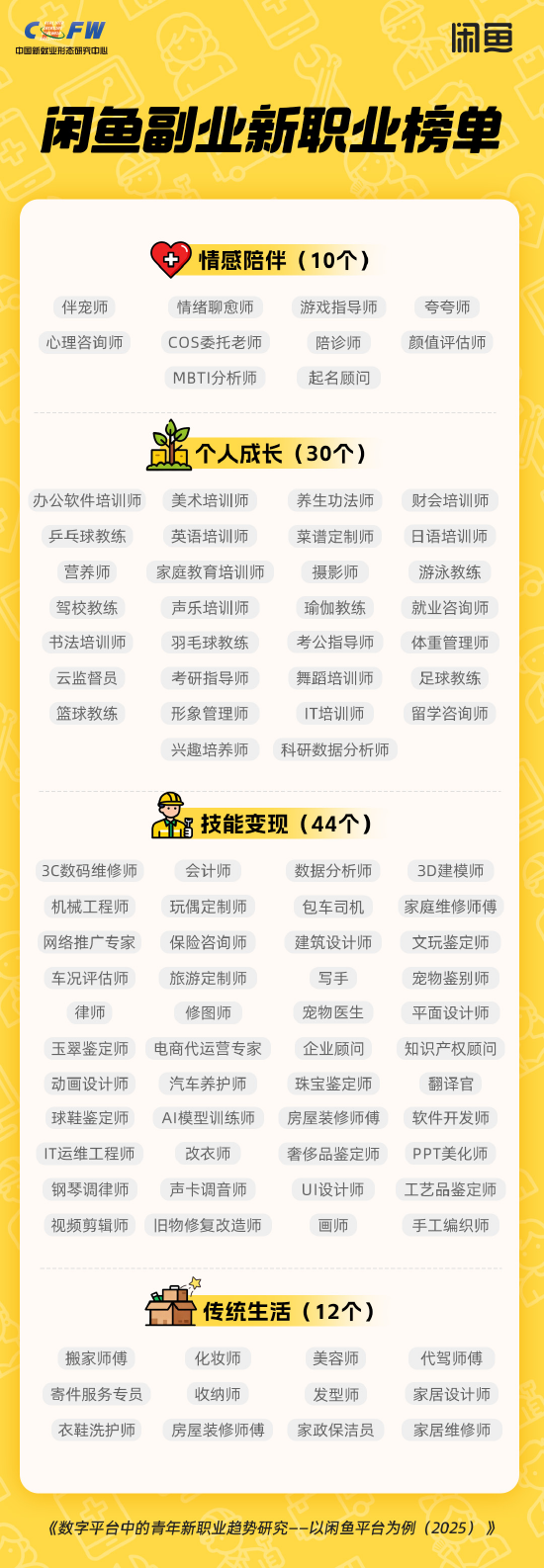
Core Insights - The report highlights a shift in the employment perspective of contemporary youth from seeking "long-term stable positions" to accepting "flexible and diverse employment" opportunities, with platforms like Xianyu serving as incubators for new professions and important grounds for youth employment and entrepreneurship [1] Group 1: Employment Trends - Nearly 19.62 million sellers have published skill services on Xianyu in the past year, with those born after 2000 accounting for 41% of this group [2] - High-educated, non-student youth are active in side jobs, with an average annual income of 4,317 yuan for active side job workers, indicating a significant economic supplementary effect [2] - Over 41% of side job workers earn more than 30% of their monthly income from these activities, with about 30% working 30 hours per week, resembling part-time or secondary jobs [4] Group 2: New Professions - The platform has seen the emergence of new professions in three main directions: personal growth, emotional companionship, and skill monetization, with all three categories experiencing over 100% year-on-year growth in order volume [6] - The report lists 96 new professions, including promising roles such as companion doctors, pet companions, and weight management coaches, which are expected to be included in the National Occupational Classification [6][9] - The demand for personalized learning paths and emotional support services is rapidly increasing, as evidenced by the growth of emotional companionship orders by 107.41% [6] Group 3: Platform Role and Recommendations - Xianyu serves as a unique platform for supporting youth side jobs, providing a natural laboratory for task-oriented, flexible, and online employment models [9] - The report suggests that universities should recognize verified side job hours as equivalent to innovation practice or professional internship credits, integrating online side jobs into educational and employment statistics [9][10] - Recommendations include developing short training courses based on platform data and industry standards, and incorporating online side job entrepreneurship into youth entrepreneurship support projects [10]
闲鱼青年新职业趋势研究报告发布:四成从业者副业收入占比超30%
Xin Lang Cai Jing· 2025-12-26 06:58
Core Insights - The report by the China New Employment Form Research Center highlights the trends of new youth professions on digital platforms, specifically focusing on Xianyu, indicating a significant shift in employment patterns among young people in China [4][6]. Group 1: Employment Trends - In the past year, 19.62 million sellers have published skill services on Xianyu, with 41% being post-2000s generation and 33% from the post-90s and post-95s generations combined [4][9]. - The average annual income of active side job practitioners on the platform has reached 4,317 yuan, indicating a notable economic supplementary effect [4][9]. - A survey of 1,225 side job practitioners revealed that over 41% of them earn more than 30% of their monthly income from side jobs, with about 30% working 30 hours per week on the platform [9]. Group 2: New Professional Directions - The platform has seen a transformation in consumer attitudes from "material acquisition" to "experience and growth," leading to the emergence of three new professional directions: personal growth, emotional companionship, and skill monetization, all of which have seen order volume growth exceeding 100% year-on-year [9]. - Orders in the personal growth category have surged by 158.01% year-on-year, with roles such as exam preparation tutors and cloud supervisors becoming increasingly popular [9]. - The emotional economy is also on the rise, with emotional companionship orders growing by 107.41%, leading to the emergence of roles like emotional healing coaches and MBTI analysts [9]. Group 3: New Occupation List - The report includes a list of 96 new professions in the Xianyu side job sector, highlighting five potential new occupations for inclusion in the National Occupational Classification: accompanying diagnosis specialists, pet companions, weight management specialists, emotional healing coaches, and employment consultants [5][9].
闲鱼:从“边缘”二手交易平台到阿里增长引擎 信用卡盗刷、水军、卡券骗局等灰产横行?监管漏洞或尚存
Xin Lang Cai Jing· 2025-12-25 02:28
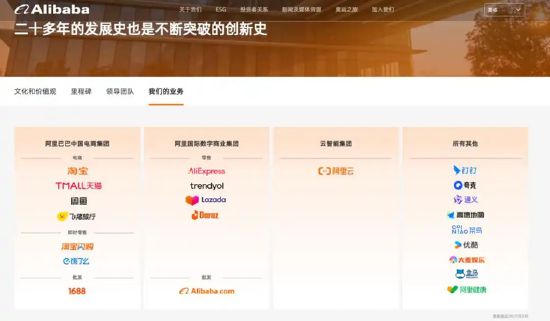
Core Insights - Xianyu, a leading second-hand trading platform in China, has a vast user base and an active community, creating a thriving C2C market. However, its open and low-threshold model has also fostered various gray industries [1][5][21]. Group 1: Company Development - Xianyu originated from the "Taobao second-hand" channel and has evolved into a significant player within Alibaba's e-commerce ecosystem. Recent organizational changes at Alibaba have elevated Xianyu's status [2][19]. - By the end of 2023, Xianyu was upgraded to a primary business unit under the TaoTian Group, marking a significant shift in its strategic importance within Alibaba [2][19]. - In 2024, Xianyu was officially integrated into Alibaba's Chinese e-commerce business system, further solidifying its role in the company's growth strategy [2][19]. Group 2: User Metrics and Financial Performance - Xianyu has over 600 million registered users and sees an average of over 4 million second-hand items posted daily. Its daily GMV has surpassed 1 billion yuan [4][21]. - As of March 2025, Xianyu's monthly active users (MAU) reached 209 million, a nearly 20% year-on-year increase, ranking it among the top ten apps in user growth [4][21]. Group 3: Revenue Generation and Fee Structure - Xianyu implemented its first fee policy on June 6, 2023, charging a 1% service fee for sellers with more than 10 transactions and a total transaction amount exceeding 10,000 yuan [3][20]. - The fee structure was expanded on September 1, 2024, introducing a 0.6% basic service fee for all sellers, with a maximum fee of 60 yuan per transaction. High-frequency sellers continue to be charged 1% on excess amounts [3][20]. - By 2025, the service fee for sellers with over 10 transactions and a total amount exceeding 10,000 yuan was raised to 1.6% [3][20]. Group 4: Gray Market Issues - Xianyu's open platform has led to the proliferation of gray market activities, including credit card fraud through low-priced hotel bookings and the presence of "water army" networks that manipulate reviews [5][22]. - Users have reported various scams, such as the "crab card" fraud and deceptive practices in the second-hand luxury goods market, where sellers significantly reduce prices after purchase [6][22][32].
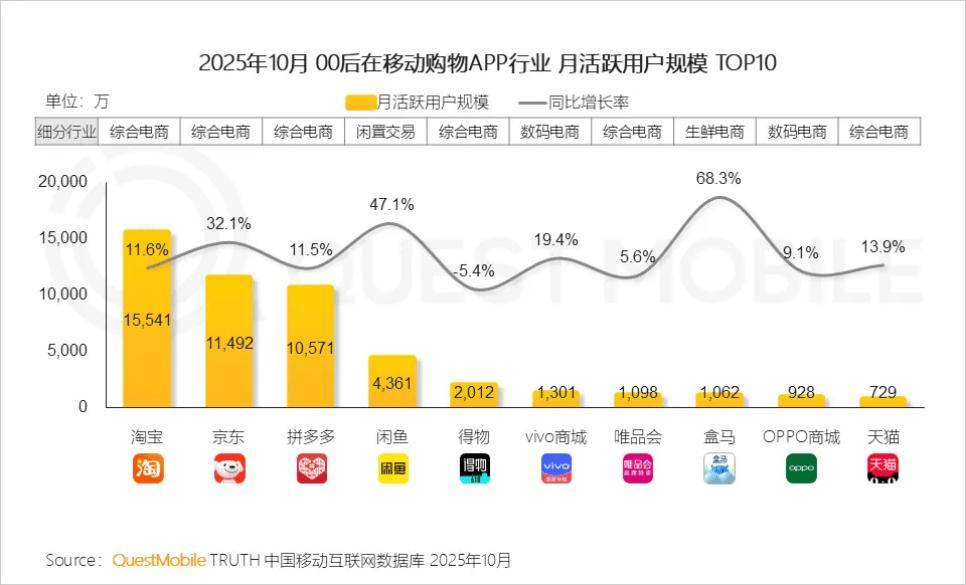
QuestMobile最新数据:闲鱼00后用户月活达4361万,增速47.1%超过所有综合电商平台
Sou Hu Cai Jing· 2025-12-10 03:21
Core Insights - The report by QuestMobile indicates that the monthly active user base of post-2000s (00后) on Xianyu has reached 43.61 million, ranking fourth in the mobile shopping industry, following Taobao, JD.com, and Pinduoduo, with a growth rate of 47.1%, surpassing all comprehensive e-commerce platforms [1]. User Engagement and Demographics - As of October 2025, the total monthly active user base of post-2000s on the mobile internet has reached 179 million, representing a year-on-year growth of 10.1%, accounting for 14% of the overall internet user base [3]. - Post-2000s users exhibit a higher engagement level in mobile internet usage compared to other demographics, with an average monthly usage time of 217.6 hours and an average of 3,296.7 usage instances, reflecting year-on-year increases of 3.7% and 4% respectively, significantly above the average levels of all internet users [3]. Consumption Trends - The consumption patterns of post-2000s users on mobile internet reveal new characteristics, as they are not only focused on shopping but also engage in cyclical and emotional consumption, which serves to recharge their spirits and build social assets, forming a complete value satisfaction system [3]. - The report highlights that post-2000s users are the core drivers of the "Guzi Economy," showing strong interest and high consumption potential in trendy toys and IP culture. Xianyu has experienced explosive growth in these areas, with historical highs in Guzi transaction volumes in Q1 and a 167% increase in sales of traditional Guzi products; in Q2, the transaction volume for trendy toys surged over 300%, with a year-on-year increase of 43.4% in average monthly consumers and an average spending of 218 yuan per transaction [3].
闲鱼再亮相联合国气候大会,数字化赋能让减碳成为每个人的日常
Yang Zi Wan Bao Wang· 2025-11-20 10:39
Core Insights - The 30th United Nations Climate Change Conference (COP30) was held in Belém, Brazil, where Xianyu showcased its digital empowerment in the circulation of idle goods, reporting that 7 million idle items are posted daily on its platform, with a 30% year-on-year increase in daily transaction volume [1][3]. Group 1: Digital Empowerment and AI Integration - Xianyu's Public Affairs Director, Tong Shuting, highlighted that approximately two-thirds of global carbon emissions are related to household consumption, making it crucial to reduce carbon emissions on the consumption side. The trading and reuse of idle goods can significantly mitigate resource and energy consumption associated with new product manufacturing [3]. - The integration of AI technology has lowered the barriers for ordinary people to participate in idle trading, with features like AI publishing and AI intelligent management addressing sellers' concerns about posting items and managing sales. AI tools such as "AI Smart Search" and "AI Market Trends" alleviate buyers' worries about selection and pricing [3]. - The AI capabilities have led to a 10% increase in the sales of newly listed items on the same day, enhancing the efficiency of idle goods transactions by addressing the non-standardization of items and the non-professionalism of both buyers and sellers [3]. Group 2: Sustainable and Engaging Participation Mechanisms - Xianyu has developed a sustainable and engaging green participation mechanism by embedding philanthropy into idle trading. The "Charity Baby" feature allows users to select donation proportions and projects when posting idle items, resulting in over 3.91 million yuan donated from 3.85 million charity items posted by approximately 5.6 million users over two years [4]. - The collaboration with Ant Forest introduced the "Magical Fish Pond," which converts users' green behaviors in idle trading into measurable green energy, generating nearly 1,400 tons of green energy in just two months, equivalent to planting 7,700 saxaul trees [7]. - The "Give Goods Society" initiative, launched in partnership with Alibaba Public Welfare and the China Environmental Protection Foundation, facilitates precise matching of idle goods to those in need, with over 90% of users claiming two or more charitable needs since its launch [7]. Group 3: Long-term Goals and Climate Action - This year marks Xianyu's third participation in the UN Climate Conference, aiming to enable every individual to easily engage in climate action through its "SEED" carbon reduction model and advanced AI technology. The company aspires to help society reduce carbon emissions by 55 million tons by 2030, allowing more people to participate in idle circulation with zero barriers [8].

【财经观察】从“双11”战报看电商消费新趋势
Huan Qiu Wang Zi Xun· 2025-11-17 22:59
Core Insights - The 17th "Double 11" shopping festival saw significant growth, with Tmall reporting its best growth in four years and JD.com achieving record transaction volumes, with a 40% increase in the number of users placing orders [1][2] - E-commerce platforms are shifting focus from Gross Merchandise Volume (GMV) to higher quality metrics such as brand performance and consumer trends, indicating a maturation of the market [1][2] - Experts argue that e-commerce penetration rates do not accurately reflect a country's consumption strength, as they overlook the evolving dynamics between online and offline retail [2][4] E-commerce Trends - The e-commerce penetration rate in China peaked at 27.6% in 2023 but is projected to decline to 26.8% in 2024 and stabilize around 25% in 2025, suggesting a saturation point [2] - The distinction between "far-field e-commerce" (traditional online shopping) and "near-field e-commerce" (instant retail) is becoming more pronounced, with the latter driving growth in local physical stores [3][4] - The U.S. e-commerce penetration is expected to grow from 25% in 2022 to one-third by 2027, but growth is slowing post-pandemic [3] Consumer Behavior - Young consumers are increasingly engaging in "emotional consumption," with a notable rise in spending on trendy toys, outdoor products, and smart devices [5][6] - The "new three items" popular among young consumers include trendy toys, outdoor gear, and smart products, with significant growth in these categories over the past two years [5][6] - Interest-based consumption is on the rise, with platforms like Xianyu reporting substantial growth in categories such as cards and trendy toys, indicating a shift towards personalized and unique products [6][7] Silver Economy - The silver economy is gaining traction, with the elderly population's consumption needs expected to grow significantly, projected to exceed 100 trillion yuan by 2050 [9] - The elderly demographic is increasingly focused on health-related products and services, with a growing interest in travel and leisure activities [9][10] - E-commerce platforms are adapting to cater to the silver population, with a focus on health management and service-oriented offerings [9][10] Service Consumption - The shift towards service consumption is evident, with service spending in China rising from 46.1% in 2024 to 46.8% in the first three quarters of the year, indicating room for further growth [11] - Experts emphasize the importance of understanding diverse consumer experiences and creating unique value propositions to drive growth in both e-commerce and physical retail [11]