食品饮料ETF(515170.SH)

Search documents
茅台酒投放量已超全年规划的30%,贵州茅台股价在1500元附近震荡
Mei Ri Jing Ji Xin Wen· 2026-02-12 02:33
Core Viewpoint - The price of Feitian Moutai has seen a significant increase, with the latest reported price at 1715 RMB per bottle, reflecting a rise of 25 RMB from the previous day, indicating strong demand during the festive season [1] Price Trends - The wholesale price of Feitian Moutai has fluctuated between 1600 RMB and 1760 RMB over the past two weeks, showing signs of stabilization as the Spring Festival approaches [1] - The terminal price of Feitian Moutai has also been steadily increasing, with an average transaction price rising from 1665 RMB on January 30 to 1755 RMB in early February, and stabilizing above 1750 RMB [1] Sales Performance - Sales are currently exceeding market expectations, with the allocation for January-February combined with voluntarily requested allocations for March resulting in Moutai's supply exceeding 30% of the annual plan [1] Investment Opportunities - The food and beverage ETF (515170.SH) is highlighted as a passive investment option that tracks a specific food index, with a significant holding in high-quality liquor brands, including an 18% stake in Kweichow Moutai [1] - Investors are encouraged to consider regular investments in the Huaxia Food and Beverage ETF linked fund (013126.OF) during market dips [1]

万亿市值贵州茅台放量涨超8%,行业悲观预期或已充分释放
Mei Ri Jing Ji Xin Wen· 2026-01-29 06:28
Group 1 - The liquor sector is experiencing a strong rally, with stocks like Luzhou Laojiao, Shede Liquor, and others hitting the daily limit, while Kweichow Moutai's market value surged over 8% with a trading volume of 21.5 billion yuan [1] - Public fund holdings in liquor have decreased from a peak of 16% in 2020 to 3.93% currently, down from 6.4% in the previous quarter, indicating a significant reduction in positions [1] - Current public fund holdings in liquor are lower than those at the start of previous liquor cycles in 2009 and 2019, suggesting that the conditions for a new cycle may be in place [1] Group 2 - The food and beverage sector is considered to be in an extremely undervalued state, with the latest PE-TTM for the index at only 19 times, placing it in the bottom 1% of valuations over the past decade [2] - The low valuation combined with high dividend yields provides a safety net for investments in the food and beverage sector [2]
北京住房限购条件再放宽!可选消费潜力释放?
Mei Ri Jing Ji Xin Wen· 2025-12-24 11:20
Group 1 - The core viewpoint of the article is the adjustment of Beijing's real estate policies aimed at optimizing housing conditions and stimulating market recovery, effective from December 24, 2025 [1][2] - The policy adjustments include relaxing home purchase conditions for non-Beijing residents, reducing the social security or tax payment duration required for purchasing homes within the Fifth Ring from 3 years to 2 years, and for homes outside the Fifth Ring from 2 years to 1 year [2] - Support for multi-child families is emphasized, allowing Beijing residents with two or more children to purchase an additional home within the Fifth Ring, and non-Beijing multi-child families with 2 years of social security or tax payments to buy 2 homes [2] Group 2 - The minimum down payment for second home public housing loans is reduced from 30% to 25% [2] - The adjustments are expected to promote a cyclical recovery in the real estate market, as indicated by Guohai Securities, which noted that ongoing structural adjustments in the real estate market could impact consumer sentiment and willingness to leverage [2] - Data from Dongwu Securities shows that China's household consumption rate is projected to be 39.9% in 2024, still lagging behind developed countries by approximately 10-30 percentage points [2]
2025收官倒计时6天!两大行业年内涨超85%,食品饮料恐将年线“五连阴”?
Xin Lang Cai Jing· 2025-12-23 07:35
Group 1 - The A-share market is currently in a phase of "pressure above and support below," with overall trading volume continuing to shrink, while only certain thematic sectors remain active [1] - The performance of the Shenwan first-level industries shows significant divergence, with non-ferrous metals and communications being the top performers, each with a year-to-date increase exceeding 85% as of December 23 [1] - In contrast, the food and beverage, coal, and beauty care sectors are underperforming, with the food and beverage sector experiencing a year-to-date decline of over 7%, potentially facing five consecutive years of negative returns if the trend does not reverse in the remaining trading days [1] Group 2 - Looking ahead to 2026, institutions are optimistic about a potential turnaround in the food and beverage sector, noting that stock price turning points often precede fundamental turning points [2] - Guosen Securities highlights that the food and beverage sector has characteristics of "low base, low institutional holdings, and low valuation," and expects investment opportunities in this sector due to its relative valuation reaching a new low since 2011 [2] - Investment options include the food and beverage ETF (515170.SH) and its linked funds, as well as a food ETF that excludes liquor, which is currently being launched [2]
飞天茅台批价连续3日企稳!参照历史或为逐渐筑底信号
Mei Ri Jing Ji Xin Wen· 2025-12-17 09:12
Group 1 - The core viewpoint of the articles indicates that the liquor market, particularly the premium segment represented by Moutai, is showing signs of stabilization and potential recovery after a period of decline [1][2] - The latest data shows that the price of Feitian Moutai has stabilized at 1550 RMB per bottle for three consecutive days, with an increase to 1570 RMB per bottle, and the price of She Moutai Zodiac wine has risen to 1720 RMB per bottle [1] - Historical analysis of the liquor industry reveals a pattern of three rises and falls, with previous downturns linked to economic and policy pressures, and the current phase is transitioning from stage two to stage three, indicating a potential recovery [2] Group 2 - The report from China Galaxy Securities highlights that the focus on "expanding domestic demand" in December's important meetings may signal a recovery in consumer income and domestic demand, which could positively impact the food and beverage sector [2] - The investment focus is on the Food and Beverage ETF (515170.SH), which emphasizes leading liquor companies and has a significant weight on top brands, suggesting that these companies may benefit from market consolidation and a shift towards premium consumption [2] - The Food and Beverage ETF also includes leaders from other segments like dairy, beer, and condiments, providing a diversified investment opportunity for individual investors looking to capitalize on the recovery in the industry [2]
11月CPI数据公布,食品由降转涨!旅游ETF反弹,食品饮料ETF横盘震荡
Mei Ri Jing Ji Xin Wen· 2025-12-10 05:30
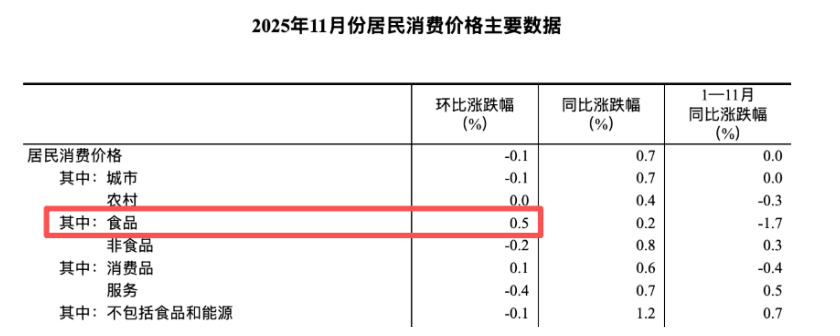
Group 1 - The consumer sector showed signs of stabilization and growth, with duty-free and airline stocks leading the gains, while the Food and Beverage ETF (515170.SH) and Tourism ETF (562510.SH) also saw price increases in the secondary market [1] - The Food and Beverage ETF (515170.SH) experienced a decline since late November but saw a net subscription of over 170 million yuan in the last five days as investors bought the dip [1] - Major holdings in the Tourism ETF (562510.SH) such as China Duty Free Group rose nearly 2%, while Southern Airlines and Air China also performed well [1] Group 2 - The National Bureau of Statistics reported that the Consumer Price Index (CPI) rose by 0.7% year-on-year in November, an increase of 0.5 percentage points from October, marking the highest level since March 2024, primarily driven by rising food prices [1][2] - In November, food prices increased by 0.3% year-on-year, contributing approximately 0.09 percentage points to the CPI increase, with fresh vegetable prices rising by 14.5% and impacting the CPI by about 0.31 percentage points [4] - Service prices saw a seasonal decline, decreasing by 0.4%, which affected the CPI by approximately 0.16 percentage points, with significant drops in hotel accommodation and airfare prices [4][5]

育儿补贴启航!真金白银迈出第一步!教育消费双主线布局或是时候!
市值风云· 2025-07-29 10:08
Core Viewpoint - The implementation of the childcare subsidy policy is a significant step towards addressing the declining birth rate in China, with a basic annual subsidy of 3,600 yuan per child for families with children under three years old starting from January 1, 2025 [2][5]. Group 1: Policy Details - The subsidy will be provided annually and is exempt from personal income tax, not counted as family income for social assistance evaluations [2]. - Families with children born before January 1, 2025, will receive a prorated subsidy based on the number of eligible months [2]. Group 2: Economic Context - The cost of raising children in China is significantly high, with a ratio of 6.3 compared to GDP, surpassing many developed countries [3][4]. - The subsidy of 300 yuan per month is seen as insufficient to alleviate the overall financial burden of raising children, but it is a step towards improving birth rates [5][7]. Group 3: Market Reaction and Investment Opportunities - Following the announcement of the subsidy, the infant and child-related stocks showed a slight increase, indicating market optimism [9]. - The policy is expected to have a broader impact on consumer spending, particularly in the baby and education sectors, suggesting potential investment opportunities in related ETFs [12][14]. Group 4: Long-term Implications - The increase in birth rates is anticipated to be a long-term process requiring a combination of supportive policies beyond just financial subsidies [7][11]. - The childcare subsidy is viewed as a starting point for a more comprehensive approach to population policy, which may include enhancements in education and social support systems [11].