
技术周期

Search documents
国联民生:百年浮沉,商品距离“大牛市”还缺什么?
Xin Lang Cai Jing· 2026-02-01 08:46
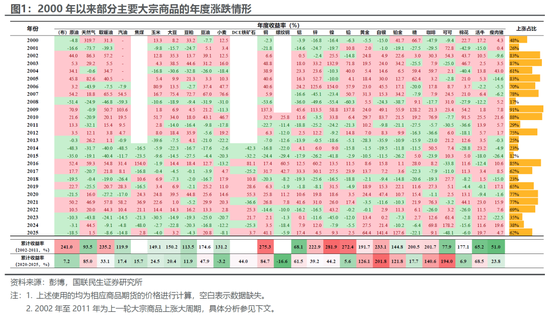
Group 1 - The current commodity price cycle, particularly for precious metals like gold and silver, is facing challenges, and the narrative surrounding the commodity price increase may still have room to develop [1][33] - The recent commodity price increase lacks breadth compared to the previous cycle from 2002 to 2011, where over 60% of major commodities experienced price increases, while the current cycle shows limited upward movement [1][33] - The report suggests that the current commodity price cycle may still be in its early stages, and further time may reveal greater upward potential [1][33] Group 2 - Since 1850, commodities have experienced five distinct upward cycles, with an average duration of approximately 12 years and an average price increase of 79% when adjusted for inflation [3][34] - The last two cycles have seen precious metals outperform, while the earlier cycles were characterized by stronger performances from energy, industrial metals, and agricultural products [5][36] - The report emphasizes the importance of analyzing the structural factors that drive these commodity cycles, including technological advancements and geopolitical tensions [6][18] Group 3 - Energy and industrial metals are considered the most stable and classic commodities, often driven by technological and industrial revolutions, as well as geopolitical conflicts [6][37] - Agricultural products have shown weaker long-term performance compared to other asset classes, often lagging behind inflation, but can excel during periods of significant supply shocks [9][41] - Gold and silver have not always been the primary focus in commodity cycles, with their significant price increases occurring mainly in the last two cycles due to the decoupling of currencies from gold standards [14][43] Group 4 - The report identifies three long-term perspectives that influence commodity cycles: war, technology, and emerging demand, highlighting that conflicts can disrupt supply chains and affect demand differently [18][19] - Technological cycles are noted to have a longer duration and can significantly impact commodity prices during their explosive and transitional phases [22][24] - Emerging demand often coincides with periods of war or technological transformation, driving commodity price increases [27][30]


2025收官倒计时6天!两大行业年内涨超85%,食品饮料恐将年线“五连阴”?
Xin Lang Cai Jing· 2025-12-23 07:35
Group 1 - The A-share market is currently in a phase of "pressure above and support below," with overall trading volume continuing to shrink, while only certain thematic sectors remain active [1] - The performance of the Shenwan first-level industries shows significant divergence, with non-ferrous metals and communications being the top performers, each with a year-to-date increase exceeding 85% as of December 23 [1] - In contrast, the food and beverage, coal, and beauty care sectors are underperforming, with the food and beverage sector experiencing a year-to-date decline of over 7%, potentially facing five consecutive years of negative returns if the trend does not reverse in the remaining trading days [1] Group 2 - Looking ahead to 2026, institutions are optimistic about a potential turnaround in the food and beverage sector, noting that stock price turning points often precede fundamental turning points [2] - Guosen Securities highlights that the food and beverage sector has characteristics of "low base, low institutional holdings, and low valuation," and expects investment opportunities in this sector due to its relative valuation reaching a new low since 2011 [2] - Investment options include the food and beverage ETF (515170.SH) and its linked funds, as well as a food ETF that excludes liquor, which is currently being launched [2]
存储设备公司成长性:“价格周期”和“技术周期”共振带来高斜率
2025-11-18 01:15
Summary of Conference Call on Semiconductor Equipment Industry Industry Overview - The global semiconductor equipment market is dominated by a few leading suppliers, particularly in the thin film deposition sector, which typically has around three major players. [2] - The storage device industry is experiencing growth driven by the "price cycle" and "technology cycle" resonance, leading to high growth rates. [1] Key Company Insights - **Company Performance**: - Lam Research's revenue grew from $4.86 billion in 2014 to $16.2 billion in 2024, with a compound annual growth rate (CAGR) of 12.8%. Profits increased from $720 million to $4.29 billion, achieving a CAGR of approximately 20%. [1][5] - Expected revenue CAGR from 2024 to 2028 is around 10%, with gross margins projected to reach 50% by 2028. [6][7] - **Market Position**: - Lam Research holds a global market share of nearly 20% in chemical vapor deposition (CVD) and 40%-50% in dry etching. [1][4] - The company has significantly increased its revenue in the NAND sector, from $1.63 billion in 2014-2015 to $7.47 billion in 2022. [11] Market Trends and Dynamics - **NAND and DRAM Development**: - The future of memory development is focused on increasing NAND layer stacking and transitioning DRAM from planar to 3D structures, which will enhance the demand for etching and deposition equipment. [1][12] - The DRAM market is benefiting from the explosion of AI demand, particularly for high bandwidth memory (HBM), leading to increased capital expenditures. [3][14] - **Emerging Technologies**: - New processes such as CMOS bonding and array bonding are being adopted in NAND technology, with companies like Yangtze Memory Technologies (YMTC) implementing advanced stacking solutions. [18] - The industry is seeing a shift towards 3D NAND technology, which significantly increases the demand for etching and deposition equipment. [11] Financial Insights - **Capital Expenditure Trends**: - Capital expenditures in the logic chip sector are expected to grow by approximately 30% per 10,000 wafers, reflecting the industry's responsiveness to technological advancements. [15] - The DRAM market is projected to see a significant increase in capital expenditures driven by new technology innovations, despite potential price declines. [14] Competitive Landscape - **Key Competitors**: - Lam Research, Applied Materials, and Tokyo Electron are major players in the semiconductor equipment market, each performing differently across various segments. [12] - Emerging companies like Tuojing Technology and Zhongwei Company are also gaining attention for their potential in the expanding market. [25] Future Outlook - **Market Opportunities**: - China's demand for DRAM and NAND accounts for at least 20%-25% of the global market, but local manufacturers hold only about 10% market share, indicating significant room for growth. [17] - Upcoming IPOs of major storage companies are expected to alleviate funding pressures and support ongoing capital expenditures, potentially increasing their global market share. [17] Conclusion - The semiconductor equipment industry is poised for continued growth driven by technological advancements and increasing demand for memory solutions. Companies that adapt to these changes and innovate will likely capture greater market share in the evolving landscape. [13][19]

华泰证券:短期继续“哑铃型”配置,关注低位景气品种
Mei Ri Jing Ji Xin Wen· 2025-11-10 00:39
Core Viewpoint - The short-term market is in a policy and performance vacuum, requiring more catalysts for the index to break through key levels, with the market likely to remain volatile [1] Group 1: Market Strategy - The recommendation is to maintain a "barbell" strategy in asset allocation [1] - In the technology sector, the pressure of crowding has eased, and after adjustments, the cost-effectiveness is gradually improving, focusing on low-position targets in areas such as Hang Seng Technology, domestic computing power, and AI applications [1] - Given the uncertainties both domestically and internationally, previously underperforming dividend stocks are experiencing a rebound, with current opportunities in banks and certain cyclical dividend stocks [1] Group 2: Sector Focus - The third-quarter reports and high-frequency indicators are cross-validating, indicating that varieties with non-crowded valuations and chips, such as new energy and chemicals, are worth attention [1] - In the medium term, seven key clues will be monitored: policy cycle, technology cycle, real estate cycle, capacity cycle, inventory cycle, energy cycle, and capital market reform, with advanced manufacturing and pro-cyclical consumption being potential decisive factors [1]

机构:核心资产有望在本轮ROE周期回升中当“先锋手”,A500ETF基金(512050)盘中成交额超10亿元,暂居同标的产品第一
2 1 Shi Ji Jing Ji Bao Dao· 2025-06-03 03:05
Group 1 - The A-share market showed a strong recovery after a low opening on June 3, with major indices such as the Shanghai Composite Index, Shenzhen Component Index, ChiNext Index, and CSI A500 Index turning positive. Key sectors that performed well included online gaming, brain-computer interfaces, gold and jewelry, and rare earths [1] - The A500 ETF (512050) recorded a trading volume exceeding 1 billion yuan, ranking first among similar products. Notable stocks within this ETF included Zhangqu Technology, which rose over 13%, and Giant Network, Huahai Pharmaceutical, and Aerospace Rainbow, which all increased by over 8% [1] - The A500 ETF tracks the CSI A500 Index and employs a dual strategy of industry-balanced allocation and leading stock selection, covering all sub-industries. It emphasizes both value and growth attributes, with a higher allocation in sectors like pharmaceuticals, electronics, and power equipment compared to the CSI 300 Index, representing core assets in the current A-share market [1] Group 2 - Huatai Securities released a mid-term outlook for 2025, predicting that ROE (Return on Equity) is expected to stabilize and recover in the second half of 2025 due to improvements in net profit margins, stabilization of turnover rates, and an increase in equity multipliers, marking the end of the downward cycle for A-share ROE [1] - The broad valuation recovery of Chinese assets is still in progress, driven by three main variables: technological innovation, the end of the rapid decline in the real estate sector, and improvements in policy cycles. The trend is expected to remain unchanged in the second half of the year, with "de-dollarization" providing upward pressure on the renminbi, enhancing the attractiveness of Chinese asset allocation [1] - Core assets represented by A50, consumption, and finance have shown remarkable fundamental resilience over the past three years and are expected to play a leading role in the upcoming ROE recovery cycle. Additionally, five investment themes are highlighted: renminbi appreciation, technology cycles, capacity cycles, inventory cycles, and capital market reforms [1]