
顺周期复苏

Search documents
华安基金:估值低位与周期筑底共振,港股通央企红利价值显现
Xin Lang Cai Jing· 2026-02-10 08:42
Market Overview - The Hang Seng China Enterprises Dividend Index decreased by 0.11%, the Hang Seng Index fell by 3.02%, and the Hang Seng Technology Index dropped by 6.51% last week [1][7] - In contrast, the CSI State-Owned Enterprises Dividend Index rose by 0.17%, while the CSI 300 Index declined by 1.29% [1][7] - A significant style rotation is observed in the market, with a "seesaw" effect between the previously strong technology growth sector and the dividend value style [1][7] Economic Recovery and Policy Support - The domestic economy is stabilizing, with traditional cyclical industries such as real estate, transportation, and energy experiencing a marginal recovery [2][8] - Increased policy support in the real estate sector includes measures like easing purchase and loan restrictions, lowering mortgage rates, and accelerating the construction of affordable housing [2][8] - These policies are expected to alleviate cash flow pressures on real estate companies and positively impact upstream industries like construction materials and public utilities [2][8] Investment Opportunities in Dividend Assets - The dividend assets are currently seen as having high cost-effectiveness, attracting increased capital allocation [2][8] - The market is showing signs of a "high to low" shift, with funds moving from high-valuation, high-volatility growth sectors to low-valuation, relatively stable value assets [2][8] - The Hang Seng China Enterprises Dividend Index, with its high dividend yield and stable fundamentals, has become a key focus for investors seeking to rebalance their portfolios [2][8] Dividend Yield and Valuation Comparison - The Hang Seng China Enterprises Dividend Index has a dividend yield of 5.70%, compared to 4.80% for the CSI Dividend Index, with a price-to-book (PB) ratio of 0.65 and a price-to-earnings (PE) ratio of 7.31 [3][9] - Over the past five years, the total return of the Hang Seng China Enterprises Dividend Index has been 158%, outperforming the Hang Seng Total Return Index by 150% [3][9] - The CSI State-Owned Enterprises Dividend Index has a dividend yield of 4.76%, with a PB of 0.86 and a PE of 8.59, achieving a total return of 74% over five years, outperforming the CSI 300 Total Return Index by 78% [3][9] ETF Product Overview - The Hang Seng China Enterprises Dividend ETF (513920) is the first ETF in the market with the combined attributes of Hong Kong stocks, state-owned enterprises, and dividends, tracking the Hang Seng China Enterprises Dividend Index [4][11] - The product has a net value of 1.6934 and a scale of 6.708 billion, with a weekly trading volume of 1.689 billion [5][12] - The CSI Dividend ETF (561060) tracks the CSI State-Owned Enterprises Dividend Index, selecting 100 stocks with high cash dividend yields and stable dividends from state-owned enterprises [5][12]


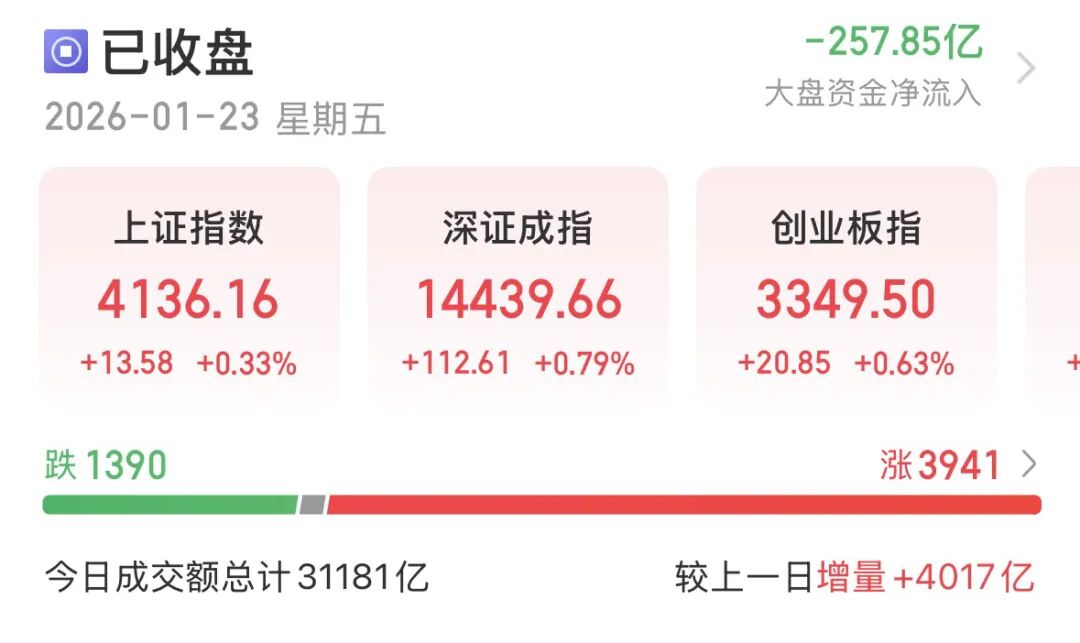
电源设备、商业航天大涨!下周A股怎么走?
Guo Ji Jin Rong Bao· 2026-01-23 16:19
Core Viewpoint - The market shows signs of recovery with a significant increase in trading volume and a majority of stocks rising, indicating a shift in investor sentiment towards riskier assets and sectors with high growth potential [1][4][14]. Market Performance - On January 23, the market's trading volume exceeded 3.12 trillion yuan, with nearly 4,000 stocks closing higher, reflecting a strong market sentiment [1][4][14]. - Major indices experienced moderate gains, with the North Stock 50 index surging nearly 4%, while the Shanghai Composite Index rose by 0.33% [1][4][14]. Sector Performance - Leading sectors included aerospace, marketing services, and power equipment, while consumer sectors remained weak [1][4][7]. - The power equipment sector saw a notable increase, with 28 stocks hitting the daily limit up, indicating strong investor interest [6][10]. - The non-consumer sectors, particularly those related to economic recovery and technology, are attracting more capital, while traditional sectors like banking and consumer goods are underperforming [13][18]. Investment Strategy - Investors are advised to focus on sectors with strong fundamentals and growth potential, such as power equipment, non-ferrous metals, and defense industries, while avoiding high-valuation stocks that have recently surged [3][17][18]. - New investors should adopt a cautious approach, emphasizing gradual accumulation of stocks with solid earnings prospects and reasonable valuations [3][17][18].


西南证券:紧扣顺周期复苏与成长 四大主线布局结构性机会
Zhi Tong Cai Jing· 2026-01-09 01:33
Core Viewpoint - The report from Southwest Securities indicates that the performance of the light industry sector in 2025 is expected to be flat, with cyclical and traditional manufacturing valuations under pressure, while packaging, exports, and personal care sectors show differentiated performance [1] 2025 Sector Review - In 2025, the light industry sector experienced relatively flat performance, with traditional cyclical and manufacturing companies facing valuation pressure. However, the packaging and printing sectors benefited from price increases and cross-industry transformations, leading to better stock performance [1] - The export sector showed some differentiation due to tariff policy disruptions, with companies that have balanced production capacity, strong demand resilience, and low tariff impact performing better [1] - The personal care sector achieved excess returns in the first half of the year but entered a valuation digestion phase in the second half due to intensified competition in e-commerce channels. However, domestic brands are expected to continue their growth trajectory due to product structure optimization and channel expansion [1] 2026 Stock Selection Strategy - The focus will be on undervalued cyclical assets as valuation recovery is anticipated amid changes in the bulk commodity cycle, gradually realizing allocation value [2] - There is a need to balance the valuation and growth potential of new consumption and export sectors, favoring high-growth or low-valuation, high-safety stocks [2] - Four main lines of focus for stock selection include: 1. Gradually emphasizing undervalued cyclical stocks, particularly in the paper sector, which is expected to see price increases driven by "anti-involution" and traditional peak season factors, with net profit per ton likely to recover [2] 2. Export stocks with strong demand resilience and manufacturing capabilities are still considered valuable for allocation, especially those with good growth potential in niche categories and minimal tariff impact [2] 3. Domestic personal care brands are expected to see upward trends in market share and growth potential due to rapid product iteration and competitive pricing [2] 4. New consumption trends in AI glasses, new tobacco products, pet supplies, and trendy toys are expected to continue their upward trajectory, contributing to the growth of the consumption sector [2] Recommended Stocks - Recommended stocks include Sun Paper, Bohui Paper, Weigao Medical, Baiya Co., Nobon Co., Yiyi Co., Mengbaihe, and Gujia Home [3]





十大投行话2026:增持中国资产成共识
Zhong Guo Zheng Quan Bao· 2026-01-04 20:07
Group 1: Market Outlook - Major investment banks are releasing their 2026 market outlooks, indicating a reshaping of the global macroeconomic landscape and a continued upgrade of domestic industries in China [1] - There is an expectation of increased capital inflow into China, which is anticipated to inject new vitality into the market [1] - The recovery trend in capital market profitability is becoming clearer, with structural opportunities emerging in technology innovation, globalization of manufacturing, and cyclical recovery [1] Group 2: Sector Focus - Three key areas for industry allocation are identified: 1. Resource and traditional manufacturing industries upgrading to convert share advantages into pricing power, focusing on non-ferrous metals, chemicals, and new energy [1] 2. Chinese companies going global, significantly expanding profit growth potential, with a focus on machinery, innovative pharmaceuticals, power equipment, and military industries [1] 3. AI further broadening commercial applications, continuing the development trend in the technology sector, with a focus on semiconductors, computing power, edge hardware, and AI applications [1] Group 3: Profit Recovery and Market Trends - A-share profitability is expected to slowly recover, transitioning from a liquidity-driven phase to a profitability-driven phase, with PPI recovery marking substantial improvement in corporate earnings [2] - The second half of 2026 may see a comprehensive market uptrend, with a shift in market style towards cyclical stocks leading the index [2][3] - The best-performing sectors are likely to concentrate on technology innovation and industries linked to global demand, such as non-ferrous metals, automotive, home appliances, and new energy [2][3] Group 4: Investment Themes - AI remains a core investment theme, with opportunities in light chips, copper foil, and domestic computing demand rebound [3] - The power and new energy sector is expected to experience a turnaround, with demand recovery and capacity clearance improving asset turnover rates [3] - The strategic focus includes technology, domestic circulation, strategic security, and external openness, with specific attention to chip manufacturing, satellite communication, and AI applications [3] Group 5: Foreign Investment and Economic Growth - More foreign capital is expected to return to the Chinese market in 2026, supported by a relatively loose liquidity environment [4] - The valuation repair of A-shares is nearly complete, with a focus on maintaining reasonable valuation levels while driving market growth through earnings [5] - China's AI monetization is leading other markets, with significant growth expected in advanced manufacturing and technology sectors [5] Group 6: Commodity Market Insights - Gold prices are projected to continue rising, supported by central bank purchases and a Federal Reserve rate cut cycle, with a target of $4,900 per ounce by December 2026 [6] - Copper is expected to strengthen due to supply constraints and sustained demand growth, with a long-term price forecast of $15,000 per ton by 2035 [6] - The oil market is anticipated to face significant oversupply, with supply growth expected to triple demand growth in 2026, leading to price adjustments [7]
白酒板块午后直线拉升!水井坊涨停,贵州茅台涨1%
Mei Ri Jing Ji Xin Wen· 2025-12-25 05:42
Group 1 - The core viewpoint of the news highlights a significant rise in the liquor sector, particularly after Beijing's announcement to further relax housing purchase restrictions, which is expected to stimulate a cyclical recovery in the economy [1] - As of December 25, 2025, the food and beverage industry has experienced a decline of over 7% year-to-date, ranking it as the worst-performing sector among 31 Shenwan primary industries, indicating a potential for the fifth consecutive year of negative returns if the decline is not mitigated in the remaining trading days [1] - Looking ahead to 2026, many institutions are optimistic about a turnaround in the food and beverage sector, particularly in liquor and restaurant supply chains, following a five-year adjustment period from 2021 to 2025 [1] Group 2 - The food and beverage ETF (515170.SH) is based on the CSI sub-index for the food and beverage industry, focusing on leading liquor companies such as Kweichow Moutai, Wuliangye, and Luzhou Laojiao, which together account for nearly 60% of the index weight [2] - The ETF also includes leading consumer food companies, providing a diversified investment opportunity for individual investors to capture potential recovery in the industry [2] - The ETF and its linked funds are considered effective tools for investors looking to engage with the sector at a low capital threshold while diversifying their exposure [2]

北京住房限购条件再放宽!可选消费潜力释放?
Mei Ri Jing Ji Xin Wen· 2025-12-24 11:20
Group 1 - The core viewpoint of the article is the adjustment of Beijing's real estate policies aimed at optimizing housing conditions and stimulating market recovery, effective from December 24, 2025 [1][2] - The policy adjustments include relaxing home purchase conditions for non-Beijing residents, reducing the social security or tax payment duration required for purchasing homes within the Fifth Ring from 3 years to 2 years, and for homes outside the Fifth Ring from 2 years to 1 year [2] - Support for multi-child families is emphasized, allowing Beijing residents with two or more children to purchase an additional home within the Fifth Ring, and non-Beijing multi-child families with 2 years of social security or tax payments to buy 2 homes [2] Group 2 - The minimum down payment for second home public housing loans is reduced from 30% to 25% [2] - The adjustments are expected to promote a cyclical recovery in the real estate market, as indicated by Guohai Securities, which noted that ongoing structural adjustments in the real estate market could impact consumer sentiment and willingness to leverage [2] - Data from Dongwu Securities shows that China's household consumption rate is projected to be 39.9% in 2024, still lagging behind developed countries by approximately 10-30 percentage points [2]
中国银河证券:国庆中秋弱复苏 关注食饮板块三季报业绩
Zhi Tong Cai Jing· 2025-10-14 02:09
Core Insights - The food and beverage index underperformed the broader market in September, with all sub-sectors in a phase of adjustment. The focus for October will be on Q3 earnings reports, with attention on high-performing stocks and sectors [1] Group 1: Industry Performance - In September, the food and beverage industry index declined by 4.9%, underperforming the Wind All A index by 5.7%, ranking 27th among 31 sub-industries [3] - All ten sub-sector indices experienced a pullback, with meat products, soft drinks, pre-processed foods, and beer showing relatively smaller declines of -0.3%, -1.4%, -1.8%, and -3.5% respectively [3] Group 2: Alcohol Sector Insights - During the Mid-Autumn Festival and National Day, the overall sales of liquor declined by 20%-30%, with variations across scenes, regions, and brands. Business banquet demand remains weak, while mass consumption and gatherings are relatively stable [1] - In terms of brand performance, top liquor brands are seeing a recovery in demand, with Kweichow Moutai's sales volume doubling month-on-month and increasing over 20% year-on-year since September [1] Group 3: Supply Chain and Consumer Trends - The Ministry of Commerce and other departments have introduced policies to boost service consumption, which is expected to enhance consumer confidence [1] - Travel during the National Day holiday showed steady growth, with approximately 2.432 billion people moving across regions from October 1 to 8, averaging 304 million daily, a year-on-year increase of 6.2% [1] Group 4: Pricing and Cost Trends - In September, the wholesale prices of various liquors faced downward pressure, with notable declines in prices compared to the previous month and year [2] - The prices of packaging materials showed mixed trends, with PET and packaging film prices down by 7.1% and 4.8% year-on-year, while aluminum, glass, and cardboard prices increased by 3.2%, 2.6%, and 8.0% respectively [2] - Raw material costs for sugar, flour, quail eggs, and pork decreased significantly year-on-year, while prices for soybeans, palm oil, and sunflower seeds saw slight increases [2]

银河证券:关注食品饮料板块三季报业绩 中长期建议重点关注三条主线
Zheng Quan Shi Bao Wang· 2025-10-14 00:33
Core Viewpoint - The report from China Galaxy Securities indicates that the food and beverage index underperformed the broader market in September, with all sub-sectors undergoing a phase of adjustment. The focus for October will be on the performance of third-quarter reports, with a recommendation to pay attention to high-performing stocks and sectors. Looking ahead to the fourth quarter of 2025, there is an expectation of improvement in PPI gradually transmitting to CPI, suggesting a focus on cyclical stocks that are at valuation bottoms and experiencing supply clearance [1]. Summary by Categories Market Performance - In September, the food and beverage index showed weaker performance compared to the overall market, with all sub-sectors in an adjustment phase [1]. Future Outlook - For October, the market will concentrate on third-quarter earnings reports, with a recommendation to focus on high-performing stocks and sectors [1]. - By the fourth quarter of 2025, there is an expectation that improvements in PPI will gradually lead to improvements in CPI, indicating a potential focus on cyclical stocks [1]. Investment Recommendations - The report suggests three main investment lines for the medium to long term: 1. Growth stocks in new categories and new channels [1]. 2. Sectors with relatively stable demand and improved competitive landscapes [1]. 3. Cyclical recovery directions [1].
银河证券:食品饮料国庆中秋弱复苏,关注三季报业绩
Mei Ri Jing Ji Xin Wen· 2025-10-14 00:13
Core Viewpoint - The food and beverage index underperformed the broader market in September, with all sub-sectors undergoing adjustments. Attention is expected to shift towards Q3 earnings reports in October, highlighting potential investment opportunities in high-performing stocks and sectors [1] Group 1: Market Performance - The food and beverage index showed weaker performance relative to the overall market in September [1] - All sub-sectors within the food and beverage industry are currently in an adjustment phase [1] Group 2: Future Outlook - In October, the market focus will be on Q3 earnings reports, with an emphasis on high-performing stocks and sectors [1] - For Q4 2025, there is an expectation that improvements in PPI will gradually transmit to CPI, suggesting a focus on cyclical stocks that are at valuation bottoms and experiencing supply clearance [1] Group 3: Long-term Investment Strategies - Long-term investment recommendations include three main lines: 1) Growth stocks in new categories and channels 2) Sectors with relatively stable demand and improved competitive landscapes 3) Cyclical recovery directions [1]
中国银河证券:国庆中秋食品饮料行业弱复苏 关注三季报业绩
Zhi Tong Cai Jing· 2025-10-13 09:19
Core Insights - The overall sales of liquor during the Mid-Autumn Festival and National Day holidays have declined by 20%-30%, with variations across scenes, regions, and brands [1] - Business banquet demand remains weak, while mass consumption and gatherings are relatively stable [1] - The liquor industry shows signs of recovery, particularly for leading brands like Moutai, which has seen a significant increase in sales [1] Liquor Industry Analysis - Sales during the holiday period have shown a decline of 20%-30%, with a notable differentiation in performance based on consumption scenarios, regions, and brands [1] - Business banquet demand is still low, while mass consumption and gatherings are holding up better [1] - Traditional liquor consumption provinces such as Henan, Shandong, and Jiangsu are performing relatively well [1] - Moutai's sales have rebounded, with a reported increase of approximately 100% month-on-month and over 20% year-on-year since September [1] Restaurant Supply Chain Industry - The Ministry of Commerce and other departments have issued policies aimed at boosting consumer confidence [2] - High-frequency consumer traffic initiatives are being launched to support the restaurant and service industries [2] - The transportation department reported a record high of 2.432 billion cross-regional movements during the National Day holiday, indicating a marginal recovery in consumer activity [2] Price Tracking and Cost Analysis - Liquor prices are under pressure, with various brands experiencing price declines compared to last year [3] - Packaging material prices have shown mixed trends, with some materials increasing while others have decreased [3] - Raw material costs for certain food items have decreased significantly, while others have seen slight increases [3] Investment Recommendations - The food and beverage index has underperformed relative to the broader market, with various sub-sectors in a phase of adjustment [4] - Focus on companies with growth potential in new categories and channels, such as Guoquan and Dongpeng Beverage [4] - Emphasis on stable demand and improved competitive landscapes in sectors like Nongfu Spring and Uni-President [4] - For cyclical recovery, attention should be given to leading liquor brands like Moutai and Wuliangye [5]