
AI药物研发

Search documents
乔布斯亲儿子,干VC了
投中网· 2026-03-01 07:39
Core Viewpoint - Reed Jobs, son of Steve Jobs, has launched a venture capital fund focused on innovative medical projects, particularly those aimed at curing cancer, with an initial fund size exceeding $200 million [4][11]. Group 1: Background and Motivation - Steve Jobs passed away from pancreatic cancer in 2011, leaving a legacy that deeply influenced Reed Jobs, who initially aspired to be a doctor to combat cancer [4][7]. - Reed Jobs' journey into venture capital was driven by a desire to participate in the incubation of projects that could advance scientific and medical development [4][11]. Group 2: Career Development - After his father's death, Reed Jobs shifted his academic focus from medicine to history, eventually earning a master's degree from Stanford University [7][12]. - In 2015, he joined the Emerson Collective, a foundation established by his mother, where he began investing in healthcare, initially as a limited partner in established funds [11][12]. Group 3: Investment Strategy and Achievements - Reed Jobs' investment strategy evolved to focus on supporting research teams with innovative ideas that are not yet commercially viable, particularly in cancer treatment [12][13]. - By 2025, the Emerson Collective had invested in over 40 biotech startups, with 8 companies achieving valuations over $200 million through IPOs or acquisitions [13]. Group 4: New Ventures and Future Plans - In 2023, Reed Jobs founded his own venture capital fund, Yosemite, with a mission to ensure cancer is no longer a fatal disease, starting with a fund size of $263 million [13][14]. - The second phase of Yosemite's fundraising has already raised $200 million, with plans to reach a total of $350 million, indicating strong investor interest [14]. Group 5: Broader Impact and Challenges - Reed Jobs has expressed concerns about the state of the U.S. healthcare system, highlighting issues such as outdated technology and declining public trust in institutions [18][19]. - He has considered political involvement to influence healthcare policy but remains focused on his venture capital efforts, aiming to invest in 25 companies through Yosemite [19].


5年10亿美元豪赌!英伟达与礼来联手押注AI制药,成立AI药物实验室【附AI药物研发市场现状分析】
Qian Zhan Wang· 2026-01-14 07:59
Core Insights - Nvidia and Eli Lilly announced a joint investment of $1 billion to establish a lab in the San Francisco Bay Area, marking a significant step in integrating AI with drug development [2] - The collaboration aims to leverage Nvidia's AI models and hardware to create a dedicated drug development platform for pharmaceutical companies [2][3] - AI technology is expected to reduce drug development timelines by 40%-60% and costs by 25%-50%, while increasing the success rate of Phase I clinical trials to 80%-90% [4] Investment and Collaboration - Eli Lilly has been proactive in AI drug development, having announced the establishment of an AI factory using Nvidia's systems and deploying a supercomputer with over 1,000 Nvidia Grace Blackwell chips [3] - The company has engaged in ten collaborations in the AI drug development field in 2025 alone, partnering with entities like OpenAI and various Chinese AI firms [3] Market Dynamics - The AI drug development sector is a critical focus within the broader AI healthcare market, which reached $5.4 billion in 2022, with AI drug development accounting for approximately 28% of this market [6] - The increasing complexity of innovative drug development has led to a decline in research efficiency among top pharmaceutical companies, highlighting the urgent need for accelerated drug development processes [9] Technological Impact - AI drug development involves a combination of pharmacological analysis, AI, and big data, creating high technical barriers and involving various types of companies, including self-developed AI drug firms and CRO service providers [5] - Experts believe that AI can significantly lower innovation costs, speed up innovation processes, and enhance the quality of innovations in drug development [9]



AI医疗概念股再度走强 英伟达将“全栈式”布局医疗领域 AI医疗商业化确定性将加强
Zhi Tong Cai Jing· 2026-01-14 06:50
Group 1 - AI healthcare stocks have strengthened, with notable increases in share prices for companies such as Alibaba Health (+18.81%), MicroPort (+7.7%), Yidu Tech (+6.06%), Ping An Good Doctor (+5.9%), and JD Health (+4.08%) [1] - NVIDIA and Eli Lilly announced a joint investment of $1 billion to establish an AI drug development lab in San Francisco, aimed at accelerating drug development processes [1] - NVIDIA has previously invested in biotechnology company Recursion and established partnerships with leading firms in the healthcare sector, including Novo Nordisk and Mayo Clinic [1] Group 2 - Citic Securities believes that AI in healthcare will accelerate the restructuring of the trillion-dollar pharmaceutical market, with significant changes expected by 2026 [2] - The core change in AI healthcare is the clearer and stronger payment capabilities of payers this year, which is expected to enhance the commercial viability of AI healthcare [2] - 2026 is anticipated to be a year of greater certainty for the commercialization of AI healthcare, opening up new commercial opportunities [2]
港股异动 | AI医疗概念股再度走强 英伟达将“全栈式”布局医疗领域 AI医疗商业化确定性将加强
智通财经网· 2026-01-14 06:49
Group 1 - AI healthcare concept stocks have strengthened, with notable increases in share prices for companies such as Alibaba Health (+18.81%), MicroPort Scientific (+7.7%), Yidu Tech (+6.06%), Ping An Good Doctor (+5.9%), and JD Health (+4.08%) [1] - NVIDIA and Eli Lilly announced a joint investment of $1 billion to establish an AI drug development lab in San Francisco, aimed at accelerating drug development processes [1] - NVIDIA has previously invested in biotechnology company Recursion and established partnerships with leading firms in the healthcare sector, including Novo Nordisk and Mayo Clinic [1] Group 2 - Citic Securities believes that AI in healthcare will accelerate the restructuring of the trillion-dollar pharmaceutical market, with a fundamental change in the logic of AI healthcare expected by 2026 [2] - The core of this change is that the payers for AI healthcare have become clearer and more powerful this year, indicating a stronger certainty for commercialization in 2026 [2]


英伟达与礼来联合投资10亿美元建AI药物研发实验室
Sou Hu Cai Jing· 2026-01-13 03:23
Core Viewpoint - Nvidia and Eli Lilly announced a joint investment of $1 billion to establish an AI drug research laboratory in San Francisco, aimed at accelerating drug development processes [1][5]. Group 1: Investment Details - The $1 billion investment will be allocated over five years for laboratory infrastructure, computing power, and talent deployment [5]. - The collaboration will involve Nvidia engineers working alongside Eli Lilly's experts in biology, science, and medicine to advance medical research, with operations set to begin in early 2023 [5]. Group 2: Strategic Implications - Eli Lilly's CEO, David Ricks, emphasized that combining vast data and scientific knowledge with Nvidia's computational capabilities could fundamentally transform drug development methods [5]. - Nvidia has previously invested in biotechnology company Recursion and established partnerships with leading firms in the healthcare sector, indicating a strategic focus on the AI ecosystem [5]. - Nvidia's CEO, Jensen Huang, stated that AI is transforming every industry, with its most profound impact expected in the life sciences sector [7].
一座城市的长期主义:用产业生态撑起下一个技术支点
远川研究所· 2026-01-08 13:37
Core Insights - The article discusses the evolution of Silicon Valley from an agricultural region to a global technology hub, driven by successive waves of technological innovation and the emergence of key companies in the semiconductor, computing, internet, and AI sectors [2][4]. Group 1: Historical Development of Silicon Valley - Before the 1950s, Santa Clara Valley was known as the "World's Fruit Basket" and not the tech hub it is today [2]. - The IPOs of Intel and AMD in 1971 and 1972 marked the beginning of a significant investment wave in the semiconductor industry, providing crucial funding for expansion and R&D [2]. - Apple's IPO in 1980 raised over $100 million, the largest since Ford's in 1956, signaling the start of the personal computing and enterprise IT era [2]. Group 2: Emergence of Key Tech Companies - Adobe, founded in 1982, represented a novel business model in software licensing [3]. - Cisco, Nvidia, Yahoo, and Google were established in the 1980s and 1990s, contributing to the diversification of Silicon Valley's tech landscape [3]. Group 3: Transition to AI Era - Nvidia has become a core player in AI computing, with its market value rising from $100 billion three years ago to over $4 trillion today [4]. - Google has diversified into cloud computing, AI applications, and AI chips, solidifying its position as a leading internet company [4]. - OpenAI, founded in 2015, has emerged as a top-tier company in the AI era [4]. Group 4: Shanghai's AI Industry Development - Shanghai has seen a surge in AI companies, with five firms going public within a month, including MuXi and BiRan Technology [6]. - The city is fostering a comprehensive AI ecosystem, from semiconductor design to application deployment, creating a positive feedback loop in the industry [9][10]. Group 5: Infrastructure and Support for AI Startups - Shanghai's AI startups benefit from a complete supply chain within a 10-kilometer radius, facilitating rapid innovation and production [10]. - The city has established a robust semiconductor industry cluster, providing essential support for AI development [10]. Group 6: Policy and Resource Allocation - Shanghai's policy shift aims to provide entrepreneurs with clearer pathways and more security, enhancing resource responsiveness [14][16]. - Initiatives like the "1 yuan office space" and "targeted apartments" are designed to extend the cash flow lifespan of startups [14]. Group 7: Talent and Ecosystem - Shanghai's talent pool, supported by local universities and international recruitment, is a significant advantage for AI startups [17]. - The city's industrial ecosystem combines manufacturing and services, allowing for unique flexibility in AI application development [20]. Group 8: Long-term Vision - The article emphasizes that the competition among cities in technology is a long-term endeavor, requiring a resilient infrastructure to support ongoing innovation [19][21]. - Shanghai is focused on aligning research, funding, regulations, and market needs to build a strong foundation for future technological waves [21].


苏州创新药研究院揭牌
Su Zhou Ri Bao· 2025-10-02 00:07
Core Viewpoint - The establishment of the Suzhou Innovation Drug Research Institute marks a significant step in promoting the biopharmaceutical industry in Suzhou, focusing on innovation and collaboration among government, academia, and enterprises [1][2]. Group 1: Establishment and Purpose - The Suzhou Innovation Drug Research Institute was inaugurated on September 29, with key figures from the government and academia in attendance [1]. - The institute aims to serve as a "catalyst" for technological breakthroughs, a "nurturer" for top talent, and a "connector" for the transformation of research outcomes, thereby becoming a source of innovation for Suzhou's biopharmaceutical industry [1]. Group 2: Collaborative Framework - The institute is a collaborative effort between the Suzhou municipal government, Suzhou Industrial Park, and Suzhou University, adhering to the principle of "enterprises pose questions, jointly solve problems, and the government assists" [2]. - It will focus on cutting-edge fields such as molecular targeted drugs, biopharmaceuticals, gene and cell therapy, and AI drug development, aiming to create an organized research and transformation framework [2]. Group 3: Integration and Development - The research institute seeks to establish a three-in-one innovation loop involving laboratories, enterprises, and hospitals, promoting deep integration of government, industry, academia, research, and medical sectors [2]. - During the inauguration, the institute also unveiled joint innovation centers with Ascentage Pharma and Innovent Biologics, and held its first council meeting [2].
李家超,重大发布!
Zheng Quan Shi Bao· 2025-09-17 05:38
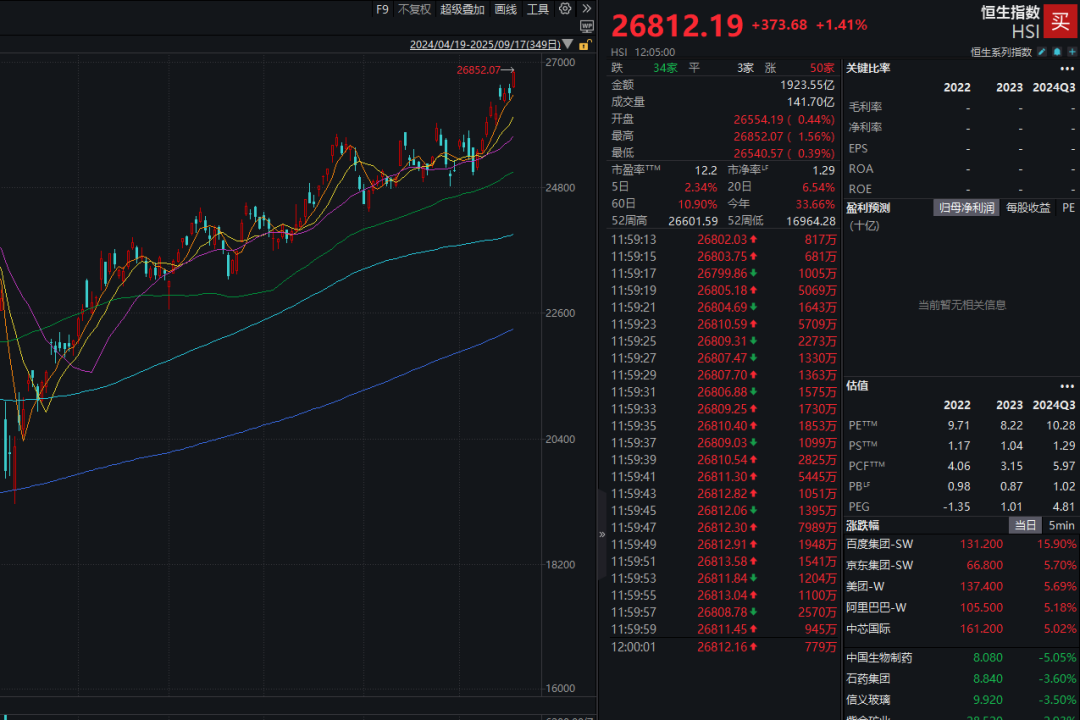
Core Points - The 2025 Policy Address by Hong Kong Chief Executive John Lee emphasizes economic development and aligning with national strategies [1] - Specific measures include accelerating the development of the Northern Metropolis, industrial innovation, and reinforcing Hong Kong's status as an international financial center [1] Development of Northern Metropolis - The Northern Metropolis is identified as a new economic engine for Hong Kong, with plans to establish a "Northern Development Committee" led by John Lee [2] - The government will create dedicated legislation to facilitate the development of the Northern Metropolis, including funding channels for park companies and streamlined cross-border logistics [2] - The first phase of the Hong Kong Science and Technology Innovation Cooperation Zone is complete, with major industries like life sciences and AI tenants moving in [2] Industrial Development and Innovation - Emphasis on artificial intelligence (AI) development, including a HKD 3 billion funding plan to attract international research talent [4] - Plans to establish the "Hong Kong AI Research Institute" by 2026 with a budget of HKD 1 billion to promote AI research and application [4] - The life sciences sector is set to grow, with initiatives to attract pharmaceutical companies for clinical trials and the establishment of an "International Clinical Trial Academy" [5] Reinforcing Hong Kong's Financial Center Status - The government aims to support tech companies in raising funds through the stock market and improve listing mechanisms [6] - Initiatives to enhance the bond market include creating a centralized platform for managing various assets and promoting offshore Chinese government bonds [6][7] - Plans to establish an international gold trading market and enhance commodity trading, including carbon trading [7][8] Stock Market Performance - Following the Policy Address, the Hang Seng Index rose by 1.41%, reaching a new high [9] - The Hong Kong stock market has seen significant recovery in 2025, with the Hang Seng Index up over 33% year-to-date and new stock issuance increasing dramatically [10][11] - The average daily trading volume in the Hong Kong stock market has surged by 118% year-on-year [11]
港股异动 | 维亚生物(01873)绩后拉升逾20% 中期股东应占溢利同比增加4.28% 公司AI订单呈增长趋势
智通财经网· 2025-08-29 03:49
Core Viewpoint - Via Biotechnology (01873) experienced a significant stock price increase of over 20% following the release of its interim results for the six months ending June 30, 2025, with a reported share price of HKD 2.85 and a trading volume of HKD 49.03 million [1] Financial Performance - The company reported revenue of RMB 832 million, a year-on-year decrease of 15.27% [1] - Shareholder profit attributable to the company was RMB 122 million, reflecting a year-on-year increase of 4.28% [1] - Basic earnings per share were RMB 0.06 [1] - The gross profit margin improved to 40.8%, an increase of 6.3 percentage points compared to the same period last year, attributed to optimization of the Langhua business structure and enhanced operational efficiency in CRO business [1] AI Drug Development - Via Biotechnology has been investing in AI drug development for the past five years, with AI-related orders now accounting for 12% of new signed orders, indicating a growing trend [1] - According to Guojun International, significant transactions in AI drug development (AIDD) have occurred in the last five years, totaling over USD 50 billion [1] - The development of generative AI in pharmaceuticals emphasizes the importance of building leading model barriers over time, with efficiency in model development and training experience being crucial [1] - Collaborations with large pharmaceutical companies in AI research and development create a positive feedback loop in data and model construction, enhancing the competitive moat of leading firms [1]