CMP材料

Search documents
鼎龙股份2025年业绩预增超34%,拟收购皓飞新材切入锂电材料
Jing Ji Guan Cha Wang· 2026-02-12 04:23
Core Viewpoint - Dinglong Co., Ltd. (300054) expects a significant increase in net profit for 2025, driven by strong growth in semiconductor and display materials, along with optimized cost control [1] Financial Performance - The company forecasts a net profit attributable to shareholders of 700-730 million yuan, representing a year-on-year growth of 34.44%-40.20% [1] - The non-recurring net profit is expected to be 661-691 million yuan, reflecting a year-on-year increase of 41.00%-47.40% [1] Project Advancement - The company plans to acquire 70% of Shenzhen Haofei New Materials Co., Ltd. for 630 million yuan, aiming to enter the lithium battery auxiliary materials market [2] - Haofei New Materials reported revenues of 290 million yuan, 345 million yuan, and 481 million yuan for the years 2023, 2024, and January-November 2025, respectively, and has established relationships with leading power battery clients [2] Strategic Development - The company announced plans to issue H-shares in Hong Kong on January 14, 2026, to build an international capital platform and accelerate overseas business expansion [3] Product R&D Progress - In 2026, the company will focus its R&D efforts on three main areas: deepening CMP material research, advancing the industrialization of high-end wafer photoresists and semiconductor advanced packaging materials, and enhancing the development of new semiconductor display materials [4]

反倾销+AI双驱动,这个赛道要起飞?
Xin Lang Cai Jing· 2026-01-10 10:14
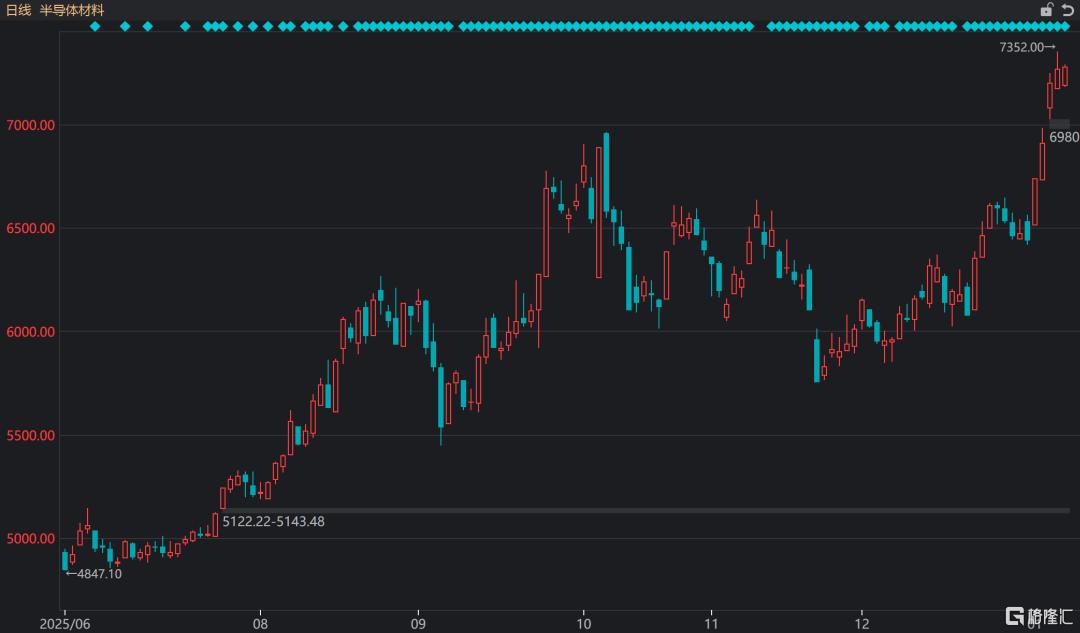
Core Viewpoint - The semiconductor materials sector in A-shares has shown strong performance driven by a combination of policy support, surging demand from AI, and technological advancements, leading to significant investment opportunities in the industry [1][3][21]. Group 1: Demand Explosion - The AI computing revolution is expected to significantly increase demand, with global AI server shipments projected to exceed 3 million units by 2026, leading to a doubling of material usage per wafer due to new technologies [4][5]. - The global expansion of wafer fabs is set to add certainty to capacity growth, with 48 new fabs expected to come online in 2024, primarily in advanced 12-inch processes, further driving material demand [5]. Group 2: Technological Breakthroughs - Domestic companies have made substantial progress in achieving self-sufficiency in mature process materials, with over 40% localization rates for products like 8-inch silicon wafers and polishing liquids [6]. - The emergence of third-generation semiconductor materials, such as silicon carbide (SiC) and gallium nitride (GaN), is creating new growth avenues, particularly in electric vehicles and 5G applications, with a compound annual growth rate exceeding 25% [6][7]. Group 3: Policy Support - The anti-dumping investigation into imported dichlorodihydrosilane from Japan is seen as a timely opportunity for domestic semiconductor materials, potentially increasing local market share if dumping is confirmed [8]. - Continuous domestic policy support, including significant funding from the National Integrated Circuit Investment Fund, is expected to accelerate breakthroughs in domestic materials [9][10]. Group 4: Market Dynamics - The semiconductor materials market is characterized by a high concentration of foreign firms, particularly in high-end segments like silicon wafers and photoresists, where Japanese companies dominate [11][14]. - Despite progress in domestic production, critical segments such as EUV photoresists and high-end electronic gases remain heavily reliant on imports, highlighting ongoing challenges in achieving full self-sufficiency [19][20]. Group 5: Investment Opportunities - Investment opportunities are emerging in high-end segments with low localization rates, particularly in areas like ArF photoresists and advanced target materials, where domestic firms are poised to benefit from policy support and technological advancements [22]. - The anti-dumping measures are expected to create immediate benefits for domestic players in the chemical processing sector, particularly for dichlorodihydrosilane and upstream materials for photoresists [23]. - The demand-driven segments, particularly those related to AI and wafer fab expansions, are anticipated to experience exponential growth, presenting clear investment prospects [24].

重磅!全球关键电子材料应用进展与我国未来发展方向(23000字)
材料汇· 2025-12-23 15:04
Core Viewpoint - The article emphasizes the importance of electronic materials in various high-tech industries, highlighting the need for innovation and domestic production capabilities to enhance China's competitiveness in the global market [7][9]. Group 1: Industry Overview - Electronic materials are crucial for manufacturing electronic devices, integrated circuits (ICs), and optoelectronic devices, directly impacting product functionality and efficiency [7]. - The global semiconductor industry is projected to reach a total sales of $526.8 billion in 2023, with IC electronic materials accounting for approximately 12.7% of this market [7]. - The demand for electronic materials is increasing in sectors such as ICs, display technology, photovoltaic energy, and high-end capacitors/resistors, driven by advancements in information technology and communication [7][9]. Group 2: Key Electronic Materials - **Semiconductor Materials**: Silicon (Si) is the primary material used in over 95% of semiconductor devices, with a market dominated by companies like Shin-Etsu Chemical and Sumco, holding over 90% market share in 8-12 inch wafers [11][15]. - **Electronic Specialty Gases**: The market for electronic specialty gases is highly concentrated, with major players like Air Products and Linde holding over 80% market share. The largest category, NF3, has a market size of $8.8 billion [16][18]. - **Photoresists**: The photoresist market is critical for IC manufacturing, with costs accounting for about 35% of total chip manufacturing costs. The development of EUV photoresists is essential for advanced nodes below 7nm [19][21]. - **Wet Electronic Chemicals**: The global market for wet electronic chemicals was valued at 639.1 billion yuan in 2022, with a projected growth rate of 8.9% annually [25]. - **CMP Materials**: Chemical Mechanical Polishing (CMP) materials are vital for achieving high precision in wafer manufacturing, with the global market for CMP pads and slurries growing significantly from 2016 to 2021 [28][29]. - **Third-Generation Semiconductor Materials**: Materials like SiC and GaN are gaining traction due to their superior properties for high-frequency and high-power applications, with China's market for these materials reaching approximately 85.4 billion yuan in 2023 [30][31]. Group 3: Market Dynamics and Trends - The electronic materials industry is characterized by a high degree of international competition, with the U.S., Europe, Japan, South Korea, and China being the main players [8]. - The ongoing technological revolution and industrial transformation present both challenges and opportunities for the electronic materials sector, necessitating advancements in material performance to meet the demands of emerging technologies like 6G and quantum computing [8][9]. - The article highlights the need for China to enhance its domestic production capabilities and innovation in electronic materials to ensure supply chain security and reduce reliance on foreign imports [9].

博来纳润数亿投建双厂占先机,领跑行业量产CMP材料|新质衢州
2 1 Shi Ji Jing Ji Bao Dao· 2025-11-26 11:02
Core Viewpoint - The domestic semiconductor CMP (Chemical Mechanical Polishing) materials market is accelerating its localization process, driven by both external pressures and internal demands for innovation in the integrated circuit industry [1]. Group 1: Company Overview - Zhejiang Bolainarun Electronic Materials Co., Ltd. was established in 2022, focusing on providing comprehensive CMP material solutions for semiconductor planarization processes, with over 10 years of R&D and industrialization experience [1]. - The company has a diverse client base, including Tianyue Advanced, ShuoKe Crystal, Lian Micro, Youyan Silicon, Hejing Silicon, Lens Technology, and Bern [1]. Group 2: Market Dynamics - Prior to 2020, CMP materials in China were heavily reliant on imports. The dual pressures of international trade friction and the domestic industry's transition to advanced processes have created opportunities for local innovation [1]. - The current domestic CMP materials localization rate is approximately 30%, with Bolainarun achieving full coverage of leading domestic clients in the substrate sector and beginning testing processes with major chip manufacturers [2]. Group 3: Product Development and Competitiveness - Bolainarun aims to be a comprehensive solution provider for CMP materials, producing abrasives, polishing liquids, and pads to enhance customer experience and address CMP process challenges [2]. - The company’s silicon carbide substrate products reportedly have a lifespan 1.5 to 2 times longer than similar imported products, aiming for "superior replacement" rather than mere localization [2]. Group 4: Investment and Production Capacity - Bolainarun has invested significantly in building two production bases in Quzhou, with the first phase of production starting in September 2023, targeting an annual output value exceeding 400 million yuan [3][4]. - The first phase includes a planned capacity of 6,000 tons of silicon sol, 15 million square meters of polishing pads, and 18,000 tons of CMP polishing liquid, with the second phase expected to partially commence production by the end of the year [3]. Group 5: Strategic Location and Collaboration - The company has established operational and R&D centers in Shanghai, Hangzhou, and Quzhou, with Quzhou providing a government-leased factory space that facilitated rapid production startup [6]. - Bolainarun has initiated the establishment of a concept verification center for integrated circuit materials in Quzhou, aimed at enhancing testing feedback and R&D efficiency, thereby boosting the local semiconductor materials cluster [6].
鼎龙股份(300054):Q2盈利能力持续提升 新业务布局打开成长空间
Xin Lang Cai Jing· 2025-09-17 04:35
Core Insights - The company reported a significant increase in revenue and net profit for the first half of 2025, with revenue reaching approximately 1.73 billion yuan, a year-on-year growth of about 14.0%, and a net profit of approximately 310 million yuan, a year-on-year increase of about 42.8% [1] - The company's gross margin improved to 49.2%, up by approximately 4.0 percentage points year-on-year, indicating enhanced profitability [1] Financial Performance - For Q2 2025, the company achieved revenue of approximately 910 million yuan, a year-on-year increase of about 11.9% and a quarter-on-quarter increase of about 10.2% [1] - The net profit for Q2 was approximately 170 million yuan, reflecting a year-on-year growth of about 24.8% and a quarter-on-quarter growth of about 20.6% [1] - The gross margin for Q2 was approximately 49.6%, showing a year-on-year increase of about 3.6% and a quarter-on-quarter increase of about 0.8% [1] Business Segments - CMP polishing pads generated revenue of 480 million yuan in H1 2025, a year-on-year increase of 59.6%, with Q2 revenue reaching a record high of 260 million yuan [2] - CMP polishing liquids and cleaning liquids achieved revenue of 120 million yuan in H1 2025, a year-on-year increase of 55.2%, with successful orders for copper polishing liquids and multi-crystalline silicon polishing liquids [2] - Semiconductor display materials revenue reached 270 million yuan in H1 2025, a year-on-year growth of 61.9%, establishing the company as a leading domestic supplier [2] - The company has developed nearly 30 types of high-end wafer photoresists, with over 15 products sent for customer verification and more than 10 products in gallon sample testing [2] - The semiconductor advanced packaging materials business has begun initial sales, with 7 types of packaging PI products developed and orders received from 3 customers [2] Investment Outlook - The company is projected to achieve revenues of 3.96 billion yuan, 4.73 billion yuan, and 5.75 billion yuan for 2025-2027, with net profits of 720 million yuan, 940 million yuan, and 1.22 billion yuan respectively [3] - Corresponding EPS is expected to be 0.76, 0.99, and 1.29, with PE ratios of 40.24, 30.9, and 23.7x [3]
兴业证券:承接Capex后周期产能释放和需求复苏 持续看好Opex业务景气度提升
Zhi Tong Cai Jing· 2025-06-17 06:55
Group 1 - The core viewpoint is that the semiconductor materials industry is expected to benefit from a recovery in demand and the ongoing trend of domestic substitution, leading to growth opportunities in the sector [1][2][3] - The global semiconductor materials market is projected to reach approximately $67.5 billion in 2024, with a year-on-year growth of 3.8%, following a downturn in 2023 [2] - The domestic wafer manufacturing capital expenditure remains high, which, combined with the recovery in demand, is expected to drive stable growth in materials and other operational expenditure (Opex) businesses [2][3] Group 2 - The domestic semiconductor materials market has seen significant progress in domestic substitution, with over 40% localization rates in silicon wafers, wet electronic chemicals, CMP materials, and target materials [3] - In 2024, the total revenue of selected semiconductor materials companies in China is estimated to be around 34 billion yuan, reflecting a year-on-year increase of 20%, primarily driven by the recovery in downstream terminal demand [3] - However, the net profit for these companies is expected to decline by 35% year-on-year, largely due to losses from companies like Shanghai Silicon Industry and Li'an Micro, which are affected by intensified competition and falling silicon wafer prices [3]

半导体材料:承接 Capex 后周期产能释放和需求复苏,持续看好 Opex 业务景气度提升
2025-06-16 15:20
Summary of Semiconductor Materials Industry Conference Call Industry Overview - The global semiconductor materials market is projected to reach $67.5 billion in 2024, with a year-on-year growth of 3.8% [1][4] - Wafer manufacturing materials account for 64% of the market, while packaging materials make up 36% [1][4] - The market size in mainland China is expected to reach $13.5 billion, with a compound annual growth rate (CAGR) of approximately 8%, making it the second-largest market after Taiwan [1][4] Key Insights and Arguments - Capital expenditure (Capex) in semiconductor equipment significantly influences operational expenditure (Opex) demand, with a robust growth forecast for Opex due to high Capex levels [1][5] - The semiconductor industry is expected to see a capacity growth rate of about 15% in 2025-2026, with an industry beta coefficient growth potentially reaching 20%-30% due to increased capacity utilization [1][5][6] - Recovery in consumer electronics and automotive industries is driving marginal demand for semiconductors, with emerging applications like AI further increasing demand for underlying chips [1][8] - The IPO project of Huahong will release new capacity in the second half of the year, addressing market demand [1][9] Market Composition and Trends - Silicon wafers represent 38% of semiconductor materials, while photolithography machines and auxiliary materials account for 12% [1][10] - Domestic production rates for silicon wafers, CMP materials, and wet electronic chemicals have exceeded 40%, but photolithography resists and electronic gases still have room for improvement in domestic production [1][10] Specific Market Segments - The global semiconductor silicon wafer market saw a 6.5% decline last year, with domestic companies like Shanghai Silicon Industry and TCL Zhonghuan actively expanding production [2][11] - The electronic gas market consists of bulk gases (55%) and specialty gases (45%), with domestic production of specialty gases being less than 30% [2][12][14] - The specialty gas sector experienced revenue declines last year, but prices have stabilized and are expected to recover, marking a turning point for many gas companies [2][15] - The semiconductor mask market is primarily dominated by third-party manufacturers, with low domestic production rates but potential for growth from companies like Qingyi Optoelectronics [2][16] Company Performance and Projections - Major semiconductor material companies reported a total revenue of approximately 34 billion RMB in 2024, a year-on-year increase of nearly 20%, but net profits fell by about 35% due to price competition and depreciation pressures [2][22] - Companies like Anji Technology and Dinglong Co. are positioned to benefit from industry growth, with Anji's revenue compound annual growth rate nearing 45% over the past five years [2][22] - The semiconductor materials sector is expected to see a beta growth rate of 20-30% in the coming years, with potential for individual companies to achieve alpha growth through product expansion and increased domestic production [2][23] Investment Outlook - The semiconductor materials sector is viewed as having high certainty and is considered a promising investment direction, with some companies potentially doubling their stock value over three years [2][23] - Current stock prices of many material companies have retraced to bottom levels, making the third quarter of this year an opportune time for asset allocation [2][23]
6月重要政策催化,最新利好领域梳理(附名单)
摩尔投研精选· 2025-05-30 10:48
Core Viewpoint - The market in May showed a pattern of fluctuating trends with rapid sector rotation, indicating a lack of sustained momentum and clear profit-making opportunities. The expectation for June is a shift towards large-cap growth stocks, with core assets expected to show early signs of profit recovery [1]. Group 1: Market Trends - In May, various sectors were frequently speculated upon, including Huawei's HarmonyOS, military aircraft, and innovative drugs, reflecting poor market sustainability and rapid rotation among sectors [1]. - The anticipated market style for June is a transition to large-cap growth, with a focus on core assets showing profit inflection points [1]. Group 2: Emerging Hot Topics for June - **Low-altitude Economy**: Recent policies in regions like Sichuan and Shandong support low-altitude economic development, including a 30 billion yuan special fund and the establishment of 400 digital takeoff and landing platforms [3]. - **AI and Robotics**: Significant breakthroughs in AI technology have been noted, with advancements in models from Anthropic and Google, as well as ongoing optimizations in domestic models like Baidu's Wenxin and iFlytek's Spark [5]. - **6G Technology**: The global research on 6G technology standards has officially commenced, with China leading the development process, aiming to complete the first version of technical specifications by 2029 [6]. - **Semiconductor Self-sufficiency**: The U.S. has intensified semiconductor export controls against China, prompting accelerated domestic alternatives and a notable increase in the domestic EDA tool localization rate to 35% within a week [7]. - **Federal Reserve Policy Shift**: The upcoming Federal Reserve meeting is expected to provide economic outlooks, with market speculation leaning towards potential interest rate cuts in late 2025, which could benefit high-debt sectors like real estate and consumer goods [8]. Group 3: Key Companies and Sectors - **Low-altitude Economy**: Key players include SF Holding (drone delivery network), Zhongyun Drone (military-to-civil technology), and Huace Navigation (low-altitude smart network) [3][4]. - **AI and Robotics**: Core companies include Zhongke Shuguang (computing chips), Inspur Information (servers), and Keda Xunfei (AI applications in education and healthcare) [5][4]. - **6G Technology**: Major companies involved are ZTE Corporation (base station equipment) and China Satellite Communications (satellite manufacturing) [6][4]. - **Semiconductors**: Key firms include Zhongwei Company (etching machines) and Zhaoyi Innovation (NOR Flash) [7][4]. - **Real Estate and Gold**: Notable companies are Poly Development (state-owned enterprise reform) and Shandong Gold (benefiting from rising gold prices) [8][4].

衢州智造新城多举措助推企业“升规纳统”
Zhong Guo Hua Gong Bao· 2025-05-20 07:23
Group 1 - The core viewpoint of the articles highlights the rapid growth and expansion of companies in the Zhuzhou Intelligent Manufacturing New City, particularly Zhejiang Te Ying Low Temperature Liquefaction Equipment Co., Ltd. and Zhejiang Bolainarun Electronic Materials Co., Ltd. [1][2] - Zhejiang Te Ying achieved a production value of 200 million yuan last year, with over 100 million yuan already this year, indicating a strong upward trend in development [1] - Zhejiang Bolainarun plans to double the production value of its self-developed CMP materials this year, supported by a complete upstream and downstream industrial chain in Chuzhou [1] Group 2 - The Zhuzhou Intelligent Manufacturing New City has established a tiered mechanism for nurturing "small-scale enterprises," promoting their growth through policy support and resource guarantees [2] - In 2024, 38 industrial enterprises in Zhuzhou Intelligent Manufacturing New City are expected to complete their transformation into "small-scale enterprises," achieving a record total output value of 2.345 billion yuan [2] - The upgraded enterprises span various industries, including equipment manufacturing, new materials, life health, and integrated circuits, with a total of 378 regulated industrial enterprises currently in the Intelligent Manufacturing New City [2]
【光大研究每日速递】20250314
光大证券研究· 2025-03-13 09:05
Group 1 - The article discusses the investment value of the lithium mining sector from the perspective of reset costs, indicating that the overall stock prices tend to rise during the clearing phase of the previous cycle [4] - Reset cost calculations include intangible assets primarily related to mining rights and fixed assets such as lithium salt smelting plants and mining selection plants, suggesting that many companies are currently undervalued even when only considering their lithium mining operations [4] Group 2 - The commercial aerospace industry is expected to drive demand, with government policies encouraging social capital participation in China's aerospace sector, highlighting the importance of rocket launch services as a key area of policy support [5] - Sulfur prices have significantly increased due to supply-demand mismatches and rising downstream demand for phosphate fertilizers, while domestic inventory continues to deplete due to reduced sulfur imports from overseas [6] Group 3 - EHang Intelligent achieved a total revenue of 456 million yuan in 2024, representing a year-on-year growth of 288.5%, with a gross margin of 61.4%, slightly down from 64.1% in 2023, marking the first year of adjusted profitability and positive operating cash flow [8] - The semiconductor materials market is recovering driven by AI industry growth, replenishment of storage chips, and expansion of wafer fabs, with high-end materials' localization process accelerating across various segments [9] Group 4 - Industrial Fulian reported a revenue of 609.1 billion yuan in 2024, a year-on-year increase of 27.88%, and a net profit attributable to shareholders of 23.216 billion yuan, up 10.34%, driven by the growing demand for AI computing infrastructure and advancements in smart manufacturing [11]