IGX Thor

Search documents
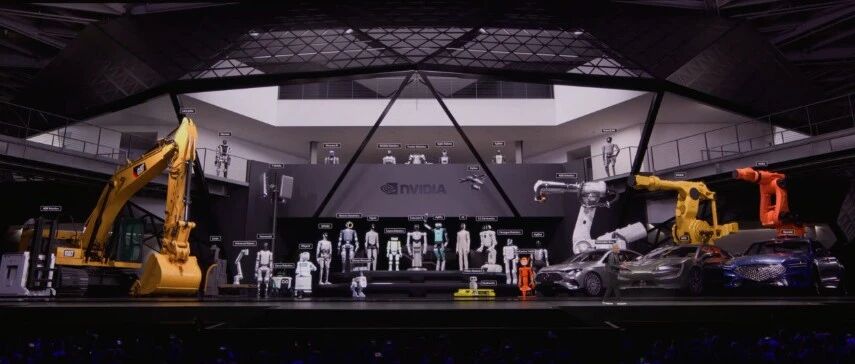
GTC 2026上,英伟达展现的六大机器人趋势
机器人大讲堂· 2026-03-17 15:00
Core Viewpoint - NVIDIA is promoting the concept of "Physical Artificial Intelligence" at the GTC 2026 conference, which expands on the advancements in large language models and generative AI tools to enhance robotics capabilities [2][6]. Group 1: Trends in Robotics - Trend 1: NVIDIA accelerates the simulation and synthetic data generation to "feed" robots [4]. - Trend 2: NVIDIA collaborates with FANUC and ABB to evolve industrial robots [4]. - Trend 3: NVIDIA is building a "General-Expert" brain system for robots [5]. - Trend 4: The GR0 0T N2 architecture enables faster deployment of humanoid robots [5]. - Trend 5: NVIDIA's IGX Thor is aiding breakthroughs in medical robotics [5]. - Trend 6: NVIDIA is driving the global robotics ecosystem co-construction [4]. Group 2: Physical AI Strategy - NVIDIA aims to replace expensive real-world data collection with simulation and synthetic data generation, transforming data challenges into computational problems [6]. - The company has developed a comprehensive platform strategy that includes chips, computing platforms, open models, simulation tools, software frameworks, and security architectures, covering the entire value chain of physical AI systems [6]. - NVIDIA's founder, Jensen Huang, stated that every industrial company will become a robotics company in the future [6][7]. Group 3: Market Potential - The market for industrial robots driven by AI is projected to reach $80 billion by 2030 [10]. - NVIDIA is expanding its physical AI platform into autonomous driving, industrial robots, and humanoid robots, establishing partnerships with major industrial players like ABB and FANUC [10]. Group 4: Generalized Robot Intelligence - NVIDIA is transitioning robots from specialized devices to general-expert systems capable of adaptive and specialized tasks while maintaining industrial-grade precision and reliability [12]. - The company introduced the Cosmos 3 model, which combines synthetic world generation, visual reasoning, and action simulation to enhance robotic capabilities [12][14]. - The open reference architecture consists of three stages for automating the data flow from raw data to final training datasets [14]. Group 5: Humanoid Robots - NVIDIA launched a foundational model based on GR0 0T N1.7 for humanoid robots, which includes dexterous control capabilities [16]. - The GR0 0T series models are designed to handle various tasks across different robotic platforms, with leading developers adopting NVIDIA's Isaac GR0 0T models to accelerate industrial deployment [17]. Group 6: Medical Robotics - NVIDIA's IGX Thor platform is aimed at edge applications in safety-critical environments, facilitating the deployment of autonomous systems in healthcare [20]. - Companies like CMR Surgical and Johnson & Johnson are utilizing NVIDIA's simulation technologies for training and validating their surgical systems [20][21]. Group 7: Ecosystem Collaboration - NVIDIA is fostering deep collaboration within the robotics ecosystem by building an open physical AI platform that integrates design, training, testing, and deployment [23]. - The BONES-SEED dataset, which includes 142,000 high-fidelity human motion animations, is being developed to support humanoid robotics applications [23]. - Disney is using NVIDIA's technology to train its robots, showcasing the practical applications of NVIDIA's simulation tools in real-world scenarios [24][25]. Group 8: Conclusion and Future Outlook - NVIDIA's robotics platform strategy follows a familiar model of providing tools and infrastructure to enable others to innovate [27]. - The importance of the tools provided by NVIDIA for robotics technology is likened to the significance of CUDA for machine learning [27]. - The focus is not on whether the era of intelligent robots will arrive, but on NVIDIA's ability to maintain its position as a global supplier of robotic "brains" [27].


AI与机器人盘前速递丨英伟达预测27年前算力需求达万亿美元,优必选合作西门子冲刺万台产能
Mei Ri Jing Ji Xin Wen· 2026-03-17 01:20
Market Overview - The A-share market for artificial intelligence and robotics has shown signs of recovery after a period of decline, with both thematic ETFs experiencing a rebound after initial dips, indicating a gradual stabilization of market sentiment [1] - The market has shifted from a phase of low trading volume consolidation to a stage of recovery, supported by mid to long-term capital inflows [1] ETF Performance - The Huaxia Sci-Tech AI ETF (589010) fluctuated in the morning but stabilized in the afternoon, closing at 1.458 yuan, with 15 out of 30 tracked stocks rising, signaling a recovery in the sector [2] - Key performers included Lingyun Optics, which rose over 7%, and other stocks like Lanke Technology and Yuntian Lifeng, which increased by over 3%, boosting overall market sentiment [2] - The ETF recorded a total trading volume of 69.82 million yuan and a turnover rate of 3.14%, indicating a steady trading rhythm [2] - The Robotics ETF (562500) also saw a morning dip followed by a recovery, closing at 1.004 yuan, with 29 out of 66 tracked stocks rising, although structural differentiation remains evident [2] - The ETF had a trading volume of 730 million yuan and a turnover rate of 3.23%, with increased trading activity in the afternoon [2] Strategic Insights - The investment strategy suggests monitoring the stability of average price support and the sustainability of the rebound, with a focus on core stocks that can lead the market [2] - For investors with higher risk tolerance, there are opportunities to capitalize on the strong and weak stock transitions within the sector as market sentiment improves [2] Industry Developments - NVIDIA's CEO Jensen Huang announced a significant increase in computing demand, projecting a doubling of the forecasted computing needs to $1 trillion by 2027, introducing the concept of "token factories" for future data centers [3] - NVIDIA also unveiled advancements in AI computing for space applications, enhancing the capabilities of its Vera Rubin architecture and achieving a 25-fold increase in space inference computing power compared to previous models [3] - UBTECH and Siemens signed a strategic cooperation agreement to enhance humanoid robot production, aiming for a target of 10,000 industrial humanoid robots by 2026 [4] - Bank of America predicts that annual shipments of humanoid robots will grow from 90,000 units in 2026 to 1.2 million units by 2030, with a compound annual growth rate of 86% [4]

英伟达发布“太空算力模块”,“太空版” Vera Rubin后续将推出
Hua Er Jie Jian Wen· 2026-03-17 00:26
Core Insights - Nvidia is expanding its AI computing capabilities into space, introducing dedicated computing modules for space scenarios and an enterprise-level AI agent platform called NemoClaw [1][2] Group 1: Space Computing Modules - Nvidia announced the launch of space-specific computing modules at the GTC annual developer conference, showcasing its ambition in AI infrastructure [1] - The new modules are designed for applications such as orbital data centers, advanced geospatial intelligence processing, and autonomous space operations, offering up to 25 times the AI inference power compared to the previously deployed H100 GPU [1][2] - The Vera Rubin space module is set to be officially launched at a later date, while the IGX Thor and Jetson Orin products are already available [2] Group 2: Partnerships and Applications - Six partners, including Aetherflux and Axiom Space, will deploy Nvidia's computing hardware in orbit, with Aetherflux aiming for solar-powered AI inference using the Vera Rubin module [1][2] - Sophia Space and Kepler Communications are also integrating Nvidia's Jetson series products into their platforms [2] Group 3: AI Agent Platform - NemoClaw - Nvidia introduced the NemoClaw platform, designed to provide enterprises with secure and privacy-compliant local AI agent deployment capabilities, currently in early Alpha testing [1][5] - NemoClaw is built on the open-source AI agent project OpenClaw, incorporating enterprise-level security and privacy mechanisms, allowing unified control over agent behavior and data processing [6] - The platform is compatible with any programming agent or open-source AI model, including Nvidia's own NemoTron model, and is integrated with Nvidia's AI agent software suite NeMo [6] Group 4: Competitive Landscape - The space computing sector is attracting major players, with Google planning to launch multiple TPUs into space and SpaceX's Elon Musk seeking to deploy a constellation of satellites for orbital AI data centers [4] - However, there are criticisms regarding the commercial viability of space data centers from industry leaders like OpenAI's Sam Altman and AWS's Matt Garman [4]
5分钟速览黄仁勋最新演讲
财联社· 2026-03-17 00:09
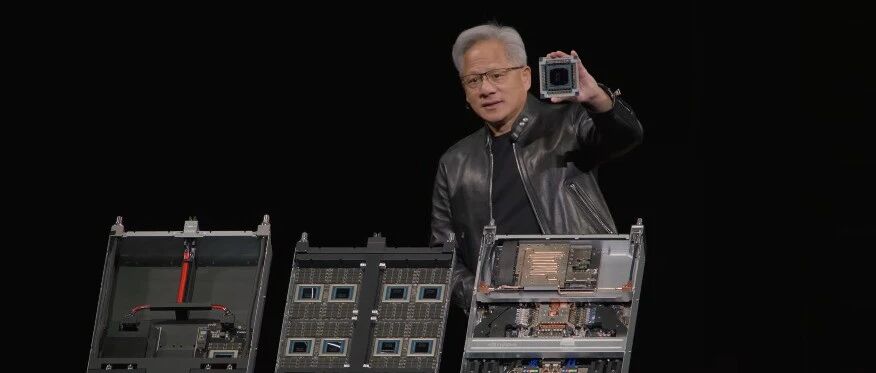
Core Insights - Nvidia's CEO Jensen Huang announced that the company's flagship chip will help generate $1 trillion in revenue by 2027, doubling previous sales forecasts for data center equipment to $500 billion by the end of 2026 [4][6]. - The stock price of Nvidia saw an intraday increase of over 4%, closing up by 1.6% [7]. Group 1: AI Hardware and Software Innovations - Nvidia introduced the Vera Rubin platform, which is a complete AI supercomputer platform consisting of seven types of chips and five rack systems, rather than a single chip [8]. - The Vera CPU rack integrates 256 Vera CPUs, achieving double the computational efficiency and a 50% increase in speed compared to traditional CPUs [10]. - The Groq 3 LPX rack features 256 LPU processors, providing 128GB on-chip SRAM and 640TB/s expandable bandwidth, enhancing inference throughput/power consumption by 35 times when combined with the Vera Rubin platform [10]. Group 2: Advanced Cooling and Networking Technologies - All introduced racks utilize liquid cooling architecture [12]. - The Spectrum-6 SPX employs Co-Packaged Optics (CPO) technology, resulting in five times higher optical power efficiency and ten times greater network reliability [13]. Group 3: Future Product Developments - The Rubin Ultra will utilize vertical insertion arrangements in the Kyber rack, allowing for the connection of 144 GPUs within a single NVLink domain [15]. - Future GPUs will adopt stacked chip and custom HBM technology [15]. Group 4: Space and AI Integration - Nvidia launched the Space-1 Vera Rubin module, which deploys data center-level AI computing capabilities to satellites and orbital data centers, focusing on on-orbit inference and real-time geospatial intelligence [16]. - The product lineup, including Jetson Orin, IGX Thor, RTX PRO 6000 Blackwell GPU, and the upcoming Space-1 module, creates a comprehensive computing architecture from edge computing to cloud analysis [18]. Group 5: AI in New Industries - Nvidia is entering the lobster industry with NemoClaw, an AI agent platform that allows for simplified deployment of AI agents with a focus on safety and privacy [19]. - The company is expanding its open foundational model family to cover three major AI areas: Agentic AI, Physical AI, and Medical AI [19]. Group 6: Breakthroughs in Graphics Technology - Nvidia announced DLSS 5, claiming it to be the most significant breakthrough in computer graphics since the introduction of real-time ray tracing in 2018 [20]. - Huang described DLSS 5 as a "GPT moment" in graphics, combining traditional 3D graphics data with generative AI models to enhance image rendering [21].
英伟达推出太空计算服务,将人工智能送入轨道
Xin Lang Cai Jing· 2026-03-16 20:24
Core Insights - NVIDIA has launched a space computing service plan at the GTC conference, introducing the Space-1 Vera Rubin module, IGX Thor, and Jetson Orin platforms designed for environments with constraints on size, weight, and power, providing data center-level performance and edge AI inference [1][2] Group 1 - The NVIDIA Space-1 Vera Rubin module is the latest component of NVIDIA's space-accelerated platform, offering up to 25 times the AI computing power for space-based inference compared to the NVIDIA H100 GPU, enabling next-generation capabilities for distributed computing centers (ODC), advanced geospatial intelligence processing, and autonomous space operations [1][2] - NVIDIA's CEO Jensen Huang emphasized that space computing is the final frontier, stating that intelligence must exist wherever data is generated as satellite constellations are deployed and space exploration deepens [1][2] - The AI processing across space and ground systems can facilitate real-time perception, decision-making, and autonomous operations, transforming orbital data centers into tools for exploration and spacecraft into autonomous navigation systems [1][2]
Nvidia announces Vera Rubin Space-1 chip system for orbital AI data centers
CNBC· 2026-03-16 20:24
Core Insights - Nvidia has launched computing platforms for orbital data centers, marking a significant advancement in artificial intelligence applications in space [1] - The Vera Rubin Space-1 Module, featuring IGX Thor and Jetson Orin chips, is designed for space missions and optimized for size, weight, and power constraints [1] - Nvidia's CEO Jensen Huang highlighted the need for intelligence to be present wherever data is generated as satellite constellations are deployed [1] Industry Developments - Nvidia is collaborating with partners like Axiom Space, Starcloud, and Planet to develop a new computer for orbital data centers, facing engineering challenges related to cooling systems in the absence of convection in space [2] - The rising electricity costs associated with data center buildouts for AI have led to interest in orbital data centers, although high launch costs and limited availability pose significant barriers [2] - Other companies, such as Google with its 'Project Suncatcher' and Elon Musk's xAI, are also exploring the potential of space computing, indicating a competitive landscape [3] Regulatory and Environmental Concerns - SpaceX has sought approval from the Federal Communications Commission to launch 1 million satellites for AI centers, a plan that has faced opposition from scientists due to environmental concerns like light pollution and orbital debris [4]
Archer Aviation Is Putting NVIDIA’s IGX Thor at the Core of Its Air Taxi’s Brain
Yahoo Finance· 2026-03-03 14:56
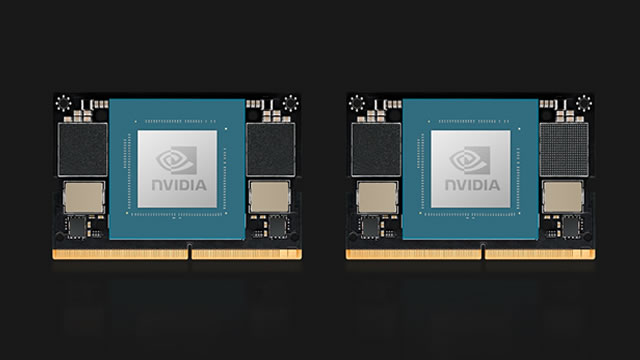
Core Insights - Archer Aviation is integrating NVIDIA's IGX Thor compute platform into its Midnight eVTOL aircraft for safety-critical autonomy applications, marking a significant hardware decision rather than a mere branding partnership [2][7] Technology Integration - IGX Thor is designed for real-time inference in safety-critical environments, focusing on low latency, reliability, and functional safety certification, which are essential for autonomous air taxis operating in urban airspace [3] - The integration allows for onboard sensor fusion, obstacle detection, and flight decision logic to operate on a unified, certifiable compute platform, enhancing compliance with aviation regulatory requirements for safety-critical software [4][7] Financial Position - Archer Aviation reported a fourth-quarter 2025 EPS of approximately -$0.24, consistent with its pre-revenue burn profile as it remains in the certification and early commercialization phase [5] - The company's market capitalization was approximately $5.23 billion, indicating investor confidence in the long-term potential of the commercial air taxi market despite ongoing cash consumption [5] Partnership Credibility - The partnership with NVIDIA adds credibility to Archer's technical roadmap, as NVIDIA has reported four consecutive quarters of earnings beats, showcasing the expansion of its AI compute business into industrial applications like Archer's eVTOL platform [6]

Archer Aviation Is Putting NVIDIA's IGX Thor at the Core of Its Air Taxi's Brain
247Wallst· 2026-03-03 14:56
Core Insights - Archer Aviation (ACHR) is integrating NVIDIA's (NVDA) IGX Thor compute platform into its Midnight aircraft for enhanced safety in flight autonomy [1] Company Developments - The integration of NVIDIA's IGX Thor compute platform is aimed at improving safety-critical flight autonomy features in Archer Aviation's Midnight aircraft [1]
计算机行业点评报告:英伟达(NVDA.O):Blackwell系列与数据中心推动公司业绩创高
Huaxin Securities· 2025-11-23 13:35
Investment Rating - The report maintains a "Recommendation" rating for the industry [10] Core Insights - The report highlights that NVIDIA achieved a revenue of $57 billion in Q3 2025, representing a year-on-year growth of 62% and a quarter-on-quarter growth of 22%. The data center business generated $51.2 billion, with a year-on-year increase of 66% and a quarter-on-quarter increase of 25% [3][4] - NVIDIA's GAAP gross margin was 73.4%, and net profit reached $31.91 billion, reflecting a year-on-year growth of 65% [4][7] - The Blackwell architecture has been fully implemented, driving product updates and performance breakthroughs across multiple product lines [4][6] Revenue and Profit Performance - Total revenue for NVIDIA in Q3 2025 was $57 billion, with the data center segment contributing $51.2 billion, accounting for nearly 90% of total revenue [4] - The gaming, professional visualization, and automotive and robotics segments also saw year-on-year growth of 30%, 56%, and 32%, respectively [4] - GAAP net profit was $31.91 billion, with a GAAP gross margin of 73.4%, indicating stable profitability [4] Product and Technology Layout - The Blackwell architecture has led to significant updates in NVIDIA's product offerings, including the new GPU "NVIDIA Rubin CPX" designed for large-scale context processing [4][6] - New gaming titles such as "Borderlands 4" and "Battlefield 6" were released, enhancing player experience with advanced technologies [4] - NVIDIA introduced the world's smallest AI supercomputer, DGX Spark, and upgraded its automotive and robotics platforms with the DRIVE AGX Hyperion 10 development platform [4][6] Customer and Ecosystem Cooperation - NVIDIA has expanded its global strategic partnerships, including a collaboration with OpenAI for AI infrastructure deployment [6] - Partnerships with major companies like Google Cloud, Microsoft, and Oracle aim to build AI infrastructure in the U.S. and Europe [6] - In Asia, NVIDIA is working with the South Korean government and major corporations to enhance AI infrastructure [6] AI Technology Empowerment - AI remains the core driver of NVIDIA's strategy, with breakthroughs in training and inference achieved during the quarter [6] - The Blackwell platform set records in MLPerf Inference v5.1 benchmarks, showcasing its capabilities [6] - NVIDIA launched the NVQLink open system architecture, integrating GPU computing with quantum processors [6] Investment Recommendations - The report suggests that investors should continue to monitor NVIDIA's advancements in AI technology, global ecosystem collaborations, and multi-industry solution expansions [7]
英伟达(NVDA.US)的自动驾驶野心:从地面到天空,全能芯帝的下一块增长引擎
智通财经网· 2025-10-29 10:28
Core Insights - Nvidia unveiled a comprehensive roadmap covering seven key areas including AI, quantum computing, and autonomous driving at the GTC conference, leading to a 5% surge in stock price and a market cap nearing $5 trillion [1] Group 1: Autonomous Driving Strategy - Nvidia's partnership with Uber aims to deploy up to 100,000 autonomous taxis by 2027, with initial deliveries of at least 5,000 vehicles starting in 2028 [2] - The collaboration allows Nvidia to integrate its chips, sensors, and software into Uber's operations, creating a sustainable revenue stream [2] - Uber will establish a "robotic taxi data factory" to provide 3 million hours of driving data over three years, enhancing Nvidia's bargaining power in the L4 autonomous driving market [3] Group 2: High-End Passenger Vehicles - Lucid Group announced plans to develop L4 autonomous driving capabilities based on Nvidia's DRIVE AV platform, starting with the Gravity SUV [4] - The partnership reflects Nvidia's strategy of gradual validation from driver assistance to full autonomy, facilitating technology commercialization in the luxury vehicle market [4][5] - Lucid's dual strategy includes developing a fleet of 20,000 autonomous Gravity SUVs in collaboration with Uber and Nuro while internally advancing L4 technology [5] Group 3: Expanding into Aerial Mobility - Nvidia is collaborating with Joby Aviation to integrate its IGX Thor computing platform into Joby's aircraft, advancing autonomous flight technology [6] - This partnership aims to enhance the aircraft's ability to autonomously determine optimal flight paths and respond to various conditions [6][7] - Following the announcement, Joby Aviation's stock rose over 10%, indicating market confidence in the collaboration [7]