
L4级自动驾驶技术

Search documents
小马智行(02026)获纳入恒生综合指数 有望成为港股通标的
智通财经网· 2026-02-13 13:31
Core Viewpoint - The announcement by Hang Seng Index Company regarding the inclusion of Pony.ai (02026) in the Hang Seng Composite Index is a significant development, expected to enhance the company's visibility and investment potential in the market [1] Group 1: Index Inclusion - Pony.ai is set to be included in the Hang Seng Composite Index as of March 6, 2026, with the changes taking effect on March 9, 2026 [1] - The inclusion will lead to adjustments in the eligible stocks for the Hong Kong Stock Connect, as per the regulations of the Shanghai and Shenzhen stock exchanges [1] - According to CICC's research report, Pony.ai meets various criteria such as market capitalization, liquidity, and listing duration, making it a candidate for inclusion in the Hong Kong Stock Connect [1] Group 2: Strategic Partnership - On February 6, Pony.ai, known as the "first global Robotaxi stock," announced a strategic partnership with Moore Threads (688795.SH), a leading domestic full-function GPU company [1] - The collaboration will focus on the implementation and scaling of Level 4 autonomous driving technology, emphasizing deep cooperation on training and optimization of Pony.ai's core technologies, including the world model and virtual driver system [1] - The partnership aims to leverage safe and reliable AI computing power to facilitate the iteration and commercial deployment of autonomous driving technologies [1]
利好来袭!上海,重磅发布!明确9项重点任务
券商中国· 2026-01-14 15:17
Core Viewpoint - The article discusses the significant policy boost for the autonomous driving sector in Shanghai, highlighting the "Mosu Zhixing" action plan aimed at accelerating the transformation of autonomous driving technology into industrial competitiveness [1][2]. Group 1: Action Plan Overview - The "Mosu Zhixing" action plan outlines a strategy based on "model-driven leadership, application demonstration, industrial collaboration, and policy support" to promote innovation in autonomous driving technology [2]. - The plan includes nine key tasks across three main areas: promoting the application of autonomous driving equipment, enhancing data monitoring platforms, and expanding open areas for autonomous driving [2][3]. Group 2: Goals and Targets - By 2027, the plan aims for large-scale implementation of high-level autonomous driving scenarios, with public service platforms supporting industry innovation and achieving international leadership in key technologies and industrial scale [3]. - The plan targets over 6 million passenger trips and more than 80,000 TEU in cargo transport through L4-level autonomous driving technology in smart public transport, taxis, and heavy trucks [5]. Group 3: Infrastructure and Ecosystem Development - The action plan emphasizes the establishment of a digital twin training ground for autonomous driving and aims to create a comprehensive industrial ecosystem covering vehicles, components, data, maps, safety, and services [5][9]. - It proposes to expand the autonomous driving open area to 2,000 square kilometers, with over 5,000 kilometers of roads featuring diverse types and scenarios [5]. Group 4: Financial and Innovation Support - The plan encourages social capital investment in smart connected vehicles and key component startups, supporting quality enterprises in accessing multi-tiered capital markets [5]. - It also highlights the need for innovative insurance products that align with the advancements in autonomous driving technology [5][7]. Group 5: Industry Collaboration and Technology Development - The action plan calls for deepening commercial vehicle demonstration scenarios and advancing the operational model from "platooning with human oversight" to "fully unmanned" operations [7]. - It aims to foster collaboration between universities, research institutions, and key enterprises to accelerate the industrial application of cutting-edge technologies like autonomous driving models [9].


有序扩大自动驾驶开放区域 上海印发“模速智行”行动计划
Zheng Quan Shi Bao Wang· 2026-01-14 11:21
Group 1 - The core idea of the plan is to accelerate the transformation of autonomous driving technology innovation into industrial competitiveness, aiming to establish a leading area for high-level autonomous driving by 2027 [1] - The plan targets the large-scale application of L4-level autonomous driving technology in smart public transport, smart taxis, and smart heavy trucks, with a goal of serving over 6 million passengers and transporting over 800,000 TEUs [1] - A public service platform will be established, including a digital twin training ground for autonomous driving, with an open area of 2,000 square kilometers and over 5,000 kilometers of roads for diverse scenarios [1] Group 2 - The plan aims for over 90% of new car production to feature L2 and L3 level autonomous driving capabilities, with L4 level vehicles entering mass production and key technologies being independently controllable [2] - It emphasizes the organization of smart taxi demonstration operations and the exploration of innovative applications for L3 level autonomous vehicles in personal and unit user travel scenarios [2] - The plan includes the development of key technologies such as onboard high-performance chips and intelligent computing platforms, fostering a complete industrial ecosystem [2] Group 3 - The focus areas for developing intelligent connected vehicles and key component industries include Pudong, Jiading, and Lingang, promoting collaboration and unique characteristics in these regions [3] - The plan supports the establishment of testing and verification platforms for intelligent connected vehicles and traffic safety, enhancing the capabilities for system validation and application services [3]
L4级自动驾驶赛道分化,Robobus将成为“第一战场”?
3 6 Ke· 2025-12-23 11:17
Core Insights - The autonomous driving industry is transitioning from a phase of singular breakthroughs to a critical point of track differentiation, with companies reassessing their strategic focus based on the varying technical adaptability and commercialization potential across different scenarios [1][3] Track Differentiation - The differentiation in the L4 autonomous driving track reflects a renewed understanding of technology implementation, moving away from the misconception that overcoming core technology guarantees universal commercialization [3] - The complexity, safety, and commercial value of specific scenarios are crucial for the successful deployment of L4 technology, with Robotaxi facing significant challenges compared to more controlled environments like Robotruck and Robobus [3][4] Financing Trends - Since 2025, financing in the autonomous driving sector has increasingly concentrated on Robobus, Robotruck, and Robovan, with notable investments such as over $600 million in New Stone Technology, setting a record in China's autonomous driving financing [4] Robovan Insights - Robovan focuses on last-mile logistics with a core emphasis on low-cost scalability, with leading companies nearing the threshold of 10,000 units delivered, and prices dropping significantly to as low as 16,800 yuan [4][5] Robotruck Insights - Robotruck aims to revolutionize efficiency in long-distance logistics, addressing cost reduction needs in traditional logistics plagued by low-price competition and safety issues, gaining attention from logistics companies [5] Robobus Insights - Robobus benefits from public transport attributes, addressing high-frequency demand in urban micro-circulation and providing a clear commercial path, supported by strong policy backing [5][8] - The operational flexibility of Robobus allows it to adapt to various semi-open and closed scenarios, significantly lowering the implementation difficulty of L4 technology [9] Commercialization Pathways - Robobus has two primary commercialization models: To G, collaborating with governments for public transport integration, and To B, providing customized services for specific venues [9][10] - The scalability of Robobus operations can further reduce costs through increased order volumes, creating a positive feedback loop of cost reduction and expanded service [10] Global Expansion - Chinese companies are positioned to lead in the Robobus sector globally, leveraging complete industrial chain advantages and rich operational experience, as evidenced by successful projects in Singapore [11][12] Competitive Landscape - The competition in the Robobus sector extends beyond technology to include business models, ecosystem integration, and global capabilities, necessitating a comprehensive approach for success [12][13] - Companies must adapt to local regulations and establish deep collaborations with local partners to navigate the complexities of international markets [13][14] Challenges Ahead - Robobus faces technical challenges in specific scenarios, such as adverse weather conditions affecting sensor accuracy and the need for effective vehicle-road collaboration [14] - Initial investment costs for L4 Robobus remain high, necessitating strong financial capabilities for companies to achieve scalability [14] - A robust operational maintenance system is essential for Robobus, which includes not only vehicle maintenance but also monitoring and upgrading autonomous driving systems [14][15]
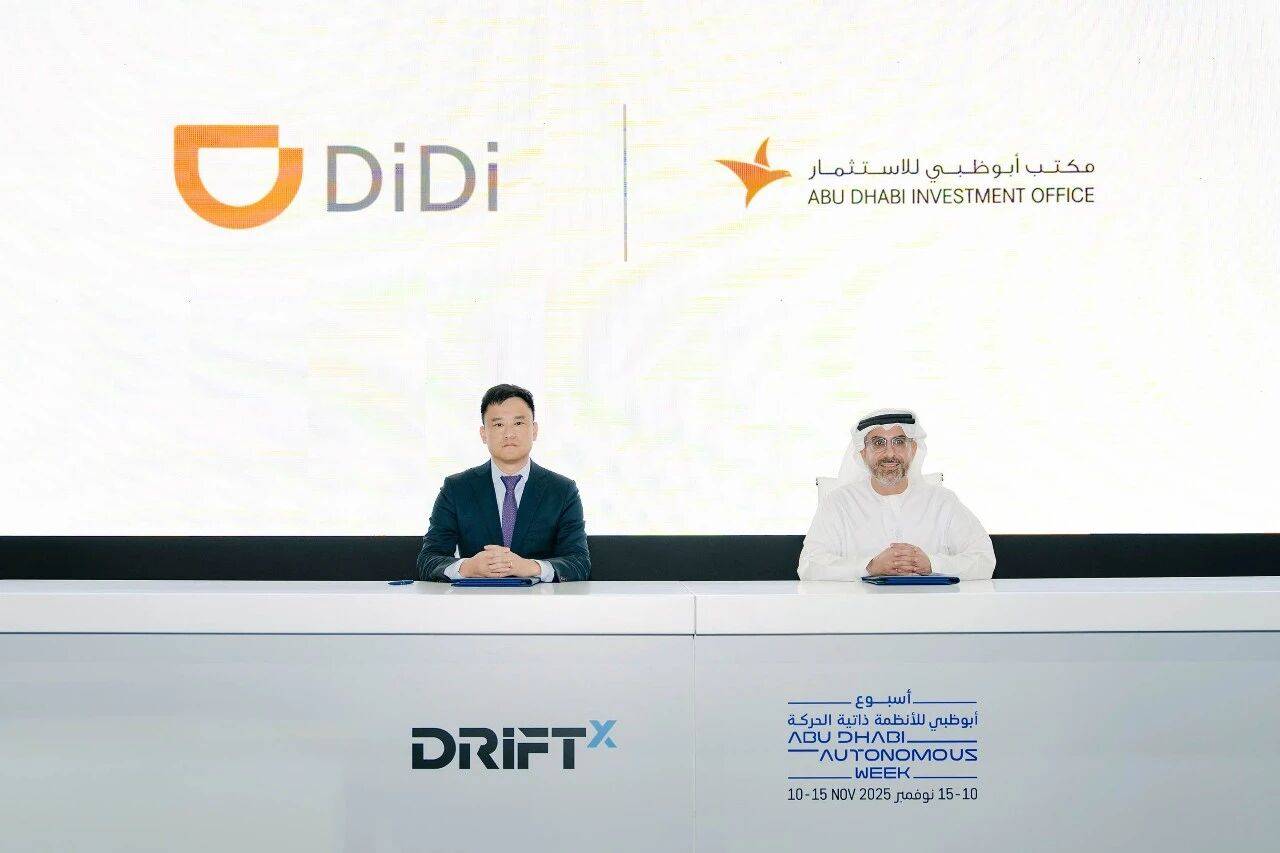
滴滴自动驾驶宣布与阿布扎比投资办公室达成战略合作
Sou Hu Cai Jing· 2025-11-13 08:36
Core Insights - Didi Autonomous Driving has announced a strategic partnership with the Abu Dhabi Investment Office (ADIO) to support the development of smart mobility and sustainable transportation ecosystems in Abu Dhabi and the broader Middle East region [1][3] Group 1: Strategic Partnership - The partnership involves Didi joining the Abu Dhabi Smart and Autonomous Vehicle Industry Cluster (SAVI) to collaborate on innovation in autonomous driving technology, AI talent development, and ecosystem building [1][3] - The collaboration aims to establish Abu Dhabi as a leading hub for smart mobility and sustainable transportation [1][3] Group 2: Economic Impact - The SAVI cluster, initiated by the Abu Dhabi Department of Economic Development and ADIO, is expected to contribute 44 billion dirhams to Abu Dhabi's GDP and create 40,000 jobs by 2045 [3] Group 3: Company Positioning - Didi Autonomous Driving is recognized as a global leader in autonomous driving technology, and the partnership is seen as a key milestone in shaping the future of transportation in Abu Dhabi [3] - The Middle East is identified as a crucial part of Didi's global strategy, aligning with Abu Dhabi's goals for smart city development and sustainable growth [3] Group 4: Technological Advancements - Didi Autonomous Driving focuses on L4-level autonomous driving technology, leveraging advanced AI for research and product application [4] - The company has achieved over 1,900 days of safe operation and plans to deliver a new generation of autonomous vehicles in collaboration with GAC Aion by the end of the year [4]

小马智行完成美股+港股双重上市
Zhong Zheng Wang· 2025-11-06 07:21
Group 1 - The core viewpoint of the articles is that Xiaoma Zhixing has successfully listed on the Hong Kong Stock Exchange, establishing a dual listing structure with its upcoming NASDAQ listing, which enhances its market presence and investor base [1][2] - Xiaoma Zhixing's IPO raised approximately HKD 7.7 billion, with around 48.25 million shares issued at an offering price of HKD 139 per share [1] - The net proceeds from the IPO will be used for the large-scale commercialization of L4 autonomous driving technology, covering business development, production, sales and marketing, customer service, and collaborations with industry participants [1] Group 2 - Since its establishment, Xiaoma Zhixing has focused on developing L4-level autonomous driving technology, particularly in the autonomous ride-hailing service sector [2] - The company also offers autonomous truck services and technology licensing, demonstrating the adaptability and scalability of L4 autonomous driving technology across different commercial scenarios [2] - Xiaoma Zhixing's Robotaxi fleet has surpassed 720 vehicles, indicating significant growth in its operational capacity [2]
继美股IPO后 优步(UBER.US)拟再参投小马智行(02026)与文远知行(00800)香港上市
Zhi Tong Cai Jing· 2025-10-28 11:56
Group 1 - Uber plans to invest approximately $100 million in Pony.ai's IPO in Hong Kong, deepening its collaboration with the autonomous taxi companies in China [1] - Pony.ai aims to raise up to $972 million in its Hong Kong IPO, excluding any potential over-allotment [1] - Other potential investors in Pony.ai's IPO may include Grab, Temasek, and Bosch [1] Group 2 - Pony.ai intends to use the funds raised from the IPO to commercialize L4 autonomous driving technology in ride-hailing and trucking services, as well as for research and development [3] - WeRide plans to utilize its IPO proceeds to accelerate the commercialization of L4 autonomous vehicle fleets and expand its business over the next five years [3] Group 3 - Uber has previously invested in both Pony.ai and WeRide during their U.S. IPOs and has announced an additional $100 million investment in WeRide [2] - Grab has been actively investing in the autonomous driving sector, including a recent investment in May Mobility, with plans to introduce autonomous taxis in Southeast Asia [2]


【IPO追踪】港股“四箭齐发”!文远知行未引入基石,筹资逾29亿
Sou Hu Cai Jing· 2025-10-28 06:11
Core Viewpoint - The Hong Kong IPO market is experiencing a simultaneous surge in both listings and offerings, with multiple companies going public and others initiating their IPO processes on the same day [2]. Company Overview - WeRide, established in 2017, focuses on L4 autonomous driving technology and has deployed over 1,500 autonomous vehicles globally as of October 20, 2023, covering over 30 cities in 11 countries [3]. - The company ranks second in the global market for L4 and above autonomous driving business revenue, holding a market share of 21.8% [3]. IPO Details - WeRide plans to globally offer 88.25 million shares, with an expected net fundraising of approximately HKD 2.932 billion, using the funds primarily for R&D, commercialization of L4 autonomous vehicle fleets, marketing team establishment, and general corporate purposes [2]. - The Hong Kong public offering period for WeRide is from October 28 to November 3, 2023, with shares expected to start trading on November 6, 2023 [2]. Financial Performance - WeRide's revenue has declined from RMB 528 million in 2022 to RMB 361 million in 2024, but it saw a 32.8% year-on-year increase in revenue to approximately RMB 200 million in the first half of 2025 [4]. - The company's losses have widened from RMB 1.298 billion in 2022 to RMB 2.517 billion in 2024, with a loss of RMB 792 million in the first half of 2025, showing a slight improvement compared to the same period in 2024 [4].
Space42公司与韩国“Autonomous A2Z”公司设立合资企业
Shang Wu Bu Wang Zhan· 2025-10-21 05:44
Core Viewpoint - The establishment of a joint venture between Abu Dhabi's Space42 and South Korea's Autonomous A2Z marks a significant advancement in the UAE's smart transportation and technology innovation sector, focusing on the industrialization of Level 4 autonomous driving technology in the Middle East and Africa [1] Group 1 - The joint venture aims to develop smart fleets and local talent training, contributing to the creation of a national-level smart transportation innovation system [1] - The project is expected to enhance operational efficiency and traffic safety, supporting the UAE's "Smart Autonomous Systems Committee" in promoting collaborative development of technology research and industrialization [1]
佑驾创新涨超8% 中标桐乡无人车项目 金额达1185万元
Zhi Tong Cai Jing· 2025-10-20 06:03
Core Viewpoint - Youjia Innovation (02431) has seen a significant stock increase of over 8% following the announcement of winning a bid for a key project in the autonomous driving sector, indicating strong market confidence in the company's growth potential in smart city and intelligent transportation fields [1] Group 1: Project Announcement - On October 19, Youjia Innovation announced that it has officially received a bid notification confirming its status as the winning bidder for the Tongxiang City Vehicle-Road Cloud Integration Urban Traffic Perception Project, specifically for the 2025 autonomous bus procurement project, with a bid amount of RMB 11.85 million [1] - This project marks a critical breakthrough for the company in the commercialization process of L4-level autonomous driving, further solidifying its leading position in the smart city and intelligent transportation sectors [1] Group 2: Financial Performance - According to the 2025 mid-year performance report, Youjia Innovation's L4 business revenue has surpassed RMB 10 million, with over ten projects secured, indicating a shift towards scalable and commercial development [1] - The Tongxiang project is expected to drive the company's L4 business revenue to new heights, showcasing the potential for continued financial growth [1] Group 3: Future Outlook - The company plans to continue increasing its investment in core technology research and development for L4-level autonomous driving, aiming to leverage technological iterations and scenario expansions to unlock new growth opportunities [1]