
MI500系列

Search documents
AMD发布2025年Q4财报,数据中心业务创纪录但股价大跌
Jing Ji Guan Cha Wang· 2026-02-14 16:48
Financial Performance - AMD reported Q4 2025 revenue of $10.27 billion, a 34% year-over-year increase, with non-GAAP EPS of $1.53, exceeding market expectations [1] - Data center revenue grew 39% year-over-year to $5.4 billion, setting a record, but the Q1 2026 revenue guidance is $9.8 billion (±$300 million), indicating a 5% quarter-over-quarter decline [1] - Revenue from the MI308 chip in the Chinese market is expected to drop from $390 million in Q4 to $100 million in Q1, raising concerns about slowing growth momentum [1] Project Development - Management highlighted that the second half of 2026 will be a critical turning point, with the Instinct MI450 AI accelerator set to begin mass production and shipping [2] - Collaboration with OpenAI is expected to progress, entering an enhancement phase in the latter half of 2026 [2] - The next-generation MI500 series, utilizing CDNA6 architecture and 2nm process, is anticipated for release in 2027 [2] Future Outlook - The company reiterated a projected compound annual growth rate (CAGR) of 60% for data center business (including CPU and GPU) over the next 3-5 years, with AI business revenue targets in the hundreds of billions by 2027 [3] - However, institutions like Citigroup have pointed out execution risks and competitive pressures for the MI450 series, suggesting that short-term stock prices may remain in a "wait-and-see" mode [3] Company Status - Client and gaming segments performed strongly in Q4 2025, but a decline is expected in Q1 2026 due to factors like the gaming console cycle [4] - R&D expenses remain high, increasing 36% year-over-year to $2.33 billion in Q4, reflecting the company's efforts to catch up with competitors [4]

超威半导体:关注数据中心执行落地;维持买入-20260206
BOCOM International· 2026-02-05 12:34
Investment Rating - The report maintains a "Buy" rating for Advanced Micro Devices (AMD US) with a target price of $275, indicating a potential upside of 37.4% from the current closing price of $200.19 [1][18]. Core Insights - The report emphasizes the strong execution in the data center segment, with expectations for significant growth in CPU and GPU demand. Management projects a compound annual growth rate (CAGR) of 60% for data center revenue over the next 3-5 years [2][7][8]. - AMD's recent quarterly performance exceeded expectations, with Q4 2025 revenue reported at $10.27 billion, a 34% year-over-year increase. The guidance for Q1 2026 revenue is set at $9.8 billion, reflecting a 32% year-over-year growth [7][13]. - The report highlights the anticipated launch of new products, including the Venice CPU and MI500 GPU series, which are expected to enhance AMD's competitive position in the market [7][8][11]. Financial Overview - Revenue projections for AMD are as follows: $25.79 billion in 2024, $34.64 billion in 2025, $46.73 billion in 2026, $64.63 billion in 2027, and $79.30 billion in 2028, with corresponding year-over-year growth rates of 13.7%, 34.3%, 34.9%, 38.3%, and 22.7% respectively [6][20]. - Non-GAAP net income is projected to reach $5.42 billion in 2024, $6.83 billion in 2025, $10.84 billion in 2026, $15.93 billion in 2027, and $19.74 billion in 2028, with significant growth rates [6][20]. - The report notes that AMD's gross margin is expected to remain strong, with a Non-GAAP gross margin of 55% projected for Q1 2026 [7][8]. Market Position and Competitive Landscape - AMD is expected to increase its market share in the data center CPU segment, driven by strong demand and the introduction of new products. The management's confidence in the data center business is reflected in the projected growth rates [7][8][11]. - The report also mentions potential competitive pressures from Intel and NVIDIA, which could impact AMD's market position. However, AMD's technological advantages in hardware configurations are expected to mitigate some of these risks [8][15].
AMD喊AI业务下半年爆发 CEO苏姿丰强调新芯片将加速放量
Jing Ji Ri Bao· 2026-02-04 22:59
Core Viewpoint - AMD reported strong quarterly earnings but provided guidance below market expectations, leading to an 11% drop in stock price. However, the CEO emphasized that AI business is expected to accelerate in the second half of the year, driven by the ramp-up of the MI450 AI chip and increasing demand in data centers [1][2]. Group 1: Financial Performance - AMD's revenue for the last quarter increased by 34% year-over-year to approximately $10.3 billion, surpassing market expectations of $9.7 billion [1]. - Adjusted earnings per share were $1.53, exceeding analyst forecasts [1]. - For the upcoming quarter, AMD forecasts revenue between $9.5 billion and $10.1 billion, which is above the external estimate of $9.38 billion [1]. Group 2: AI Business Outlook - AMD is set to significantly ramp up AI chip production in the second half of the year, with the MI450 series expected to start contributing to revenue in Q3 and scale up in Q4, continuing through 2027 [2]. - The company confirmed that the next-generation MI500 series will transition to a 2nm process by 2027, indicating a long-term commitment to advanced technology [2]. - The CEO noted that the AI trend is boosting demand not only for GPUs but also for CPUs, with strong demand for server CPUs driven by the expansion of infrastructure in large-scale data centers to meet increasing AI cloud service needs [2]. Group 3: Strategic Partnerships - AMD disclosed that its collaboration with OpenAI is progressing as planned, with a 6GW deployment set to gradually commence in the second half of this year, involving multiple cloud and data center customers showing high interest in the MI450 and complete cabinet solutions [2].

超威半导体:AI业务26H2有望加速-20260204
SINOLINK SECURITIES· 2026-02-04 08:24
Investment Rating - The report maintains a "Buy" rating for the company, indicating a positive outlook for future performance [4]. Core Insights - The company reported a revenue of $10.27 billion for Q4 2025, representing a year-on-year increase of 34%, with a GAAP net profit of $1.511 billion, up 213% year-on-year [2]. - The data center business remains robust, with Q4 2025 revenue reaching $5.38 billion, a 39% increase year-on-year. The company anticipates continued growth in this segment, projecting a revenue growth rate exceeding 60% over the next 3-5 years [3]. - The company expects Q1 2026 revenue to be around $9.8 billion, reflecting a 32% year-on-year increase but a 5% decrease quarter-on-quarter, primarily due to seasonal factors in consumer electronics [3]. Summary by Relevant Sections Performance Review - For Q4 2025, the company achieved a GAAP gross margin of 54% and a Non-GAAP gross margin of 57%. The Non-GAAP net profit for the same quarter was $2.519 billion, a 42% increase year-on-year [2]. Business Analysis - The company forecasts that both data center GPU and CPU revenues will grow quarter-on-quarter in Q1 2026, driven by strong demand for data center CPUs. The company also expects significant revenue from the MI400 series products in the second half of 2026 [3]. - The company is optimistic about the CPU market, anticipating high double-digit growth in 2026, driven by the demand for high-performance CPUs for AI workloads [3]. Profit Forecast and Valuation - The company is projected to achieve GAAP net profits of $7.715 billion, $10.970 billion, and $14.377 billion for the years 2026, 2027, and 2028, respectively [4].
超威半导体:AI业务26H2有望加速
SINOLINK SECURITIES· 2026-02-04 07:55
Investment Rating - The report maintains a "Buy" rating for the company, indicating a positive outlook for future performance [4]. Core Insights - The company reported a revenue of $10.27 billion for Q4 2025, representing a year-on-year increase of 34%, with a GAAP net profit of $1.511 billion, up 213% year-on-year [2]. - The data center business remains robust, with Q4 2025 revenue reaching $5.38 billion, a 39% increase year-on-year. The company anticipates continued growth in this segment, projecting a revenue growth rate exceeding 60% over the next 3-5 years [3]. - The company expects Q1 2026 revenue to be around $9.8 billion, reflecting a 32% year-on-year increase but a 5% decrease quarter-on-quarter, primarily due to seasonal factors in consumer electronics [3]. Summary by Relevant Sections Performance Review - For Q4 2025, the company achieved a GAAP gross margin of 54% and a Non-GAAP gross margin of 57%. The Non-GAAP net profit for the same quarter was $2.519 billion, a 42% increase year-on-year [2]. Business Analysis - The company forecasts that both data center GPU and CPU revenues will grow quarter-on-quarter in Q1 2026, driven by strong demand for data center CPUs. The company is optimistic about the CPU market, expecting high double-digit growth in 2026 [3]. - The company anticipates significant revenue from the MI400 series products in the second half of 2026, with the MI500 series expected to launch in 2027 [3]. Profit Forecast and Valuation - The company is projected to achieve GAAP net profits of $7.715 billion in 2026, $10.970 billion in 2027, and $14.377 billion in 2028, reflecting substantial growth rates [4][9].
高盛CES总结会:AI基建的增量需求来自“具身智能”和“代理”
Hua Er Jie Jian Wen· 2026-01-08 11:27
Core Insights - The market is experiencing a deep evolution in AI infrastructure rather than a simple cyclical peak, with strong demand continuing but structural changes in drivers [1] - The focus for investors should shift from merely stacking computing power to hardware that supports longer context and more complex reasoning capabilities [1] Group 1: Nvidia - Nvidia's Rubin platform is set to ramp up production significantly in the second half of 2026, with assembly time reduced from 2 hours to approximately 5 minutes, breaking supply bottlenecks [2] - The new platform allows each GPU to access up to 16TB of context memory, a substantial increase from the previous 1TB, which is expected to greatly benefit the NAND market [2] - Nvidia is also advancing in physical AI with the release of the open-source model "Alpamayo" for L4-level autonomous driving development [2] Group 2: AMD - AMD is focusing on closing the gap with competitors, targeting "agent AI" and "physical AI" as key growth areas, with the MI400 series GPU set to launch in 2026 and the MI500 series in 2027 [3] - The company aims to offer competitive pricing with the MI440X GPU for enterprises and Ryzen AI Max for PCs, which is positioned against Nvidia's offerings [3] - The Ryzen AI Halo development platform will be available in Q2 2026, supporting models with up to 200 billion parameters for edge computing [3] Group 3: Micron - Micron is experiencing a strong supply-demand environment for DRAM, with pricing remaining firm and entering a supply allocation mode due to high demand [4] - The NAND market is expected to see significant growth driven by AI data center demand for SSDs, marking a shift in focus from HBM to NAND as an additional growth engine [4] Group 4: Marvell - Marvell is strengthening its position in data center interconnects through the acquisition of XConn Technologies for $540 million, expected to contribute revenue starting in the second half of 2026 [6] - The company has aggressive growth targets, projecting 25% and 40% year-over-year growth for its data center business in 2026 and 2027, respectively [6] Group 5: Analog Chips - The analog chip sector, exemplified by ADI, is facing a "bottoming" phase with channel inventory below 6 weeks, indicating a supply shortage [7] - Despite low inventory levels, OEM customers have not begun to replenish stock, leading to a cautious recovery outlook [7] - ON expects a normalization in pricing in 2026, while Skyworks is relying on its major customer to withstand market pressures [7] Group 6: Synopsys - The battlefield for chip design is shifting towards the integration of design and physical simulation, with Synopsys showcasing a collaborative product with Ansys for advanced packaging expected in the first half of 2026 [8] - This integration signifies a move beyond traditional logic design to precise simulations of the physical world [8]

从英伟达Rubin引领“AI工厂时代”到AMD MI500“千倍路线图”:“AI牛市叙事”继续主导股票市场
智通财经网· 2026-01-06 08:33
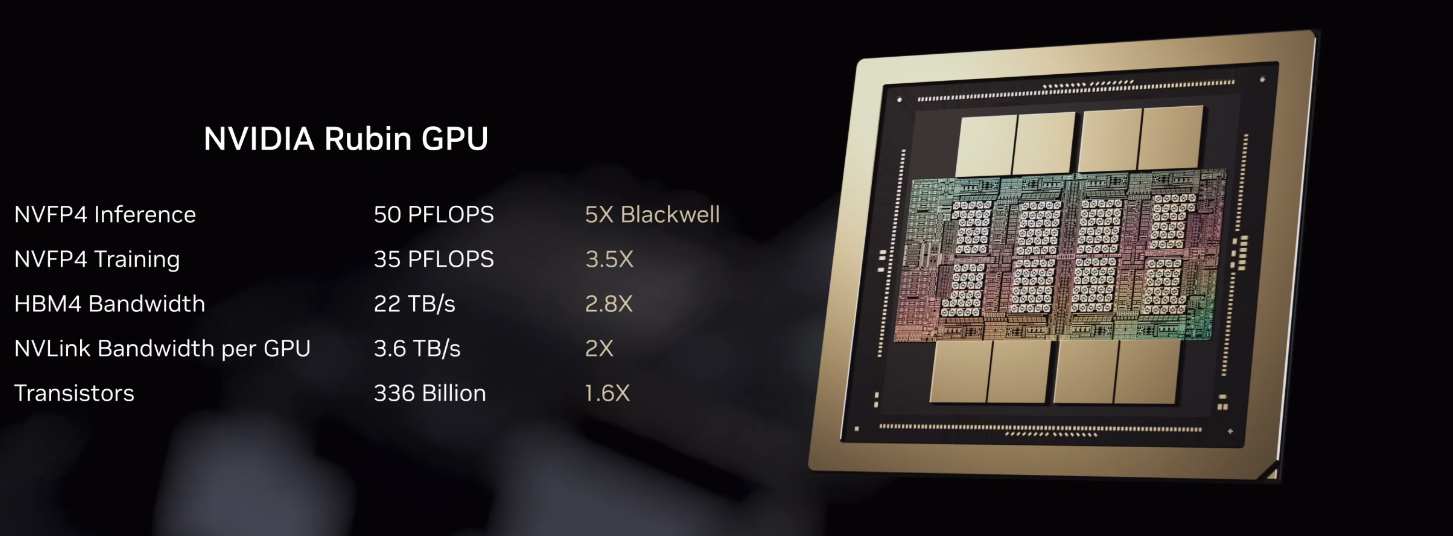
Core Insights - AMD announced a new enterprise-level AI GPU platform, MI455X, shortly after NVIDIA's CEO unveiled the Vera Rubin AI GPU infrastructure at CES, indicating intensified competition in the AI data center market [1][6] - Both companies emphasized the ongoing exponential growth in AI computing demand, with AMD projecting a significant increase in active AI users from 1 million to 1 billion since the rise of ChatGPT, and potentially reaching 5 billion by 2030 [5][6] Group 1: NVIDIA's Vera Rubin Platform - NVIDIA's Vera Rubin platform has entered full production, featuring six core chips that significantly enhance AI inference performance by 5 times and training performance by 3.5 times compared to the previous Blackwell architecture [3][5] - The platform reduces the cost of AI inference token generation to just 1/10 of the previous architecture, making it commercially viable for Agentic AI applications [5][6] - NVIDIA's CEO highlighted the transition to a "rack-scale AI factory era," emphasizing system collaboration and cost-effectiveness [3][7] Group 2: AMD's Competitive Position - AMD's MI455X GPU is designed for large-scale data centers, boasting a performance increase of 10 times over its predecessor, MI355X, and is part of a broader strategy to capture a significant share of the AI computing market [1][6] - The company aims to achieve a "double-digit" market share in the data center AI chip market, with projected annual revenue reaching $100 billion within five years [19] - AMD's stock has surged over 80% since 2025, driven by major partnerships and contracts, including a significant deal with OpenAI [10][12] Group 3: Market Dynamics and Future Outlook - Analysts predict that the AI infrastructure investment cycle is still in its early to mid-stages, with a potential market size of $3 to $4 trillion by 2030 [21][22] - The competition between NVIDIA and AMD is expected to shape the future of AI computing, with both companies focusing on enhancing their product offerings to meet the growing demand [8][19] - The AI chip market is anticipated to remain a key driver of stock market performance, with significant growth expected in semiconductor sales and related technologies [20][22]

AMD20251117
2025-11-18 01:15
Summary of AMD Conference Call Company Overview - **Company**: AMD (Advanced Micro Devices) - **Industry**: Semiconductor and Data Center Solutions Key Points and Arguments Market Share and Growth Projections - AMD expects its data center business market share to reach double digits in the next 3 to 5 years, with an AI business CAGR of 80% and a data center business CAGR of 60% [2][3] - Overall revenue is projected to grow at a CAGR of 35%, exceeding Wall Street's expectations of 20% to 30% [3] - By 2030, AMD anticipates its addressable market for data centers to reach $1 trillion, up from a previous estimate of $500 billion [2][5] Revenue Expectations - AMD forecasts data center revenue to reach $100 billion by 2030, with the business currently accounting for about half of total revenue [2][6] - Expected revenue for 2025 is approximately $16 billion, indicating significant growth potential [2][6] Product Development and Innovations - AMD plans to launch cabinet-level products in 2026, similar to NVIDIA's NVL72, utilizing Infiniband Fabric to connect GPUs and CPUs [2][7][9] - The MI400 and MI500 series GPUs are set to be released in 2026 and 2027, respectively, showcasing AMD's commitment to advancing GPU architecture [2][5] AI and Data Center Collaborations - AMD has signed a 6 GW collaboration agreement with OpenAI, with deployment expected to begin in the second half of the year [2][10] - Oracle has started deploying systems based on AMD cards, with new customers anticipated to choose AMD products in 2026 [2][10] Financial Guidance - AMD's long-term financial guidance includes a total revenue growth target of 35%, with gross margins projected between 50% and 58% and operating margins expected to improve to 35% [4][22] - EPS is anticipated to exceed $20, compared to the current consensus of $16 to $18, indicating potential for significant upside [22] Data Center CPU Market Outlook - The global data center CPU market is projected to reach $60 billion by 2030, nearly doubling from $26 billion in 2025, with a CAGR of 18% [4][13] Emerging Markets - The AI PC market is expected to surpass 1 billion devices in the coming years, while the physical AI market could reach $200 billion by 2035 [17] - Client business is projected to maintain low single-digit growth over the next 3 to 5 years, highlighting the potential of emerging sectors [17] Challenges and Considerations - The successful delivery of new cabinet and product launches in 2026 is critical, as supply chain challenges may impact market performance [21] - AMD's reliance on third-party suppliers for switch devices may affect the deployment timeline of new technologies [9] Overall Outlook - AMD's optimistic outlook includes a $1 trillion market for computing cards, GPUs, CPUs, and network cards, with significant revenue elasticity expected if the supply chain operates smoothly [23][24]