OceanBase seekdb

Search documents
从王坚的一问,到上万名大学生的赛场:中国数据库的“换道超车”之路
Sou Hu Cai Jing· 2026-01-24 01:17
Core Insights - The article discusses the evolution of the Chinese database industry, highlighting the shift from reliance on foreign technology to the development of domestic solutions, initiated by Alibaba's "Go IOE" campaign [2][12]. Group 1: Historical Context - The question posed by Alibaba's chief architect, Wang Jian, about the necessity of purchasing an IBM mainframe in 2010 sparked a pivotal moment for Alibaba and the Chinese internet economy, emphasizing the need for self-reliance in core database systems [2]. - The "Go IOE" campaign marked a significant turning point in China's tech landscape, leading to the development of domestic databases and reducing dependence on foreign technology [2][12]. Group 2: Recent Developments - The 2025 National College Student Computer System Capability Competition, including the fifth OceanBase Database Competition, attracted 1,223 teams and 2,620 students, showcasing the growing interest and talent in the field [3]. - The competition focused on real-world industry problems, challenging participants to optimize the OceanBase database under limited hardware resources and develop a multi-modal RAG system [3][4]. Group 3: Educational Impact - The competition serves as a bridge between academia and industry, with winners receiving direct recruitment opportunities from OceanBase, highlighting the importance of practical experience in education [7]. - The event reflects a shift in educational philosophy, emphasizing the need for students to engage with real-world challenges rather than theoretical knowledge alone [3][8]. Group 4: Philosophical Insights - The understanding of data has evolved from being merely a record-keeping tool to a critical production factor, necessitating a shift in how databases are perceived and utilized [8][9]. - The article discusses the need for databases to transform into "data empowerment platforms" that can unlock the value of data in the age of big data and AI [8][10]. Group 5: Future Outlook - The future of the database industry in China hinges on an open and collaborative approach, leveraging open-source technologies to foster innovation and adaptability [11]. - The article emphasizes the importance of addressing real-world challenges in China to cultivate a skilled workforce capable of driving technological advancements [15][16].

第五届OceanBase数据库大赛收官:2620名学生参赛,探索AI原生数据库
Bei Jing Shang Bao· 2026-01-18 11:19
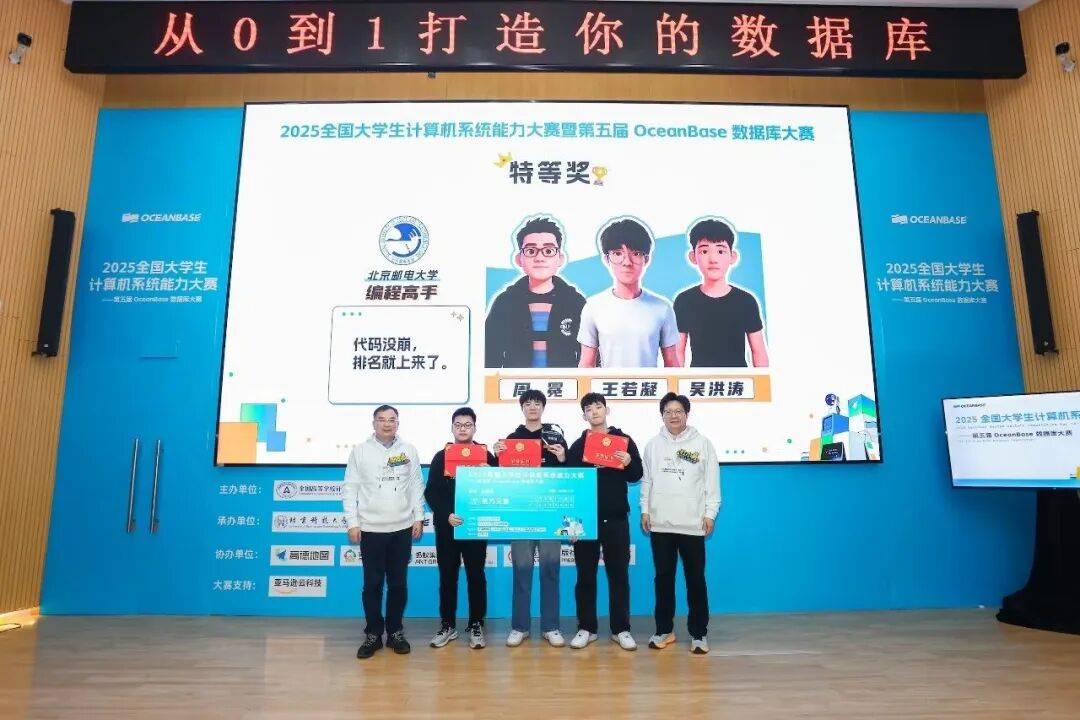
Group 1 - The 2025 National College Student Computer System Capability Competition and the 5th OceanBase Database Competition concluded at Beijing University of Science and Technology, attracting 1,223 teams and 2,620 students from across the country [1] - The champion team from Beijing University of Posts and Telecommunications won a prize of 100,000 yuan for their performance in database kernel optimization and AI application development [1] - The OceanBase Database Competition, initiated in 2021, has become a key platform for talent cultivation in the database field, covering over 500 universities and more than 11,000 students in five years [1] Group 2 - The competition adopted a "preliminary + final" format, focusing on practical projects and requiring participants to implement core database modules and integrate vector retrieval functions [2] - The finals introduced the Apache 2.0 open-source AI native database OceanBase seekdb, with challenges addressing core demands of AI implementation, specifically "running fast" and "stability" [2] - The dean of the Computer and Communication Engineering School emphasized the need for deep integration of AI and databases to enhance performance and build efficient data infrastructure for AI training and applications [2]
模力工场 022 周 AI 应用榜:记忆型 AI Infra PowerMem 登顶榜首,本周 AI 应用全面升级“长期主义”
AI前线· 2025-12-03 04:29
Core Insights - The article discusses the recent developments and trends in AI applications, particularly focusing on memory management and the integration of AI in various sectors [4][26]. Group 1: Event Announcements - The Vibe Coding Sprint event is scheduled for December 6, where participants will use AI to write code and develop demos, with awards for outstanding projects [3]. - The results of the Autumn Competition of Moli Workshop have been announced, with rewards to be distributed this month [1]. Group 2: AI Memory Management - OceanBase PowerMem addresses memory management challenges in AI applications, enabling persistent memory similar to human memory [7][11]. - Key features of PowerMem include intelligent memory management, support for multiple agents, and a hybrid retrieval architecture that combines various search methods for improved accuracy and speed [9][12]. Group 3: Performance Metrics - In comparative tests, PowerMem achieved an accuracy of 78.70% compared to 52.9% for full-context methods, a 48.77% improvement [13]. - PowerMem also demonstrated a response speed improvement, with a p95 latency of 1.44 seconds versus 17.12 seconds for full-context, marking a 91.83% enhancement [13]. Group 4: User Feedback and Future Developments - Users have expressed surprise at the effectiveness of the Ebbinghaus forgetting curve feature, which allows the system to automatically forget outdated information [15]. - There is a demand for more multimodal support, particularly for video memory, indicating a potential area for future development [16]. Group 5: Application Trends - The current trend in AI applications emphasizes "persistent memory," with PowerMem and OceanBase seekdb forming a foundational infrastructure for the next generation of applications [26]. - Applications like GetDraft and Hai Luo AI are reshaping content creation, highlighting a shift in the roles of humans and AI in writing and creative processes [26].

IT员工抄公司量化代码赚8千万,被罚1.7亿;传毫末智行停工解散、赔偿不明;实习生抽中显卡被公司要求上交?回应来了 | AI周报
AI前线· 2025-11-23 05:33
Group 1 - An IT employee in Zhejiang was fined 1.7 billion yuan for stealing company trading algorithms and profiting 88.58 million yuan through insider trading [3][4][5] - The employee, Lin Yiping, was involved in key responsibilities at a tech company linked to two private equity firms, allowing him access to confidential information [3][4] - The regulatory body found sufficient evidence of his wrongdoing, leading to a five-year ban from the securities market [5] Group 2 - The autonomous driving company, Haomo Zhixing, backed by Great Wall Motors, has reportedly ceased operations and is in the process of dissolution [6][7][8] - Haomo Zhixing, established in November 2019, was known for its advancements in autonomous driving technology and had over a thousand employees at its peak [6][7] - The company faced challenges as Great Wall Motors shifted focus to other suppliers, leading to significant management turnover [7] Group 3 - ByteDance's Seed team has seen the departure of seven core members this year, including key figures who have joined Meta and Apple [11] - Former Baidu VP Jing Kun's AI startup Genspark raised $275 million in Series B funding, achieving a valuation of $1.25 billion [12][13] - TikTok's algorithm head, Song Yang, has left for Meta, indicating a trend of talent migration from TikTok to major competitors [14][15] Group 4 - Rabbit, a tech company, has reportedly delayed employee salaries for several months, leading to employee strikes, while the CEO claims a new AI hardware version is forthcoming [16] - New Oriental's chairman, Yu Minhong, faced backlash for a planned trip to Antarctica with employees, which he later clarified was intended for educational purposes [17][18][19] Group 5 - Alibaba's AI application "Qianwen" faced service interruptions due to high user traffic on its launch day, prompting a response from the company [20][21] - Ant Group's AI assistant "Lingguang" also experienced service issues shortly after its launch, indicating high demand for AI tools [22] Group 6 - Google launched the Gemini 3 Pro image model, which is designed for advanced image generation and editing tasks, showcasing significant improvements over competitors [29][30][31] - OpenAI introduced the GPT-5.1-Codex-Max model, optimized for long-running tasks and capable of handling extensive context windows [32][33] - Musk's xAI company released Grok 4.1 Fast, a low-cost model that excels in real-time applications, indicating a competitive landscape in AI development [34][35]

智能范式跃迁,OceanBase打造AI原生混搜数据库
2 1 Shi Ji Jing Ji Bao Dao· 2025-11-20 11:58
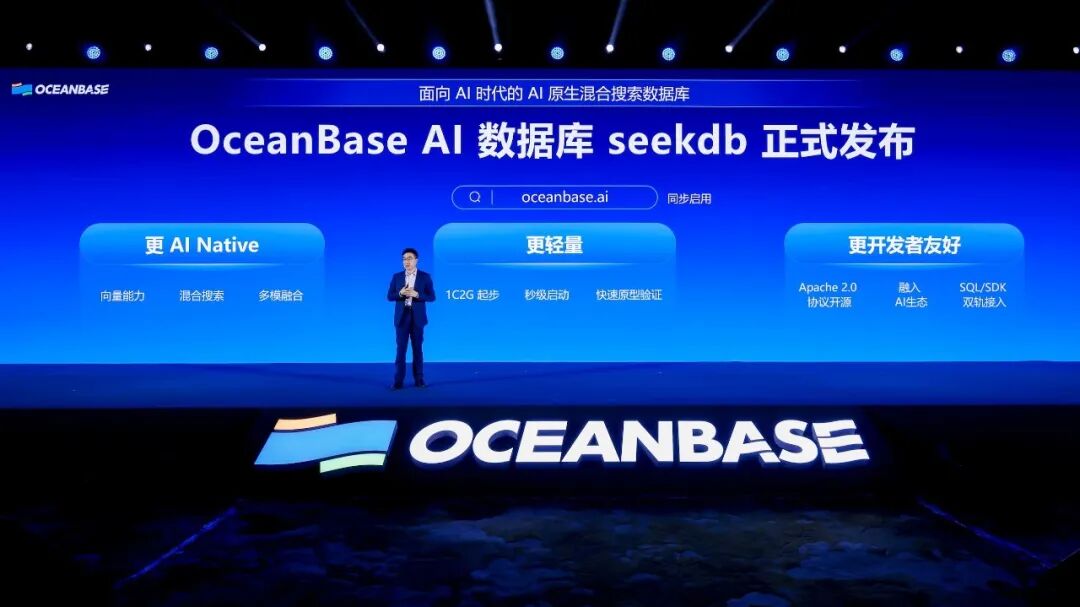
Core Insights - The article emphasizes the need for integrated data systems in the AI era, highlighting that fragmented data can lead to inefficiencies and a lack of understanding in AI models, akin to "brain damage" in humans [1][3] - OceanBase has launched its first AI-native hybrid search database, seekdb, which aims to provide a unified platform for managing diverse data types and workloads, thus addressing the challenges posed by fragmented data systems [1][6] Group 1: OceanBase's Strategic Response - OceanBase's strategy focuses on achieving "AI-native integration" by enhancing its core capabilities to support AI workloads while maintaining high reliability and consistency [1][6] - The seekdb database is designed to be lightweight and easy to deploy, requiring minimal resources (1 CPU core and 2GB RAM) and allowing developers to quickly build AI applications with just three lines of code [1][8][9] - The database supports a variety of data types, including vector, scalar, text, JSON, and GIS, enabling seamless mixed retrieval and analysis [8][9] Group 2: Market Context and Challenges - The article notes that 95% of enterprises have not seen measurable returns from their investments in generative AI, primarily due to fragmented data and complex system architectures [3][4] - Traditional database systems struggle to meet the demands of AI applications, necessitating a shift towards integrated and responsive data infrastructures [4][6] - Major database vendors are increasingly focusing on integrating various data capabilities to create "universal" databases suitable for the AI era [4][6] Group 3: OceanBase's Growth and Market Position - Since its commercialization in 2020, OceanBase has seen significant growth, with over 4,000 global customers and an average annual growth rate exceeding 100% [11][14] - The company has established a strong presence across multiple sectors, including finance, government, and retail, and has expanded its cloud services to major platforms like Alibaba Cloud, AWS, and Azure [11][14][18] - OceanBase's collaborative ecosystem has contributed to its growth, with over 350 ISVs and a significant increase in revenue from partnerships [18][20]
智能范式跃迁,OceanBase打造AI原生混搜数据库
21世纪经济报道· 2025-11-20 11:56
Core Viewpoint - The article emphasizes the necessity for integrated data systems in the AI era, highlighting that fragmented data can hinder AI performance and lead to inefficiencies. The focus is on creating an "AI-native integrated" database that supports real-time analysis and intelligent applications [1][6][10]. Group 1: AI Native Database Development - OceanBase launched its first AI-native hybrid search database, "seekdb," which allows developers to build knowledge bases and AI applications with just three lines of code, enabling efficient handling of multi-modal data retrieval at a scale of billions [2][4]. - The CEO of OceanBase stated that "seekdb" is not merely an addition of traditional database functions but a restructured database specifically designed for the AI era, aiming to be a real-time entry layer for large models and private data integration [4][10]. Group 2: Challenges in AI Implementation - A recent MIT study revealed that 95% of enterprises did not see measurable returns after implementing generative AI, primarily due to fragmented multi-modal data and complex system linkages, which hindered the models' ability to understand business contexts [7]. - Traditional fragmented systems are inadequate for AI demands, as they complicate cross-system queries and real-time responses, necessitating a shift towards integrated data management systems [7][8]. Group 3: OceanBase's Strategic Response - OceanBase's strategy involves a deep integration of four core capabilities: unified multi-modal data management, multi-workload support, native AI function capabilities, and hybrid multi-cloud deployment, all aimed at creating a modern data architecture that supports AI [10][11]. - The company aims to ensure that its database can handle various data types and workloads simultaneously, providing a seamless experience for developers and businesses [11][12]. Group 4: Market Performance and Growth - Since its commercialization in 2020, OceanBase has reported over 4,000 global customers, with an average annual growth rate exceeding 100% for five consecutive years, indicating strong market demand [15][18]. - The company has expanded its cloud services across major platforms like Alibaba Cloud, AWS, and Azure, supporting a "one architecture, global operation" model for Chinese enterprises [16][21]. Group 5: Ecosystem and Collaboration - OceanBase emphasizes the importance of ecosystem growth, with over 70% of its revenue coming from partners and an annual growth rate of 80% in the private cloud sector [21][22]. - The company collaborates with over 350 ISVs to create standardized solutions across various industries, enhancing its market presence and operational efficiency [22][23].
三行代码就能手搓一个AI应用!蚂蚁OceanBase开源其首款AI数据库
量子位· 2025-11-19 09:01
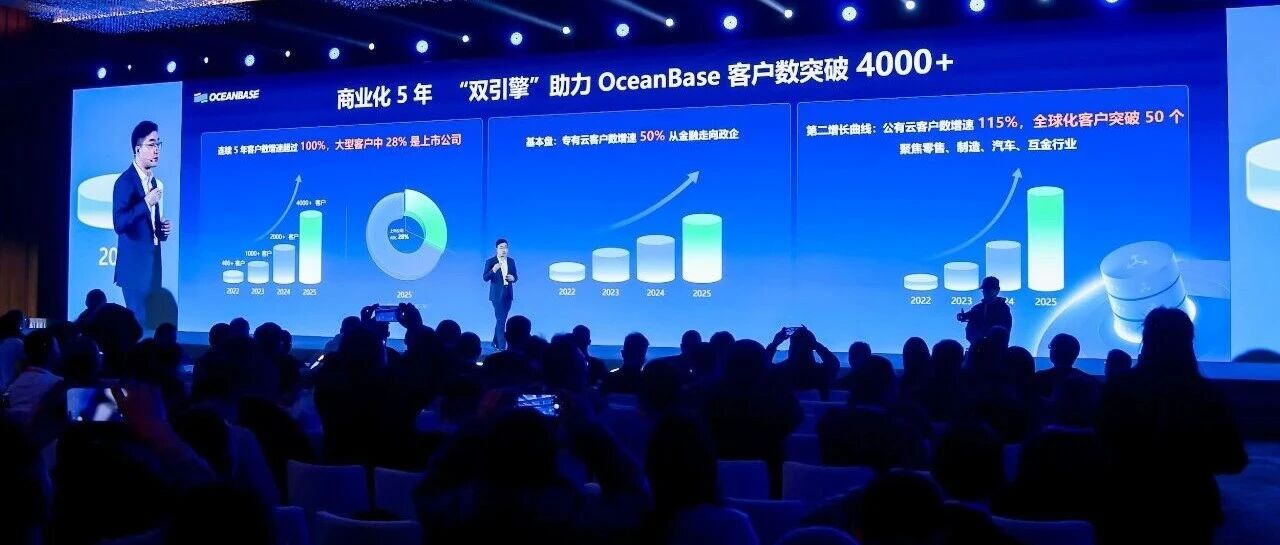
Core Insights - OceanBase has launched its first AI-native database, seekdb, designed to meet the demands of the AI era, allowing developers to build AI applications with just three lines of code [8][9][19] - The database aims to address the challenges faced by enterprises in integrating multimodal data for AI applications, which often suffer from fragmentation and complexity [11][12][19] - OceanBase's seekdb features a hybrid search capability that combines vector retrieval, full-text search, and scalar filtering, enhancing both speed and accuracy [14][19] Group 1: OceanBase Overview - OceanBase is a self-developed distributed relational database by Ant Group, launched in 2010, and has evolved over 15 years to become a leading domestic database [3][4] - The database has over 4,000 global customers and has achieved an average annual growth rate of over 100% for five consecutive years [4] - As of May this year, OceanBase has built an active community of over 25,000 developers, with cumulative downloads exceeding one million [5] Group 2: seekdb Features - seekdb supports unified storage and retrieval of various data types, including scalar, vector, text, JSON, and GIS, facilitating complex queries without cross-system calls [14] - The database is designed for easy deployment, requiring only 1 CPU core and 2GB of memory, and can be installed with a single command [16] - seekdb is open-sourced under the Apache 2.0 license, allowing users to freely use, modify, and extend the software [17] Group 3: AI Integration - OceanBase's CEO emphasizes that the real bottleneck in AI is not the models but the data, particularly in high-sensitivity scenarios like finance and government [19] - seekdb is positioned as a real-time entry layer for integrating large models with private data, aiming to simplify the data architecture for AI applications [20][21] - The new OceanBase 4.4 version integrates transaction processing, analytical processing, and AI capabilities into a single core, enhancing distributed scalability and high availability [22] Group 4: Additional Tools - OceanBase has also released a series of tools alongside seekdb, forming a complete toolchain for AI applications, covering data management, retrieval, analysis, and memory [23] - PowerRAG is an enterprise-level retrieval-augmented generation solution that simplifies the process of building AI applications like knowledge bases and intelligent customer service [24] - PowerMem is designed to efficiently manage and recall user interaction context, achieving a top score in the LoCoMo Benchmark while significantly reducing token consumption [26][27] Group 5: Strategic Vision - OceanBase's strategy focuses on unifying data across different systems and formats through a multi-load, multi-modal, and hybrid cloud architecture [29] - The goal is to provide enterprises with a single database core capable of handling transactions, analysis, search, and AI inference, streamlining operations and reducing complexity [31]
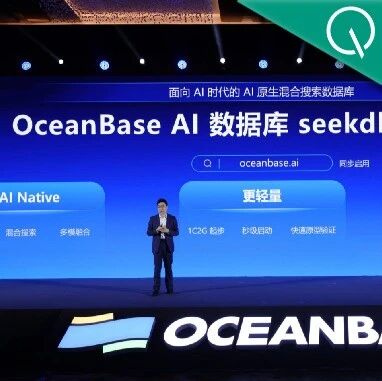
OceanBase发布首款AI数据库seekdb 支持AI原生混合搜索
Zheng Quan Ri Bao Wang· 2025-11-19 03:42
Core Insights - OceanBase launched its first AI database, OceanBase seekdb, at the 2025 annual conference, enabling developers to build AI applications with just three lines of code [1] - The product supports unified mixed search for vector, full-text, scalar, and spatial geographic data, integrating AI reasoning with data processing [1] - OceanBase's "Data×AI" strategy is reflected in seekdb, which can be used independently or integrated into the newly released OceanBase 4.4 version [1] Product Features - Seekdb allows for efficient handling of multi-modal data retrieval at a scale of billions, achieving a "plug-and-play" AI data foundation [1] - The new version integrates TP, AP, and AI capabilities into a single kernel, offering distributed scalability, multi-cloud deployment, and high availability [1] - The commercial LTS version is set to launch on February 2, 2026 [1] Industry Applications - OceanBase's mixed search capabilities have been successfully implemented across various industries, including telecommunications and finance [2] - China Unicom utilized mixed search to build a unified AI knowledge base, addressing document permission management and efficient retrieval challenges [2] - Ant Group's Baibaoxiang leveraged mixed search for real-time online search, enhancing information accuracy and response efficiency [2] Company Growth - Since its commercialization in 2020, OceanBase has surpassed 4,000 global customers, with an average annual growth rate exceeding 100% for five consecutive years [2] - The technology has penetrated over ten sectors, including finance, government, telecommunications, retail, manufacturing, and the internet, serving 16 countries and regions [2]
8点1氪:西贝回应门店一线全员涨薪;谷歌发布Gemini 3;苹果回应iPhone 17 Pro Max掉色;
36氪· 2025-11-19 00:27
Group 1 - Xibei has raised the average salary of frontline employees by 500 yuan per person per month since September in response to negative public sentiment and online harassment [3][4] - Google has launched its latest AI model, Gemini 3, which aims to provide better answers to complex questions without requiring excessive prompts [4][5] - Gemini 3 Pro has achieved a groundbreaking Elo score of 1501, surpassing its predecessor in almost all major AI benchmarks [5] Group 2 - Xiaomi plans to release a new version of its end-to-end assisted driving system at the Guangzhou Auto Show on November 21 [8] - Meta's Chief Revenue Officer, John Hegeman, is leaving the company to start his own venture, marking a significant leadership change [10] - Meta has won a federal antitrust lawsuit regarding its acquisitions of Instagram and WhatsApp, as the court found no violation of antitrust laws [10] Group 3 - The U.S. stock market saw a collective decline, with the Dow Jones down by 1.07% and the Nasdaq down by 1.21% on November 18 [11] - Nvidia and Microsoft are set to invest up to $150 billion in Anthropic as part of a new strategic partnership [12] - ByteDance has integrated its engineering teams for e-commerce, life services, and advertising to enhance R&D efficiency [12] Group 4 - Weibo reported a total revenue of 3.456 billion yuan for Q3 2025, a decrease of 5% year-on-year [22] - iQIYI's total revenue for Q3 2025 was 6.68 billion yuan, down 8% year-on-year [23] - Baidu's Q3 2025 revenue reached 31.2 billion yuan, with AI business revenue growing over 50% [24] - Xiaomi's Q3 2025 revenue was 113.1 billion yuan, reflecting a year-on-year growth of 22.3% [25]




百度Q3 AI业务增长超50%,蚂蚁推出全模态通用AI助手“灵光” | 蓝媒GPT
Sou Hu Cai Jing· 2025-11-18 12:06
Group 1: Baidu Q3 Financial Results - Baidu reported Q3 total revenue of 31.2 billion yuan, with core revenue of 24.7 billion yuan [1] - AI business revenue grew over 50% year-on-year, with AI cloud revenue increasing by 33% [1] - AI application revenue reached 2.6 billion yuan, while AI native marketing service revenue surged by 262% to 2.8 billion yuan [1] Group 2: Autonomous Driving Service - Luobo Kuaipao - Luobo Kuaipao achieved 3.1 million global ride-hailing services in Q3, marking a 212% year-on-year growth [1] - The service's weekly fully autonomous orders exceeded 250,000 in October, with a total of over 17 million global ride-hailing services by November [1] - The autonomous driving mileage surpassed 240 million kilometers, with over 140 million kilometers of fully autonomous driving [1] Group 3: AI Innovations and Developments - Baidu's founder emphasized the transformative value of AI, highlighting the robust growth of AI cloud and the expansion of Luobo Kuaipao's fully autonomous operations [2] - The company aims to continue AI innovation to create significant value for users, businesses, and society, reinforcing its leadership in the AI era [2]