
Vera Rubin系统

Search documents
美国的“阳谋”:让英伟达充当AI基建的“小发改委”
Guan Cha Zhe Wang· 2026-03-20 00:31
Core Insights - The article discusses NVIDIA's significant role in shaping the AI industry, particularly highlighted during the GTC 2026 event, where CEO Jensen Huang emphasized the company's vision of AI as a multi-layered "five-layer cake" with energy as the foundational element [3][9][19] Group 1: Product and Technology Developments - NVIDIA introduced several new products at GTC 2026, including the Vera CPU, Rubin GPU, and Groq LPU, which collectively represent a new system architecture philosophy aimed at optimizing both high throughput and low latency [4][5] - The Vera CPU, designed for high single-core performance, signifies NVIDIA's ambition to move beyond being just a GPU company to becoming a complete machine provider [5] - The introduction of the Nemotron alliance aims to ensure that AI models from various companies are optimized for NVIDIA hardware, reinforcing the company's ecosystem [7] Group 2: Infrastructure and Energy Considerations - Huang highlighted that energy is the "absolute constraint" determining how much intelligence a system can produce, indicating NVIDIA's focus on energy efficiency and planning for future power needs [9][19] - The company is developing the "Vera Rubin Space-1" space data center system, addressing potential future limitations of terrestrial power and cooling for AI computing [9] - NVIDIA's infrastructure strategy includes a comprehensive approach that encompasses not just chips but also land, power delivery, cooling systems, and network architecture, which Huang refers to as "AI factories" [6] Group 3: Market Position and Strategic Influence - NVIDIA's influence extends to the AI infrastructure investment landscape, with Huang predicting a demand of at least $1 trillion by 2027, comparable to national infrastructure spending [11] - The company controls GPU supply allocation, which significantly impacts the AI capabilities of major cloud service providers like AWS and Azure, effectively determining their business limits [12] - Huang's remarks suggest that NVIDIA is not just a company but acts as a "market coordinator" for the AI industry, aligning its commercial interests with broader national strategic goals [14][19]


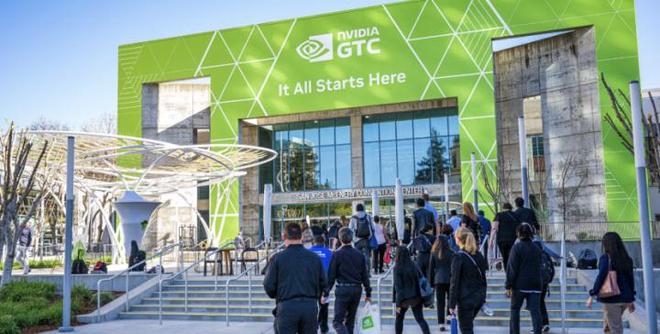
黄仁勋GTC演讲全文:推理时代到来,2027营收至少万亿美元,龙虾就是新操作系统
华尔街见闻· 2026-03-16 23:55
Core Insights - The article discusses NVIDIA's transformation from a "chip company" to an "AI infrastructure and factory company," emphasizing the concept of "Token Factory Economics" as a driving force for future growth [2][5][13]. Group 1: Market Demand and Growth Projections - NVIDIA's CEO Huang Renxun projected a significant increase in AI computing demand, estimating at least $1 trillion by 2027, up from a previous estimate of $500 billion [6][65]. - The company anticipates that actual computing demand will exceed this projection, indicating a robust growth trajectory for AI infrastructure [10][11]. Group 2: AI Infrastructure and Token Production - Huang highlighted that modern data centers will evolve into "Token factories," focusing on the efficiency of token production as a key operational metric [74]. - The future pricing structure for tokens will include various tiers, with costs ranging from free to $150 per million tokens, reflecting the value of throughput and speed [16][75]. Group 3: Technological Advancements - The introduction of the Vera Rubin system, which achieved a 350-fold increase in token generation speed, showcases NVIDIA's commitment to cutting-edge technology [20][81]. - The integration of Groq technology aims to enhance inference performance, with a focus on optimizing the processing pipeline for AI workloads [77][79]. Group 4: Software and Ecosystem Development - The emergence of OpenClaw as a pivotal open-source project signifies a shift towards "Agent-as-a-Service" (AaaS), transforming how software companies operate [26][91]. - NVIDIA's collaboration with various enterprises to develop AI models and platforms indicates a strategic move to solidify its position in the AI ecosystem [96]. Group 5: Industry Impact and Future Outlook - The article emphasizes that the AI industry is experiencing unprecedented growth, with venture capital investments reaching $150 billion, marking a historic high [57]. - The anticipated shift towards AI-native companies will redefine industries, similar to past technological revolutions [58].

黄仁勋:对OpenAI的300亿美元投资"可能最后一次",排除投资1000亿美元的可能性
硬AI· 2026-03-05 10:59
Core Viewpoint - Nvidia's CEO Jensen Huang indicated that the recent $30 billion investment in OpenAI might be the last significant opportunity for large-scale equity investment, as OpenAI plans to go public by the end of this year [2][3][4]. Group 1: Investment Details - Nvidia's $30 billion investment in OpenAI is part of a larger $110 billion funding round, which values OpenAI at $730 billion [5][11]. - The initial agreement between Nvidia and OpenAI included a potential investment cap of $100 billion, which has since been shelved as of January this year [8][9]. - Nvidia's investment in OpenAI is the largest single investment the company has made in a startup to date, despite being significantly lower than the initially considered $100 billion [10][11]. Group 2: Market Response and Industry Outlook - Huang's comments did not dampen market sentiment, as Nvidia's stock rose over 2.6% during the trading session following the announcement [5]. - Huang countered concerns about a potential "AI bubble," asserting that the deployment of AI computing power is already generating substantial revenue for companies, including major data center operators like Microsoft [12][14]. - The industry is still at the beginning of a significant growth cycle, with Huang expressing confidence in Nvidia's recent financial performance, describing it as the best earnings season in the company's history [17][18].

黄仁勋暗示:英伟达将终止对OpenAI和Anthropico的投资
Huan Qiu Wang Zi Xun· 2026-03-05 08:59
Group 1 - Nvidia's CEO Jensen Huang stated that the recent $30 billion investment in OpenAI may be the last, indicating a significant shift in their previously announced $100 billion infrastructure partnership due to OpenAI's preparations for an IPO [1][2] - The ambitious $100 billion investment plan is now deemed "highly unlikely" to be realized, as OpenAI's upcoming IPO will fundamentally change its capital structure and financing strategy, making it difficult for Nvidia to continue large-scale investments as a private equity investor [2] - The confirmed $30 billion investment is part of OpenAI's total $110 billion financing plan, which also includes $50 billion from Amazon and $30 billion from SoftBank, providing OpenAI with dedicated inference and training capabilities to support its growing AI data center needs [2] Group 2 - Nvidia's investment in another AI giant, Anthropic, amounting to $10 billion, is also likely to be the last, as Anthropic plans to go public in 2026, although the IPO decision has not been officially confirmed [3] - Huang expressed that this may be Nvidia's last opportunity to invest in such significant companies, as leading AI startups move towards the public market, redefining Nvidia's dual role as a chip supplier and strategic investor [3] - The AI industry is experiencing a profound shift in demand from model training to inference, which requires new chip efficiency and latency standards, prompting Nvidia to develop new chips optimized for inference tasks [4]
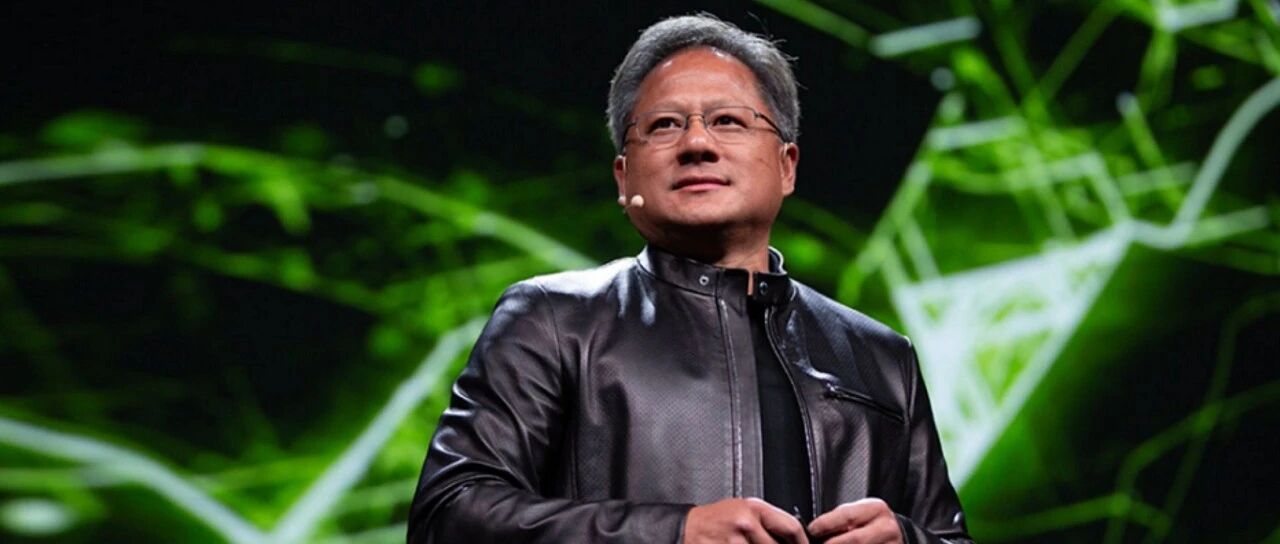
黄仁勋:300亿投资OpenAI“可能是最后一次”
第一财经· 2026-03-04 23:45
Group 1 - Nvidia's CEO Jensen Huang stated that the recent $30 billion investment in OpenAI may be the company's "last" as OpenAI prepares for an IPO [1] - Nvidia also invested $10 billion in OpenAI's competitor, Anthropic, indicating a strategic focus on AI investments [1] - The investment in OpenAI is part of a larger $110 billion funding round, which includes commitments of $50 billion from Amazon and $30 billion from SoftBank [1] Group 2 - OpenAI has secured 30 billion watts of dedicated inference computing power and 20 billion watts of training computing power through an agreement with Nvidia, utilizing the Vera Rubin system for AI data centers [1]
英伟达CEO黄仁勋:300亿投资OpenAI“可能是最后一次”
Jin Rong Jie· 2026-03-04 23:40
Core Insights - Nvidia's CEO Jensen Huang indicated that the company's recent $30 billion investment in AI startup OpenAI may be the "last" of its kind as OpenAI prepares for an IPO [1] - Nvidia also invested $10 billion in OpenAI's competitor, Anthropic, as part of a larger funding round that raised $110 billion [1] - The funding round included commitments of $50 billion from Amazon and $30 billion from SoftBank [1] - OpenAI secured 30 billion watts of dedicated inference computing power and 20 billion watts of training computing power on Nvidia's Vera Rubin system as part of the agreement [1]
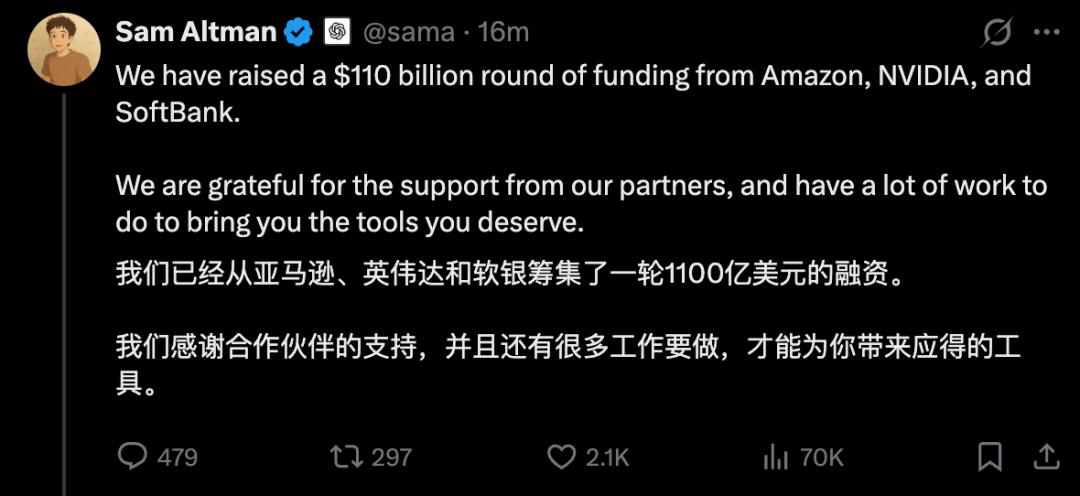
亚马逊、英伟达和软银向OpenAI投资1100亿美元
Sou Hu Cai Jing· 2026-02-28 15:35
Core Insights - OpenAI has secured a new investment of $110 billion from Amazon, Nvidia, and SoftBank, raising its pre-investment valuation to $730 billion, with specific conditions attached to these investments [2] Investment Structure - Amazon's investment of $50 billion includes $35 billion that will only be paid upon meeting specific conditions, such as renting 2 gigawatts of Trainium AI accelerators and deploying OpenAI models on AWS [2][6] - Nvidia's $30 billion investment also has similar conditions, requiring the deployment of 5 gigawatts of computing capacity based on the Vera Rubin system [3][6] - Both Amazon and Nvidia's investments are structured to ensure that every dollar invested yields returns, effectively providing discounts on computing infrastructure without diluting their revenues [5] Operational Support - SoftBank plans to invest an additional $30 billion in OpenAI to support its operations, with payments structured in three phases of $10 billion each, starting in April and concluding in October [5] Financial Performance - OpenAI has reported annual recurring revenue exceeding $20 billion and over 50 million paid subscribers, but it is expected to rely on external funding until at least 2029 to achieve profitability [5][7] Relationship with Microsoft - OpenAI has clarified that the recent investment announcements will not alter the terms of its relationship with Microsoft, with Azure remaining the exclusive cloud provider for OpenAI's API and first-party products [2][7]



OpenAI最新融资1100亿美元,英伟达亚马逊软银都抢到船票了
3 6 Ke· 2026-02-28 04:15
Core Insights - OpenAI has secured a record-breaking funding of $110 billion, marking the largest single financing in AI history, with a pre-money valuation of $730 billion [1][2]. Group 1: Funding Details - The funding sources include $30 billion from SoftBank, $30 billion from NVIDIA, and $50 billion from Amazon, with Amazon being the largest investor [1][5]. - Amazon's investment will be phased, starting with $15 billion and potentially increasing by an additional $35 billion upon meeting specific conditions, such as OpenAI achieving AGI or going public [5]. - SoftBank's investment will be disbursed in three installments in April, July, and October of 2026 [9][11]. Group 2: Strategic Partnerships - NVIDIA will provide foundational computing power, focusing on GPUs and next-generation accelerators, while also being a strategic investor [2][8]. - Amazon will offer cloud infrastructure and global deployment capabilities, supporting OpenAI's model delivery and commercialization across various sectors [2][6]. - SoftBank will play a dual role as an investor and ecosystem facilitator, potentially connecting OpenAI with additional investors [11]. Group 3: Operational Commitments - OpenAI plans to develop a new "stateful runtime environment" for its models on Amazon's Bedrock platform, committing to significant cloud computing resource consumption, including approximately 2 gigawatts of Trainium chip power [6]. - OpenAI will expand its previous $38 billion agreement with Amazon, aiming to consume around $100 billion in cloud resources over the next eight years [6]. Group 4: Microsoft Relationship - Microsoft remains a key partner, maintaining its exclusive cloud service provider status for OpenAI's API and retaining exclusive licensing rights to OpenAI's models and products [12]. - Despite the new investments, OpenAI is diversifying its partnerships, as evidenced by its collaboration with Amazon, a competitor to Microsoft in the cloud computing space [12]. Group 5: Market Context - OpenAI's latest funding brings its total available capital to approximately $150 billion, with expectations of achieving positive free cash flow by 2030 [15]. - The competitive landscape in AI remains intense, with other companies like Anthropic also securing significant funding, enhancing their competitive position against OpenAI [15].

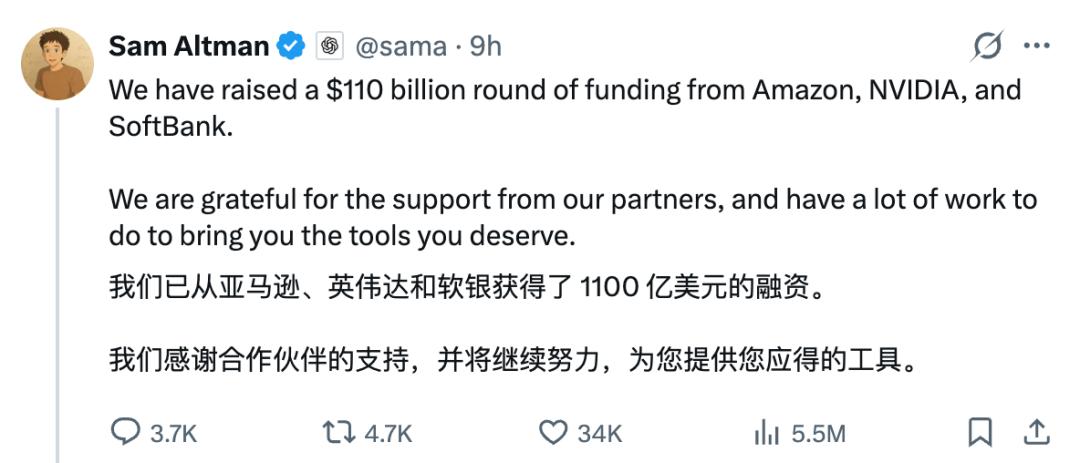
刚刚,OpenAI狂揽7500亿元,英伟达、亚马逊、软银抢投
3 6 Ke· 2026-02-28 01:08
Core Insights - OpenAI has secured a record-breaking $110 billion funding round, marking the largest single financing in the global AI sector to date [1][12] - Major investors include Amazon, NVIDIA, and SoftBank, with Amazon contributing $50 billion, NVIDIA $30 billion, and SoftBank $30 billion [1][3] Investment Details - Amazon's investment consists of an initial $15 billion, with a potential additional $35 billion contingent on OpenAI achieving specific milestones related to general artificial intelligence or going public [3] - NVIDIA's investment will enhance its long-term collaboration with OpenAI, focusing on exclusive inference and training capabilities [3][8] - The pre-funding valuation of OpenAI was estimated at $730 billion, although the post-funding valuation remains undisclosed [3] Strategic Partnerships - OpenAI and Amazon have established a multi-year strategic partnership, with AWS becoming the exclusive third-party cloud provider for OpenAI's enterprise platform, Frontier [7][10] - The partnership includes the development of a Stateful Runtime Environment on AWS, allowing developers to build generative AI applications [7][8] - OpenAI will utilize AWS infrastructure to consume 2 gigawatts of Trainium computing power for various advanced workloads [8] Future Developments - OpenAI plans to leverage the new funding to accelerate infrastructure development, next-generation model research, and global commercialization efforts [12] - The collaboration with Amazon is expected to drive upgrades across the data center, high-speed networking, and custom chip industries, reshaping the global AI computing supply chain [12] - OpenAI's ongoing relationship with Microsoft remains strong, with both companies committed to continued collaboration while maintaining independent growth opportunities [10][11]
超市场预期!英伟达单季营收681亿美元创新高,黄仁勋宣布AI智能体拐点已至,这三大核心赛道或迎黄金爆发期!
Jin Rong Jie· 2026-02-26 10:31
Group 1: Company Financial Performance - Nvidia reported Q4 FY2026 revenue of $68.1 billion, a 73% year-over-year increase, exceeding market expectations of $65.684 billion and up from $39.331 billion in the same quarter last year [1] - Data center revenue reached $62.3 billion, surpassing market expectations of $60.62 billion and up from $35.58 billion year-over-year [1] - Nvidia's Q4 gaming revenue was $3.7 billion, falling short of analyst expectations of $4.01 billion [1] - For Q1 FY2027, Nvidia expects revenue between $76.44 billion and $79.56 billion, higher than the market estimate of $72.78 billion [1] Group 2: Industry Trends and Insights - The demand for AI computing is experiencing exponential growth, with enterprises rapidly investing in AI capabilities, which are seen as the driving force behind the AI industry revolution [1] - Nvidia's CFO noted that the Grace Blackwell system accounted for two-thirds of data center revenue in Q4, with major cloud companies planning capital expenditures close to $700 billion, exceeding previous targets [1] - The high-end PCB and IC substrate sectors are crucial for AI server upgrades, with Nvidia's NVLink SerDes technology evolving from 56Gbps to 224Gbps, necessitating upgrades in core materials for PCBs [2] - The optical module and CPO (Co-Packaged Optics) sectors are vital for AI cluster interconnects, with significant market growth expected, particularly in 800G and 1.6T optical modules [3] - Liquid cooling technology is becoming essential as AI chip power consumption exceeds kilowatt levels, with the liquid cooling server market in China projected to exceed 80 billion yuan by 2026, reflecting a 160% growth rate [4]