
Zhong Guo Jing Ying Bao

Search documents
2026年财务造假“第一罚”落在路桥信息 19人被查处公告暗藏玄机
Zhong Guo Jing Ying Bao· 2026-01-17 03:45
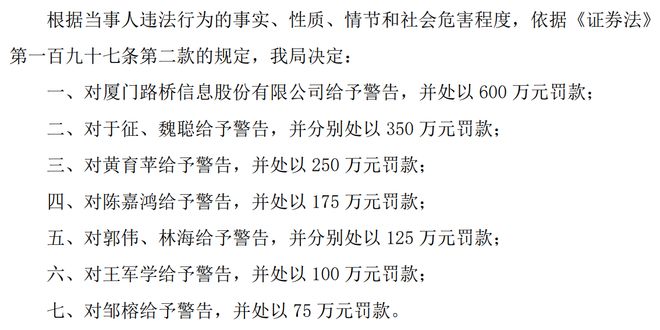
Core Viewpoint - The regulatory actions against Luqiao Information (920748.BJ) mark a significant step in combating financial fraud among listed companies, with the company facing substantial penalties for inflating profits and revenues in its financial reports for 2023 and 2024 [1][3]. Summary by Sections Regulatory Actions - Luqiao Information was fined 6 million yuan for inflating profits by 37.7663 million yuan over 2023-2024, leading to false records in its annual reports [1][3]. - Eight individuals were fined a total of 15.5 million yuan, with two facing a three-year ban from the securities market [1][3]. - The company reported inflated revenues of 15.836 million yuan and 25.764 million yuan for 2023 and 2024, respectively, which constituted 6.66% and 10.71% of the reported revenue [3]. Company Response and Management Changes - Luqiao Information announced the resignation of its board secretary, Wei Cong, citing "personal reasons," despite his direct involvement in the financial fraud [1][8]. - Wei Cong was fined 3.5 million yuan and banned from the securities market for three years due to his severe violations [1][8]. Market Implications - Legal experts warn that the company's statements regarding the lack of major violations that would trigger mandatory delisting may mislead investors into thinking the worst is over [6][9]. - The potential for civil claims, goodwill impairment, tightened bank credit, and loss of customer orders could pose further risks to the company [6][9]. Internal Control and Future Outlook - The regulatory actions reflect a "tiered" responsibility structure, emphasizing that the costs of financial fraud are significantly higher than previously perceived [5]. - Luqiao Information expressed intentions to improve governance and internal controls, although skepticism remains regarding the effectiveness of these measures without a clear timeline or third-party oversight [7][9].

银行净息差向稳!央行今年降息存在空间
Zhong Guo Jing Ying Bao· 2026-01-17 03:45
中国人民银行副行长邹澜1月15日在国新办举行的新闻发布会上表示,2026年降准降息存在一定空间。 他指出,2025年以来银行净息差已经出现企稳迹象。同时,2026年还有规模较大的3年期及5年期等长期 存款到期重定价,中国人民银行1月15日下调了各项再贷款利率,均有助于降低银行付息成本、稳定净 息差,为降息创造一定空间。 定向下调银行成本 中经记者 慈玉鹏 北京报道 2026年存在降息空间 据了解,2026年人民银行将落实中央经济工作会议的决策部署,继续实施适度宽松的货币政策,发挥存 量政策和增量政策的集成效应,加大逆周期和跨周期调节力度,为经济稳定增长和高质量发展创造适宜 的货币金融环境。 邹澜表示,2026年降准降息还有一定的空间。从政策利率来看,在外部约束方面,目前人民币汇率比较 稳定,美元处于降息通道,总体来看汇率不构成很强的约束。 在内部约束方面,邹澜表示,2025年以来银行净息差已经出现企稳的迹象,连续两个季度保持在 1.42%,2026年还有规模较大的3年期及5年期等长期存款到期重定价,这次人民银行也下调了各项再贷 款利率,这些都有助于降低银行付息成本、稳定净息差,为降息创造一定空间。 数据显示, ...
开年吸金67亿 黄金ETF如何成为资产组合“压舱石”?
Zhong Guo Jing Ying Bao· 2026-01-17 03:45
中经记者 秦玉芳 广州报道 近来,以黄金为代表的贵金属价格持续震荡上行,受此影响,资金对黄金资产追捧热度不减,尤其黄金 ETF吸金能力愈加凸显。 Wind数据统计显示,2026年1月1—16日,全市场14只商品型黄金ETF中,12只基金实现区间资金净流入 为正,合计流入约67.5亿元,其中3只基金区间净流入额超过10亿元。 从市值规模来看,根据Wind数据,华安基金的黄金ETF(518880.SH)规模首次突破千亿元大关,截至1 月16日达到1012亿元。 世界黄金协会表示,2025年黄金价格创下53次历史新高,全球投资者将前所未有的资本投入实物支持的 黄金ETF。年流入激增至890亿美元,创历史新高。与此同时,全球黄金ETF管理资产(AUM)翻倍至 历史新高5590亿美元,持股量达到历史高峰4025吨,较2024年的3224吨有所增长。 黄金ETF作为机构和个人投资者配置黄金资产的重要渠道,常常反映短期和长期持有黄金的偏好和愿 望。近来投资者积极加码黄金ETF配置的背后,是多重结构性因素与复杂宏观环境交织的结果。 这些动因需置于当前的全球宏观环境中理解——世界正处于"高债务 + 货币宽松预期 + 地缘碎片化 ...
银行定增背后的博弈
Zhong Guo Jing Ying Bao· 2026-01-17 03:45
中经记者 郝亚娟 夏欣 上海、北京报道 上海金融与发展实验室副主任、招联首席研究员董希淼分析,银行"破净"定增,是银行在股价长期低于 净资产的情况下,为补充核心资本而进行的一种特殊融资操作。它既是银行解决现实资本压力的手段, 也反映了当前市场对银行板块的低估。相比配股、可转债等方式,锁价定增流程更简单、补充资本效率 更高,且对二级市场股价的直接冲击较小。 平衡"稳住股价"与"补充资本" 2026年开年以来,商业银行增资扩股持续活跃,其中城市商业银行成为"主力军"。 《中国经营报》记者注意到,部分银行"破净"定增,即发行价格低于每股净资产。 就这一现象,星图金融研究院副院长薛洪言分析,城商行的资本补充渠道相对狭窄,且可能面临区域信 用风险集中等问题,在难以找到愿意以高于净资产价格入股的投资者时,"破净"定增成为其快速补充资 本、缓解经营压力的现实途径,这一趋势也凸显了银行在补充资本与修复估值之间的两难处境。 定增价格怎么制定? 日前,陕西省国际信托股份有限公司(000563.SZ)公告披露了其拟入股长安银行的方案。公告显示, 其2025年11月26日收到长安银行发来的《长安银行增资扩股关于法人股东认购股份的意向 ...
金价上涨!这类骗局防不胜防
Zhong Guo Jing Ying Bao· 2026-01-17 03:45
Core Viewpoint - The rise in gold prices has led to an increase in financial scams disguised as "gold investment" opportunities, prompting warnings from regulatory authorities about the associated risks [1][3]. Summary by Sections Types of Scams - Four main types of "gold investment" scams have been identified: 1. "Gold Custody Interest" scams, where fraudsters promise high fixed returns on entrusted gold without actual gold assets backing them [2]. 2. "Deferred Delivery Investment" scams, which involve fictitious gold trading to attract funds, essentially operating as a Ponzi scheme [2]. 3. Fake gold trading platform scams that mimic legitimate institutions to lure investors, subsequently manipulating market conditions and restricting withdrawals [2]. 4. "Gold Buyback/Appreciation" scams that charge high fees under the guise of buying back gold or offering value-added exchanges, ultimately disappearing with the funds [2]. Risks and Deceptive Practices - These scams primarily use "guaranteed high returns" as a bait, with a strong deceptive nature and hidden operational models [3]. - Regulatory bodies have noted that many of these schemes do not involve actual gold transactions, instead relying on the public's trust in gold as a safe asset to attract investments [3][4]. Prevention Measures - To mitigate risks, investors are advised to: 1. Abandon the illusion of "guaranteed high returns," as all investments carry risks, and high fixed return promises are often scams [4]. 2. Verify the credentials of institutions, ensuring they are licensed entities such as banks or members of the Shanghai Gold Exchange [4]. 3. Recognize the essence of transactions, avoiding any investment projects that do not involve actual gold delivery [5]. 4. Enhance financial literacy, being cautious of unfamiliar investment recommendations and verifying new investment models with regulatory authorities [5][6].
“低估值+高成长”成关键考量 机构掘金中小上市银行
Zhong Guo Jing Ying Bao· 2026-01-17 03:45
Core Viewpoint - Institutional investors are increasingly focusing on the growth potential and refinancing capabilities of small and medium-sized banks, particularly quality city commercial banks, driven by a favorable banking sector outlook and attractive investment valuations [1][2]. Group 1: Institutional Interest - Since January, Ningbo Bank has undergone three rounds of institutional investor research, with 15 institutions including funds, insurance, and securities participating [1]. - From November 2025 to January 2026, 19 listed banks were researched, with 11 receiving significant attention from institutional investors [1]. Group 2: Fundamental Analysis - Since the end of 2025, the net interest margin of small and medium-sized banks has stabilized, and asset quality has improved, with non-performing loan rates for quality city commercial banks dropping to low levels [2]. - The regulatory environment has become more supportive for capital replenishment in small and medium-sized banks, reducing operational uncertainties [2]. Group 3: Shifts in Investment Focus - There has been a notable shift in institutional focus from "expansion speed" and "regional advantages" to "profit quality" and "specialized sectors," emphasizing profitability metrics over mere asset growth [2][3]. - Institutions are now more interested in the dynamics of regional industrial upgrades and changes in wealth management needs, moving from static location advantages to dynamic collaborations [3]. Group 4: Investment Trends - Current investment strategies are evolving from low-valuation defensive positions to a dual focus on high growth and high certainty, with a shift from passive to active investment approaches [3]. - Institutional investors are increasingly selective, focusing on quality city commercial banks in economically developed regions while emphasizing long-term strategies and sustainable profitability [3].


2026年城投新趋势:“债贷联动”“AI+场景”加速落地
Zhong Guo Jing Ying Bao· 2026-01-17 03:45
Core Insights - The report highlights the key trends and challenges in the Chinese urban investment industry as it enters the "14th Five-Year Plan" period, focusing on transformation, debt resolution, financing expansion, business changes, digital integration, asset revitalization, and state-owned enterprise reform [1] Financing Preferences - The "14th Five-Year Plan" period is seen as a critical time for urban investment companies to reshape their functional positioning and development logic, which will directly impact their survival and resilience [1] - Financing remains a central concern for urban investment companies, with a focus on the deepening of credit isolation mechanisms and debt-loan linkage models [2] Debt-Loan Linkage Mechanism - The debt-loan linkage mechanism is recognized for its ability to broaden financing channels for major projects and address long-term funding gaps, enhancing the leverage effect of special bonds [2] - A differentiated credit evaluation system is being established, linking evaluation results to financing costs and bond issuance limits, thereby strengthening market-based pricing mechanisms for urban investment platforms [2] Digital Empowerment for Industry Transformation - The report suggests that national fiscal policies will continue to support major strategic projects and social welfare initiatives, with resource allocation favoring county-level development and urban-rural integration [3] - Urban investment companies are encouraged to upgrade traditional industries through technology innovation, soft power enhancement, spatial restructuring, and application scenario expansion [3] Digitalization Trends - Urban investment companies are increasingly establishing digital technology subsidiaries to enhance management digitization and operational intelligence [4] - The focus for these subsidiaries will shift towards professional operations and industry cultivation, emphasizing the creation of collaborative platforms to drive technological innovation and application [4] Data Value Extraction - Urban investment companies are advised to explore the value of data elements in terms of resourceization, assetization, and capitalization [5] - The report indicates that the market system for data elements is becoming more structured, with a clearer path for data asset valuation and ongoing innovations in data asset financing and securitization [5]
证监会两年内处罚会计所80家次 财务造假综合惩防体系震慑力持续升级
Zhong Guo Jing Ying Bao· 2026-01-17 03:45
Core Viewpoint - The regulatory scrutiny on accounting firms in China's capital market has intensified significantly, with the China Securities Regulatory Commission (CSRC) imposing substantial penalties to combat financial fraud and enhance market integrity [1][5][6]. Regulatory Actions - In 2024 and 2025, the CSRC penalized a total of 80 accounting firms and 209 individuals, with total fines amounting to 1.073 billion yuan (approximately 10.73 billion) [1]. - The penalties included 30 instances in 2024, totaling 599 million yuan, and 50 instances in 2025, totaling 474 million yuan [1][2]. - The frequency and severity of penalties have increased, with a 66.67% rise in the number of firms penalized in 2025 compared to 2024 [3]. Specific Cases - In September 2024, the CSRC issued a record fine of 325 million yuan against PwC Zhongtian for its audit of Evergrande, which was nearly equivalent to the total fines imposed on over 50 firms in the previous three years [2]. - In December 2025, Yongtuo Accounting Firm became the first firm banned from providing securities services since the implementation of the securities audit registration system in 2020, with a fine of 65.28 million yuan [3]. Individual Accountability - In 2024, 77 individuals were penalized, with fines totaling 29.1 million yuan, and 7 individuals faced bans from the securities market for 3 to 7 years [2]. - In 2025, the number of penalized individuals rose to 132, with total fines of 46.155 million yuan, marking increases of 71.43% and 58.61% respectively [3]. Systemic Improvements - Experts emphasize that strengthening accountability for accounting firms is crucial for building a comprehensive system to prevent financial fraud in the capital market [5][6]. - The CSRC's approach includes a "zero tolerance" policy towards violations, aiming to enhance the quality of audits and ensure the reliability of financial information [6]. Recommendations for Future Actions - Suggestions include implementing a "double penalty" system that holds both firms and individual auditors accountable, increasing fines for serious violations, and establishing a mechanism linking personal integrity records to professional qualifications [7][8]. - There is a call for improved collaboration among regulatory bodies to create a comprehensive accountability system that integrates administrative, civil, and criminal measures against accounting firms [8][9].
因信息安全管理受罚 中小银行如何补齐能力短板?
Zhong Guo Jing Ying Bao· 2026-01-17 03:45
Core Insights - Recent penalties imposed on Shangrao Bank and Xingtai Bank highlight the inadequacies in information security management within the banking sector [1][2] - The evolving regulatory landscape emphasizes that data security is now a critical component of corporate governance and comprehensive risk management in the banking industry [1][6] Regulatory Environment - The National Financial Regulatory Administration will implement the "Data Security Management Measures for Banking and Insurance Institutions" by December 2024, followed by the People's Bank of China issuing the "Data Security Management Measures in the Business Field" by May 2025 [1] - Data security is transitioning from a technical issue to a focal point of regulatory scrutiny, indicating a long-term trend in the banking sector [1] Challenges Faced by Banks - Small and medium-sized banks are struggling with a significant gap between increasing regulatory demands and their limited technical capabilities, management levels, and resource investments [1][4] - The shift from traditional network security management to data security governance presents a challenge, as many banks have not yet integrated data management with their IT infrastructure effectively [3][4] Operational Shortcomings - Many small and medium-sized banks prioritize business operations over information security, often viewing security as a compliance cost rather than a core competency [4] - There is a lack of collaboration between IT departments and business units, leading to blurred responsibilities and difficulties in accountability during security incidents [4] Recommendations for Improvement - The regulatory focus is on embedding data and network security into corporate governance and daily operations, moving from reactive compliance to proactive management [6] - Banks are encouraged to adopt a unified governance framework that integrates data lifecycle management with network protection to enhance security and business development [3][6] - Smaller banks may benefit from partnering with security service providers to enhance their monitoring and response capabilities, allowing them to focus on core risk management [6]
上市辅导报告集中更新 银行治理难题悬而未决
Zhong Guo Jing Ying Bao· 2026-01-17 03:45
中经记者 郭建杭 北京报道 近日,证监会官网集中披露多家证券公司提交的银行上市辅导进展工作报告(以下简称"辅导报告"), 其中,法律纠纷、资本充足率以及股权结构等问题受到辅导机构的关注。 中信证券发布的成都农商行上市辅导进展报告第12期显示,目前,公司在开展信贷等业务的过程中为维 护自身合法权益发生了一些尚未审理完结的法律纠纷,此类诉讼通常因公司试图清收借款人的违约欠款 而形成,对公司正常经营不构成重大影响。 值得注意的是,多家银行的辅导报告中提及的问题均不是首次出现,此前已被多次提及。 例如,汉口银行2025年12月12日公布的上市辅导工作进展报告第63期提及,未来随着银行业务的进一步 发展,资本持续消耗,汉口银行资本补充渠道相对有限。在此之前的辅导报告中也提到,汉口银行面临 资本补充压力的问题;以及东方证券发布的如皋农商行的IPO辅导工作进展情况报告(第28期)中指 出,其股权结构中存在一定比例的质押与冻结问题。而在此之前的辅导报告中也指出,如皋农商行面临 历史遗留的股权代持,以及股权质押与冻结风险的问题。 筑牢合规基础 为什么在银行上市辅导进程中有一些长期悬而未决的问题难以得到解决?博通咨询首席分析师王 ...