
Zhong Guo Qing Nian Bao

Search documents
致敬历史!那些展品背后的星辰大海
Zhong Guo Qing Nian Bao· 2025-09-14 22:43
Core Viewpoint - The article emphasizes the importance of university museums and historical exhibits in reflecting the history, culture, and spirit of higher education institutions in China, showcasing their contributions to national development and scientific progress over the past 70 years [1][2]. Group 1: Historical Contributions - Tsinghua University and Peking University have dedicated exhibition areas that honor the contributions of notable figures in China's scientific history, such as the "Two Bombs, One Satellite" pioneers [3][4]. - The "Beijing No. 1" aircraft, designed and built by students and faculty at Beijing University of Aeronautics and Astronautics, represents a significant achievement in China's aviation history, completing its first flight in 1958 after just 100 days of development [5][7]. Group 2: Educational Impact - University museums serve as educational resources, providing students with insights into the historical context of scientific achievements and encouraging them to inherit the spirit of dedication and innovation from their predecessors [9][12]. - The integration of historical exhibits into educational programs, such as the "Aerospace Spirit" lessons at Beijing University of Aeronautics and Astronautics, aims to inspire students to contribute to national defense and technological advancement [12][13]. Group 3: Scientific Achievements - The article highlights various scientific breakthroughs, including the development of the first Chinese laser typesetting system and the discovery of artemisinin by Tu Youyou, showcasing the universities' roles in advancing technology and medicine [9][11]. - The narrative of self-reliance and innovation is prevalent, with universities like Tsinghua and Beihang University leading in research and development across multiple fields, including aerospace and artificial intelligence [11][13].


AI+高等教育:改变与被改变的
Zhong Guo Qing Nian Bao· 2025-09-14 22:40
Core Viewpoint - The State Council's "Opinions on Deepening the Implementation of 'Artificial Intelligence+' Action" aims to promote the integration of artificial intelligence across various sectors, reshaping production and living paradigms, and accelerating the transition to an intelligent economy and society [1] Group 1: AI Integration in Education - The "Opinions" set a target for 2027 to achieve deep integration of AI in six key sectors, with the intelligent economy becoming a significant growth driver by 2030, and a fully developed intelligent economy and society by 2035 [2][3] - Experts emphasize the need for educational institutions to adapt teaching models to align with the AI era, focusing on personalized talent cultivation and collaboration with industries [2][3] Group 2: Talent Development and Curriculum - There is a call for universities to enhance their academic programs to support the rapid development of the AI industry, with a focus on building a robust talent pool and innovative training models [3] - The Ministry of Education has announced the addition of 108 AI-related programs among 863 new undergraduate programs, indicating a growing emphasis on AI education [3] Group 3: Teaching Methodology Transformation - The integration of AI in education is transforming teachers from knowledge transmitters to designers of learning experiences, emphasizing the need for innovative teaching methods that enhance student capabilities [4][6] - AI tools like large language models are being utilized to improve learning efficiency, allowing students to focus on higher-level problem-solving and creativity [5] Group 4: Ethical Considerations and Risks - The "Opinions" highlight the importance of addressing ethical issues in AI, advocating for the incorporation of ethical education within AI curricula to foster responsible innovation [8] - Experts warn of the potential risks of AI misuse and the exacerbation of the digital divide, stressing the need for policies that ensure equitable access to educational resources [7][8] Group 5: Overall Impact on Education - The transformative impact of AI on education is described as disruptive, affecting various aspects such as goals, content, methods, and evaluation [9] - The pace of educational transformation is influenced not only by technological advancements but also by societal adaptation and collective understanding of AI [9]
低空经济时代 我们离“打飞的”生活还有多远
Zhong Guo Qing Nian Bao· 2025-09-14 22:20
Core Insights - The development of low-altitude economy is becoming a reality, with applications such as logistics drones and aerial commuting vehicles being discussed at the recent forum in Guiyang [1] - The Beidou satellite navigation system is highlighted as a crucial component for enabling precise navigation and safety in low-altitude operations [2][3] - Experts emphasize the need for a new, integrated air traffic management model that combines Beidou's capabilities with low-altitude economic activities [3][4] Group 1: Beidou System and Low-Altitude Economy - The Beidou system is described as the only global satellite navigation system that integrates communication, navigation, remote sensing, and search and rescue functions, providing high precision in location tracking [2] - The system's capabilities address challenges in low-altitude airspace management, such as visibility and communication issues [2] - Experts stress that simply adding Beidou terminals to drones is insufficient; a deeper integration of the Beidou system with low-altitude economic activities is necessary for effective development [3] Group 2: Infrastructure and Technology - The development of low-altitude economy requires robust digital infrastructure, with spatial information being a key component for safe and efficient operations [6][7] - Geographic spatial intelligence is proposed as a solution to enhance low-altitude economic activities by providing accurate spatial representation and navigation support [8] - The integration of Beidou with advanced communication networks like 5G-A is suggested to ensure reliable data transmission and monitoring of low-altitude airspace [8][9] Group 3: Aircraft Types and Challenges - The low-altitude economy encompasses various types of aircraft, including unmanned aerial vehicles (UAVs) and electric vertical takeoff and landing (eVTOL) aircraft, which are expected to dominate future applications [10][11] - Challenges such as noise pollution, reliability of control systems, and safety concerns need to be addressed for the successful deployment of low-altitude aircraft [12][13] - The market potential for China's low-altitude economy is significant, with projections estimating a market size of 1.5 trillion yuan by 2025 and 3.5 trillion yuan by 2035 [13]
在服贸会体验“体育+科技”新玩法
Zhong Guo Qing Nian Bao· 2025-09-14 22:15
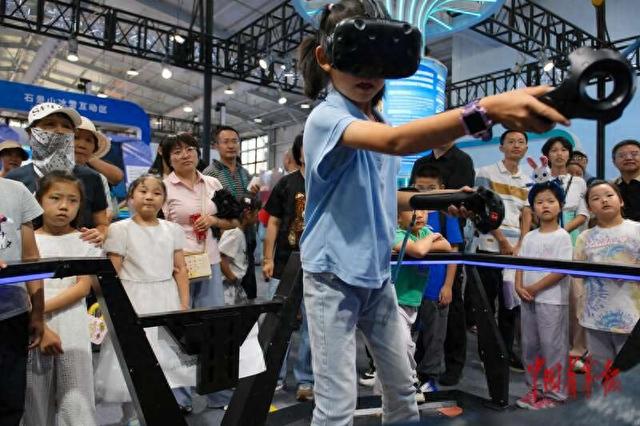
Core Insights - The 2025 China International Service Trade Fair (CIFTIS) features a sports service exhibition themed "Sports City, Connecting the World," focusing on technology empowerment, international cooperation, and innovation in sports consumption [2][6]. Group 1: Event Highlights - The exhibition showcases new technologies, business models, and achievements in the sports service trade sector, allowing visitors to experience "Sports + Technology" [2]. - Visitors can engage in various activities, including VR table tennis and AI sports challenges, highlighting the integration of technology in sports [10][12]. - The event also features esports, with the 2024 International Olympic Committee's decision to host the first Olympic esports event in 2027, emphasizing the growing popularity of esports racing [6]
2025年服贸会闭幕:国潮文创人气旺
Zhong Guo Qing Nian Bao· 2025-09-14 15:29
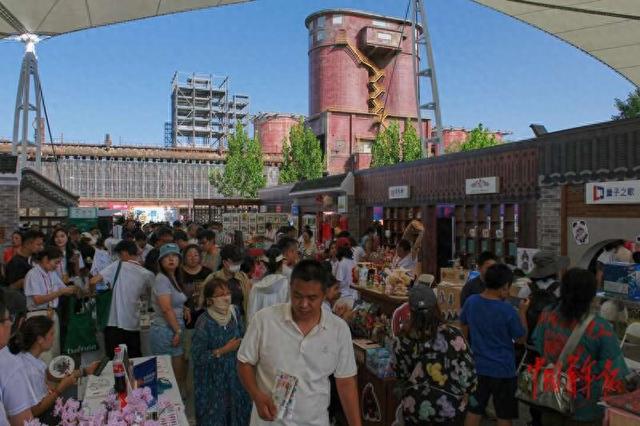
Core Insights - The 2025 China International Service Trade Fair (CIFTIS) showcased a variety of cultural and creative products, highlighting the evolution of the cultural industry from "product output" to "value transmission" [2] - The event attracted a record attendance of 755,000 visitors at Shougang Park from September 10 to 14, marking a new high in visitor numbers [2] Group 1: Event Highlights - The fair featured various engaging cultural exhibitions, including a popular booth by Quanjude that demonstrated the traditional craft of Peking duck preparation [15] - Visitors experienced interactive installations, such as the "one-tap bao" photo machine by China Youth Daily, which allowed them to create commemorative prints [6][7] - The event included large art installations, like the "TWINKLE TWINKLE" character from Pop Mart, which drew significant attention from attendees [9] Group 2: Visitor Engagement - The fair provided immersive experiences that aimed to blend traditional culture with modern consumption, appealing to younger audiences [15] - Attendees actively participated in purchasing cultural products, with some using children's smartwatches for transactions [20] - The event's atmosphere was lively, with numerous visitors engaging with various cultural and creative offerings [2][17][19]
荣获四大奖项,银河M9将于9月17日上市
Zhong Guo Qing Nian Bao· 2025-09-14 13:35
在动力系统上,吉利银河M9采用了雷神EM-P AI电混,拥有CLTC工况百公里4.8升馈电油耗、超1500公 里综合续航、4.5秒破百等领先性能。同级独有的分布式三电机系统,还能提供华尔兹式掉头、漂移泊 车等极致操控体验。9月17日,吉利银河M9将正式上市。 来源:中国青年报客户端 中国青年报客户端讯(中青报·中青网记者 张真齐)近日,在中国汽车技术研究中心有限公司主办 的"2025中国十佳底盘"及"2025中国十佳车身"评选中,吉利银河M9凭借静态、动态两大维度的出色表 现,荣膺年度"十佳底盘""十佳车身""最佳安全"奖项,此外GEA Evo架构获"最佳架构"奖。 据了解,吉利银河M9是吉利基于GEA Evo架构开发的AI科技大六座旗舰SUV,搭载了同级独有的AI数 字底盘,并得到了路特斯团队的全球深度调校,实现了操控精准性与舒适性的平衡。整车高速不晃、过 坎不颠、过弯不甩,可轻松应对全路况挑战。 ...


仰望U8L持续助力比亚迪发力高端市场
Zhong Guo Qing Nian Bao· 2025-09-14 13:35
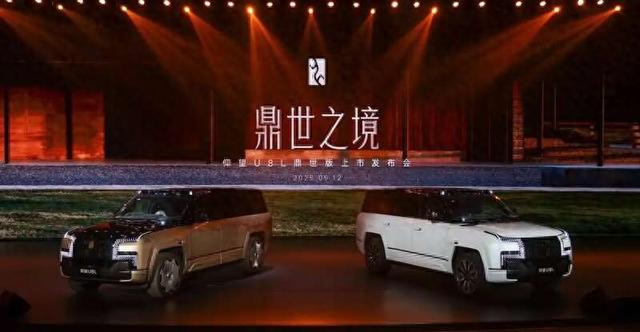
Group 1 - BYD's high-end electric vehicle brand, Yangwang, has launched the new model U8L Ding Shi Edition, priced starting at 1.28 million yuan, with deliveries set to begin at the end of September [2] - The U8L Ding Shi Edition emphasizes "safety" as the core of luxury, differentiating itself from traditional luxury brands that rely on material and brand premium [2] - The vehicle features a full aluminum chassis developed according to global five-star safety standards, enhancing durability and corrosion resistance [2] Group 2 - The U8L Ding Shi Edition is designed to meet the needs of its primary customer base, which consists of nearly 80% entrepreneurs who value both business efficiency and personal comfort [3] - The model reflects a cultural expression of Chinese luxury and represents the understanding and choices of the entrepreneurial group regarding modern transportation [3]

带着“不必答题”的第一份作业上大学
Zhong Guo Qing Nian Bao· 2025-09-14 02:14
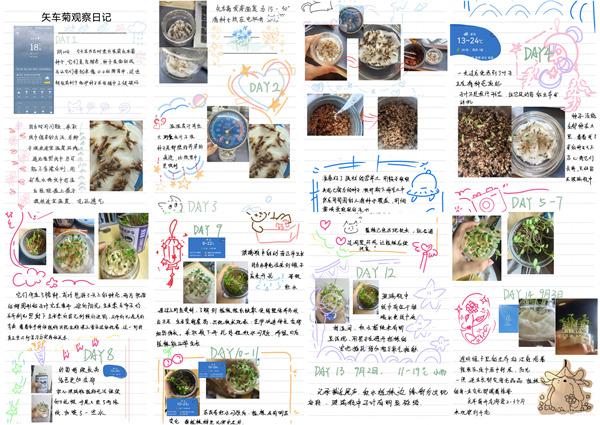
Core Insights - The article discusses the innovative approach taken by various universities in China to assign summer homework to incoming freshmen, focusing on practical and experiential learning rather than traditional academic knowledge [1][2][9] Group 1: Educational Initiatives - South China Agricultural University has implemented a summer assignment for new students that encourages social practice and reading, emphasizing the importance of practical engagement in rural revitalization [1][6] - Northwest A&F University has designed multiple summer assignments for its horticulture students, aiming to connect their studies with historical and practical contexts, thereby enhancing their understanding of the discipline [3][4][5] Group 2: Student Experiences - Students like Wang Xinning and Du Fei have engaged in meaningful projects that link their academic pursuits with personal and historical narratives, fostering a deeper connection to their chosen fields [6][7] - The assignments have prompted students to reflect on their roles in society and the historical significance of their studies, such as the impact of horticulture on rural economies [5][8] Group 3: Transition from High School to University - The concept of "high-level transition" is highlighted, focusing on preparing students for personal growth and self-management rather than merely academic readiness [2][9] - Educators emphasize the importance of addressing the challenges students face during the transition to university life, including cultural shifts and changes in learning environments [8][9]
年轻人“捧红”剧场经济背后的消费逻辑
Zhong Guo Qing Nian Bao· 2025-09-14 02:07
Core Insights - The theater economy is being reshaped by the younger generation, who are not only consumers but also the driving force behind its development [1][2][3] Group 1: Market Dynamics - The theater economy has become an entertainment necessity for the younger demographic, with 76% of ticket buyers aged 18 to 34 over the past three years [2] - In the first half of 2025, 16.05 million theater performances generated a box office of 5.402 billion yuan, with dramas leading the category [2] - 72% of theater audiences are aged between 18 and 34, with 40% of musical theater audiences being under 25 [2] Group 2: Emotional and Social Value - The theater serves as an emotional outlet for young people, who prioritize emotional value over cost-effectiveness, willing to wait three hours for an eight-minute immersive performance [3] - The social aspect of theater consumption allows young individuals to express their aesthetic preferences and cultural identity, creating unique social circles [3] Group 3: Industry Innovation - Young people's preferences are driving the theater industry towards personalized, experiential, and digital development [4][5] - The industry is moving from traditional stage performances to immersive experiences, with examples like the large-scale starry sky concert in Dunhuang [4] - Cities are transforming unused spaces into theater venues, enhancing cultural density and reducing development costs [5] Group 4: Future Development - The balance between spiritual consumption upgrades and supply innovation is essential for the healthy development of the theater economy [6] - Differentiated positioning and cluster development are necessary to avoid homogenization in competition [6] - The integration of theater with tourism and other sectors is crucial for creating a comprehensive cultural consumption ecosystem [6] Group 5: Technological Empowerment - Enhancements in immersive experiences and digital infrastructure are vital, utilizing AR and VR technologies to improve audience engagement [7] - Data-driven operations and AI integration are being promoted to refine theater production and audience experience [7] - Establishing a self-regulatory framework within the industry is important for maintaining service standards and audience satisfaction [7]

郑万众:用焊接技术点燃中职生青春梦想
Zhong Guo Qing Nian Bao· 2025-09-14 02:01
Core Viewpoint - The article highlights the dedication and impact of Zheng Wanzhong, a welding instructor at a vocational education center in Tangshan, Hebei, who has significantly influenced his students' lives through skill development and personal mentorship [1][2][3]. Group 1: Instructor's Background and Achievements - Zheng Wanzhong, aged 50, has been teaching for 26 years and is the only representative from China's vocational education to be nominated for the 2025 "Most Beautiful Teacher" award [1]. - He transitioned from teaching chemistry to welding in 2006, becoming a "dual-skilled" teacher, and has led his students to win numerous awards, including first place in the Hebei Provincial Vocational College Skills Competition for eight consecutive years [2][3]. - His students have achieved notable success in national competitions, including a bronze medal at the World Vocational College Skills Competition in August this year [2]. Group 2: Teaching Environment and Methodology - The training environment is challenging, with no air conditioning and high temperatures, which requires students to endure tough conditions to master welding skills [3]. - Zheng maintains high standards for his students, emphasizing the importance of practice and muscle memory, often requiring them to train rigorously even during competitions [3][5]. - He incorporates innovative teaching methods, such as turning practical tasks into competitions and inviting welding influencers to engage students [5]. Group 3: Student Development and Community Engagement - Many students, previously lacking confidence, have found new directions in life through welding, with some expressing a desire to train even during breaks [5][6]. - Zheng emphasizes the connection between teaching and community service, encouraging students to use their skills to help local residents by repairing tools and equipment [4][6]. - The vocational education center has seen a consistent increase in enrollment, with 51 students this year, primarily from rural backgrounds, indicating a growing interest in practical skills [1].