
Zhong Guo Hua Gong Bao

Search documents
石油与化工指数多数下跌(11月17日至21日)
Zhong Guo Hua Gong Bao· 2025-11-25 03:06
Group 1: Market Indices - The chemical sector indices experienced significant declines, with the chemical raw materials index down 8.61%, chemical machinery index down 7.11%, pharmaceutical index down 6.63%, and pesticide and fertilizer index down 5.94% [1] - In contrast, the oil sector indices showed mixed results, with the oil processing index up 1.4% and the oil extraction index up 0.67%, while the oil trade index fell by 4.96% [1] Group 2: Oil Prices - The sentiment in the crude oil market turned bearish due to the Trump administration urging Ukraine and Russia to reach a peace agreement, alongside a strengthening US dollar, leading to a decline in oil prices [1] - As of November 21, the settlement price for West Texas Intermediate (WTI) crude oil futures was $58.06 per barrel, down 3.38% from November 14, while Brent crude oil futures settled at $62.56 per barrel, down 2.84% [1] Group 3: Chemical Products - The top five rising petrochemical products included industrial-grade lithium carbonate up 13.67%, dimethyl carbonate up 12.32%, lithium battery electrolyte up 8%, sulfur up 7.54%, and folic acid up 6.25% [2] - Conversely, the top five declining petrochemical products were liquid chlorine down 6.25%, diethylene glycol down 5.35%, isooctyl acrylate down 5.13%, PVC by ethylene method down 3.49%, and tetrachloroethylene down 3.49% [2] Group 4: Stock Performance - In the capital market, the top five gaining listed chemical companies were Guofeng Plastics up 33.33%, Huarong Chemical up 27.82%, Tongyi Co. up 16.51%, Chenguang New Materials up 16.37%, and Tongcheng New Materials up 14.75% [2] - The top five declining listed chemical companies included Annada down 26.13%, Taihe Technology down 25.64%, Jiaao Enpro down 25.62%, Jianye Co. down 24.85%, and Sanfangxiang down 23.33% [2]
苯酐:低位徘徊态势难改
Zhong Guo Hua Gong Bao· 2025-11-25 03:06
Group 1 - The anhydride market is experiencing a significant downturn, with prices reaching a four-year low of 5700 yuan per ton, indicating a persistent low-level trend due to unresolved supply-demand contradictions [1][2] - The traditional peak season of "Golden September and Silver October" has failed to boost market performance, with prices dropping below 5900 yuan in October, marking a decline of over 1000 yuan compared to the same period in 2024 [2] - Increased supply is identified as the core factor behind the sluggish anhydride market, with new production capacities contributing to a total of 163,000 tons per year for neighboring anhydride and 172,000 tons per year for naphthalene anhydride, leading to weakened bargaining power for producers [2][3] Group 2 - A reversal in profitability has been observed between neighboring and naphthalene anhydride, with neighboring anhydride moving from a loss of 300-500 yuan to a break-even state due to increased supply of ortho-xylene [3] - Naphthalene anhydride, despite some recovery in profits, remains in a state of loss exceeding 900 yuan, with overall industry operating rates dropping to 40%-50% [3] - The anhydride industry is expected to enter a deep adjustment period, with low operating rates and the permanent exit of some outdated capacities potentially providing limited space for profit recovery [3] Group 3 - Demand for anhydride remains weak, with downstream industries such as plasticizers and unsaturated resins showing slow recovery and maintaining only minimal purchasing needs [4] - The main downstream product, DOP, faces challenges from increasing substitutes and declining demand, leading to low operational loads and continuously falling prices [4] - The unsaturated resin market is also under pressure, with operating rates around 36% and limited potential for price recovery, further contributing to the downward trend in the anhydride market [4]
信和新材料万华化学联合实验室挂牌
Zhong Guo Hua Gong Bao· 2025-11-25 02:58
Core Viewpoint - Sinochem New Materials Co., Ltd. and Wanhua Chemical Group Co., Ltd. have established a joint development laboratory to enhance collaboration on advanced coating materials and domestic high-performance raw materials [1] Group 1: Joint Development Laboratory - The joint development laboratory aims to focus on cutting-edge technology in high-end coating materials and the compatibility of Wanhua Chemical's domestic high-performance raw materials [1] - The initial collaboration will concentrate on single product supply, gradually expanding to R&D technology improvements and production process optimizations [1] Group 2: Domestic High-End Curing Agents - Sinochem New Materials is one of the first companies to switch to Wanhua Chemical's domestic HDI curing agents, addressing the long-standing reliance on imports for high-end curing agents in China [1] - Through joint testing and formulation optimization, the companies aim to achieve domestic substitution of high-end curing agents [1] Group 3: Trust and Collaboration - The partnership is built on years of accumulated trust, transitioning from "supply-demand synergy" to "technology co-creation" [1]

抓牢“牛鼻子” 守好“生命线”——晋能控股装备制造集团化工产业项目建设纪实
Zhong Guo Hua Gong Bao· 2025-11-25 02:58
Group 1 - The core viewpoint emphasizes that project construction is a "hard support" for high-quality development, with a focus on key project construction mechanisms to ensure safety, efficiency, and quality in the chemical industry [1] - The company has established a "dynamic tracking + key verification" mechanism to oversee construction safety standards, engineering progress, and technology upgrades [1] - Several projects, including the gasification system upgrade and energy efficiency improvements, have been completed and are operational, while additional projects are progressing smoothly [1] Group 2 - Safety is highlighted as a "lifeline," with a "three management and three musts" approach implemented to ensure project safety and efficiency [2] - The company has integrated project construction into its decision-making process, emphasizing quality and safety to accelerate project progress [2] - Regular project progress meetings are held to ensure accountability and timely resolution of issues, with a clear focus on risk management [2] Group 3 - The Tianqing company's melamine project is noted for its rapid construction timeline, achieving full operational capacity within a year and a half [3] - A systematic approach to project management, including a detailed checklist for task completion, has facilitated the swift progression of the project [3] - The project utilizes advanced production technology, resulting in lower energy consumption and improved environmental performance [3] Group 4 - The Xin Heng Sheng company's relocation project has achieved impressive production metrics, with daily ammonia production exceeding 2,256 tons [4] - A comprehensive safety inspection and meticulous operational management have been implemented to ensure stable project performance [4] - The project has successfully integrated advanced monitoring systems to maintain operational efficiency and safety [5] Group 5 - The company plans to continue leveraging its roles in advising, guiding, supervising, and servicing to enhance project management across all phases [5] - Future initiatives will focus on integrating digital and intelligent technologies into project construction to support high-quality development [5] - The emphasis will be on the scientific nature of project planning, efficiency in funding, and the advancement of process selection [5]
圣奥化学两公司获评用户满意四星企业
Zhong Guo Hua Gong Bao· 2025-11-25 02:58
Core Viewpoint - Shengao Chemical's subsidiaries, Shandong Shengao and Tai'an Shengao, have been awarded the "2025 User Satisfaction Four-Star Level Enterprise" by the China Quality Association, highlighting the company's commitment to customer satisfaction and quality management [1] Group 1: Company Achievements - Shengao Chemical has consistently adhered to a "customer-centric" philosophy, integrating excellent management throughout its production processes [1] - The company has achieved certifications for ISO9001 Quality Management System and IATF16949:2016 Automotive Industry Quality Management System [1] - The company's stable operating factory testing centers have received recognition from the China National Accreditation Service for Conformity Assessment (CNAS) [1] Group 2: Quality Management and Customer Satisfaction - Shengao Chemical maintains a high level of user satisfaction within the industry due to comprehensive control over product quality details and superior service [1] - The company plans to continue its commitment to "quality integrity and user satisfaction," emphasizing responsibility and craftsmanship as foundational elements [1] - Shengao Chemical aims to provide higher quality products and better services to its customers in the future [1]
抚顺石化石蜡产品进入欧洲市场
Zhong Guo Hua Gong Bao· 2025-11-25 02:58
Core Viewpoint - China Petroleum Fushun Petrochemical has successfully produced paraffin products that meet European RAL-GZ041 testing standards, marking a significant step in international competition for the company [1] Group 1: Production and Quality Improvement - The company utilized a major maintenance opportunity to implement technical upgrades for enhancing the quality of paraffin products [1] - Technical personnel adjusted process conditions and strengthened process management to explore optimal production parameters, leading to the successful production of 56 paraffin in mid-October [1] Group 2: Sales and Market Entry - The company has sold 1,773 tons of 56 paraffin and 993 tons of 58 paraffin, aiming for a quarterly production target of no less than 10,000 tons [1]

扬子石化丁苯橡胶装置的“三精”实践
Zhong Guo Hua Gong Bao· 2025-11-25 02:58
Core Insights - The company is implementing refined management practices in its styrene-butadiene rubber plant to ensure stable long-term operation amid challenging market conditions and high operational risks [1] Group 1: Inspection Optimization - The inspection process has been streamlined by merging similar inspection points, resulting in a 13% reduction in the number of inspection points while maintaining focus on core risk areas [2] - A leadership-led inspection mechanism has been established, requiring weekly inspections to assess the rationality of inspection routes and the quality of inspections conducted by team members [2] Group 2: Energy Consumption Control - The company has created a detailed action indicator breakdown for energy consumption, assigning clear targets to each position and equipment, which has led to a reduction in abnormal occurrences from an average of 6 times per month to 3.5 times [3] - Employees are actively engaged in identifying energy-saving opportunities, contributing 62 issues and 46 optimization suggestions [3] Group 3: Blind Plate Management - A comprehensive management system for blind plates has been established, ensuring that all installations are verified against plans and approved by relevant authorities, achieving a 100% compliance rate in blind plate operations [5] - A differentiated inspection mechanism for various types of blind plates has been implemented, resulting in the inspection of 534 regular blind plates with three issues identified and resolved [5]
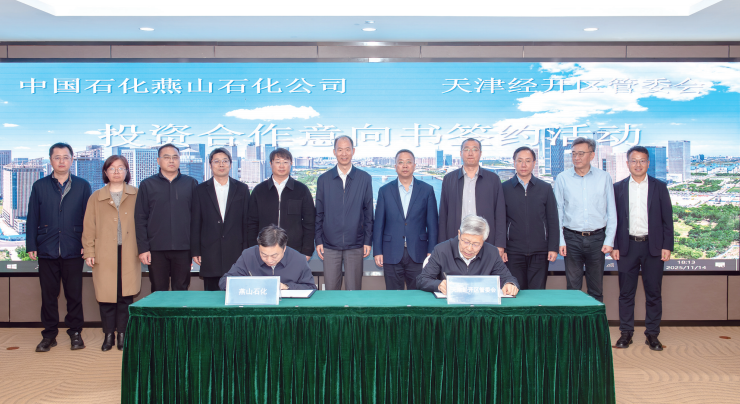
燕山石化、天津经开区携手助力京津冀协同发展
Zhong Guo Hua Gong Bao· 2025-11-25 02:51
Core Insights - Yanshan Petrochemical has signed an investment cooperation intention agreement with the Tianjin Economic and Technological Development Zone, marking a significant step in promoting coordinated development in the Beijing-Tianjin-Hebei region and initiating a new chapter in its "second entrepreneurship" [1][3] Group 1: Project Overview - The Tianjin Nangang Green High-end Rubber New Materials Project is a key initiative under Sinopec's "New Materials" and "Ten Dragons" engineering programs, as well as a major project for Tianjin City by 2025 [3] - The project aims to meet the high-quality raw material demand for the high-end tire market, aligning with national and Tianjin industrial policy directives [3] Group 2: Project Development Status - The project received approval for its feasibility study from Sinopec in February, with plans for a 100,000 tons/year solution-styrene butadiene rubber and a 100,000 tons/year polybutadiene rubber facility [3] - Administrative licensing procedures have been completed, and the project has transitioned into the engineering construction phase [3] Group 3: Strategic Importance - The Nangang Industrial Zone is a core petrochemical industrial park in Tianjin and a demonstration base for new industrialization, serving as a key site for coordinated development in the Beijing-Tianjin-Hebei region [3] - Yanshan Petrochemical's establishment in the Tianjin Nangang base is a crucial support point for its future development strategy, aiming to create a new pattern of high-quality growth and contribute significantly to industrial collaboration in the region [3]

中国石化驻晋企业发布“十四五”成果报告
Zhong Guo Hua Gong Bao· 2025-11-25 02:51
Core Viewpoint - China Petroleum & Chemical Corporation (Sinopec) has showcased its achievements in energy security, green transformation, and improving people's livelihoods in Shanxi Province over the past five years through the "14th Five-Year Plan" high-quality development report [1][2]. Group 1: Energy Security - Sinopec's enterprises in Shanxi have integrated into the province's energy structure optimization, establishing a diversified supply system including oil, gas, hydrogen, electricity, and geothermal energy [1]. - Shanxi Petroleum has completed the upgrade to National VI standards for oil products and is responsible for 40% of the province's refined oil supply, with an annual average growth rate of 95% in natural gas retail volume, making it the largest natural gas retailer in the province [1]. - Sinopec (Shanxi) Coalbed Methane Company has developed key technologies for deep coalbed methane extraction, promoting the conversion and utilization of local clean energy resources [1]. - New Star Double Cool Geothermal Energy Company has built a geothermal heating capacity of 13 million square meters, serving nearly 120,000 households, becoming the largest geothermal heating enterprise in the province [1]. Group 2: Green Development - Sinopec's enterprises in Shanxi have contributed to the continuous improvement of ecological environment quality by investing over 20 million yuan annually in environmental protection projects such as oil and gas recovery and wastewater treatment [2]. - Shanxi Petroleum has established 24 "carbon-neutral" stations, providing experience for low-carbon transformation for enterprises across the province [2]. - Sinopec (Shanxi) Coalbed Methane Company has pioneered a "full gas power generation + full electric drive reservoir transformation" technology model, achieving zero carbon emissions in coalbed methane development [2]. - New Star Double Cool Geothermal Energy Company has replaced 300,000 tons of standard coal with geothermal energy annually, reducing carbon dioxide emissions by 780,000 tons, equivalent to planting 1.15 million trees [2]. Group 3: High-Quality Development - Sinopec's enterprises in Shanxi have created a new development pattern of "enterprise-local interaction and mutual benefit" through strategic alignment, industrial co-construction, and public service [2]. - Shanxi Petroleum has signed cooperation agreements with local governments and organized production and sales matching events to promote Shanxi specialties nationwide [2]. - In support of rural revitalization, Sinopec's enterprises have invested in assistance funds and actively conducted agricultural support activities, reducing fuel costs for farmers [2]. - Sinopec has established 255 love stations and 88 driver homes, providing convenience services for over 500,000 freight drivers [2]. - The company has collaborated with the China Health Express Foundation to provide free cataract surgeries for over 4,000 impoverished patients in Changzhi and other areas [2].

“一米宽”处掘“百米深”| 大家谈 如何破除“内卷式”竞争
Zhong Guo Hua Gong Bao· 2025-11-25 02:45
Core Viewpoint - The chemical industry is facing intensified competition characterized by homogenization, structural capacity contradictions, and concentrated technological innovation. Companies need to recalibrate their strategic positioning towards differentiation, focusing on "specialized, refined, unique, and innovative" approaches to build a sustainable competitive advantage [1][3]. Group 1: Strategic Directions for Chemical Enterprises - Companies should deeply explore value "gaps" in the industrial chain, targeting high-tech, performance-demanding niche markets such as electronic chemicals, high-performance composite materials, high-end pharmaceutical intermediates, and specialty catalysts, which have high customer loyalty and low price sensitivity [2]. - A shift from being a single chemical supplier to providing comprehensive application solutions is essential. For instance, plastic additive companies should offer not just plasticizers but also technical services and formula support to enhance processing performance and meet specific environmental standards, thus increasing customer loyalty and diversifying revenue sources [2]. - Embracing both green and digital transformations is crucial. Sustainable development (ESG) and digitalization should be viewed as strategic investments rather than mere cost items, focusing on developing green processes, bio-based materials, and circular economy systems while leveraging AI, big data, and industrial internet for production optimization and smart supply chain management [2]. Group 2: Importance of Specialized Development - In the face of fierce competition, chemical companies must firmly adopt the "specialized, refined, unique, and innovative" development path to take the initiative in industry restructuring. This approach represents a strategic choice to break the cycle of homogenization and is a critical leap from quantitative expansion to qualitative breakthroughs [3].