
Zhong Guo Hua Gong Bao

Search documents
多重利好因素共振 尿素市场迎“开门红”
Zhong Guo Hua Gong Bao· 2026-01-09 00:52
Core Viewpoint - The domestic urea market is expected to end its downward trend in November 2025 and enter a recovery phase, driven by steady demand release, reduced supply, and increased exports, leading to a price increase in early 2026 [1] Group 1: Demand Recovery - A new batch of urea export quotas totaling approximately 600,000 tons was issued in November 2025, boosting market activity [2] - In December 2025, domestic urea consumption reached around 5.38 million tons, a month-on-month increase of 27.49% and a year-on-year increase of 37.15% [2] Group 2: Supply Constraints - Urea inventories in domestic enterprises have decreased for three consecutive months, with December 2025 inventory at 1.0689 million tons, down from 1.5543 million tons in October [5] - The supply of urea has tightened due to maintenance shutdowns and environmental regulations, leading to a daily production drop to around 190,000 tons, a decrease of 5% [5] Group 3: Export Growth - Cumulative urea exports reached 4.6161 million tons in the first eleven months of 2025, a year-on-year increase of 1663.22% [6] - The announcement of a new urea tender by India for 1.5 million tons has positively impacted market confidence and prices [6] Group 4: Market Outlook - Short-term market demand is expected to fluctuate slightly, but long-term demand growth remains strong, particularly in the agricultural and industrial sectors [3] - Key factors influencing the market include the pace of new capacity coming online, export policy adjustments, and the speed of low-carbon transition [7]
超130亿元!磷酸铁锂行业再添三个大项目
Zhong Guo Hua Gong Bao· 2026-01-07 10:38
Core Viewpoint - The lithium iron phosphate (LFP) industry is experiencing a new wave of expansion with significant investments announced despite recent challenging years [1] Group 1: Project Announcements - Bangpu Times is set to launch a new generation lithium iron phosphate project with an annual capacity of 450,000 tons by December 29, 2025, involving a total investment of 5.6 billion yuan and an expected annual output value of 14.5 billion yuan [2] - Fulin Precision plans to establish a high-end energy storage lithium iron phosphate project with an annual capacity of 500,000 tons in Inner Mongolia, with a total investment of 6 billion yuan, aimed at meeting the growing demand for high-performance lithium iron phosphate batteries [3] - Longpan Technology intends to build a production base for high-density lithium iron phosphate with an annual capacity of 240,000 tons in Jiangsu, with a planned investment of no more than 2 billion yuan [4] Group 2: Strategic Importance - The projects announced by Bangpu Times and Fulin Precision are strategically aligned with the increasing demand for high-performance lithium iron phosphate batteries in the energy storage market, which is expected to enhance their market position and production capacity [2][3] - Longpan Technology's investment in high-density lithium iron phosphate production is also aimed at optimizing its product offerings and expanding its market reach [4]



煤化工成为山西能源转型新路径
Zhong Guo Hua Gong Bao· 2026-01-07 07:59
Core Viewpoint - Shanxi Province has introduced the "Implementation Opinions on Accelerating Energy Technology Innovation to Support Energy Transition Development," aiming to enhance energy technology innovation capabilities and explore new paths for energy transition, with coal chemical industry being one of the nine new paths for energy transformation [1] Group 1: Energy Transition Paths - The implementation opinions identify nine strategic paths for energy transition, including coal mining, flexible and efficient power generation, coal chemical industry, coalbed methane exploration and development, new energy, smart grid, solid waste disposal and utilization, carbon capture, utilization, and storage, and "Artificial Intelligence + Energy Innovation" [1] - A total of 33 key tasks have been outlined to drive breakthroughs in critical core technologies, providing robust technological support for energy transition [1] Group 2: Coal Chemical Industry Development - Shanxi will promote high-end, diversified, and low-carbon technology development in the coal chemical industry, focusing on the steady advancement of coal's differentiated and graded utilization, new coal coking, and downstream material development [2] - The province aims to advance the integration of coal, coke, and steel industries, conduct research on low-rank coal pyrolysis technology, and develop industrialization technologies for high-end fuels and materials from coke oven gas, coal tar, and asphalt [2] - Efforts will also include the development of advanced gasification technologies and equipment suitable for Shanxi's coal types, as well as research on key technologies for the high-value conversion of indirect liquefaction products [2] Group 3: Renewable Energy and Technology Innovation - The development of wind and solar technologies will be accelerated, focusing on high-efficiency, low-cost crystalline silicon batteries, perovskite-crystalline silicon tandem solar cells, new perovskite batteries, and cadmium telluride thin-film battery technologies [2] - Research will be conducted on the extraction technologies and materials for new energy metals such as lithium and aluminum, along with application demonstrations for electric heavy trucks and hydrogen-powered heavy trucks [2] - The exploration and utilization of geothermal energy will be promoted, including precise exploration and efficient large-scale utilization technologies, as well as the promotion of heat pumps, geothermal, and distributed renewable energy heating technologies [2] Group 4: CO2 Utilization and Artificial Intelligence - Technologies for converting CO2 into high-value oxygen-containing compound products will be advanced, focusing on breakthroughs in efficient catalysts and reaction processes for CO2 chemical conversion [3] - A safe and controllable CO2 storage technology system will be constructed, including potential assessment technologies for saline aquifers, salt caverns, and abandoned mines [3] - The implementation of "Artificial Intelligence + Energy Innovation" will be promoted, enhancing coal chemical processes through high-throughput research and data platform construction, which will empower catalyst development, process simulation, and reactor design [3]
天智辰业应用5G防爆智能终端
Zhong Guo Hua Gong Bao· 2026-01-07 04:42
Core Viewpoint - Xinjiang Tianzhicheng Chemical Co., Ltd. has launched a 5G explosion-proof smart terminal to enhance safety and efficiency in chemical production environments [1] Group 1: Product Features - The smart terminal is certified for explosion-proof electrical use and operates on a dedicated 5G network, ensuring secure and controlled communication [1] - It includes industrial applications such as electronic work tickets and equipment monitoring, leveraging 5G's high speed and low latency for efficient data processing [1] - The terminal enables real-time collection of critical data like temperature, pressure, and vibration, with immediate alerts for abnormal conditions [1] Group 2: Operational Improvements - The introduction of the 5G smart terminal streamlines inspection processes, allowing for quick approvals and risk notifications without the need for multiple tools or manual record-keeping [1] - Employees report enhanced safety management and data transmission speed, leading to more precise safety controls [1] - The terminal's features, including high-definition cameras and BeiDou positioning, facilitate comprehensive tracking of inspection routes and emergency responses [1]
湖南石化年产百万吨重整联合装置投产
Zhong Guo Hua Gong Bao· 2026-01-07 04:37
Core Viewpoint - The successful commissioning of Hunan Petrochemical's 1 million tons/year continuous reforming unit project marks a significant advancement in gasoline production and quality, utilizing proprietary technology and domestic catalysts [1][2] Group 1: Project Overview - The project has achieved design standards in key operational indicators after 72 hours of monitoring, indicating a successful initial operation [1] - It employs Sinopec's self-developed Super Low-Pressure Continuous Reforming (SLCR) technology and domestic reforming catalyst PS-VI, processing straight-run naphtha and mixed naphtha to produce high-octane gasoline components and by-products [1] Group 2: Production and Process Management - The project includes three units: continuous reforming, aromatics extraction, and high-purity gas separation (PSA), forming a closed-loop industrial chain that enhances product value [1] - During construction, Hunan Petrochemical coordinated closely with contractors to ensure timely completion of project phases and improved management of project quality and progress [1] Group 3: Safety and Operational Readiness - The company conducted seven full-process simulation drills to refine operational details and ensure a smooth startup process [2] - A special task force monitored the startup progress in real-time, with key personnel maintaining a 24-hour presence on-site to enforce safety controls [2]
湖北新祥云硫铁矿制酸装置投产
Zhong Guo Hua Gong Bao· 2026-01-07 04:26
Group 1 - The core viewpoint of the article is the successful commissioning of a 400,000 tons/year sulfuric acid production facility by China Chemical Engineering Thirteenth Construction Company in Hubei Province, which utilizes advanced technology and achieves high conversion rates of sulfur dioxide and absorption rates of sulfur trioxide [1] - The facility employs a "3+1" two-turn two-absorption process to produce 92.6% concentrated sulfuric acid, with a total sulfur dioxide conversion rate exceeding 99.8% and a sulfur trioxide absorption rate of 99.9% [1] - This project is a key initiative in Hubei Province and represents the largest single investment industrial project in Huanggang City, establishing a foundation for the company to undertake similar major projects in the future [1]

“铜白潼”管道渭河定向钻回拖成功
Zhong Guo Hua Gong Bao· 2026-01-07 04:26
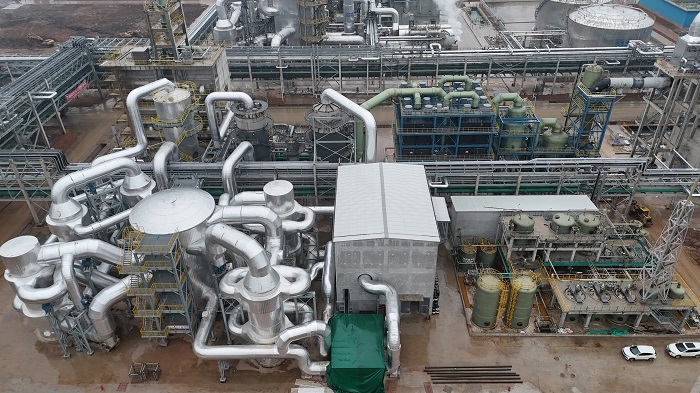
Core Viewpoint - The successful completion of the directional drilling for the "Tongchuan–Baihe–Tongguan" gas pipeline project sets a new world record for the length of directional drilling in sandy strata with a diameter of 610 mm, reaching 4259.67 meters [1]. Group 1: Project Details - The "Tongchuan–Baihe–Tongguan" gas pipeline project is a key construction initiative in Shaanxi Province aimed at improving the natural gas network layout and enhancing gas supply security in the Weibei region [1]. - The project was independently designed and executed by China National Petroleum Pipeline Engineering Company, which identified and addressed various technical challenges related to the complex geological conditions of the Weihe River [1]. Group 2: Technical Innovations - The design team implemented strict requirements for drilling machine selection, lightweight drill rod combinations, and mud composition to tackle risks such as local collapse, pipe sticking, and high drag during the back-dragging process [1]. - A unique design approach was adopted, including a smooth crossing curve with small entry and exit angles, and a "pre-excavated pit + pipe hoisting machine + hoisting basket + sending trench" design to facilitate the successful back-dragging of the large-diameter pipeline [1]. Group 3: Environmental Considerations - To protect the fragile ecosystem of the Weihe River, the design team established effective technical measures for soil erosion prevention, waste mud treatment, and solid waste and domestic garbage management to mitigate environmental damage during construction [2].
福建莆田10万吨级化工码头完工
Zhong Guo Hua Gong Bao· 2026-01-07 04:26
石门澳化工新材料产业园是莆田国家级新型功能材料千亿产业集群核心承载区。6#、9#泊位项目作为福 建省内唯一具备液氨作业资质的10万吨级化工码头,预计12月验收投运,将为莆田新型功能材料千亿产 业集群打通物流关键节点,支撑区域产业升级。该项目新建5000吨级、10万吨级液体散货泊位各1个, 年设计通过能力396万吨。其中,6#泊位专注服务小批量高附加值化学品运输,9#泊位主打大宗原料接 卸,承担了项目70%以上的吞吐量,单船卸载效率较传统模式提升3倍。 中化新网讯日前,福建湄洲湾港秀屿港区石门澳作业区6#、9#泊位码头主体、疏浚工程、导助航工程等 8个单位工程顺利通过交工验收。 ...
新浦化学高端化学品项目环评获批
Zhong Guo Hua Gong Bao· 2026-01-07 04:25
Core Viewpoint - The environmental impact report for the high-end chemical project by Xinpu Chemical (Taixing) Co., Ltd. has been approved, indicating a significant investment in the chemical industry in Taizhou [1] Investment Details - The total investment for the project is 718.732 million yuan, with 54.53 million yuan allocated for environmental protection, representing 0.76% of the total investment [1] Project Specifications - The project includes the construction of a 62,400 Nm3/h syngas unit, a 500,000 tons/year butanol unit, a 400,000 tons/year polypropylene unit, a 16,000 Nm3/h gas separation unit, and a 200,000 cubic meter ethane tank, along with other supporting facilities [1] Production Capacity - Upon completion, the project is expected to produce 323,000 tons of syngas, 1,840 tons of hydrogen, 413,240 tons of n-butyraldehyde, 236,000 tons of n-butanol, 90,000 tons of isobutyraldehyde, 150,000 tons of isooctanol, 205,300 tons of oxygen, 433,600 tons of nitrogen, 9,400 tons of liquid argon, and 400,000 tons of polypropylene annually [1]
全球最大陆上薄膜型LNG储罐开建
Zhong Guo Hua Gong Bao· 2026-01-07 04:00
Core Insights - The project marks the commencement of the construction of the largest land-based membrane LNG storage tank globally, located at the Guangdong Eastern LNG receiving station [1][2] - The project aims to enhance the LNG storage capacity in South China, filling a significant gap in large-scale membrane LNG storage facilities in the region [1] Group 1: Project Details - The project will involve the construction of three membrane LNG storage tanks, each with a diameter of nearly 100 meters and an effective volume of 240,000 cubic meters [1] - The new storage tanks will increase the total storage capacity of the Guangdong Eastern LNG receiving station to 780 million cubic meters, with an annual processing capacity of 6 million tons [2] Group 2: Technological and Economic Advancements - The project utilizes advanced membrane tank technology, achieving a 10% increase in effective tank capacity and a 5% reduction in construction costs compared to traditional full-containment tanks [1] - The core materials for the tanks will be fully sourced domestically, significantly improving land resource utilization and economic efficiency [1] Group 3: Environmental Impact - The steel usage for the inner wall protection system will be reduced by 90% compared to traditional tanks, leading to a reduction in overall carbon emissions by over 25% [1] - The design includes nitrogen protection and thermal insulation, ensuring stable cooling performance and significantly enhancing the reliability of the tanks throughout their lifecycle [1]
