Zhong Guo Chan Ye Jing Ji Xin Xi Wang

Search documents
我国首套"取芯"波浪补偿平台投入应用
Zhong Guo Chan Ye Jing Ji Xin Xi Wang· 2025-09-11 21:32
Core Viewpoint - The article highlights a significant technological breakthrough in the construction of the first phase of the breakwater project at the Xiaomo International Logistics Port, which is being undertaken by China Communications Second Navigation Engineering Bureau Co., Ltd. The introduction of the domestically developed "core sampling" wave compensation platform is expected to provide essential technical support for key port construction in the Guangdong-Hong Kong-Macao Greater Bay Area [1] Group 1: Technological Innovations - The "core sampling" wave compensation platform is based on parallel mechanism kinematics and utilizes inertial sensors to monitor the vessel's motion data in real-time [1] - The control system calculates the compensation amount, and the electromechanical coupling drive system achieves vertical displacement compensation and two-axis angular displacement correction, with an auxiliary precision of centimeters [1] - The platform has improved wave resistance from 0.4 meters to 0.8 meters, increasing the core sampling window period by 50% [1] Group 2: Efficiency Improvements - The integrity of 16-meter long core samples has increased from 90% to 99% [1] - Core sampling efficiency has doubled, allowing for the collection of two cores per day [1] Group 3: Strategic Importance - The core technology system of the platform has been fully localized, serving as a critical component for the Xiaomo International Logistics Port project [1] - The project team has laid out patents around the core technology, ensuring a strong intellectual property foundation [1] - The platform is advancing core sampling tasks, contributing to the goal of achieving a handling capacity of 1 million vehicles by 2027 at the Xiaomo International Logistics Port [1]
中国造压缩空气“超级充电宝” 锚定未来“新三样”
Zhong Guo Chan Ye Jing Ji Xin Xi Wang· 2025-09-11 21:32
Core Viewpoint - China Energy Construction (China Energy) has achieved significant breakthroughs in the research and development of compressed air energy storage (CAES) technology, marking a major advancement from theoretical concepts to practical engineering applications [1][3]. Group 1: Technological Breakthroughs - China Energy has successfully constructed the world's largest artificial cavern gas storage test platform and has set five world records and eight pioneering achievements in gas sealing cycle tests, achieving a breakthrough pressure of 18 MPa [1]. - The artificial cavern technology is expected to expand the site selection for CAES plants and significantly reduce costs, enhancing the feasibility of large-scale energy storage solutions [4]. Group 2: Industry Context and Demand - As of June this year, the installed capacity of wind and solar power in China reached 1.673 billion kilowatts, with a peak electricity load of 1.5 billion kilowatts in July, indicating a high penetration of variable renewable energy sources [2]. - The construction of a new power system necessitates long-duration energy storage solutions, which have become essential for ensuring grid stability and enhancing the absorption capacity of renewable energy [2][3]. Group 3: Future Prospects - The National Development and Reform Commission and the National Energy Administration have identified CAES as a key technology for development, aiming to promote the engineering application of hundred-megawatt-level projects [5]. - By 2030, it is projected that China's CAES installed capacity will reach 43 GW, driven by the need for effective energy storage solutions to support renewable energy consumption and the construction of a new power system [7]. Group 4: Commercialization and Application - China Energy's CAES system solution, known as "Energy Storage No. 1," is positioned as a leading technology in the new energy storage sector, addressing challenges related to high proportions of renewable energy and energy consumption mismatches [3][6]. - Various commercialization models for CAES, including shared storage, integrated renewable energy and storage, and independent storage stations, are being explored to enhance economic viability and application scenarios [6].

全球前5000个品牌中我国品牌价值达1.76万亿美元 位居全球第二
Zhong Guo Chan Ye Jing Ji Xin Xi Wang· 2025-09-11 21:32
9月6日,由中华商标协会与山西省商标品牌标准化建设促进会共同主办,全国商标协会联席会议成员单 位支持的第十五届中国国际商标品牌节在山西省太原市开幕。本届商标品牌节以"服务商标品牌建设工 程培育中国知名商标品牌"为宗旨,以"传承.变革.共享"为主题,举办中国商标年会、中华品牌商标博览 会等活动。 记者从本届商标品牌节上获悉,近年来,我国持续加强商标品牌工作,打造一批以科技创新为支撑的知 名商标品牌,2024年全国商标质押融资登记金额超过3000亿元。我国推进修订商标注册申请快速审查有 关规定,完善审查机制,丰富政策供给。推动建设5100余个商标品牌指导站,全年服务企业超60万次, 为经营主体提供便利化的商标品牌公共服务。此外,我国积极推动中国品牌"走出去",2024年中国申请 人提交的马德里商标国际注册申请5828件,比上年增长6.3%,连续多年位居世界第三。世界知识产权 组织报告显示,2024年全球前5000个品牌中,中国的品牌价值达1.76万亿美元,位居全球第二,中国品 牌国际影响力进一步增强。 作为本届商标品牌节的重要组成部分,为期3天的2025中华品牌商标博览会备受瞩目。博览会展览面积 1.6万余平方米 ...
2025年1—7月服务进出口总额45781.6亿元,同比增长8.2%
Zhong Guo Chan Ye Jing Ji Xin Xi Wang· 2025-09-11 21:28
Core Insights - China's service trade showed steady growth from January to July 2025, with total service import and export amounting to 45,781.6 billion yuan, reflecting a year-on-year increase of 8.2% [1] Service Trade Overview - Exports reached 19,983 billion yuan, marking a growth of 15.3%, while imports totaled 25,798.6 billion yuan, with a growth of 3.3% [1] - The service trade deficit was 5,815.6 billion yuan, which is a reduction of 1,836.2 billion yuan compared to the same period last year [1] Knowledge-Intensive Service Trade - Knowledge-intensive service trade maintained growth, with imports and exports totaling 17,756 billion yuan, an increase of 6.8% [1] - Specific segments included other business services and telecommunications, computer, and information services, with import and export values of 7,509.7 billion yuan and 6,268 billion yuan, growing at rates of 3.4% and 12.6% respectively [1] - Knowledge-intensive service exports were 10,253.3 billion yuan, up by 8.6%, while imports were 7,502.7 billion yuan, increasing by 4.6%, resulting in a surplus of 2,750.6 billion yuan, which is an expansion of 482.7 billion yuan year-on-year [1] Travel Services - Travel services experienced the fastest growth, with total imports and exports reaching 12,594.6 billion yuan, a growth of 10.4% [1] - Exports in this category surged by 62.9%, while imports grew by 3.9% [1]
生态美 文化兴 产业旺 北京市门头沟打造乡村振兴创新样板
Zhong Guo Chan Ye Jing Ji Xin Xi Wang· 2025-09-11 21:27
Core Insights - The article discusses the implementation of the "first release economy" concept in Beijing's Mentougou District, focusing on innovation and the development of a "poetic rural" model that integrates ecological beauty, cultural prosperity, and industrial vitality [1][2][3] Group 1: Economic Development - Mentougou District is promoting a "rural + first release" integration model to transform from single tourism to diversified consumption, from traditional business formats to innovative ones, and from regional resources to brand assets [1] - Wangping Town has introduced various new brands such as "Huanxi Tea" and "Zhi Yuan Family Banquet," successfully activating new economic formats in rural areas and providing diverse consumption options for residents and tourists [1] Group 2: Cultural Initiatives - The district emphasizes the excavation and innovation of cultural resources, exemplified by the immersive cultural experience base in Shuiyu Village, which combines traditional elements with modern experiences [2] - The "first product" initiative has led to the creation of a new "Ancient Road IP" brand, revitalizing traditional culture through innovative cultural consumption scenarios [2] Group 3: Technological Integration - Mentougou District is leveraging digital technology for cultural heritage and experience, developing the "Jingxi Shuiyu Village Cloud Community" app to engage visitors in cultural preservation and experience through digital means [2] - This integration of modern technology with ancient culture is driving industrial upgrades and enhancing the economic capacity of rural areas [2] Group 4: Promotional Activities - The district has launched the first exhibition season for "poetic rural" demonstration villages, showcasing the transformation of 15 villages from ordinary settlements to picturesque rural areas through a series of promotional videos [3] - Future plans include further exploration of rural development potential and enhancing the brand influence of "poetic rural" initiatives [3]
技术与应用双向发力推动“人工智能+”行动走深向实
Zhong Guo Chan Ye Jing Ji Xin Xi Wang· 2025-09-11 21:24
Core Viewpoint - The recent issuance of the "Opinions on Deepening the Implementation of the 'Artificial Intelligence+' Action" by the State Council marks a significant advancement in the policy framework for artificial intelligence, emphasizing the need for coordinated development of industry application demands and foundational capabilities [1][2]. Group 1: Policy and Strategic Goals - The "Opinions" outline six major actions and eight supporting measures to solidify the "Artificial Intelligence+" initiative, establishing overall requirements, development goals, and key directions for implementation [1][2]. - By 2030, the penetration rate of new generation intelligent terminals and intelligent agents is expected to exceed 90%, promoting technological inclusivity and shared outcomes [2]. Group 2: Industry Development and Innovation - The document emphasizes the importance of strengthening technological collaboration between artificial intelligence and fields such as quantum technology and 6G, aiming for breakthroughs in foundational technologies like large model algorithms [4]. - The industry is urged to accelerate innovation and application of AI technologies across various sectors, including industrial, agricultural, and service industries, to enhance production transformation [4]. Group 3: Challenges and Opportunities - Despite the advancements, the industry faces challenges such as insufficient innovation capacity, mismatched supply and demand, and barriers to the practical application of AI technologies [3]. - The integration of AI with emerging technologies like the metaverse and brain-computer interfaces is seen as a pathway to explore new forms of intelligent products and services [3]. Group 4: Societal Impact and Governance - The "Opinions" highlight the role of AI in enhancing governance capabilities across various domains, including public safety, disaster management, and ecological protection [4]. - The initiative aims to ensure that the benefits of AI development are shared among all citizens, contributing to the modernization of China's economy and society [2][5].
埃林哲联合企云方举办EPM专题直播:解码企云方AI+EPM创新实践
Zhong Guo Chan Ye Jing Ji Xin Xi Wang· 2025-09-11 14:14
Core Insights - The value of Enterprise Performance Management (EPM) is increasingly highlighted as a core tool connecting strategy and execution, and linking business and finance amid global industrial adjustments and digital transformation challenges [1] Group 1: EPM's Role in Digital Transformation - The event focused on the critical role of EPM in strategic implementation and financial upgrades, providing methodological support and practical references for high-quality corporate development [1] - Industry experts discussed the need for financial management to evolve from "control" to "value-driven" approaches, emphasizing the importance of a comprehensive budget management system aligned with strategic requirements [2][3] Group 2: EPM System Implementation - The construction of a complete EPM process is essential, integrating strategic mapping, budget preparation, execution monitoring, and performance evaluation to create a closed-loop system [3] - EPM facilitates the seamless connection of business and financial data, enhancing data asset value and operational efficiency through real-time insights and intelligent decision-making [3][4] Group 3: AI Integration with EPM - The integration of AI technology with EPM significantly enhances the value extraction from data assets, allowing for precise sales forecasts and cost estimations by analyzing both internal and external data [4] - AI capabilities enable proactive risk management through real-time monitoring and automated alerts for budget deviations, freeing financial personnel from routine reporting tasks to focus on strategic insights [4]
找钢集团首次亮相服贸会 以数字化创新助力中国制造出海
Zhong Guo Chan Ye Jing Ji Xin Xi Wang· 2025-09-11 12:38
Core Viewpoint - The company, Zhaogang Group, is actively expanding its international presence and service capabilities, particularly in the Middle East and Southeast Asia, leveraging its digital supply chain services and AI technology to enhance local industries and support Chinese manufacturing going global [1][2][3] Group 1: International Expansion - Zhaogang Group participated in the 2025 China International Service Trade Fair for the first time, showcasing its international service system and receiving attention from government officials [1] - The company has established a presence in "Belt and Road" countries, with services covering the UAE, Saudi Arabia, Thailand, Malaysia, and Indonesia, serving over 3,000 global clients [1] - In the first half of 2025, the international business transaction volume increased by 58% year-on-year, with Southeast Asia's transaction volume reaching approximately 45,000 tons, a 441% increase compared to the second half of 2024 [1] Group 2: Supply Chain and AI Integration - Zhaogang Group is focusing on digital supply chain services for steel and industrial products, utilizing its domestic platform to provide one-stop delivery services globally [2] - The company aims to replicate its efficient and standardized supply chain service system developed over 13 years in China to overseas markets [2] - There is a significant opportunity for Chinese AI technology to enhance local industries in regions like Southeast Asia and the Middle East, where there is currently a lack of internet-based steel e-commerce [2] Group 3: Localized Strategies - Zhaogang Group employs different strategies for various overseas regions, participating in major infrastructure projects such as the China-Thailand high-speed railway and a logistics center in Malaysia [3] - In the Middle East, the company is investing in a processing plant in Dubai Industrial City, which is expected to reach an annual production capacity of 400,000 tons [3] - The company plans to expand its services from the construction sector to the manufacturing industry, focusing on local industrial material demands and enhancing localized services [3]
中国激光产业步入深度调整期:洗牌加速,前十强市占率超50%
Zhong Guo Chan Ye Jing Ji Xin Xi Wang· 2025-09-11 10:14
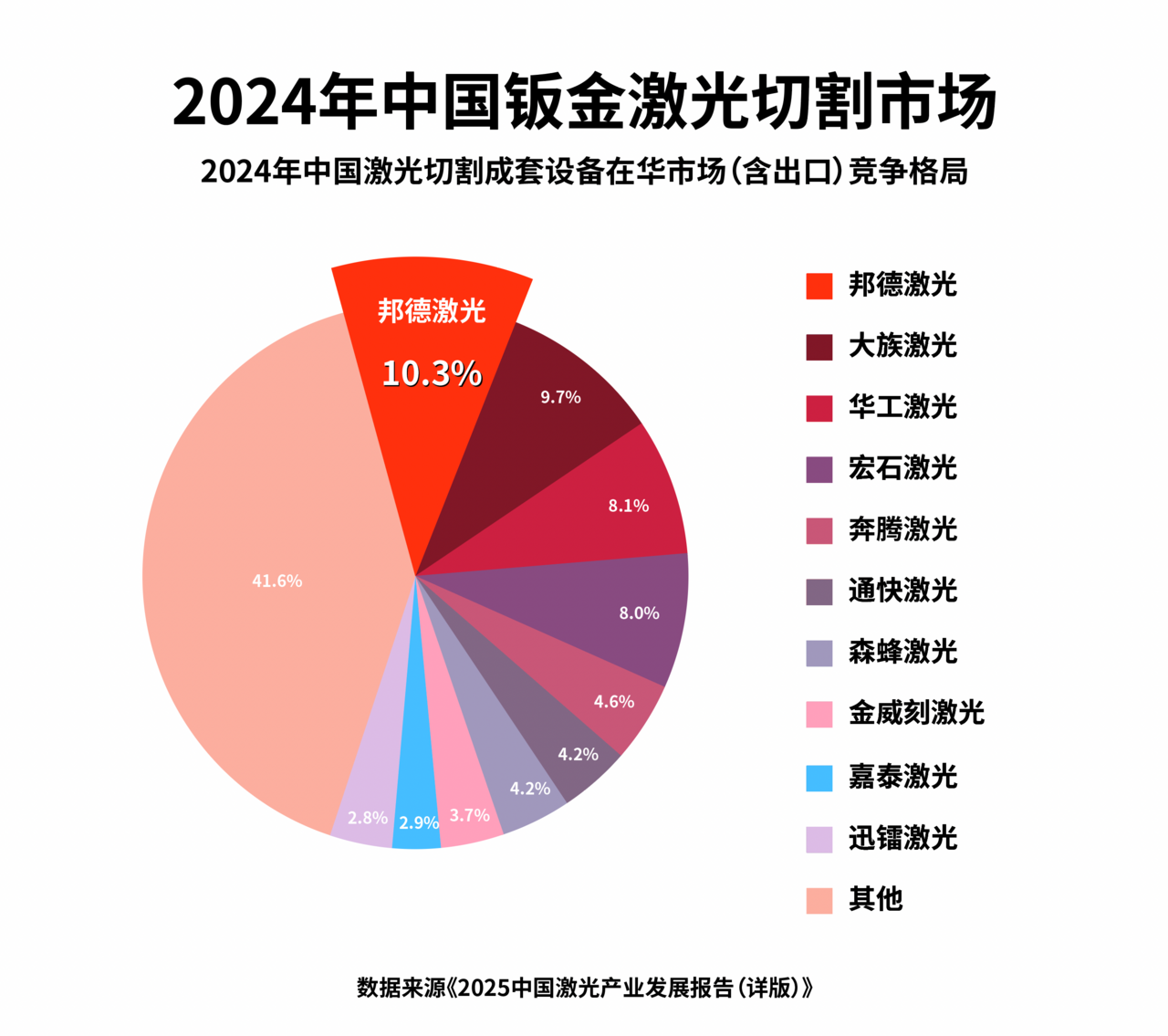
Core Insights - The "2025 China Laser Industry Development Report" highlights the current state and future outlook of the laser industry in China, indicating a significant decline in market performance and increased competition [1][5] Market Overview - The global laser equipment market is projected to reach $21.8 billion in sales revenue by 2024, with China's laser equipment market size at 89.7 billion yuan, accounting for 56.6% of the global market, but showing a year-on-year decline of 1.4% [1] - The laser cutting equipment market, particularly in sectors like engineering machinery and steel structures, is experiencing a downturn due to the real estate market's decline, with a projected sales revenue of 30.43 billion yuan in 2024, down 5.1% year-on-year [1] Industry Challenges - The laser cutting equipment sector is facing severe product homogenization and intense competition in the low-end market, with most companies focusing on general-purpose equipment and similar technology routes [1][5] - The number of new laser enterprises in 2024 has significantly decreased by 47.24% year-on-year, indicating accelerated market consolidation [5] Competitive Landscape - The market for laser cutting equipment is divided into sheet metal laser cutting and precision laser cutting, with the latter showing significant growth potential despite its smaller current size [5] - The top ten companies hold over 50% of the market share, with Bond Laser leading at a 10.3% market share, attributed to its focus on self-research and product innovation [5] Future Outlook - The Chinese laser industry is entering a deep adjustment phase, with traditional industrial market demand shrinking and competition intensifying, although some recovery is noted in consumer electronics [5] - For future growth, Chinese laser companies must move away from low-end competition and focus on high-value-added sectors through technological advancements and global operations [5]

易车研究院:小城车市消费升级加速,新能源与个性化车型成新增长极
Zhong Guo Chan Ye Jing Ji Xin Xi Wang· 2025-09-11 09:49
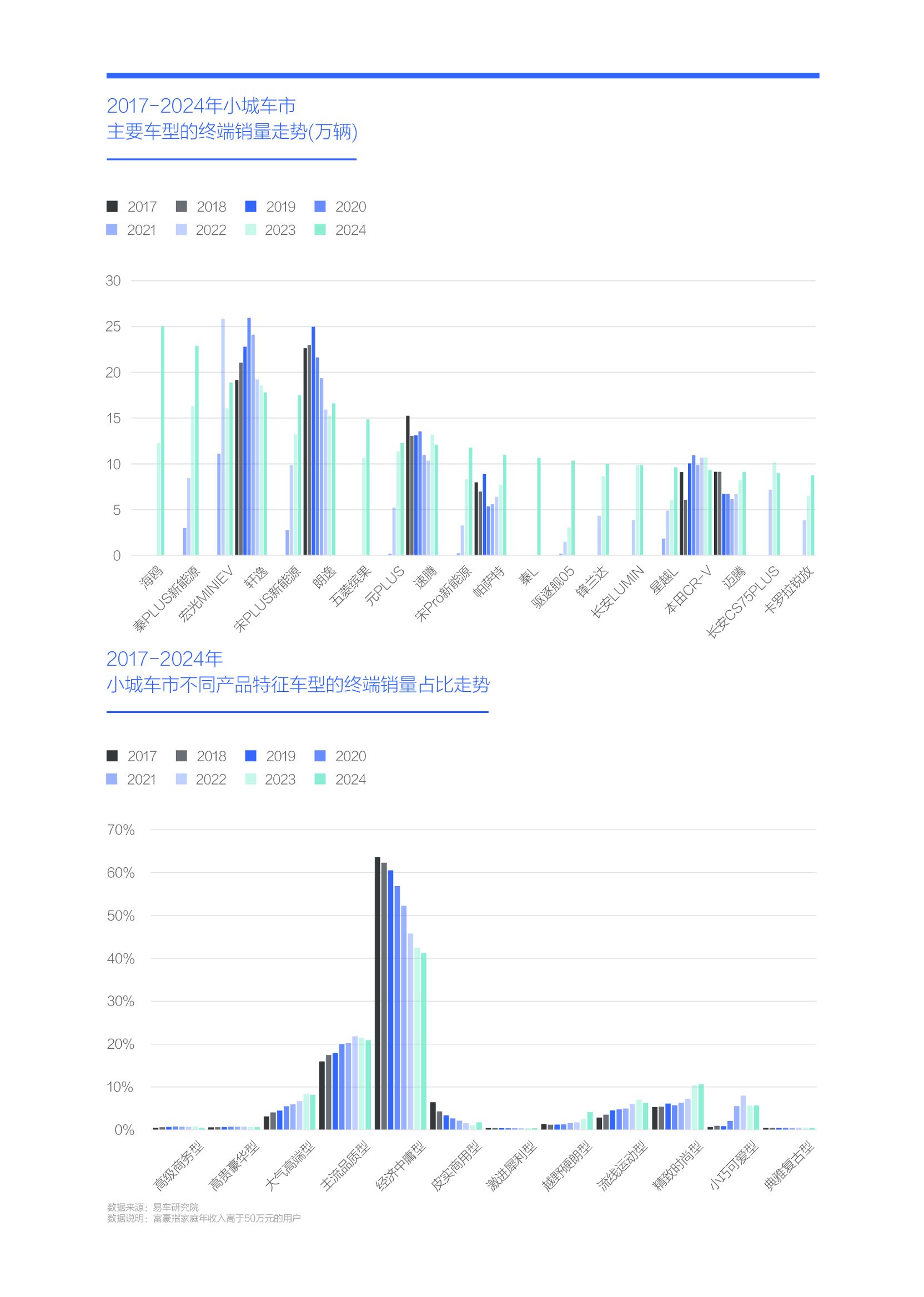
Group 1 - The core viewpoint of the articles highlights the significant transformation in the small city car market, driven by the increasing dominance of the middle-aged demographic, leading to a decline in traditional models like the Lavida, Sylphy, and Haval H6, while brands like BYD emerge as major beneficiaries [1][8][19] - From 2017 to 2024, the market share of traditional economy models dropped from 63.52% to 41.22%, while the market share of mainstream quality and high-end models increased from 15.96% to 20.92% and from 3.13% to 8.20%, respectively [1][8] - In 2024, BYD's market share in the small city car market surged to 16.43%, surpassing Volkswagen's 10.82%, with BYD occupying 7 out of the top 20 models [8][19] Group 2 - The small city car market is experiencing a shift towards upgraded, energy-efficient, and practical vehicles, with 14 out of the top 20 models in 2024 being launched after 2020, including popular electric and hybrid models [2][8] - The competition in the small city car market is intensifying, with brands like Geely aiming to challenge BYD's leadership by launching new models that emphasize cost-effectiveness and meet the evolving consumer demands [7][8] - The rise of the small city car market is attributed to government subsidies and the return of younger and older demographics to small cities, which has led to a diversification of consumer needs and preferences [17][19]