
Jin Rong Shi Bao

Search documents
当人工智能遇上健康管理 健康险风险减量能否破局
Jin Rong Shi Bao· 2026-01-07 07:33
Core Insights - The insurance industry is transitioning from traditional financial compensation models to a customer-centric service model, focusing on risk reduction through proactive health management [1][4] - The establishment of the Ping An Health Management Company marks a significant step in integrating health management services with health insurance, aiming to enhance customer engagement and reduce claims [1][2] Group 1: Industry Trends - The aging population and diverse health needs are driving the transformation of traditional insurance models, necessitating a shift towards proactive health management [1][4] - Health management services are becoming standard in health insurance products, even in basic insurance offerings, indicating a broader industry trend towards integrated health services [2][3] Group 2: Company Developments - In the first half of 2025, Ping An Health's health management services generated service revenue of 159 million yuan, serving over 4.8 million clients, reflecting a year-on-year growth of 21.4% [2] - China Pacific Insurance established a subsidiary focused on health management, aiming to meet the needs of high-end clients through innovative health services [3] Group 3: Challenges and Opportunities - The transition from passive claims to active health management is crucial for the sustainability of health insurance, with a focus on reducing claim rates and increasing customer retention [4][5] - Despite the recognized importance of health management, low user awareness and service utilization rates remain significant challenges for the industry [5][6] Group 4: Technological Integration - The integration of artificial intelligence (AI) in health management is seen as a key driver for improving service delivery and efficiency, with potential applications in personalized health interventions [6][7] - The Chinese government is promoting the use of AI in health management to enhance service capabilities and improve public health outcomes [6][7]
牛脸能贷款,海域有“身份证”?广西这样唤醒“沉睡资产”→
Jin Rong Shi Bao· 2026-01-07 04:56
Core Insights - The article highlights the transformation of rural assets in Guangxi, China, through innovative financial practices that awaken dormant resources and stimulate economic growth [1] Group 1: Challenges Faced by Rural Industries - Rural industries in Guangxi face multiple challenges, including the difficulty of asset realization and the lack of standardized valuation systems for livestock, which limits access to financing [2][3] - Natural disasters and market volatility pose significant risks to agricultural production, making it difficult for farmers to sustain their livelihoods [4] Group 2: Financial Innovations and Solutions - Innovative financial practices, such as the issuance of property rights certificates for aquaculture, have enabled farmers to secure loans by transforming previously unrecognized assets into collateral [5][6] - The introduction of technology, such as AI-based identification systems for livestock, has improved the efficiency of insurance and financing processes, allowing for better risk management [6][12] Group 3: Integration of Financial Services - The development of supply chain finance and tailored credit products has facilitated better access to funding for rural enterprises, addressing issues of weak collateral and fragmented supply chains [7][8] - Collaborative efforts between banks, insurance companies, and local governments have created a supportive ecosystem for agricultural financing, enhancing the resilience and sustainability of rural economies [10][11] Group 4: Systematic Approach to Rural Development - Guangxi has shifted from targeted assistance to a more systematic approach in promoting rural development, with policies that encourage financial resources to flow into agriculture [10][12] - The establishment of digital credit profiles for farmers has enabled the provision of unsecured loans, fostering financial inclusion and supporting agricultural growth [11][13]

16倍“牛股”遭监管警示
Jin Rong Shi Bao· 2026-01-07 03:58
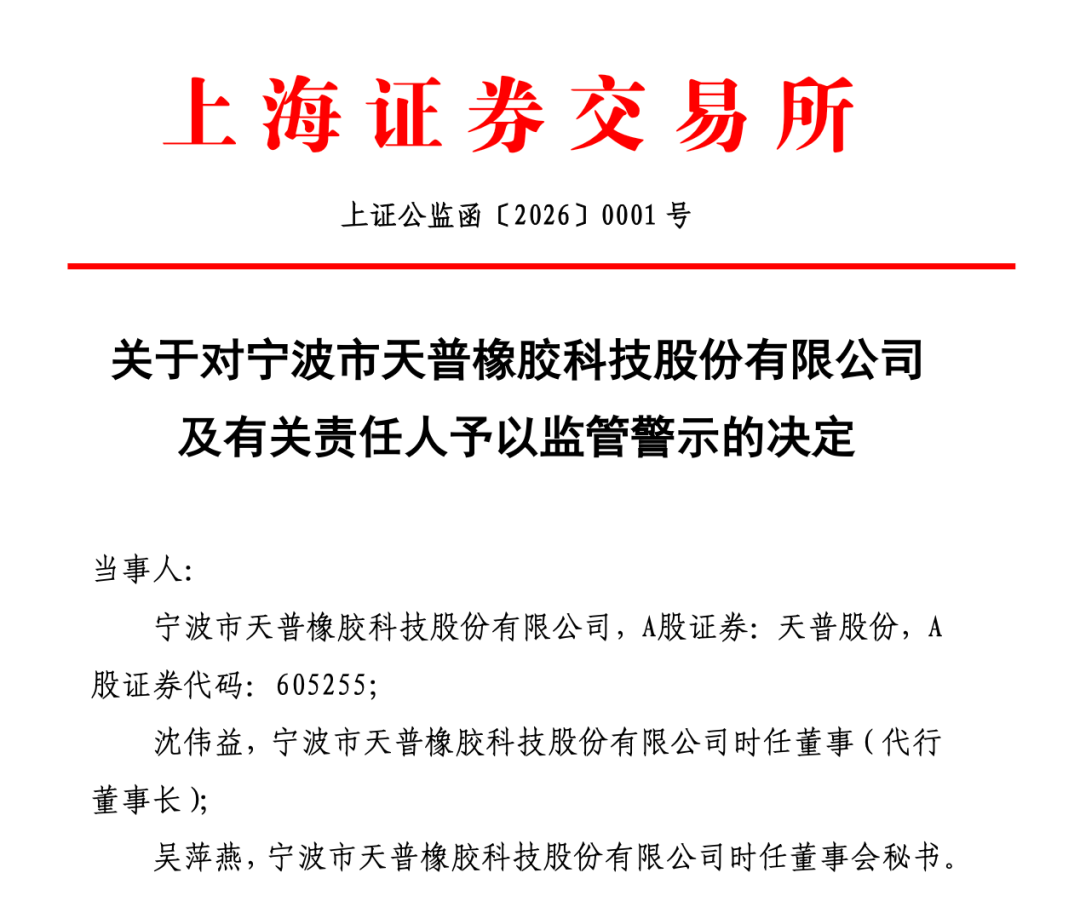
正处于第五次停牌核查期间的天普股份(605255),在董事会换届前夕,收到了监管开出的警示函。 1月5日晚间,天普股份及时任董事(代行董事长)沈伟益、董秘吴萍燕,因利用子公司经营范围炒作"人工智能"热点概念,引发市场猜测和股价异动后未及 时进行针对性说明澄清与风险提示,信息披露不准确、不完整,被上交所予以监管警示。 被监管质疑明知故犯 2025年12月29日、12月30日,天普股份股价连续两个交易日涨停,并于12月29日触及异常波动标准;12月30日、12月31日,天普股份分别披露股票交易异 常波动、股票停牌核查相关公告,均声称"截至目前,公司无开展人工智能相关业务的计划,不存在应披露而未披露的重大信息"。 那么,是什么引起的两个涨停板呢?经查明,天普股份于2025年12月26日完成全资子公司杭州天普欣才科技有限公司(以下简称"天普欣才")的工商设立登 记手续。据工商登记信息,天普欣才主要经营范围涵盖集成电路芯片设计及服务、人工智能理论与算法软件开发、人工智能行业应用系统集成服务及集成 电路芯片及产品销售等。 上述监管措施一经发布,让这只本就饱受争议的16倍"大牛股",再度置身于舆论的风口浪尖。 此后,天普股 ...


坚定功能定位 走好中国特色金融发展之路 访中信集团党委委员、副总经理兼中信金融资产党委书记、董事长刘正均
Jin Rong Shi Bao· 2026-01-07 03:41
Core Insights - The 20th Central Committee's Fourth Plenary Session outlines a blueprint for China's development over the next five years, emphasizing the importance of financial asset management companies in risk prevention and supporting the real economy [1][2]. Group 1: Understanding the Significance of the Plenary Session - The plenary session addresses major issues for the "14th Five-Year Plan" period, providing fundamental guidance for financial work in the new era [1][2]. - Financial asset management companies must grasp the session's significance and contribute positively to the construction of a financial power [1][2]. Group 2: Implementation of the Plenary Session's Spirit - The session emphasizes the need for financial asset management companies to accurately position themselves and actively play their unique roles in the broader context [2]. - Companies are required to enhance their risk management capabilities and act as stabilizers in the financial system, ensuring high-quality development [2][5]. Group 3: Focus Areas for Financial Asset Management Companies - Companies are tasked with advancing five key areas: technology finance, green finance, inclusive finance, pension finance, and digital finance, aligning with national strategic needs [3][4][5]. - Over the past three years, the company has invested a total of 107.7 billion yuan in these five areas, demonstrating its commitment to fulfilling its responsibilities [2][3]. Group 4: Specific Strategies and Innovations - In technology finance, the company aims to support enterprises in overcoming innovation challenges and optimizing governance [3]. - In green finance, the focus is on supporting the transition to a clean and low-carbon energy system, including investments in major energy projects [3]. - Inclusive finance efforts include addressing risks in the economy and providing targeted financial solutions to small and medium-sized banks [3][4]. Group 5: Addressing Aging Population and Digital Transformation - The company is actively engaging in pension finance to address the needs of an aging population, exploring sustainable business models in the healthcare sector [4]. - In digital finance, the company is promoting digital transformation and exploring innovative applications of artificial intelligence in asset management [5]. Group 6: Future Development Plans - The company plans to enhance its role in stabilizing the economy and supporting the real economy during the "14th Five-Year Plan" period, utilizing various financial tools to assist struggling enterprises [5][6]. - The focus will also be on revitalizing existing assets and addressing risks in key sectors, particularly in the real estate market [6].
上海市法院发布系统集成性司法文件
Jin Rong Shi Bao· 2026-01-07 03:41
Group 1 - The core document titled "Several Opinions on Providing Judicial Service Guarantees to Accelerate the Construction of Shanghai International Financial Center" was recently released, marking the first comprehensive judicial response to the needs of the Shanghai International Financial Center [1] - The document outlines 22 specific measures across five areas: serving the real economy, supporting high-level openness, consolidating market foundations, preventing financial risks, and improving dispute resolution mechanisms [1] - It focuses on five key areas: technology finance, green finance, inclusive finance, pension finance, and digital finance, implementing targeted judicial guarantees to activate new financial service dynamics for the real economy [1] Group 2 - In the technology finance sector, the document supports financial institutions in innovating credit evaluation standards based on patent quality, R&D team strength, and data asset scale to address financing difficulties for "light asset, lack of collateral" situations [1] - In the digital finance sector, it aims to improve evidence rules for digital financial disputes, addressing challenges in electronic data preservation, collection, and demonstration, by establishing specific evidence authentication rules [1] - The document also emphasizes proactive exploration of new rules and efficiencies in emerging industries and fields, providing clear behavioral expectations and regulatory guidance for market participants [1] Group 3 - The document benchmarks against international standards, enhancing foreign-related trial mechanisms, ensuring cross-border innovation openness, and strengthening international communication and collaboration for high-level judicial guarantees [2] - It addresses the bottom line requirement of safety in high-quality financial development by proposing measures to legally handle major financial risks, establish financial risk early warning and prevention mechanisms, and balance financial innovation with risk prevention [2] - The Shanghai court's financial risk prevention and early warning platform will utilize judicial big data to monitor emerging issues in real-time [2]
充实钱袋子 提供好服务 中国人寿持续探索养老金融新路径
Jin Rong Shi Bao· 2026-01-07 03:34
Group 1 - The core issue of aging population and the need for better pension solutions is addressed by China Life, which offers a comprehensive financial solution for retirement [1] - To enhance pension funds, China Life proposes a strategy of "one increase and one decrease," focusing on professional investment to grow pension reserves and using various insurance products to reduce personal retirement expenses [2][3] - China Life's pension insurance management services include over 750 billion yuan in basic pension insurance funds and more than 2.1 trillion yuan in enterprise annuities, leading the industry in both categories [2] Group 2 - China Life has launched a series of insurance products specifically for the elderly, including "Sunset Red," "Sunset Insurance," and "Silver Age Health," which cover common risks faced by older adults [3] - The company has developed a three-tiered elderly care product system combining institutional, community, and home care services, exemplified by the "Guoshou Jiayuan" brand [4] - The "Guoshou Jiayuan" community in Suzhou offers a high-quality retirement complex that integrates health culture, rehabilitation, and wellness services, enhancing the living experience for seniors [4] Group 3 - The aging industry is evolving into a "sunrise industry," with over 77,600 companies registered in 2024 focusing on elderly products and services, indicating a growing market [5] - China Life is establishing a 10 billion yuan fund to support the silver economy, emphasizing the importance of strategic investment in the aging sector [6] - The company is also launching investment plans targeting senior health real estate projects, aiming to create comprehensive commercial complexes catering to the elderly [6]
首版医保“双目录”开启 高价创新药惠及更多百姓
Jin Rong Shi Bao· 2026-01-07 02:58
Core Viewpoint - The implementation of the new National Medical Insurance Drug List and the Commercial Health Insurance Innovative Drug List in 2025 marks a significant step towards addressing the payment challenges for high-value innovative drugs, enhancing the role of commercial health insurance in multi-tiered medical security [1][2][3] Group 1: Policy Implementation - The new drug lists will be executed starting January 1, 2026, with the commercial health insurance list including 19 innovative drugs, notably five CAR-T cancer treatment drugs [1][2] - The introduction of the "dual directory" system aims to bridge the gap between basic medical insurance and commercial health insurance, facilitating access to high-value drugs for more patients [1][5] Group 2: Commercial Health Insurance Role - The commercial health insurance sector is expected to innovate and expand coverage in response to the new drug lists, potentially allowing more patients to access expensive treatments [1][3][6] - The "three exclusions" policy will enable hospitals to prescribe high-priced innovative drugs more freely, thus improving clinical accessibility and allowing for smoother commercial health insurance settlements [4][6] Group 3: Market Dynamics - As of 2024, commercial health insurance premiums reached 977.3 billion yuan, yet only contributed 7.7% to the innovative drug market, indicating untapped potential in this sector [8] - The dual directory system is seen as a crucial step in building a high-quality multi-tiered medical security system, aiming to resolve the issue of high-value drugs being available but not affordable [8][9] Group 4: Future Considerations - Experts emphasize the need for a collaborative platform to enhance negotiation power between insurance companies and pharmaceutical firms, as well as the importance of data management and actuarial pricing for sustainable product offerings [9] - There is a call for establishing dynamic connection mechanisms between the medical insurance and commercial insurance directories to ensure smooth transitions and effective patient support [9]
新华保险发布2025年理赔报告
Jin Rong Shi Bao· 2026-01-07 02:58
理赔是保险承诺的兑现,也是保险业社会价值的最直观体现。近日,新华保险发布的2025年理赔服 务年报显示,2025年赔付总金额达147亿元,日均赔付4029万元,全年处理赔付件数501万件,平均每天 有1.4万件理赔案结案,全年豁免保费8.1亿元,涉及2.1万张保单。从赔付结构看,重疾险赔付金额61.3 亿元,占比超过40%。 数据显示,2025年,新华保险单笔身故最高赔付1050万元,重疾最高赔付419万元;医疗赔付方 面,单一客户累计最高获赔547万元,全年赔付次数最高的客户达160次。 在服务效率方面,公司整体理赔案件从申请到结案的平均时效缩短至0.77天,其中5000元以内小额 医疗险理赔平均时效为0.5天,最快一笔理赔到账时间为10秒,全年96.4%的理赔案件实现结案当日到 账。 在普惠金融方面,2025年新华保险为乡村人群赔付33亿元,惠及38.7万人次;为老年人群赔付10亿 元,惠及94.8万人次。同时,公司在22家分公司承接55个惠民保项目,赔付金额超4600万元。公益项目 方面,"顶梁柱""加油宝贝"等项目覆盖超10个省份、35万人,累计赔付5460件、671.3万元;关爱环卫 工人项目202 ...
盘活医保个账“沉睡”资金 险企探索创新支付新场景
Jin Rong Shi Bao· 2026-01-07 02:58
Core Viewpoint - The integration of basic medical insurance and commercial health insurance is moving from policy guidance to practical implementation, exemplified by AIA's launch of a new medical insurance product that allows payment through individual medical accounts in Shanghai [1][2]. Group 1: Policy and Market Context - The Chinese government has been promoting the development of a multi-tiered medical insurance system, as indicated by policies like the "Healthy China 2030" plan and the new "National Ten Measures" for the insurance industry [2]. - Shanghai's local government has accelerated the exploration of practical measures to integrate basic medical insurance with commercial health insurance, laying a foundation for commercial health insurance to access the medical payment system [2][4]. Group 2: Product Features and Innovations - AIA's "AIA Smart Choice Medical Insurance" offers comprehensive coverage for high medical expenses, including key responsibilities such as hospitalization for serious illnesses and outpatient expenses, with a maximum payout limit of 5 million yuan and a low deductible of 5,000 yuan [3]. - The product includes personalized configurations for high-quality medical resources and outpatient drug/device coverage, supporting over 300 special drugs and three types of special devices, with a cumulative limit of 4 million yuan [3]. Group 3: Financial Efficiency and Family Coverage - The inefficiency of individual medical account usage has been a concern, with younger, healthier individuals accumulating funds while those with higher medical needs face shortages [4]. - Recent policy changes have expanded the scope of beneficiaries for individual medical accounts, allowing funds to be used for family members, thus creating a family insurance model that enhances the utilization of "sleeping" medical funds [4][5]. Group 4: Industry Implications and Future Directions - AIA's integration of medical insurance with individual accounts represents a significant release of policy benefits, allowing insured individuals to convert idle medical funds into enhanced family health coverage without additional cash outlay [5]. - The industry can learn from AIA's experience in three areas: product innovation aligned with policy, a new payment model that activates dormant medical funds, and the transition of commercial health insurance from a reimbursement model to a health service model [5][6].

保险期间内发病、期外确诊 重疾险能不能赔?
Jin Rong Shi Bao· 2026-01-07 02:53
Core Viewpoint - The case highlights the complexities and potential disputes in insurance claims related to critical illness, particularly regarding the timing of diagnosis and the interpretation of insurance contract terms [1][5]. Group 1: Case Summary - A court in Guangxi Province ruled that an insurance company must pay 100,000 yuan for a critical illness claim, emphasizing the importance of clarifying the insurance responsibility period and claim conditions [1][5]. - The insured, Wang Fang, was diagnosed with amyotrophic lateral sclerosis (ALS) two months after the insurance policy expired, but symptoms had developed during the coverage period [1][3]. Group 2: Legal Reasoning - The court determined that the onset of the illness occurred during the insurance period, despite the diagnosis being made after the policy expired, thus falling within the insurance company's responsibility [3][4]. - The court found that the insurance company's strict definitions of critical illness and the failure to adequately inform the insured about these terms rendered the exclusion clauses ineffective [4][6]. Group 3: Industry Implications - Experts noted that the time gap between the onset of symptoms and diagnosis is common in critical illness cases, and insurance companies should not use this delay to avoid liability [5][6]. - Insurance companies are advised to design clear and fair contract terms, define the trigger points for insurance claims, and fulfill their obligation to explain these terms to policyholders [6].