
以量换价

Search documents
固定收益|点评报告:债市后续如何定价春节假期数据?
Changjiang Securities· 2026-02-24 23:30
1. Report Industry Investment Rating No relevant content provided. 2. Core Viewpoints of the Report - The high - frequency data during the 2026 Spring Festival shows that the "quantity" of travel and tourism consumption continued to recover, but the price recovery lagged; the logistics was differentiated, with strong foreign trade resilience and weak production and consumption logistics; the volume of hotels and scenic spots increased while the price decreased, and the box office was weak; the real - estate market continued to be under pressure, with weak transactions in both new and second - hand housing. With the price increase in the second half of last year and the carry - over effect, it is highly likely that the subsequent fundamentals will shift from "trading price for volume" to "trading volume for price". Currently in a low - interest - rate environment in China, minor fundamental changes have limited impact on the bond market, and the view of a volatile bond market is maintained. The short - end of the bond market depends on the central bank, and the carry - trade strategy may continue. The long - end, especially the 30 - year treasury bond, needs to focus on fiscal efforts and the bank's carrying capacity. In the medium - term, the inflation theme should be monitored [1][4][7][77]. 3. Summary by Relevant Catalogs 3.1. Travel: Long holidays release travel demand, and self - driving travel is popular - The demand for family visits and tourism during the Spring Festival was continuously released, and the overall passenger volume remained high. As of the sixth day of the first lunar month, during the first 21 days of the Spring Festival travel rush, the overall passenger volume increased by 6.0% year - on - year. Among different transportation modes, the waterway had the highest growth rate, with railway, civil aviation, highway, and waterway passenger volumes increasing by 5.3%, 5.5%, 6.0%, and 23.1% respectively [10]. - The cross - regional population flow during the Spring Festival travel rush in 2026 reached a new high in recent years, with a significant increase in travel willingness. The peak occurred on the sixth day of the first lunar month, with a 12.3% increase compared to 2025, a 20.6% increase compared to 2024, and a 46.9% increase compared to 2019 [10]. - There was an obvious characteristic of off - peak travel before the festival. The growth compared to 2025 was mainly concentrated in the post - festival peak, while the improvement compared to 2024 started from the 24th day of the twelfth lunar month. The growth compared to 2019 was throughout the whole period, indicating that the long holiday catalyzed the release of residents' travel demand [11]. - The travel choices during the Spring Festival travel rush in 2026 were dominated by self - driving, reflecting residents' preference for short - distance travel. The proportion of non - commercial highway (mainly private cars) flow reached 81.6%, a 11.9 - percentage - point increase compared to 2019 [18]. - The domestic flight volume, passenger volume, and occupancy rate remained prosperous, but the price recovery was weak, and the pattern of "trading price for volume" was difficult to reverse in the short term. The domestic flight volume increased by 4.0% year - on - year, the passenger volume increased by 6.5%, the occupancy rate increased by 1.2%, and the domestic oil - included ticket price decreased by 1.5% [22]. 3.2. Logistics: Foreign trade shows resilience, while production and consumption logistics weaken in advance - The national logistics near the Spring Festival in 2026 showed a pattern of "strong foreign - trade resilience, high - then - low production logistics, and early - weakening consumption logistics". The container throughput maintained a year - on - year positive growth of 9.3% - 12.2% in the four weeks before the festival, but the growth rate of the monitored port cargo throughput fluctuated and declined [34]. - The production logistics was high in the early stage and low in the later stage. The national highway truck traffic volume increased by 4.3% and 2.6% year - on - year in the four and three weeks before the festival respectively, but the growth rate slowed down and turned negative in the last two weeks before the festival, indicating a rapid contraction of production logistics near the holiday [34]. - The consumption logistics contracted in advance. The postal express collection volume declined from 9.2% four weeks before the festival to 0.5% one week before the festival, and the delivery volume declined from 7.9% to 1.4%, suggesting that the peak of New Year goods delivery was earlier than last year [34]. - The railway transportation was stable, and civil aviation continued to grow. The national railway freight volume fluctuated slightly around zero, and the civil aviation flight volume maintained a positive growth of 4.8% - 6.0% [34]. 3.3. Tourism Consumption: Hotels and Scenic Spots See Volume Increase but Price Decrease, and the Box Office is Weak - The hotel occupancy rate increased, but the price was under pressure. The occupancy rate of the overall sample of Chinese mainland hotels increased from 54.7% five weeks before the festival to 64.0% one week before the festival, a year - on - year increase of 11.7%. However, the revenue per available room (RevPAR) and the average daily rate (ADR) decreased compared to last year [40]. - The scenic spots' business improved. The number of tourists in many provincial - level key - monitored scenic spots increased significantly, and the revenue of some popular scenic spots also increased substantially. For example, the revenue of Zhangjiajie Huanglongdong increased by 79% [42][45]. - Hainan's tourism consumption recovered strongly, with both volume and price increasing. The number of passengers at Haikou Meilan Airport increased day by day, and the off - island duty - free shopping also rebounded significantly. From February 15 - 19, the shopping amount, number of people, and per - capita consumption were 13.8 billion yuan, 17.7 million person - times, and 7,797 yuan respectively, with year - on - year increases of 19%, 24.6%, and - 4.5% [45]. - The Spring Festival movie market had a weak performance in both volume and price. The 7 - day cumulative box office from New Year's Eve to the sixth day of the first lunar month was 5.09 billion yuan, with a recovery rate of only 86% compared to 2019, and the average ticket price decreased by 5% year - on - year [47]. 3.4. Real Estate: Both New and Second - hand Housing Transactions are Weak, and the Volume and Price in First - tier Cities are Declining - The new - housing market had a significant decline in transaction volume. The transaction area of commercial housing in 30 large and medium - sized cities in the two months before the Spring Festival in 2026 was significantly lower than the same period in the past five years. In the first week before the festival, it was only 1.102 million square meters, a year - on - year decrease of 36.6%, and during the Spring Festival week, it was 83,000 square meters, a year - on - year decrease of 20.4% [61]. - The second - hand housing market was weak in both volume and price. The 7 - day moving average (7DMA) of the second - hand housing transaction area in 12 cities was only 247,200 square meters in the first week before the Spring Festival, a year - on - year decrease of 15.3%. The national second - hand housing listing price index continued to decline, with a 7.0% year - on - year decrease in the first week before the festival [61]. - The land market was also sluggish. The premium rate of land transactions in 100 large and medium - sized cities was 2.42% in the first week before the festival, significantly lower than 9.86% in the same period last year [62]. 3.5. How will the Bond Market Price the Spring Festival Holiday Data? - The real - estate market is still in a downward pressure channel, with weak sales volume and price, especially in some first - tier cities where housing prices may decline at an accelerated pace. The consumer data shows a rapid recovery in volume but pressure on prices, continuing the "trading price for volume" trend. With the price increase in the second half of last year and the carry - over effect, it is likely that the fundamentals will shift from "trading price for volume" to "trading volume for price" [77]. - In the current low - interest - rate environment in China, minor fundamental changes have limited impact on the bond market. The view of a volatile bond market is maintained. The short - end of the bond market depends on the central bank, and the carry - trade strategy may continue. The long - end, especially the 30 - year treasury bond, needs to focus on fiscal efforts and the bank's carrying capacity. In the medium - term, the inflation theme should be monitored [77].
史上最长春节假期即将开启!白酒动销旺季来临,规模领跑的消费ETF(159928)再获资金关注!机构:服务消费CPI能否重启上行?
Xin Lang Cai Jing· 2026-02-13 06:45
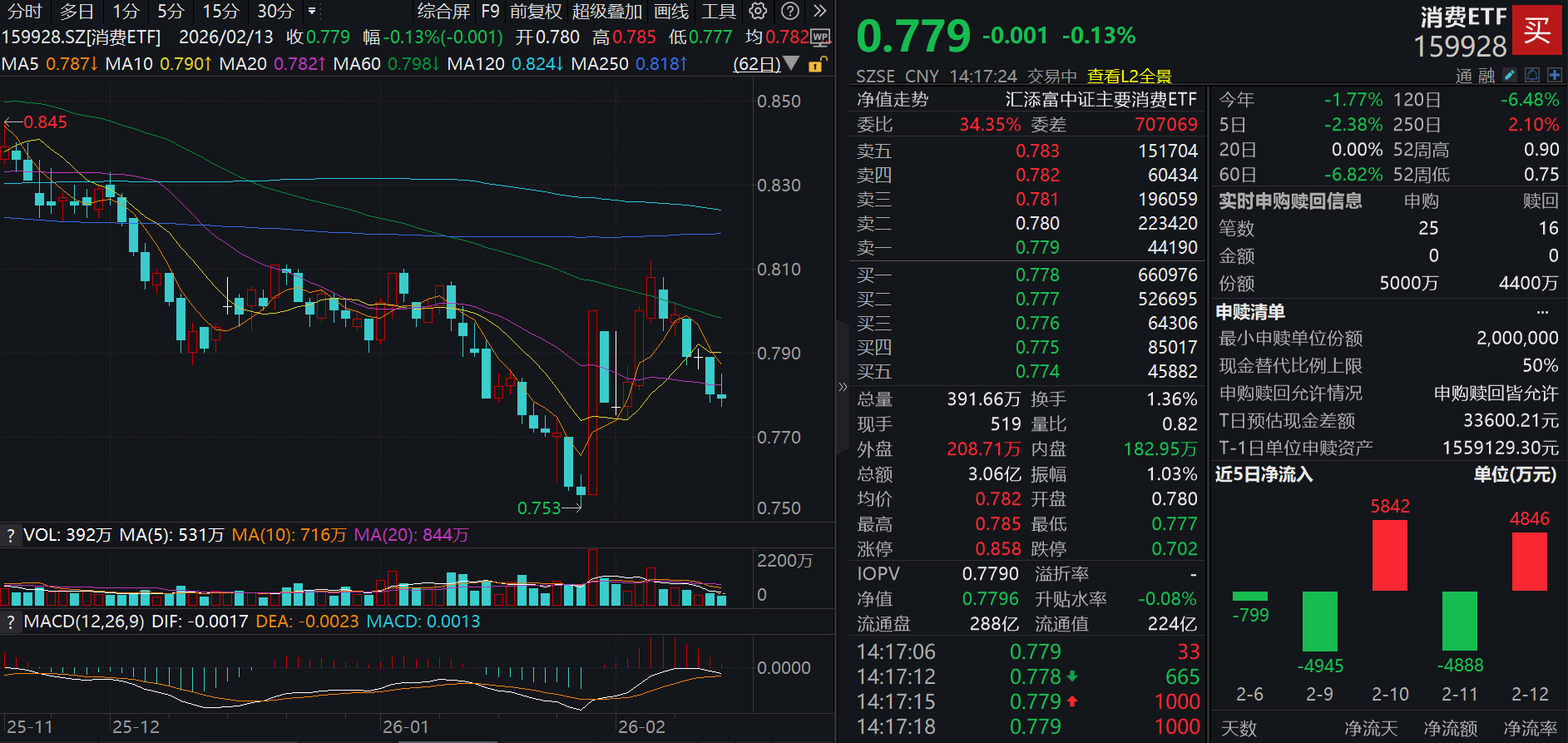
Group 1 - The consumer sector is experiencing a pullback, with the leading consumption ETF (159928) slightly down by 0.13% despite a trading volume exceeding 300 million yuan and a net inflow of 6 million units [1] - The upcoming 9-day Spring Festival holiday is expected to boost consumer spending, with government initiatives planned for 2026 to support the replacement of old consumer goods with new ones during this period [3] - The liquor sector, particularly Moutai, is showing strong sales performance as the peak season approaches, with prices for Moutai products increasing significantly compared to the previous month [5] Group 2 - Financial Street Securities highlights that the food and beverage sector is crucial for domestic demand, with policies aimed at boosting consumption expected to help the sector recover from its current low [6] - The service consumption sector is anticipated to see price increases driven by policy support and changing consumer behavior, with a focus on emotional value and health-oriented products [8] - The travel service sector is projected to experience strong demand growth, with hotel prices expected to rise as supply and demand dynamics improve [9]





八成创新药上市两年内入医保
第一财经· 2026-02-05 15:29
Core Viewpoint - The article discusses how the strategic purchasing mechanism of medical insurance, centered around centralized bulk purchasing and drug price negotiations, is reshaping China's pharmaceutical industry landscape [3]. Group 1: Policy Changes and Trends - Since 2018, China's pharmaceutical policy has shifted to a value-oriented and collaborative governance phase, with medical insurance transitioning from a passive payer to an active strategic purchaser [3][4]. - The establishment of a national drug price negotiation mechanism supports the accessibility of innovative and high-priced drugs, emphasizing clinical value and cost-effectiveness [4][5]. - The proportion of new drugs entering the medical insurance directory within the same year of approval has increased from 32% in 2019 to 97.6% in 2023, significantly reducing the time from drug approval to insurance reimbursement from five years to just over one year [4]. Group 2: Drug Procurement and Pricing - The centralized procurement system has expanded, with 490 types of drugs procured over eight years, covering various treatment areas including chronic diseases and cancer [7]. - In 2024, 28.6% of the newly negotiated drugs were cancer medications, and 71% of the new varieties were domestic innovative drugs, indicating a rapid shift towards high-value areas in the pharmaceutical industry [5][6]. Group 3: Challenges and Recommendations - The article highlights challenges such as inadequate quality supervision in bulk purchasing, insufficient collaboration between medical insurance and pharmaceutical innovation, and the need for improved access to rare disease medications [8][10]. - Recommendations include enhancing clinical monitoring of selected drugs, establishing a unified drug usage tracking system, and developing a multi-tiered payment system to address the accessibility of innovative drugs [10][11].

1月PMI点评:从以价换量到以量换价?
Changjiang Securities· 2026-02-01 23:30
1. Report Industry Investment Rating - Not provided in the report 2. Core Viewpoints - In January 2026, the manufacturing PMI dropped 0.8 pct to 49.3%, and the non - manufacturing business activity index also fell below the prosperity - decline line, weaker than the seasonal level. The overall economic stability - growth approach may shift from "trading price for volume" to "trading volume for price", and the improvement of the fundamentals requires long - term repair. There are still some bright spots, such as the price increase of commodities driving up the overall price and the continuous release of growth potential in equipment manufacturing and high - end technology manufacturing. The bond market may react to the weak data but is unlikely to have a continuous repair market, and the view of a bond market oscillation is maintained in the near term [2][6]. 3. Summary by Related Contents 3.1 Manufacturing PMI Situation - **Production and Demand**: The manufacturing PMI in January 2026 fell 0.8 pct to 49.3%, lower than the Wind consensus forecast. The production index dropped 1.1 pct to 50.6% but remained above the prosperity - decline line. The import index rose 0.3 pct to 47.3%, while the procurement index fell 2.4 pct to 48.7%. The new order index decreased 1.6 pct to 49.2%, and the new export order index dropped 1.2 pct to 47.8% [4][6]. - **Inventory**: The finished - product inventory increased 0.4 pct month - on - month and 2.1 pct year - on - year to 48.6%. The difference between the "finished - product inventory - on - hand orders" index widened 1.3 pct to 3.5 pct, and whether subsequent consumer demand can digest the inventory remains to be seen [6]. - **Price**: The raw material purchase price index was 56.1%, up 3 pct month - on - month and 6.6 pct year - on - year, reaching a two - year high. The ex - factory price index was 50.6%, rising above the critical point for the first time in 20 months. However, the pressure on corporate profit repair re - emerged, and the future price downward pressure still exists [6]. - **Enterprise Scale and Industry**: Among different enterprise scales, large - scale enterprises' prosperity declined slightly by 0.5 pct to 50.3%, still in the expansion range; medium - and small - scale enterprises' prosperity declined significantly, dropping 1.1 pct and 1.2 pct to 48.7% and 47.4% respectively, below the prosperity - decline line. Among industries, the four basic industries all declined, but the equipment manufacturing and high - end technology manufacturing industries maintained certain resilience, with their prosperity still in the expansion range [6]. 3.2 Non - manufacturing PMI Situation - The non - manufacturing business activity index in January 2026 fell 0.8 pct to 49.4%. The construction business activity index dropped 4 pct to 48.8%, and the construction new order index fell 7.3 pct to 40.1%, reaching the lowest level since the second half of 2025. The service business activity index decreased 0.2 pct to 49.5%. The financial service - related industries had a relatively high prosperity level, while the real estate industry's business activity index dropped below 40%, with overall weak prosperity [6].
站上10万亿的中信银行,仍处于转型“攻坚期”
Hua Er Jie Jian Wen· 2026-01-14 11:14
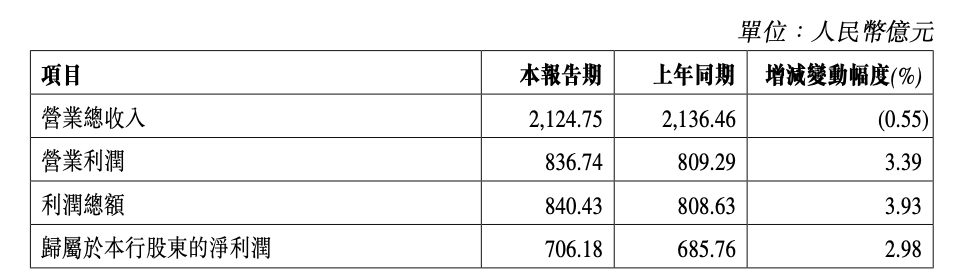
Core Viewpoint - CITIC Bank has reported its 2025 financial results, achieving a total operating income of 212.475 billion yuan, a slight decrease of 0.55% year-on-year, and a net profit attributable to shareholders of 70.618 billion yuan, an increase of 2.98% year-on-year. However, the widening gap between revenue and profit indicates a trend in the banking industry where profit growth is not necessarily linked to business expansion but rather to cost reductions and adjustments in provisioning [1][2]. Financial Performance - Total assets increased by 6.28% to 101,316.58 billion yuan, while operating income experienced a decline, highlighting the challenges of the "volume for price" dilemma faced by commercial banks [1][3]. - The net profit margin showed a slight increase, with net profit attributable to shareholders rising to 70.618 billion yuan from 68.576 billion yuan, reflecting a year-on-year growth of 2.98% [3]. - The basic earnings per share decreased by 1.64% to 1.20 yuan, and the weighted average return on equity fell by 0.40 percentage points to 9.39% [3]. Asset Quality - CITIC Bank maintained a non-performing loan ratio of 1.15%, which decreased by 1 basis point from the beginning of the year, indicating resilience in risk control [2]. - The provision coverage ratio declined from 209.43% to 203.61%, a decrease of 5.82 percentage points, suggesting a reduction in the redundancy of provisions as the bank intensified efforts to dispose of non-performing assets [2]. Strategic Focus - In its "New Three-Year Plan" for 2024, CITIC Bank emphasizes the importance of retail banking and has established a "Five Leading" strategy focusing on wealth management, comprehensive financing, transaction settlement, foreign exchange services, and digitalization [3][4]. - The chairman of CITIC Bank stated that the company's efforts aim to explore pathways for transitioning from a single growth curve to a secondary growth curve, highlighting the interconnectedness of the strategic focus areas [4]. Transition Period - The current financial results reflect a typical transitional phase for CITIC Bank, with asset scale growth indicating increased systemic importance, while revenue stagnation and declining ROE suggest that the path to high-quality development is challenging [5][8]. - Future disclosures regarding net interest margins and non-interest income ratios will further validate the effectiveness of CITIC Bank's transformation efforts [9].

首版医保“双目录”开启 高价创新药惠及更多百姓
Jin Rong Shi Bao· 2026-01-07 02:58
Core Viewpoint - The implementation of the new National Medical Insurance Drug List and the Commercial Health Insurance Innovative Drug List in 2025 marks a significant step towards addressing the payment challenges for high-value innovative drugs, enhancing the role of commercial health insurance in multi-tiered medical security [1][2][3] Group 1: Policy Implementation - The new drug lists will be executed starting January 1, 2026, with the commercial health insurance list including 19 innovative drugs, notably five CAR-T cancer treatment drugs [1][2] - The introduction of the "dual directory" system aims to bridge the gap between basic medical insurance and commercial health insurance, facilitating access to high-value drugs for more patients [1][5] Group 2: Commercial Health Insurance Role - The commercial health insurance sector is expected to innovate and expand coverage in response to the new drug lists, potentially allowing more patients to access expensive treatments [1][3][6] - The "three exclusions" policy will enable hospitals to prescribe high-priced innovative drugs more freely, thus improving clinical accessibility and allowing for smoother commercial health insurance settlements [4][6] Group 3: Market Dynamics - As of 2024, commercial health insurance premiums reached 977.3 billion yuan, yet only contributed 7.7% to the innovative drug market, indicating untapped potential in this sector [8] - The dual directory system is seen as a crucial step in building a high-quality multi-tiered medical security system, aiming to resolve the issue of high-value drugs being available but not affordable [8][9] Group 4: Future Considerations - Experts emphasize the need for a collaborative platform to enhance negotiation power between insurance companies and pharmaceutical firms, as well as the importance of data management and actuarial pricing for sustainable product offerings [9] - There is a call for establishing dynamic connection mechanisms between the medical insurance and commercial insurance directories to ensure smooth transitions and effective patient support [9]
工业硅减产尚未落地,多晶硅现货报价抬高
Dong Zheng Qi Huo· 2025-12-21 11:43
1. Report Industry Investment Rating - Industrial silicon: Oscillation; Polysilicon: Oscillation [5] 2. Core Viewpoints - The reduction in industrial silicon production has not yet been implemented, and the spot price quotation of polysilicon has increased [1][12][14] - The supply and demand of industrial silicon still depend on the production reduction and shutdown rhythm of enterprises. If the production reduction plan is implemented, the industrial silicon market is expected to reach a tight balance in December. Otherwise, inventory may accumulate in Q1 2026. The key to the success of the price increase of polysilicon lies in whether it can be passed on to the downstream, which requires the entire industry chain to be more strictly self - disciplined to achieve "trading volume for price" [2][14] 3. Summary by Directory 3.1 Industrial Silicon/Polysilicon Industry Chain Prices - The Si2605 contract of industrial silicon increased by 300 yuan/ton week - on - week to 8690 yuan/ton. The spot price of SMM East China oxygen - blown 553 remained flat at 9200 yuan/ton week - on - week, and the price of Xinjiang 99 remained flat at 8750 yuan/ton. The PS2605 contract of polysilicon increased by 3055 yuan/ton to 60245 yuan/ton. The average transaction price of N - type re -投料 of polysilicon remained flat at 53200 yuan/ton week - on - week [10][11] 3.2 Industrial Silicon Production Reduction Not Yet Implemented, Polysilicon Spot Price Quotation Increased Industrial Silicon - The main contract of industrial silicon futures fluctuated upward this week. Xinjiang added 2 furnaces, Yunnan decreased 2, Sichuan decreased 1, and Gansu decreased 3. The production reduction is not obvious. The social inventory of industrial silicon decreased by 0.8 tons week - on - week, and the sample factory inventory increased by 0.55 tons. The basis strengthened by 50 - 100 yuan/ton. Attention should be paid to the possible production reduction in the polysilicon segment [2][12] Organic Silicon - The price of organic silicon remained stable this week. The overall enterprise start - up rate was 70.74%, the weekly output was 46,800 tons, a week - on - week increase of 1.3%. The inventory was 44,900 tons, a week - on - week increase of 1.13%. The price increase support is relatively stable, but the terminal demand is in the off - season, so the increase is expected to be limited [13] Polysilicon - The main contract of polysilicon futures rose sharply this week. After the establishment of the platform company, the spot price quotation of polysilicon increased again. As of December 18, the factory inventory of polysilicon enterprises was 293,000 tons, remaining flat week - on - week. The key to the success of the new price lies in whether the price increase can be passed on to the downstream [14] Silicon Wafers - The price of silicon wafers stopped falling and rebounded this week. The mainstream transaction prices of M10/G12R/G12 silicon wafers were 1.18/1.20 - 1.23/1.50 yuan/piece. The inventory of silicon wafer factories decreased by 1.8GW week - on - week. The price of silicon wafers is expected to rise slightly [15] Battery Cells - The price of battery cells increased this week. Affected by the continuous rise in silver paste prices, many battery factories raised their prices. The inventory of overseas - sold battery cell factories increased by 0.37GW week - on - week. The probability of a price increase for battery cells is high, but the increase depends on the acceptance of the component end [16] Components - The price of components remained basically stable this week. Affected by the price increase of battery cells, some leading enterprises have updated their quotations, raising the price by 2 - 4 cents/watt. The demand has dropped significantly, and the visibility of new orders is low. Whether the component price can rise depends on whether there can be a larger - scale production reduction [17] 3.3 Investment Suggestions - Industrial silicon: The current production reduction scale is not enough to reverse the inventory accumulation pattern. The strategy is to pay attention to short - selling opportunities on rallies [4][18] - Polysilicon: The spot price is expected to be difficult to fall. The new price can only be successful if the price increase can be passed on to the downstream through "trading volume for price". Investors are advised to hold positions cautiously [4][18] 3.4 Hot News - Guangzhou Futures Exchange will adjust the minimum opening order quantity of polysilicon futures contracts from 1 lot to 5 lots starting from December 22, 2025 [19] - The mechanism electricity prices for photovoltaic and wind power in Xinjiang in 2026 are 0.15 yuan/kWh and 0.21 yuan/kWh respectively, with a total electricity volume of 19.826 billion kWh [19] - The mechanism electricity price for photovoltaic in Yunnan in 2026 is 0.329 yuan/kWh [20] 3.5 Industry Chain High - Frequency Data Tracking - The report provides a large number of charts on the prices, production, and inventory of industrial silicon, organic silicon, polysilicon, silicon wafers, battery cells, and components, with data sources including SMM and Baichuan Yingfu [9]
跨年的经济
Sou Hu Cai Jing· 2025-12-07 14:35
Group 1 - The ongoing debate about whether AI technology is becoming "bubble-like" continues, but investment is gradually penetrating upstream electricity and downstream applications, with increased fiscal budgets in the US, Europe, Japan, and South Korea for the coming year [1] - The Federal Reserve's interest rate cut cycle continues, while inflation expectations remain at historically high levels; the short-term weakness of the US dollar is accompanied by expectations of RMB appreciation [1] - High-frequency data indicates a potential short-term rebound in China's exports [1] Group 2 - The proportion of residents expecting a decline in housing prices has risen to a high level, indicating that the response to real estate risks has entered a new phase [1] - Under strict control of hidden debts, debt reduction and repayment continue, which corresponds to the ongoing weakness in infrastructure investment since the second half of the year [1] - Personal income tax has increased compared to trend values due to standardized tax administration, while cross-year consumption may still face pressure [1] Group 3 - Prices related to "anti-involution" categories have experienced a rebound in the third quarter but have since retreated, with the central tendency remaining higher than before; industrial production indicators are showing a month-on-month slowdown [1] - Vegetable prices have risen above seasonal levels due to weather disturbances, and combined with a low base, the CPI is expected to see a short-term rebound [1] - However, the resonance of pork and oil prices is expected to ease in early next year, leading to a further decline in prices [1] Group 4 - Historical economic "New Year openings" often correspond to prior year-end fiscal spending, with recent fiscal strength and continued pressure on local land transfer income indicating moderate economic growth at the beginning of next year [2] - The effectiveness of subsidy policies in promoting consumption in the service sector remains to be explored, while credit demand remains at historically low levels [2] - The management of liquidity through government bond trading is becoming more diversified, although interest rate tools remain cautious [2]
煤焦数据快讯~2025年5月原煤产量数据
Ge Lin Qi Huo· 2025-06-16 09:12
Report Summary Core View - In May, the raw coal production of industrial enterprises above designated size was 400 million tons, a year-on-year increase of 4.2%, and the growth rate was 0.4 percentage points faster than that in April. From January to May, the raw coal production of industrial enterprises above designated size was 1.99 billion tons, a year-on-year increase of 6.0%. Coal enterprises are prone to adopt a volume-for-price business strategy when coal prices decline, falling into a prisoner's dilemma where the lower the coal price, the higher the production [2]. Specific Data - In May, the raw coal production of industrial enterprises above designated size was 400 million tons, with a daily output of 13 million tons. From January to May, the cumulative production was 1.99 billion tons, which was the highest level in the same period in history. This output was 80 million tons higher than the same period in 2023 and 130 million tons higher than the same period in 2024 [2].